
 Worksheets
First Semester United States Exam
Total questions: 97
Worksheet time: 24hrs 15mins
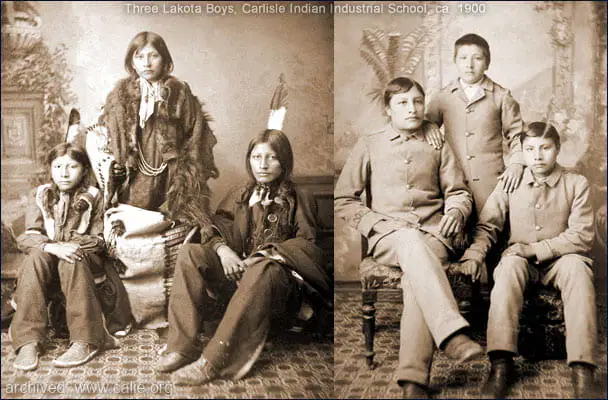
Based on these photographs, what can be concluded about the main
objective of this school?
training Native Americans to become tribal leaders
helping Native Americans to become United States citizens
assisting Native Americans in adjusting to reservation life
persuading Native Americans to accept the dominant American culture
Which Supreme Court decision ruled in favor of racial segregation under
the “separate but equal” clause?
Plessy v. Ferguson
Dred Scott v. Sanford
California Regents v. Bakke
Brown v. Board of Education of Topeka, Kansas
How did United States involvement in World War I affect some
Americans?
Many women entered the workforce.
Many children left school to work in factories.
African Americans migrated to Southern cities.
Unemployment caused the United States economy to suffer.

Which statement best explains the trend shown on this graph?
Many people began to use public transportation during the 1920s.
People became less dependent on government programs during the 1920s.
The economic changes during the 1920s resulted in an overall decrease in
purchasing power.
The popularity of installment buying during the 1920s resulted in more
people being able to buy luxury items.
Which action by the United States demonstrates its policy of isolationism
before World War II?
enactment of a peacetime draft law
passage of a series of neutrality acts
placement of an embargo on exports to Japan
deportation of American Communist Party members
what are the first ten amendments known as?
Preamble
Articles
Bill of Rights
Concurrent powers are
Powers that both States & Federal Governments share
Powers that both States & Local Governments share
Powers that both Federal & National Governments share
Powers that only the states have
What is Federalism
A government principle in which, the people share the power
A government principle in which, the national government has most of the power
A government principle in which, power is shared between the national and state governments
A government principle in which, the state government has most of the power
What government principle advocates for power to be shared between the national and state government?
Conservatism
Federalism
Checks and balances
Republicanism
Why are checks and balances important?
Easier for one person to take power
It allows the executive branch the power to supervise the actions of the other two branches.
It insures that the different branches will work together for the common good
It prevents voter suppression
How does the judicial branch check the power of the legislative branch?
Members of the Supreme Court have their positions for life and cannot be removed
they review laws of Congress for compliance with the Constitution
The Senate must confirm Supreme Court appointments
The president can veto judicial rulings
How does the executive branch check the power of the legislative branch
the President may veto legislation
the President can decide that laws of Congress are unconstitutional
The President can issue pardons
Congress can create federal courts and can impeach judges
What is the highest legal authority in the US
The President
Congress
The Supreme Court
The Constitution

What state was the last to get news of ending the Civil War?
South Carolina
Louisiana
Texas
Arkansas
The news that Black Americans were free reached enslaved people in Texas on--
June 19, 1985
June 19, 1885
June 19, 1865
June 19, 1776
What is the historical significance of Juneteenth?
It marks the end of the Civil War
It commemorates the day the Emancipation Proclamation was signed
It celebrates the day when the last enslaved African Americans were informed of their freedom
It is the day when the 13th Amendment was ratified
Which of the following did the Emancipation Proclamation do?
Freed all slaves in the Confederate states that were not currently under Union control.
Laid the groundwork for a future constitutional amendment to outlaw slavery.
Allowed for African American men to fight in the Union army.
All of the above
Abraham Lincoln's Emancipation Proclamation actually freed?
Only the slaves in states that were in rebellion
Only slaves in Western Territories
Only slaves in the border states
All of the slaves in the North and South

The ratification of which constitutional amendment made illegal the actions described in the poster?
1st Amendment
5th Amendment
10th Amendment
13th Amendment
The 14th Amendment was added to the U.S. Constitution primarily because its supporters believed it was essential to
discourage criticism of government policies
ensure the functioning of democracy
provide citizenship of the freedmen
encourage more candidates to run for office
What did the Fifteenth Amendment address?
Citizenship and naturalization
Voting rights not being denied on account of race
Ending slavery
Equal protection under the law
Which of the following BEST explains the growing popularity of the Ku Klux Klan throughout the South in the 1860s and 1870s?
The organization capitalized on Southerners' fear of the changes that occurred after the Civil War.
The organization established the first public high schools and universities in many Southern states.
The organization built many large factories and helped the South became a major manufacturing center.
The organization was the dominant political party in the South and helped influence federal policy.
Which of the following BEST describes the men who founded the Ku Klux Klan in 1865?
mercenaries hired by aristocrats in the South to terrorize African Americans
Confederate veterans of the Civil War who resented Reconstruction policies
carpetbaggers who came from the North to impose their lifestyle and cultural beliefs on the South
white men who left the North because they believed African Americans were treated too well there
Black Codes were
Laws passed immediately after the Civil War to restrict the rights of newly freed African Americans
Laws restricting what color clothing you could wear on Sundays
Codes used during the Civil War to signal troops.
Rules put into place after Reconstruction to segregate races.
Vagrancy Laws: These laws targeted African Americans who were unemployed or unable to prove their employment. They allowed authorities to arrest and fine individuals for being unemployed, leading to a cycle of debt and forced labor.
How did Vagrancy laws affect homeless or jobless African Americans?

Tests given to African Americans at the voting polls.
Literacy Tests
Voting tests
Government Tests
Poll tests
Forcing a person to pay a fee to vote is called a
Poll tax
Lynching
Literacy Test
Grandfather clause

The data in the chart support the idea that immigration laws of 1921 and 1924 were primarily designed to
stop illegal entry into the country
admit skilled workers
encourage immigration from southern Europe
reduce immigration from specific regions
In the late 19th century, the major argument used by labor union leaders against immigrants was that immigrants
took jobs from United States citizens
contributed little to enrich American life
placed financial drains on social services
refused to assimilate into American culture

Where is Ellis island located?
Washington DC
New Jersey
New York
San Francisco
What happened to the immigrants at Ellis Island and Angel Island?
Government officials asked them their plans and checked them for diseases.
Government officials asked them their plans and made them learn English.
Government officials asked them their plans and gave them a factory job.
Government officials asked them their plans and gave them money for housing.
What economic concerns were associated with nativism?
Job competition and potential wage decrease
Lack of available jobs for immigrants
Increased job opportunities for native-born Americans
Higher wages for immigrant labor
What is the enduring relevance of understanding and addressing historical nativism?
Highlighting the persistence of fears and prejudices in contemporary society
Promoting a more inclusive and diverse society
Encouraging open borders and unrestricted immigration
Ignoring the impact of historical dynamics on current attitudes

Imperialism is __________.
when a powerful nation uses its resources to help a weaker nation
when a weaker nation invites a powerful nation to help it industrialize
when a powerful nation takes control of the economy and government of a weaker nation
when weak nations join together to fight a strong nation
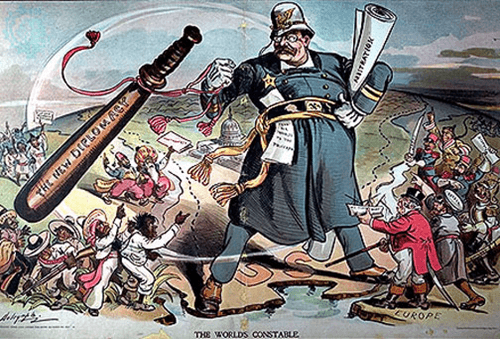

U.S. actions in Latin America were primarily focused on
Driving European powers from Latin America
Improving the lives of U.S. farmers
Shifting resources from the Pacific to Latin America
Improving the U.S.'s relationships with foreign powers.
Imperialism is __________.
when a powerful nation uses its resources to help a weaker nation
when a weaker nation invites a powerful nation to help it industrialize
when a powerful nation takes control of the economy and government of a weaker nation
when weak nations join together to fight a strong nation
Speaker A:"To preserve our American culture, people whose national origins do not match the origins of our nation's founders must be refused admission."
Speaker B:". . . let us admit only the best educated from every racial and ethnic group . . ."
Speaker C:". . . there is an appalling danger to the American wage earner from the flood of low, unskilled, ignorant, foreign workers who have poured into the country . . ."
Speaker D:"Give me your tired, your poor, your huddled masses yearning to breathe free . . ."
United States immigration legislation of the 1920's most closely reflected the views of Speakers
A and C
A and D
B and C
C and D
The main goal of the Americanization movement was to
limit the number of immigrants entering the country
assimilate immigrants of various cultures into the dominant culture
improve the living conditions in Americas largest cities
encouraged people to move from the country to the city
What was the significance of the Immigration Act of 1924?
It abolished the Chinese Exclusion Act
It restricted immigration from various 'undesirable' groups
It provided citizenship to all immigrants
It encouraged Chinese immigration
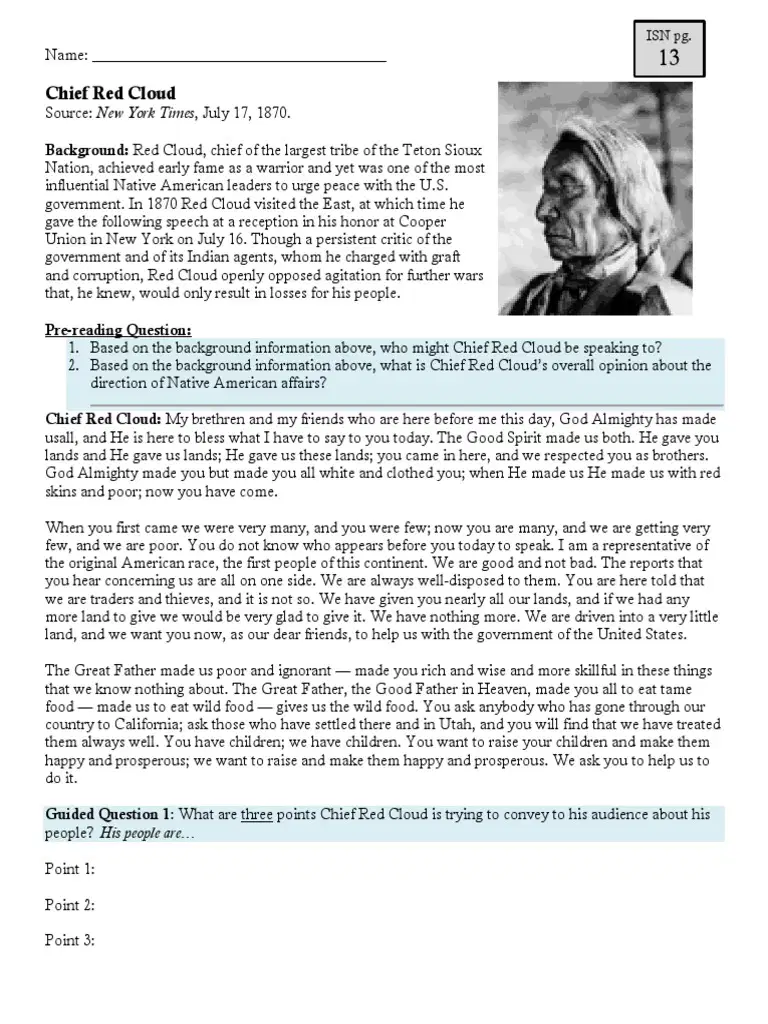
Which of the following best describes the tone of Chief Red Cloud's speech?
Celebratory
Angry
Reflective
Humorous

What is the primary purpose of Chief Red Cloud's speech?
To propose a new treaty
To express dissatisfaction with the government's actions
To celebrate a victory
To call for war
What was the main goal of the Dawes Act?
To preserve tribal landholding system
To support Native American economic prosperity
To promote individual land ownership and agriculture
To encourage communal living and cultural traditions
How did the Dawes Act affect tribal landholding?
It increased the size of tribal lands
It had no impact on tribal landholding
It preserved the communal landholding system
It divided lands into individual allotments and sold off surplus lands
What was the long-lasting effect of the Dawes Act on Native American nations?
No impact on cultural identity
Economic prosperity and stability
Complete assimilation into mainstream society
Struggle to reclaim cultural heritage and ancestral lands
Why did fighting break out between the Nez Perce and US Army?
Chief Joseph was tired of fighting and sad for his people.
The Nez Perce wanted more land.
The Nez Perce and US Army could not come to a peaceful agreement for how to share the land.
The US Army was protecting their people from the raiding tribe.
Which of the following best summarizes the circumstances Chief Red Cloud and his people were facing before they were placed on reservations?
Red Cloud describes his and the Lakota people's relations with the U.S. government as being far more fearful than it would come to be once they were settled on the reservation.
Red Cloud describes the situation as bleak; with little food and fading traditions, they felt one of their only choices was to agree to reservation life and adopt white American ways.
Red Cloud describes the situation as desperate, but the Plains Indians would persist in their active resistance against white settlement until they left entirely.
Red Cloud describes the circumstances as a time of religious fervor, when the Ghost Dance was sweeping through mid-western and western tribes.
In which events did US soldiers kill 200 men, women, and children of the Cheyenne?
Battle of Little Big Horn
Sand Creek Massacre
Medicine Lodge Massacre
Massacre at Wounded Knee
Who was the last Comanche warrior to surrender?
Quanah Parker
Parker Stevens
Sitting Bull
George Armstrong Custer

As soldiers disarmed warriors, this became the last major conflict with Native Americans. About 300 hundred Sioux were killed, including women and children.
Wounded Knee
Battle of Little Big Horn
reservation system
buffalo extermination


WEB DuBois believed in
African-Americans needed to be educated and involved in politics
believed job skills were most important
being a slave was fun
having a job was not important
Why did Americans in Hawaii want to be annexed by the United States?
Queen Liluokalani was persecuting American sugar growers.
Hawaii provided Americans with sugar and pineapples which would benefit U.S. trade.
Laws forced Americans to return land to the Hawaiian government.
This American organization was opposed to the U.S. becoming an empire.
Anti-nationalist league
Anti-immigration league
Anti-imperialist league
Anti-internationalist league
Which event best illustrates the use of 'yellow journalism' to influence public opinion?
The signing of the Treaty of Paris
The annexation of Hawaii
The reporting on the sinking of the USS Maine
The publication of the De Lôme Letter

The Hawaiian queen who was forced out of power by a revolution started by American business interests
Queen Liliuokalani
Queen Kapiʻolani
Queen Kaʻahumanu
King Kalākaua

The decision of the United States to declare war on Spain was based on all the following EXCEPT...
economic interests in Cuba
wanting to annex Spain as a new territory
humanitarian concerns for the Cuban people
a desire to demonstrate American power in the world
How did the explosion of the USS Maine contribute to start of the Spanish American War?
It was confirmed to be a Spanish attack on the U.S. military
It killed many Cuban people, which made the U.S. want to save them
Journalists used the explosion to write exaggerated articles that made many Americans support the war
It was an example of Germans sinking neutral ships
The United States gained territory after the Spanish-American War. Which of these is not one of those territories?
Cuba
Guam
the Philippines
Puerto Rico
Why did we want the Philippines?
We liked their language
Just because
So we can spy on China
Military advantages
What is the "White Man's Burden"?
A belief in "cultural superiority"
A philosophy related to Manifest Destiny
Taft's foreign policy approach
A belief in white privilege
___________: The system in which support is given only to the countries whose moral beliefs are similar to that of the democratic United States.
Dollar Diplomacy
Big Stick Diplomacy
Moral Diplomacy
Monroe Doctrine
Pres. Taft increased investment & aid to Latin American countries to build roads, harbors, and increase trade
Dollar Diplomacy
Gunboat Diplomacy
Isolationism
Expansionism
Be polite in all international affairs but show the world what military power we have and they will be hesitant to involve themselves in American affairs
Open Door Policy
Monroe Doctrine
Big Stick Policy
Dollar Diplomacy
Select all of the reasons why the US went to war with Spain in 1898.
Spain's mistreatment of the Cubans who wanted independence
To avenge Spain's attack on the USS Maine
To give independence to Cuba and the Philippines
To add Cuba as a colony and take control of its natural resources

This political cartoon is in reference to which foreign policy?
Dollar Diplomacy
Monroe Doctrine
Moral Diplomacy
Big Stick Diplomacy

This political cartoon is in reference to which foreign policy?
Dollar Diplomacy
Roosevelt Corollary
Moral Diplomacy
Big Stick Diplomacy

How did these events affect the United States
They increased public support for cuts in the U.S defense spending.
They prompted the end of Dollar Diplomacy in Latin America.
They set a precedent of including territorial acquisitions in settlements.
They helped establish the United States as an imperial power similar to European nations.
What was the name of the heir to the Austrian throne assassinated on June 28 1914?
Archduke Franz Joseph
Archduke Franz Ferdinand
Archduke Franz Kelly
Archduke Franz Fernando
Which of the following best defines 'The belief that a country should maintain a strong military capability and be prepared to use it aggressively to defend or promote national interests.'?
Militarism
Alliances
Imperialism
Nationalism


What is nationalism?
the belief that a country should maintain a strong military capability and be prepared to use it aggressively to defend or promote national interests
when a country increases their power and wealth by bringing additional territories under their control
identification with one's own nation and support for its interests, especially to the exclusion or detriment of the interests of other nations
mutual defense agreements between countries, treaties that could pull them into battle

Which group of countries formed the Triple Entente powers of WW1?
Britain, France, and Austria-Hungary
Germany, Austria-Hungary, and the Ottoman Empire
Russia, Germany, and Italy
Britain, France, and Russia
In What years did WW1 occur?
1914 - 1918
1815 - 1818
1913- 1917
Propaganda means?
agreement to stop fighting
fighting took place Germany’s plan for winning the war on two fronts
one-sided information designed to persuade
None of the above
Use the document to answer the following question. Many soldiers were exposed to chemical weapons during the war. There was nothing doctors could do to help them. One nurse described the situation in a hospital near the Western Front.
Primary Source
"I wish those people who write so glibly about this being a holy war and the orators who talk so much about going on no matter how long the war lasts and what it may mean could see a case---to say nothing of ten cases-of mustard-- coloured suppurating (oozing) blisters, with blind eyes... all sticky and stuck together, and always fighting for breath, with voices a more whisper, saying that their throats are closing and they know they will choke."
---quoted in Eye Deep in Hell: Trench Warfare in World War I
Identifying Bias
What does the nurse believe is making those who are in favor of the war ignore its human costs?
Which of the following options do not apply?
Those people are speaking in abstractions. They do not know how badly the soldiers are suffering, as they are not personally paying or witnessing its human costs.
Those people are dealing with absolutes. They understand how the soldiers truly feel and are personally invested in the soldiers human costs.
They do not know how badly the soldiers are suffering.
The people are not personally paying or witnessing soldiers human costs.
the Japanese had occupied Manchuria.
foreign troops had landed on American soil
the Austro-Hungarian Empire had invaded Belgium.
Germany had resumed unrestricted submarine warfare.

Militarism
Entente
Nationalism
Mobilization
Why did the Germans sink the Lusitania?
A. The Lusitania fired first trying to sink the German submarine
B. They were trying their submarines
C. They declared the seas around Britain a war zone, and would sink any Allied ship in the region.
D. None of the above
What was the Zimmermann Note?
The German policy of attacking all ships entering or leaving Britain
Wilson's speech concerning why the U.S should enter WWI
A proposal by Germany that Mexico attack the US in return for territory
a note left behind by a Serbian Nationalist in Austria-Hungary
What was the name of the new style of warfare during World War I?
tank warfare
plane warfare
train warfare
trench warfare
1939 - 1945
1915 - 1920
1914 - 1918
1899 - 1914


Question 1. All of the following were causes of World War I, EXCEPT
A growth in militarism. The system of secret alliances.
The growth of communist parties across Europe.
The growth of communist parties across Europe.
The rivalry among imperialistic powers
Which of the following accurately describes how foreign policy contributed to the Great Depression?
German aggression threatened war, causing massive military buildups and draining treasuries
European factories produced automobiles, challenging American manufacturing dominance.
American tariffs slowed global trade by reducing exports, harming worldwide economies.
South American sugar producers slowed production, straining worldwide supply chains.
How did the stock market crash of 1929 contribute to the Great Depression?
After the crash, wealthy people took the money they had and moved abroad.
The crash left the economy too weak to overcome bigger challenges.
The poor had invested heavily in the stock market and lost whatever money they had.
Wall Street traders lost their jobs, creating massive unemployment.
How did the stock market crash of 1929 contribute to the Great Depression?
After the crash, wealthy people took the money they had and moved abroad.
The crash left the economy too weak to overcome bigger challenges.
The poor had invested heavily in the stock market and lost whatever money they had.
Wall Street traders lost their jobs, creating massive unemployment.

