
 Worksheets
USH Sem 1 Final Review
Total questions: 204
Worksheet time: 2hrs 42mins
What do experts argue is necessary to address immigration pressures effectively?
Addressing root causes like poverty and violence
Increasing deportation rates
Building more border walls
Reducing foreign aid
What is one example of U.S. aid that could help stabilize rural communities in Central America?
Investing in climate-resilient farming
Providing military assistance
Offering tax incentives to corporations
Building urban infrastructure
What legacy of U.S. involvement in Northern Triangle countries has contributed to migration pressures?
Fueling authoritarianism and civil wars
Encouraging free trade agreements
Providing humanitarian aid
Promoting democracy
What event led to thousands of Afghan civilians seeking asylum in the U.S.?
The U.S. withdrawal from Afghanistan in 2021
The fall of the Berlin Wall
The signing of the Paris Climate Agreement
The 2008 financial crisis
What global event in 2022 caused a surge in Ukrainian refugees seeking protection in the U.S.?
Russia's invasion of Ukraine
The COVID-19 pandemic
The Syrian civil war
The Brexit referendum
How does social media influence perceptions of immigration?
It spreads stories and opinions rapidly
It only promotes misinformation
It has no significant impact
It replaces traditional news entirely
How do viral social media posts affect public perception of immigration?
They can amplify both hope and fear
They have no influence on public opinion
They always provide accurate information
They only focus on positive stories
Which countries make up the Northern Triangle?
Guatemala, El Salvador, and Honduras
Mexico, Guatemala, and Belize
Honduras, Nicaragua, and Costa Rica
El Salvador, Panama, and Colombia
What are some of the main reasons immigrants from the Northern Triangle flee their home countries?
Extreme poverty, hunger, and violent crime
Lack of education and overpopulation
Political stability and economic growth
Climate stability and low crime rates
What natural disasters in 2020 worsened conditions in Honduras and Guatemala?
Multiple hurricanes
Severe earthquakes
Tsunamis
Volcanic eruptions
What does the U.S. asylum system provide protection for?
Refugees with a well-founded fear of persecution
All unauthorized immigrants
Individuals seeking economic opportunities
Anyone crossing the border
What trend in immigration across the Mexican border was observed between 2010 and 2020?
Both legal and unauthorized immigration declined
Unauthorized immigration increased significantly
Legal immigration increased significantly
Border security was completely eliminated
What program did President Obama introduce to protect certain undocumented youth?
DACA (Deferred Action for Childhood Arrivals)
Temporary Protected Status (TPS)
Refugee Resettlement Program
Zero Tolerance Policy
What was a key feature of President Trump’s immigration policies?
The “zero tolerance” policy that separated families
Expansion of DACA protections
Increased refugee admissions
Halting deportations
What impact did the COVID-19 pandemic have on immigration?
Mass expulsions at the border due to emergency health orders
Increased refugee admissions
Improved conditions in detention centers
Suspension of all immigration policies
What new legal pathways did President Biden expand for Central American migrants?
Family reunification programs and temporary work visas
Refugee resettlement programs
Asylum for all migrants without restrictions
Permanent residency for all undocumented immigrants
What action did President Biden take regarding Trump-era immigration policies?
Reversed many policies, including halting border wall construction
Expanded the “zero tolerance” policy
Reduced the refugee cap
Increased deportations
In the early 20th century, which factor was the major cause of the migration of many African Americans to the North?
The start of the Harlem Renaissance.
Federal government job-training programs.
Increased job opportunities in northern cities.
Laws passed in northern states to end racial discrimination.
What does the term "migration" mean?
The movement of people from one place to another to live or work
A long period with little or no rain
The separation of people based on race
A protest in which people stop buying or using something
What caused the Dust Bowl in the 1930s?
Extreme drought and poor farming practices
Heavy snowstorms and flooding
The movement of African Americans to the North
A labor union strike in the Great Plains
What was the goal of the Farm Labor Movement?
To improve pay and working conditions for farmworkers
To help families move west during the Dust Bowl
To build new farms in California
To end segregation laws in schools
Who were often called "Okies" during the Dust Bowl?
Migrants from Dust Bowl states like Oklahoma
Wealthy landowners in California
African Americans during the Great Migration
Members of the United Farm Workers union
What is a drought?
A long period with little or no rain
A type of soil erosion in the Great Plains
A new crop technique
A political protest in the South
What was the Great Migration?
The movement of African Americans from the South to cities in the North and West
Families moving west during the Dust Bowl
The expansion of segregation laws
The creation of the UFW
What does "segregation" mean?
The practice of separating people based on race
A drought that ruined crops
A group of farmworkers
A movement of people seeking new jobs
What is a boycott?
A protest in which people stop buying or using something to bring about change
A nickname for Dust Bowl migrants
A type of government document
A migration from one state to another
What does UFW stand for?
United Farm Workers
Union for Fair Wages
United Families for Work
United Farmers Worldwide
What did the Homestead Act of 1862 do?
Gave settlers 160 acres of free land if they farmed it for five years
Encouraged African Americans to move north
Created jobs in California during the Dust Bowl
Paid Dust Bowl families to move west
Why did many families migrate to California during the Dust Bowl?
To find work and escape the harsh, dry conditions in the Great Plains
To join the Civil Rights Movement
To reunite with extended families already living there
To claim land through the Homestead Act
What kind of communities did many African Americans form in the North during the Great Migration?
Vibrant neighborhoods with music, art, and Black-owned businesses
Isolated farming towns
Military outposts for protection
Temporary labor camps
What challenges did Dust Bowl migrants face after moving west?
Poor housing, low pay, and discrimination
Free schooling and stable housing
Difficulties in crossing the Atlantic Ocean
Easy access to land and resources
Who were César Chávez and Dolores Huerta?
Leaders of the Farm Labor Movement who fought for farmworkers’ rights
Migrants who invented new farming machines
Civil War generals
Politicians who passed the Homestead Act
What did the United Farm Workers (UFW) do?
Fought for better pay and working conditions for farmworkers
Moved families from the South to the North
Supplied free farming tools during the Dust Bowl
Ran community schools for migrant children
What does the phrase “¡Sí, se puede!” mean, and how was it used?
“Yes, we can!” – It was a rallying cry of the Farm Labor Movement
“We are hungry” – It was sung by Dust Bowl migrants
“Freedom now” – It was used during the Civil Rights Marches
“Work for food” – It was a slogan on New Deal posters
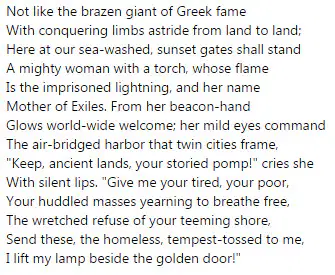
Read the following text from Emma Lazarus's "The New Colossus" (1883).
Which is the best summary of Emma Lazarus's poem?
I am the guardian who will judge you at the gate.
Keep away from our shores unless you intend to behave yourselves.
Bring all of your cultures and traditions to enrich our society.
This country welcomes even the lowliest of immigrants.
Push factors influencing immigrants to leave Europe included all of the following except
Religious intolerance.
Insufficient food.
The unequal treatment of women and people of color.
Lack of economic opportunity.
Read the excerpt on nativism.
Nativism is the idea that people born in the U.S. are better than people who come from other countries. It often shows up as negative feelings or unfair treatment toward immigrants and people seen as “outsiders.”
In American history, nativism has taken many forms—like anti-Catholicism (discrimination against Catholics), anti-Semitism (prejudice against Jewish people), and anti-immigrant attitudes. These ideas often become more common during hard times, like economic problems, wars, or when many new immigrants arrive. That’s when some Americans feel worried or threatened by people they see as “foreign,” even if those people have lived here for a long time.
Frequent targets of nativist sentiments have been...
Outspoken women.
Catholics and Jews.
African Americans in the South.
Northern European immigrants.
Read the following excerpt on nativism.
Nativism is the idea that people born in the U.S. are better than people who come from other countries. It often shows up as negative feelings or unfair treatment toward immigrants and people seen as “outsiders.”
In American history, nativism has taken many forms—like anti-Catholicism (discrimination against Catholics), anti-Semitism (prejudice against Jewish people), and anti-immigrant attitudes. These ideas often become more common during hard times, like economic problems, wars, or when many new immigrants arrive. That’s when some Americans feel worried or threatened by people they see as “foreign,” even if those people have lived here for a long time.
In general, nativism is likely to emerge at times when
Americans are experiencing an up-swelling of nationalistic pride.
There is economic or social upheaval in society.
Immigration is low and ethnic groups are less likely to defend themselves.
America has just taken part in a major war.
Nativism could best be described as
Private support for immigrant populations to retain their cultural heritage.
The deliberate effort to Americanize European immigrant populations.
A desire to restore Native American culture and the celebration of Native American traditions.
A desire shared by many existing white American populations to block or control immigrant groups.
What does the term discrimination mean?
Treating people unfairly because of their race, religion, gender, or other differences
Moving from one country to another for better opportunities
The belief that people born in the U.S. are better than immigrants
A law that banned Chinese immigration to the U.S.
What was the Potato Famine?
A disease that destroyed potato crops in Ireland, causing hunger and death
A law that stopped Chinese immigration to the U.S.
he main immigration station on the East Coast of the U.S.
A treaty that ended the U.S.-Mexico War
What are push-pull factors?
Reasons people leave one place and move to another
The belief that people born in the U.S. are better than immigrants
A treaty that gave the U.S. land in the Southwest
A disease that destroyed crops in Ireland
What was Ellis Island?
A law passed in 1882 that stopped most Chinese people from immigrating to the U.S.
A treaty that ended the U.S.-Mexico War
The main immigration station on the East Coast of the U.S.
A belief that people born in the U.S. are better than immigrants
What is nativism?
The belief that people born in the U.S. are better than immigrants
A treaty that ended the U.S.-Mexico War
A disease that destroyed crops in Ireland
Reasons people leave one place and move to another
What was the Treaty of Guadalupe Hidalgo?
The 1848 agreement that ended the U.S.-Mexico War and gave the U.S. land in the Southwest
A law that banned Chinese immigration to the U.S.
The main immigration station on the East Coast of the U.S.
A time of hunger and disease in Ireland
What was the main difference between "new" immigrants and earlier immigrants before the 1870s?
They were mostly Catholic, Jewish, or Orthodox and did not speak English
They came from northern and western Europe
They were all Protestant and spoke English fluently
They arrived in the U.S. after the 1920s
What were push factors that caused people to leave their home countries?
Not enough jobs or land, poor schools, and religious discrimination
Better jobs and more land in the U.S.
Freedom of religion and a safer life
The Statue of Liberty welcoming them to the U.S.
What was the purpose of Angel Island on the West Coast?
To process Asian immigrants and keep them separated from the city
To welcome European immigrants with health and legal checks
To provide jobs for immigrants arriving in California
To serve as a gateway for Cuban refugees
Why did some Americans support the Chinese Exclusion Act?
They feared Chinese immigrants were taking jobs and threatening American values
They wanted to encourage more immigration from Europe
They believed Chinese immigrants were better workers
They wanted to build more railroads with Chinese labor
What did the Immigration and Nationality Act of 1965 do?
It ended quotas based on nationality and allowed more immigrants from around the world
It created quotas that favored European immigrants
It banned immigration from Asia, Africa, and Latin America
It allowed Cuban refugees to become citizens more easily
Why did many Cuban refugees come to the U.S. after the Cuban Revolution?
To escape a harsh government and find safety in Florida
To work on the Transcontinental Railroad
To pass through Angel Island and settle in California
To reunite with family members already in the U.S.
What was one effect of the Chinese Exclusion Act?
Chinese immigrants already in the U.S. couldn’t become citizens
It allowed Chinese workers to build the Transcontinental Railroad
It ended quotas based on nationality
It gave citizenship to Mexicans living in the U.S.
Which current global problem was initiated with the development of atomic weapons?
Threats to world peace from unrestricted nuclear proliferation.
Increased health risks for humans and animals from industrial pollution.
Changes in world weather patterns and species habitats due to melting polar ice caps.
Elevated carbon dioxide in the atmosphere due to the deforestation of the rainforests.
During the Cold War era, the United States and the Soviet Union were reluctant to become involved in direct military conflict mainly because of
Pressure from nonaligned nations.
The potential for global nuclear destruction.
Increased tensions in the Middle East.
The peacekeeping role of the United Nations.
One way the United States Government reacted to the Soviet launching of Sputnik in 1957 was by
Establishing a naval blockade of Cuba.
Increasing federal spending on math and science education.
Urging more Americans to buy war bonds.
Starting the Strategic Arms Limitation Talks (SALT).
What was the Cold War primarily characterized by?
Political and military tension without direct warfare
Direct military conflict between the U.S. and Soviet Union
A global economic depression
The colonization of new territories
What event marked the beginning of the Space Race?
The launch of Sputnik I
The launch of Apollo 11
The Cuban Missile Crisis
The Manhattan Project
What was the Manhattan Project's primary goal?
To develop the first atomic bombs
To explore space
To create the GPS system
To end the Cold War
What was the significance of Sputnik I?
It marked the start of the Space Race
It was the first manned mission to the Moon
It ended World War II
It was the first GPS satellite
What was the outcome of the Apollo 13 mission?
The mission was aborted due to an explosion, but the crew returned safely
The astronauts successfully landed on the Moon
The spacecraft was lost in space
The mission ended the Space Race
What is GPS primarily used for?
Navigating locations using satellites
Launching spacecraft
Monitoring surveillance cameras
Conducting cyberwarfare
What does cyberwarfare involve?
Hacking and attacking digital systems
Using physical weapons to attack enemy forces
Launching satellites into space
Spying on enemy nations using cameras
What is surveillance commonly used for?
Monitoring activities using technology
Launching satellites into orbit
Navigating using GPS
Conducting space exploration
What was the primary purpose of Operation Desert Storm during the Gulf War?
To liberate Kuwait from Iraqi forces
To invade Iraq
To develop nuclear weapons
To launch the first GPS satellite
Which of the following was a major technological advancement used during the Gulf War?
GPS and precision-guided missiles
Cyberwarfare
Surveillance satellites
Artificial intelligence
What was the primary focus of the Space Race?
Achieving milestones in space exploration
Developing nuclear weapons
Ending the Cold War
Creating surveillance systems
What ethical concerns arose from the Manhattan Project?
The development and use of nuclear weapons
The use of surveillance technology
The launch of artificial satellites
The exploration of space
What was the main reason the Apollo 13 mission is remembered?
It demonstrated teamwork and problem-solving after an explosion
It was the first Moon landing
It marked the end of the Space Race
It launched the first GPS satellite
What was the significance of the Cold War in U.S. history?
It influenced technological advancements and proxy conflicts
It led to direct warfare between the U.S. and Soviet Union
It ended with the launch of Sputnik I
It resulted in the Gulf War
How did GPS technology, originally developed for the military, impact civilian life?
It allowed people to navigate using their phones and track deliveries
It was used to guide astronauts to the Moon
It helped scientists develop the atomic bomb
It was primarily used for surveillance during the Cold War
What was the significance of the atomic bomb during World War II?
It ended the war quickly but raised serious moral questions
It was used to explore outer space
It was the first weapon to use radar technology
It was developed during the Cold War
Henry Ford produced a more affordable car primarily because his company
Offered a variety of options to buyers.
Used foreign-made parts.
Paid workers lower wages than its competitors paid.
Developed a less expensive method of production.
Which statement best describes the role of railroads in the industrialization of the United States?
They were the earliest form of commercial transportation.
They were unable to compete in areas that had good water transportation.
They are more important to industry today than they were 100 years ago.
They provided an efficient means of transportation during the Age of Big Business.
What is the purpose of a patent?
To grant an inventor exclusive rights to an invention for a limited time in exchange for public disclosure.
To allow anyone to use an invention freely
To provide funding for inventors
To register a business name
Who invented the telephone?
Alexander Graham Bell
Thomas Edison
George Westinghouse
The Wright Brothers
What is the assembly line?
A system where workers perform specific tasks as a product moves along a line
A method of transportation
A type of factory machine
A way to organize workers into teams
Who is best known for inventing the first practical light bulb?
Thomas Edison
Alexander Graham Bell
Lewis Latimer
George Westinghouse
What does the term 'economy' refer to?
The system of how money is made and used in a country
A type of factory
A method of transportation
A government office
Who improved the light bulb by creating a longer-lasting filament?
Lewis Latimer
Thomas Edison
Alexander Graham Bell
George Westinghouse
Who invented the first successful airplane?
The Wright Brothers
Thomas Edison
Alexander Graham Bell
George Westinghouse
What is the Federal Patent and Trademark Office responsible for?
To grant an inventor exclusive rights to an invention for a limited time in exchange for public disclosure.
Funding new inventions
Organizing factory workers
Promoting international trade
Which invention is associated with Henry Ford?
The assembly line
The telephone
The airplane
The light bulb
Which invention made communication over long distances possible?
The telephone
The lightbulb
The airplane
The assembly line
What is the significance of the light bulb?
It replaced candles and gas lamps as a reliable source of light
It improved transportation methods
It allowed people to communicate over long distances
It sped up factory production
What is the main benefit of the assembly line?
It speeds up production by dividing tasks among workers
It improves communication between workers
It generates electricity for factories
It transports goods over long distances
What major event marked the beginning of big changes in America during the 1860s?
The Civil War
World War I
The Industrial Revolution
The Triangle Shirtwaist Fire
Why were women and children hired to work in factories during the 1800s?
They were paid less than men
They were more skilled than men
They worked faster than men
They were required by law to work
What tragic event in 1911 led to better worker safety laws?
The Triangle Shirtwaist Fire
The Civil War
The invention of the cotton gin
The rise of the automobile
What was the impact of Eli Whitney’s cotton gin?
It sped up cotton production but increased slavery
It reduced the need for slavery
It made farming more expensive
It replaced the steel plow
What invention allowed cars to be built faster and cheaper?
The assembly line
The cotton gin
The steel plow
The electric typewriter
What was one major effect of the rise of automobiles?
People could live farther from cities and drive to work
People moved closer to train stations
Farming communities grew larger
Railroads became more popular
What was the Bessemer Process used for?
Producing steel quickly and cheaply
Sending messages over long distances
Building railroads across the country
Creating electricity for factories
What was the telegraph primarily used for?
Sending messages over long distances using electric signals
Transporting goods across the country
Building skyscrapers and bridges
Providing housing for factory workers
What was the significance of the Transcontinental Railroad?
It connected the East Coast to the West Coast of the United States
It allowed steel to be produced faster and cheaper
It provided housing for immigrants in cities
It created a new way to send messages over long distances
What does the term "wealth gap" refer to?
The difference in money and living conditions between the rich and the poor
The movement of people from rural areas to cities
The process of producing goods in large quantities
The invention of new communication technologies
What is urbanization?
The movement of people from rural areas to cities
The process of producing steel quickly and cheaply
The invention of the telegraph
The construction of railroads across the country
What is mass production?
Making large amounts of the same product quickly and cheaply using machines
Building railroads to connect different parts of the country
Providing housing for factory workers
Sending messages over long distances using electric signals
What were tenements?
Crowded, poorly built apartment buildings for factory workers and immigrants
Factories that produced goods in large quantities
Railroads that connected cities across the country
Steel mills that used the Bessemer Process
The lack of city government and services led to the
Unprecedented wealth and prosperity.
Abandonment of cities for the countryside.
Growth of slums and poor living conditions.
Intercity fighting.
Factory work in the 19th century was all of the following except
Unsanitary
Poorly paid
Dangerous
Well regulated
Fast-growing cities lacked all of the following except
Places to work
Decent sanitation
School
A formal police force
Until the mid-19th century, the majority of people lived in
Suburbs
Coastal islands
Cities
The countryside
The new skylines emerging in large U.S. cities were most likely caused by
A need to pack more factory workers into urban areas.
Dramatic improvements in steel production.
Vast influxes of immigrants.
The evolution of architectural and artistic tastes in the later 1800s.
The end of the Civil War led to
A decrease in new inventions.
Increased manufacturing and scientific innovation.
The decline of industrialization.
Decreased immigration to the United States.
The primary cause for low wages among factory workers was
The disorganized nature of factory worker unions.
The social preference for the value of farming over that of manufacturing.
The high numbers of workers competing for industrial jobs.
Strict rules that disallowed women and children from entering the factory workforce.
What role did steel play in the growth of cities?
It allowed for the construction of skyscrapers and bridges that connected cities
It was used to build railroads and bridges, but not skyscrapers
It replaced electricity as the main source of power
It was only used for making tools and cars
How did new inventions like the telegraph and telephone change communication?
They allowed people to send messages quickly over long distances
They made communication slower but more reliable
They replaced newspapers as the main source of news
They were only used for personal communication, not business
What was one way the Industrial Revolution changed the U.S. economy?
It shifted the focus from small, local businesses to big companies and manufacturing
It reduced the importance of cities in economic growth
It slowed down the development of new technology
It made agriculture the main source of jobs
Why was steel important during the late 1800s?
It allowed for the construction of railroads, skyscrapers, and bridges
It replaced iron as the main material for tools
It was used to power factories and railroads
It was the first material used in early electricity
How did the transcontinental railroad impact businesses?
It allowed businesses to ship products farther and get supplies faster
It replaced steel as the main driver of economic growth
It slowed down the transportation of goods
It made local businesses more important than national ones
A prime example of the prevailing generation gap of the 1960s was which of the following quotes?
"All we are saying, is give peace a chance." -John Lennon
"Sock it to me." -Rowan and Martin's Laugh-In
"Never trust anybody over 30." -Jack Weinberg
"Turn on, tune in, drop out." -Timothy Leary
The artistic trends of the Harlem Renaissance were associated with
Southern African Americans finding ways to undermine Southern racism.
Demands by American universities that a new, non-European form of literature be established.
A desire by white musicians to create an alternative form of modern entertainment.
African Americans fleeing the racism of the South for job opportunities in the North.
All of the following illustrated a conflict between what two forces in the Scopes trial except
Younger generation and older generation
Modernism and traditionalism
Biology and chemistry
Science and religion
Bob Dylan's songs perfectly captured the ____ of 1960s America.
Manifestation
Zeitgeist
Quintessential
Intolerance
What does the term "zeitgeist" refer to?
The spirit or mood of a particular time period
A political movement in the 1920s
A type of jazz music popular in the 20th century
A cultural festival celebrating art and music
What was the "Roaring Twenties" known for?
A period of cultural, social, and economic change marked by jazz, flappers, and consumerism
Economic depression and widespread unemployment
The rise of the counterculture movement
The end of World War II and the Baby Boom
What was the Scopes Trial about?
The teaching of evolution in schools
The prohibition of alcohol in the 1920s
The civil rights movement in the 1960s
The counterculture protests against the Vietnam War
What was the Harlem Renaissance?
A cultural movement celebrating African American art, music, and literature
A political movement advocating for civil rights
A period of economic prosperity in the 1950s
A protest movement against the Vietnam War
What did flappers symbolize in the 1920s?
Independence and breaking social norms
The fight for civil rights
Traditional family values
The economic prosperity of the Baby Boom
What was the purpose of the GI Bill after World War II?
To provide veterans with access to education, housing, and job training
To fund the construction of suburban neighborhoods
To promote the counterculture movement
To encourage the Baby Boom
What was the Baby Boom?
A period of rapid population growth after World War II
The rise of the counterculture movement
The economic depression of the 1930s
The cultural movement of the Harlem Renaissance
What characterized the growth of suburbs in the 1950s?
A practice of denying loans or housing to certain groups based on race
A cultural movement celebrating African American art
protest against the Vietnam War
A legal case about teaching evolution in schools
What was the counterculture movement of the 1960s known for?
Rejecting mainstream values and advocating for peace, equality, and freedom
Promoting traditional family values
Celebrating African American art and literature
Encouraging suburban growth and the Baby Boom
What was one major cultural shift in the 1920s?
The popularity of jazz music and challenges to traditional norms
The rise of suburban neighborhoods
The focus on consumer culture and modern appliances
The emergence of rock and roll music
What was a key factor in the economic growth of the 1920s?
The use of new machines and assembly lines in factories
The introduction of redlining policies
The rise of antiwar protests
The expansion of suburban neighborhoods
What was a major societal change for women in the 1920s?
Women gained the right to vote and embraced new roles and fashions
Women began leading antiwar protests
Women became the primary focus of consumer culture
Women were excluded from suburban growth
What was one consequence of discriminatory housing policies in the 1950s?
Minority families faced barriers to homeownership and wealth-building
Suburban neighborhoods became more diverse
The rise of jazz music in suburban areas
The emergence of youth culture and rock music
What was a defining characteristic of youth culture in the 1950s?
The emergence of teenagers as a distinct group with their own style and media
A focus on traditional family values
The rejection of consumerism and materialism
The widespread popularity of jazz music
What was a common theme among young people during the 1960s?
A push for peace, equality, and self-expression through protests and art
A desire to preserve traditional values and norms
A focus on suburban growth and consumer culture
A rejection of music and art as forms of activism
In ancient Athens, Greece, citizenship was generally limited to those people who
Had been born in Athens.
Were adult males.
Were property owners.
Were war veterans.
Read the scenario below and answer the corresponding question:
Five years ago, Yuri, age 9, lived in Russia. Then he and his family moved to the United States and became legal residents. How can Yuri and his family become citizens of the United States?
By having a senator make them citizens.
By asking a congressperson to declare them citizens.
By writing a letter to the president asking to be declared citizens.
By passing a citizenship test and taking an oath.
A requirement for becoming a naturalized U.S. citizen is
Having been born in the United States.
Taking an oath of allegiance to the United States.
Reciting the preamble to the U.S. Constitution.
Singing the national anthem.
The process by which a person becomes a U.S. citizen is referred to as
Immigration
Citizenship
Naturalization
Legalization
She was granted ____ after it was made clear that she would be killed if she returned to her native country.
Asylum
Dynamic
Confer
Savior
What does the term Civic Participation refer to?
Taking action to improve your community or country
The process of becoming a U.S. citizen
A legal protection for people fleeing danger in their home country
A program that allows young undocumented immigrants to stay in the U.S.
What is a Green Card?
A permanent resident card that allows someone to live and work in the U.S.
temporary visa for tourists visiting the U.S.
A document granting asylum to refugees
A certificate of naturalization
What does Asylum provide?
A legal protection for people fleeing danger in their home country
A pathway to citizenship for undocumented immigrants
A limit on the number of immigrants allowed into the U.S. each year
A program for young immigrants to work and study in the U.S.
What is Naturalization?
The process of becoming a U.S. citizen if you weren’t born in the U.S.
A program that allows young undocumented immigrants to stay in the U.S.
A legal protection for refugees fleeing danger
A limit on the number of immigrants allowed into the U.S. each year
What are Quotas in the context of immigration?
A limit on the number of immigrants allowed into the U.S. each year
A program that allows young undocumented immigrants to stay in the U.S.
A legal protection for refugees fleeing danger
The process of becoming a U.S. citizen
What is the purpose of the DACA program?
To allow young undocumented immigrants to stay and work in the U.S.
To provide legal protection for refugees fleeing danger
Proposed law in the U.S. that would give certain undocumented immigrants who came to the country as children a path to legal status and eventually citizenship
To grant permanent residency to immigrants
What is the DREAM Act?
Proposed law in the U.S. that would give certain undocumented immigrants who came to the country as children a path to legal status and eventually citizenship
A program that allows young undocumented immigrants to stay and work in the U.S.
A limit on the number of immigrants allowed into the U.S. each year
A legal protection for refugees fleeing danger
What does Voting Rights refer to?
The legal right to vote in local, state, or national elections
The process of becoming a U.S. citizen
A program that allows young undocumented immigrants to stay in the U.S.
A limit on the number of immigrants allowed into the U.S. each year
What is one of the most powerful rights that comes with being a U.S. citizen?
The right to vote
The right to own property
The right to free education
The right to travel freely
What was the purpose of the Voting Rights Act of 1965?
To remove barriers like literacy tests and poll taxes that targeted Black voters
To give women the right to vote
To allow only citizens to vote in national elections
To create voter ID laws
How did the idea of citizenship change during the Middle Ages?
Citizenship mattered less because kings ruled and there were no elections
Citizenship became more important because of elections
Citizenship was granted to everyone regardless of class
Citizenship was based on owning land
What is birthright citizenship?
Citizenship granted to anyone born on U.S. soil, regardless of their parents' nationality
Citizenship granted to children born to U.S. parents abroad
Citizenship granted through naturalization
Citizenship granted to refugees seeking asylum
What is the “right of blood” in U.S. citizenship?
Citizenship granted to children born in another country to at least one U.S. citizen parent
Citizenship granted to refugees fleeing danger
Citizenship granted through the Diversity Immigrant Visa Program
Citizenship granted to immigrants after living in the U.S. for 5 years
Why is citizenship important for voting in the U.S.?
Only citizens can vote in national elections
Citizenship guarantees access to free education
Citizenship allows people to apply for family-based visas
Citizenship ensures protection under asylum laws
What is one step in the naturalization process to become a U.S. citizen?
Taking an Oath of Allegiance to the U.S.
Being born to U.S. parents abroad
Winning the Diversity Immigrant Visa lottery
Applying for asylum
Why were immigration quotas introduced in the 1920s?
To limit immigration from certain areas due to fears like the spread of communism
To encourage immigration from all countries equally
To prioritize family-based visas over job-based visas
To allow refugees to enter the U.S. without restrictions
What is the primary purpose of social media in modern activism?
To connect people and spread awareness about social movements
To share memes and funny videos
To replace traditional news outlets
To organize private events only
The #MeToo Movement is best characterized as
A movement to empower the LGBTQ community.
A fight against racial injustice in the workplace.
A movement to fight against sexual harassment in the workplace.
A struggle to help shy, reserved people find their voice.
What does civil disobedience involve?
Refusing to follow laws as a peaceful form of protest
Violent protests against unfair laws
Creating new laws to replace old ones
Ignoring all government rules
The primary impetus for the Women's March was
To protest the inauguration of President Donald Trump.
To rally around Hillary Clinton since she lost the presidential race.
To celebrate Take Our Daughters to Work Day in Washington, D.C.
To celebrate the 70th anniversary of the publication of the Feminist Mystique.
Which of the following is an example of a social movement?
The Civil Rights Movement
A local book club
A school fundraiser
A neighborhood cleanup day
All of the following were outcomes of Black Lives Matter activism except
The passage of a bill that extended protections to racial minorities during interactions with police.
An increase in the prosecution of police officers involved in excessive force cases.
The increase use of body cameras to hold police more accountable on the job.
An increase in public recognition of racial discrimination.
What was the focus of the Women’s March that began in 2017?
Women’s rights and equality
Environmental conservation
Technological advancements
Voting rights for women
What is the main goal of the #MeToo movement?
To raise awareness about sexual harassment and assault
To promote environmental awareness
To support small businesses
To encourage voting in elections
What is the primary reason Colin Kaepernick refused to stand for the national anthem?
He was protesting the scarcity of black football coaches in the NFL.
He was protesting his belief that African Americans receive substandard treatment in such areas as criminal justice.
His injured knee made standing for long periods difficult.
He was not a U.S. citizen but a French-Canadian who honored his own national anthem.
What event led to the founding of the Black Lives Matter movement?
The death of Trayvon Martin
The election of the first Black president
The signing of the Civil Rights Act
The Women’s March in 2017
What does the term "mass incarceration" refer to?
The imprisonment of a large number of people, often from minority communities
The release of prisoners on a large scale
The construction of new prisons
The reduction of prison sentences
What is racism?
Discrimination based on someone’s race or ethnicity
A belief in equality for all races
A movement to promote cultural diversity
A type of social media campaign
What inspired the March for Our Lives movement?
The school shooting in Parkland, Florida
The Women’s March in 2017
The signing of new gun laws
The Black Lives Matter protests
What does activism involve?
Taking action to bring about social, political, or environmental change
Watching events unfold without participating
Writing laws for the government
Avoiding controversial topics
What is a protest?
A public demonstration to express disagreement or demand change
A celebration of a new law
A private meeting to discuss issues
A type of social media post
Which of the following is an example of youth activism?
Students organizing a climate strike
Adults voting in an election
A company donating to charity
A family planting a garden
What is the definition of civil rights?
Protections provided by the government to ensure all people are treated equally under the law.
Freedoms that protect individuals from government interference.
The first ten amendments to the U.S. Constitution.
A way of fighting for change without using violence.
Which of the following is an example of a civil liberty?
Freedom of religion.
The right to vote for African American men.
The end of slavery in the United States.
The right to equal housing opportunities.
What is the Bill of Rights?
The first ten amendments to the U.S. Constitution that list and protect individual freedoms.
A law that ended segregation in public places.
A constitutional amendment that granted citizenship to anyone born in the U.S.
A federal law that banned racial discrimination in voting.
What did the Thirteenth Amendment accomplish?
It ended slavery in the United States.
It granted citizenship to anyone born in the United States.
It gave African American men the right to vote.
It banned racial discrimination in voting.
What was the purpose of the Fourteenth Amendment?
To grant citizenship to anyone born or naturalized in the United States.
To end slavery in the United States.
To give African American men the right to vote.
To ban racial discrimination in voting.
What were Black Codes?
Laws passed by Southern states to limit the rights and freedoms of African Americans.
Laws that enforced segregation and discrimination against African Americans.
A constitutional amendment that gave African American men the right to vote.
A federal law that banned racial discrimination in voting.
What did the Fifteenth Amendment guarantee?
he right to vote for African American men.
The end of slavery in the United States.
The right to equal housing opportunities.
The protection of individual freedoms from government interference.
What were Jim Crow laws?
Laws that enforced segregation and discrimination against African Americans.
Laws that granted citizenship to formerly enslaved people.
Laws that banned racial discrimination in voting.
Laws that ended slavery in the United States.
What did the Nineteenth Amendment achieve?
It gave women the right to vote in the United States.
It gave African American men the right to vote.
It banned racial discrimination in voting.
It ended segregation in public places.
Who were the Little Rock Nine?
A group of African American students who integrated Central High School in Little Rock, Arkansas.
A group of activists who fought for women's voting rights.
A group of lawmakers who passed the Civil Rights Act of 1964.
A group of African American men who gained the right to vote under the Fifteenth Amendment.
Southern whites did all of the following to prevent African Americans from voting except
They created literacy tests.
They used threats of violence against potential African American voters.
They implemented special voting taxes.
They passed local laws making it illegal for African Americans to vote in certain communities.
"Suffrage" refers to
Money paid to the government; a type of tax.
Political discrimination of one group against another.
Poll test and other obstacles to voting.
The right to vote.
The result of the Plessy v. Ferguson ruling could best be summarized as
Segregation of African Americans was to be limited to public transportation.
The concept of "separate but equal" would not apply not only to race but economic status as well.
Mixed race African Americans who appeared white could use white facilities.
It was legal to place African Americans in separate public facilities.
Of the following, this case represented an important step forward in civil rights in the United States:
Plessy v. Ferguson
Texas v. Johnson
Brown v. Board of Education
Mapp v. Ohio
This piece of legislation banned discrimination based on race in public places and hiring:
Voting Rights Act (1965)
Fourteenth Amendment
Civil Rights Act (1964)
Twenty-sixth Amendment
What is the main difference between civil rights and civil liberties?
Civil rights ensure equality under the law, while civil liberties protect individuals from government interference.
Civil rights protect individuals from government interference, while civil liberties ensure equality under the law
Civil rights are freedoms listed in the Bill of Rights, while civil liberties are protections against discrimination
Civil rights are protections against unfair government actions, while civil liberties are protections against other people
Dr. Martin Luther King Jr. believed in using peaceful marches and speeches to bring change.
What strategy did Dr. King use?
Nonviolent protest
Militant resistance
Civil disobedience
Judicial review
Look at the list:
Poll taxes
Literacy tests
Intimidation and violence
What were these used to do?
Limit voting rights
Protect civil liberties
Enforce civil rights laws
Support equal education
In 1957, nine African American students tried to attend Central High School in Arkansas and were blocked by angry mobs.
Who were these students?
Little Rock Nine
Jim Crow Nine
Voting Rights Group
Freedom Marchers
What are "natural rights"?
rights that everyone is born with and that cannot be taken away
rights that would be granted to American citizens under the new government
rights that were the point of disagreement between the Americans and the British
rights colonists had as British citizens that they would continue to have as Americans
What does the term 'Cause and Effect' mean?
The way one event leads to another
A comparison between two unrelated events
The sequence of events in a story
The description of a single event in isolation
What roles did the Enlightenment and the Great Awakening play in the founding of the United States?
They inspired ideas about freedom, equality, and challenging authority.
The encouraged loyalty to the British monarchy and traditional values.
They focused on economic growth and trade with other nations.
They discouraged political change and supported colonial rule.
What steps taken by the colonists suggest they were preparing for war with Britain?
The formed militias and stockpiled weapons.
They signed treaties with Native American tribes for peace.
They increased trade with Britain to strengthen their economy.
They avoided all forms of protest to maintain peace.
What are the ideological origins of the American Revolution?
The Enlightenment and the Great Awakening, which emphasized liberty, equality, and questioning authority.
The belief in absolute monarchy and divine right.
The focus on maintaining colonial loyalty to Britain.
The rejection of all forms of government and authority.
What does 'Cause & Effect' refer to?
The relationship between two events where one leads to another.
A method of organizing government systems.
The study of cultural traditions.
The process of creating laws and policies.
What does the term 'Diverse Ideologies' mean?
Different ways of thinking or beliefs.
A single unified way of thinking.
The study of government systems.
The rejection of all beliefs and ideologies.
What does the term 'Politics' mean?
The way people in power make decisions and solve problems.
The study of ancient civilizations.
The rejection of leadership and laws.
The process of electing officials only.
What does the term 'Society' mean?
A group of people who live together and follow certain rules.
A single individual living in isolation.
A government system that enforces laws.
A collection of laws and regulation.
What does the term 'Culture' mean?
The traditions, beliefs, and ways of life of a group of people.
The political system of a country.
The economic activities of a society.
The geographical location of a community.
The American system of government as outlined in the U.S. Constitution (1788), seeks to promote and protect the social contract in part by
Providing for the power of judicial review over laws and actions of government officials.
Limited the president to only terms of office.
Providing a means by which the veto could be overridden.
Limiting government power by separating power into different branches and creating a system of checks and balances.
Why is a social contract important to the Enlightenment view of government?
Hobbes saw it as a promise to the people that government would protect them.
It represents the idea that the people--the governed--give consent to their government to lead and manage them and society.
A government provides this to its people so that they can understand how their government functions and what powers it has.
It is the document that defines a given system of government for a specific group of people.
According to Enlightenment thinkers, which of the following would be the best way for a government to maintain legitimacy?
By seeking the participation and consent of the governed.
By passing popular laws.
By allowing all citizens to run for office and vote.
By providing for regular elections.
According to John Locke, what is the core purpose of government?
To guide society and determine its priorities.
To protect people from one another.
To protect people's natural rights.
To take care of its people and make sure that they are prosperous and happy.
What does the phrase 'We the People of the United States' signify in the Preamble of the Constitution?
The authority of the government comes from the citizens.
The government is controlled by foreign powers.
The Constitution applies only to elected officials.
The people have no role in government.
What is meant by the phrase 'to form a more perfect Union' in the Preamble?
To create a stronger and unified nation.
To establish a monarchy.
To divide the states into separate countries.
To abolish all forms of government.
What is the purpose of the phrase 'to ensure domestic Tranquility' in the Preamble?
To maintain peace and order within the country.
To declare war on foreign nations.
To establish a dictatorship.
To abolish all laws and regulations.
Which is most true about the Great Compromise and the legislative branch?
Population did not have an impact on state representation, the state's size dictated representation.
Because the Senate was smaller, it received limited control over legislation.
Large states had more elected officials than small states, but small states were equal in the Senate.
Small states and large states were to be completely equal.
Why is the Magna Carta considered such an important document to United States government?
It is a clear example of an agreement that limited the power of government.
In it is found the earliest argument for natural rights.
It created a system of separated powers.
It guarantees voting rights for citizens.

