
 Worksheets
American Revolution Review Quiz
Total questions: 49
Worksheet time: 25mins
What does "no taxation without representation" mean?
Not everyone should have to pay taxes.
Taxes are not necessary for a country to grow.
People who are rich should be the only ones paying taxes.
People who pay taxes should have a say in the government.
Use the information to answer the question. “Once we had started throwing the tea off the boat, we knew we had started something that would get a big reaction out of King George III.” -Colonist, December 16, 1763 This person was MOST LIKELY a member of which of the following groups?
Boston Militia
Sons of Liberty
Stamp Act Army
Daughters of Liberty
Who were the Daughters of Liberty?
They were wives of soldiers in the war.
They were women who boycotted British goods.
They were women who remained loyal to Great Britain.
They were women who took jobs in factories during the war.
Which event is being described?
A. Boston Massacre
B. Boston Tea Party
C. Battle of Saratoga
D. Battle of Bunker Hill
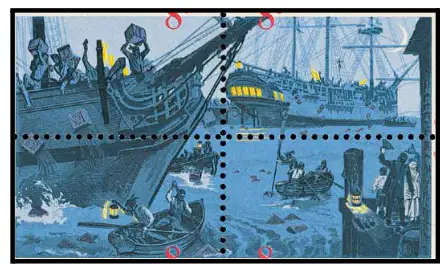
What event from the American Revolution is drawn on these stamps?
The Boston Tea Party
The Boston Massacre
The French and Indian War
The Declaration of Independence
How did Black Regiments contribute during the American Revolution?
They traded tea with Britain.
They built cannons used in battle.
They fought in the Continental Army.
They worked to gain British support for the war.
What is ONE reason Benedict Arnold became a traitor and fought for the British during the American Revolution?
He was captured by the British.
He felt disrespected by the Continental Army.
His family convinced him to stay loyal to the king.
He blamed the Continental Army for the destruction of his family's farm.
The general, or leader, of the Continental Army was _________
Ben Franklin
George Washington
John Adams
Thomas Jefferson
How did the colonists use geography to their advantage in the Battle of Lexington and Concord?
They hid behind small hills and under bridges.
They destroyed bridges and burned the forest.
They hid behind the tallest mountains in the area.
They surrounded the British who were fighting from ships.
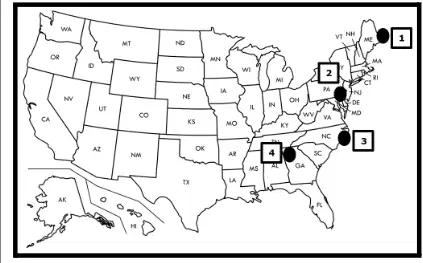
Which dot on the map shows Philadelphia, Pennsylvania where the Declaration of Independence was written and signed?
A. 1
B. 2
C. 3
D. 4
What would be the BEST title for this list?
Paul Revere and Minutemen Plan for Victory
The Continental Army’s Time at Valley Forge
American Victory at the Battle of Yorktown Ends the War
Washington Crossing the Delaware River and the Battle of Trenton

Fill in the blank with the best title for this list.
The Continental Army’s Time at Valley Forge
The Boston Tea Party
The Declaration of Independence
The Battle of Saratoga
At what battle did the Continental Army surround the British forcing them to surrender to end the war?
Saratoga
Yorktown
Valley Forge
Lexington and Concord
The Declaration of Independence explained that the colonists had many ________ about the way King George III treated them.
celebrations
compliments
grievances
positives
Who was the primary author of the Declaration of Independence?
George Washington
Patrick Henry
Paul Revere
Thomas Jefferson
What are Susan and Jane’s opportunity cost by boycotting British tea?
They will join in the Boston Tea Party.
They will not have British tea to drink.
They will not have an opportunity cost.
They will now have even more tea to drink.
In which year did colonists have a price incentive to purchase more pounds of tea?
1768
1767
1766
All three years
__________ is when producers focus on making specific goods or performing certain services well.
Opportunity cost
Price incentive
Specialization
Trade
Jim had extra drinking cups, but needed vegetables. Susan had lots of vegetables but needed drinking cups. They voluntarily exchanged cups and vegetables with each other.
only Jim benefited
only Susan benefited
both Jim and Susan benefited
neither Jim nor Susan benefited
__________ is when two countries or two states exchange goods for money or other goods. Both countries/states are able to get something that their citizens need.
Opportunity Cost
Specialization
Trade
Voluntary Exchange
Who was fighting who in the French and Indian War?
France vs. Britain and American Indians
France and Colonists vs. Britain and American Indians
France and Britain vs. Colonists and American Indians
France and American Indians vs. Britain and Colonists
What was the MAIN cause of the French and Indian War?
control of the Boston Harbor
control of the British colonies
control of the land near Lexington and Concord
control of the land west of the Appalachian Mountains
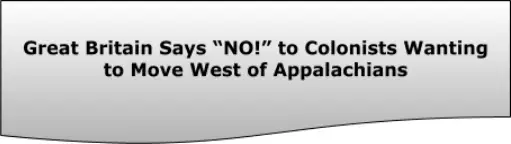
After which event would this newspaper headline MOST LIKELY have appeared in colonial newspapers?
The Boston Tea Party
The Battle of Saratoga
The Battle of Valley Forge
The French and Indian War
Which of the following was one result of the French and Indian War?
A. Colonists were given as much land as they wanted.
B. Colonists were forced to house and feed British soldiers.
C. Colonists were required to pay fewer taxes than before the war.
D. Colonists were allowed to have more of a voice in the government.
Which of the following happened next in the American Revolution?
Colonists boycotted British tea.
The Stamp Act was passed by Great Britain.
Colonists armed themselves to fight the British.
The Boston Massacre was reported in newspapers.
Which of the following BEST explains the phrase “No taxation without representation?”
A. Colonists did not like being taxed without gaining more goods and services to trade.
B. Colonists did not like being taxed without collecting more stamps for official documents.
C. Colonists did not like being taxed without having a representative in the British government.
D. Colonists did not like being taxed without receiving military protection from the British government.
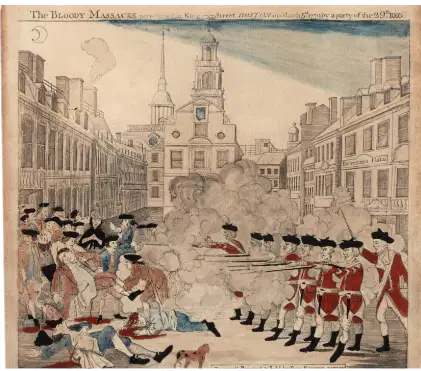
Why did Paul Revere share his image of the Boston Massacre so soon after it happened?
to show everyone that taxes are important
to convince people to turn against Great Britain
to convince people to stay loyal to Great Britain
to show everyone the colonists were aggressive
Who was the first person to be killed at the Boston Massacre?
A. Ben Franklin
B. Crispus Attucks
C. John Adams
D. Paul Revere
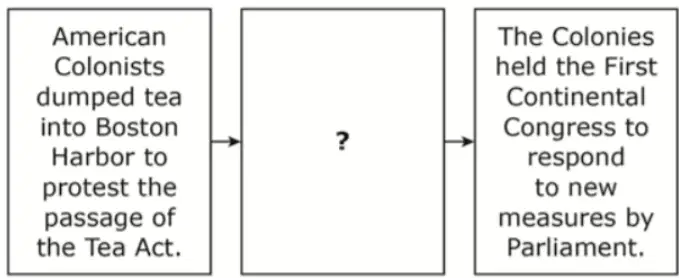
Use the chart to answer the question. [Flowchart: American Colonists dumped tea into Boston Harbor to protest the passage of the Tea Act. → ? → The Colonies held the First Continental Congress to respond to new measures by Parliament.] Which statement BEST completes the flow-chart?
Great Britain orders troops to leave colonies.
Great Britain issues the Proclamation of 1763.
Great Britain closes Boston’s port and passes unfair laws.
Great Britain stops allowing the colonies to trade with each other.
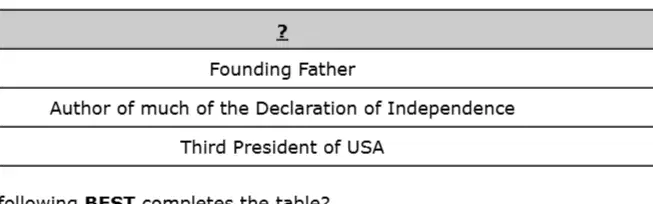
Use the table below to answer the question.
Which of the following BEST completes the table?
Paul Revere
Patrick Henry
Thomas Jefferson
Benjamin Franklin
Why was Thomas Jefferson so important to the success of the American Revolution?
His many inventions helped the Continental Army defeat the British troops in battle.
He was a strong military leader and led the Continental soldiers in many battles.
His writing and speaking skills helped him convince colonists to fight against Britain.
He wrote a musical about Alexander Hamilton to convince France to help the colonies.
Which colonist is famous for saying, "Give me liberty, or give me death?"
Paul Revere
Patrick Henry
Benjamin Franklin
George Washington
Why was the 1st Rhode Island Regiment known as the "Black Regiment" during the American Revolution?
It was one of the only regiments to ban African Americans.
The regiment was under the command of Colonel Nathaniel Black.
The regiment wore black uniforms to make them hard to see at night.
It was one of the first military regiments to include African Americans.
How did geography help the Continental Army defeat the British many times?
A. Colonists built the battlefields before each battle.
B. Colonists decided the locations of the battles for the British.
C. Colonists were more familiar with the land than the British soldiers.
D. Colonists used a secret code about hills and valleys to beat the British.
Use the information to answer the question. “We saw the British troops coming down the road. Their red coats were so bright in the sunshine. My father called for me, my brother, and my sister to grab our guns from inside the house and prepare to fight.” -Adam Beige, 1775 Which battle with citizens fighting is being described?
Valley Forge
Battle of Saratoga
Battle of Bunker Hill
Lexington and Concord
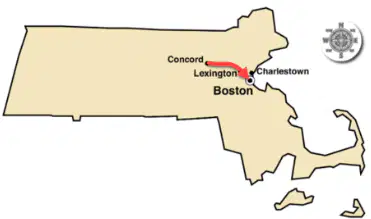
What does the arrow on the map show following the Battles of Lexington and Concord?
French soldiers marching to help the colonists against the British.
Colonists with guns running to Boston to get away from the British.
American Indians marching to help the British against the colonists.
British soldiers marching to Boston after they were defeated by the colonists.
How did the physical environment affect the strategy of the Continental Army at the Battle of Saratoga?
A. Soldiers in the Continental Army used small bridges and short buildings to fight the British.
B. Soldiers in the Continental Army relied on the Appalachian Mountains to slow the movement of enemy forces.
C. Soldiers in the Continental Army hid in the heavily forested areas around Saratoga to more easily surprise the British.
D. Soldiers in the Continental Army built forts around the Hudson River to prevent the British soldiers from attacking by water.
What was one outcome of the Continental Army’s winter at Valley Forge?
A. Soldiers turned against Washington.
B. Soldiers became more trained and skilled.
C. Soldiers became less familiar with the land.
D. Soldiers defeated the French army to end the war.
In what city was the Declaration of Independence written?
Philadelphia, Pennsylvania
Boston, Massachusetts
New York, New York
Washington, DC
Based on the list, why did colonists think the British treated them unfairly?
The British refused to send soldiers to protect the colonists.
The British did not treat them the same as other British citizens.
The British did not allow the colonists to make money in the colonies.
The British took advantage of the natural resources found in the colonies.
Which phrase from the Declaration of Independence declared that the colonies were leaving British rule?
"All men are...endowed by their Creator with certain unalienable rights."
"Governments long established should not be changed for light and transient causes."
"That these United Colonies are, and of Right ought to be Free and Independent States."
"That to secure these rights, Governments are instituted among Men, deriving their just powers from the consent of the governed."
33.b: explain how price incentives affect people's behavior and choices
During the war, many colonists sold their belongings to raise money to support the Continental Army.
During the war, wood was needed for the war effort so stores only sold it to the wives of soldiers for $5.00 a piece.
After the war, soldiers who served in the Continental Army were given a small amount of money for fighting in the war.
After the war, silversmith Paul Revere’s metal picture frames’ prices dropped from 5.00to 1.00 to gain more customers.
At Valley Forge, George Washington brought in various leaders who specialize in training soldiers. What was the result of using these leaders’ specializations?
The Continental Army lost many soldiers to the harsh winter.
The Continental Army improved their ability to fight the British.
The Continental Army increased their chances of being attacked by the British.
The Continental Army allowed the black regiments to join their training.
explain how voluntary exchange helps both buyers and sellers
Sam, a store owner, lowered the prices of apples so more people could eat healthy.
Anna, a cook, prepares food each night, and she gives the extra food to the homeless.
Jim, a blacksmith, made horseshoes for Susan, and she gave him vegetables from her garden.
Jenny, a dressmaker, made new outfits for the children in one village because they could not afford new clothes.
How did trade help the colonies during the American Revolution?
The colonies gained warships by trading with Spain.
The colonies gained supplies by trading with France.
The colonies won its independence by refusing to trade with Spain.
The colonies won its independence by refusing to trade with France.
Analyze a painting from an event leading up to the American Revolution. What does the painting depict and how does it relate to the causes of the war?
It shows colonists protesting British taxes, highlighting growing resentment that led to the Revolution.
It depicts the signing of the Declaration of Independence, marking the official start of the war.
It shows British soldiers celebrating victory over the French, unrelated to the Revolution's causes.
It depicts George Washington crossing the Delaware, which occurred during the war, not before.
What does the following quote related to the American Revolution mean, and how does it relate to the events of the time?
It reflects the colonists' desire for independence and connects to their struggle against British rule.
It describes the economic prosperity of the colonies during the Revolution.
It highlights the peaceful negotiations between Britain and the colonies.
It refers to the technological advancements made during the American Revolution.
According to the Declaration of Independence, the people of a country have the right to replace their government when:
the government fails to protect their rights.
the government increases taxes.
the government changes its leaders.
the government passes new laws.
The Declaration of Independence contains quotes that reflect the ideals of the American Revolution. Which of the following best explains how these quotes relate to the Revolution?
They express the colonists' desire for independence and justification for rebelling against British rule.
They describe the economic policies of the British government.
They outline the military strategies used during the Revolution.
They list the names of the leaders of the Continental Congress.

