
 Worksheets
25-26 SS WG Final PAP REVIEW
Total questions: 67
Worksheet time: 35mins
Which factor most contributes to defining a region’s human characteristics?
River system
Soil type
Language
Elevation
The _____ allows geographers to collect and analyze spatial data.
GIS
GPS
Remote sensing
Topographic map
What is the main reason functional regions develop?
Shared religion
Political unity
Transportation and trade
Climate similarity
Drag the correct level of economic activity to the example:
Software design
Quaternary
Factory work
Secondary
Teaching
Tertiary
Farming
Primary
Which Earth system is most directly affected by hurricanes through coastal flooding and erosion?
Lithosphere
Atmosphere
Biosphere
Hydrosphere
Which of the following is a trend in world population growth?
Slowing birthrates in many developed countries
Decreasing urbanization
Declining global literacy
Lower life expectancy in all regions
A country with low literacy and high infant mortality likely has which level of development?
Developed
Developing
Newly industrialized
Post-industrial
How does El Niño affect global climate patterns?
It cools the oceans permanently
It increases hurricane frequency in the Atlantic
It alters weather patterns worldwide
It only affects South America
How do humans depend on the environment for natural resources, and what is one way they are working toward sustainability?
Humans rely on forests and water for survival and are using solar panels to reduce reliance on fossil fuels.
Humans no longer rely on the environment and have completely replaced natural resources with synthetic materials.
Humans depend on technology instead of natural resources and are using more fossil fuels for faster development.
Humans rely on natural resources but are doing nothing to promote sustainability.
Which of the following is a characteristic of a democracy?
Power held by one ruler
Citizens elect representatives
Religious leaders control government
Government owns all property
How has the Internet changed the way people study geography, and what is one advantage it provides over traditional maps?
The Internet limits access to geographic data, making it harder to study real-time events.
The Internet only provides historical maps, so it does not improve how people study geography.
The Internet allows access to live maps and real-time data like traffic and weather, giving an advantage over traditional maps.
The Internet has made maps less important and encourages people to stop studying geography altogether.
What is one way the Human Development Index (HDI) measures quality of life?
Percentage of people in the military
Distance to the nearest capital
Life expectancy
Number of natural disasters
What is a major factor influencing the movement of oil from Canada to the U.S.?
Lack of infrastructure
Political instability
Pipeline networks and trade agreements
Water scarcity
How does the political system of the United States help shape the overall character of the country?
The U.S. political system is based on democratic principles, which promote citizen participation, individual rights, and representative government.
The U.S. is known for its large land area and variety of natural resources.
The U.S. economy relies heavily on agriculture in rural areas.
The U.S. has a wide range of climates, from arctic conditions in Alaska to tropical weather in Florida.
Which of the following best explains how both a past event and a physical feature influenced the development of a region in the United States or Canada?
The discovery of gold in California attracted migrants, while the Sierra Nevada Mountains made transportation and settlement more difficult.
The Great Plains were easy to settle because of their flat land and mild climate.
The construction of railroads helped connect cities across the United States without any geographic challenges.
The Canadian Shield was settled quickly because of its rich farmland and easy access by boat.
Match each region to its defining feature.
Quebec
Language (French)
Bible Belt (South)
Religion (Christianity)
Pacific Northwest
Climate (Wet/Temperate)
U.S.- Mexico Border
Vegetation (Desert)
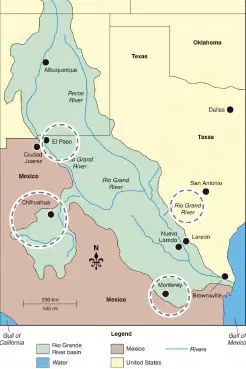
Click on the physical boundary that separates the U.S. and Mexico.
Rio Grande River
Mississippi River
Rocky Mountains
Appalachian Mountains
How has American popular culture most affected other countries?
It has remained limited to the U.S.
It led to isolation in global trade.
It has been adopted and adapted worldwide.
It discouraged innovation abroad.
A ______ is a belief system that often influences a society's values, traditions, and laws.
religion
climate
economy
constitution
Which of the following best describes a sustainable practice in the U.S. or Canada?
Clear-cutting forests
Using solar panels
Increasing oil dependency
Building cities without planning
Which statement best explains how the Dust Bowl affected the physical and human characteristics of the Great Plains in the 1930s?
It improved agricultural techniques and brought prosperity.
It led to widespread migration and long-term soil erosion.
It caused a population boom due to fertile land.
It had little to no effect on the region's development.
Political instability in a country is a ______ factor that causes people to migrate to more stable regions.
push
pull
neutral
cyclical
Select the TWO cultural groups that have contributed significantly to U.S. multicultural society.
Hispanics
huns
Inuit
African Americans
North America has seen ______ population growth in rural areas over the past century.
declining
increasing
stable
fluctuating
Identify the Andes Mountains on the map of South America.
How has the Amazon River influenced settlement patterns in Brazil?
It has created deserts that are unsuitable for farming.
It has encouraged dense urban development in the region.
It has supported agriculture and transportation routes into the interior.
It has discouraged any economic activity in the region.
Which factor most contributes to the tropical climate of the Amazon Basin?
Proximity to ocean currents
High elevation
Equatorial latitude
Deforestation
Why is terrace farming practiced in the Andes Mountains?
To increase rainfall
To protect crops from wind
To make use of steep land for agriculture
To prevent overgrazing by livestock
What country in Latin America produces 20% of the world's beef?
Brazil
Mexico
Argentina
Peru
Which economic system is most associated with government ownership of resources?
Free Enterprise
Communism
Traditional
Cottage industry
How has the Panama Canal affected global trade?
It made air travel more efficient
It increased the cost of trade
It shortened the shipping route between the Atlantic and Pacific Oceans
It reduced economic growth in Central America
Which country has maintained many traditional cultures, including indigenous economies?
Canada
Brazil
Guatemala
Chile
The physical process that causes the formation of mountains like the Andes is
Tectonic activity
Erosion by rivers
Wind deposition
Volcanic ash accumulation
Select the TWO policies that could help Latin America use its resources more sustainably.
Reforestation of the Amazon
Overfishing in coastal areas
Investment in renewable energy
Clear-cutting rainforest for agriculture
Match each biome with its climate.
Tropical Rainforest
Hot/wet climate
Highland
Climate varies by elevation
Desert
Hot/dry climate
Select THREE statements that describe cultural patterns unique to Latin America.
Spanish and Portuguese are dominant languages
The region is mostly Buddhist
Catholicism is widely practiced
Indigenous traditions blend with European customs
Which of the following physical features has historically acted as a barrier to migration and contributed to cultural divisions in Europe?
The Great Plains
The Ural Mountains
The Alps
The Andes
Which of the following was an original purpose of the European Union?
Address the problem of international corruption.
Eliminate global terrorism.
Increase the economic growth of member nations.
Reduce environmental pollution.
Polders in the Netherlands; Canals in Venice, Italy; City-states in Greece — The three examples above are evidence for which statement?
Ethnic groups have remained unchanged over time.
Architecture developed at the same time throughout Europe.
Europeans have adapted/modified to their environments.
The governments of Europe have adopted the policy of isolationism.
Human modifications and adaptations, such as windmills and polders, are characteristics of which country’s human–environment interaction?
Italy
Spain
Netherlands
Denmark
On a map of Europe, which area represents the Scandinavian Peninsula?
Norway and Sweden in northern Europe
Spain and Portugal in southwestern Europe
Italy extending into the Mediterranean Sea
Greece and nearby lands in southeastern Europe
Which organization is an economic and political union that has helped promote free trade and peace among many European countries?
European Union (EU)
North Atlantic Treaty Organization (NATO)
United Nations (UN)
Organization of the Petroleum Exporting Countries (OPEC)
In the fall of 2017, the people of Catalonia voted to leave Spain for reasons including economics, nationalism, and cultural preservation. Nationalism in this issue is best described as —
A method of solving the basic economic problems of society.
The achievement of world peace and global understanding.
The desire to take over other societies by force.
The loyalty of a people to their values, traditions, and a geographic region.
Many parts of Southern Europe experience which climate, characterized by hot, dry summers and mild, wet winters?
Mediterranean
Subarctic
Marine West Coast
Humid Continental
Which statement best describes a concern of European countries taking in refugees from Syria?
Fewer terrorist attacks are occurring each year.
The national security of their country.
There are only four terrorist organizations currently in existence.
It will cause political instability.
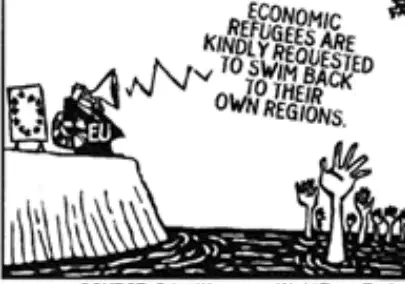
Use the cartoon and your knowledge of social studies to answer: The cartoon implies which statement about economic refugees?
They arrived because of flooding in their countries.
They should seek refuge in the United States and Canada.
They should be able to solve the problems of their regions.
They will not be admitted to Europe.
What is the most common reason for acid rain in Germany?
Having outdoor festivals
Pollution caused by industrialization
Dumping sewage into the river system
Using uranium to generate electricity
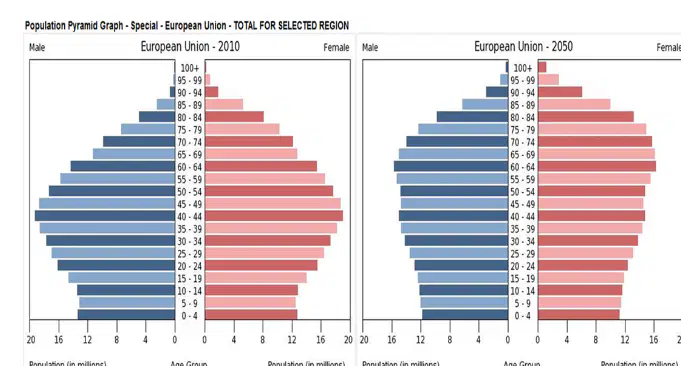
Which best describes the population changes predicted in Europe by 2050, as shown by the population pyramids?
Negative growth
Urban sprawl
Rural decline
Aging population
Which physical feature has most influenced Russia’s historical isolation and migration patterns?
Ural Mountains
Sahara Desert
Amazon River
Andes Mountains
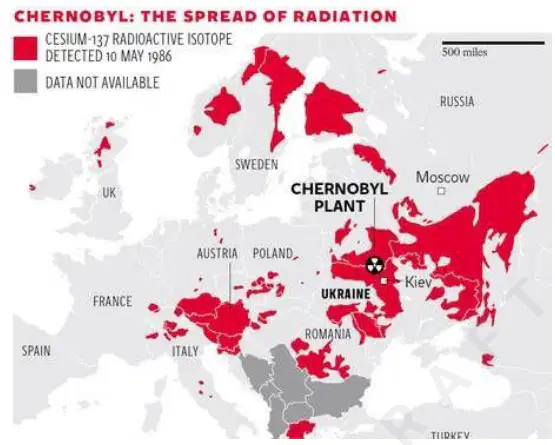
Based on the image, what conclusion can best be drawn?
Environmental problems require global cooperation to find solutions.
Only nations that create environmental problems will suffer from them.
Technology has helped the world reduce environmental pollution.
The fall of the Soviet Union has caused severe environmental hazards.
How do geography and location contribute to the climate of Siberia?
Siberia is a vast, grassy plain protected from cold winds by the Ural Mountains.
Siberia is bordered by mountains, which keep the climate predictable and stable.
Siberia has few geographic barriers with the Gobi Desert, giving the region a warm climate most of the year.
Siberia is a vast, flat region partly within the Arctic Circle with few geographic barriers to the freezing winds from the north.
This transition event led Russia to a new system of totalitarian government and communist (Collective) economic policies:
Yalta Conference
The Cold War
Russian Revolution
Annexation of Crimea
Which of the following factors significantly contributed to the shrinking of the Aral Sea?
Erosion
Irrigation
Pollution
Drought
Complete the analogy with the correct combination of words listed American Revolution: ____________; Bolshevik Revolution: ____________
Democracy, Communism
Communism, Democracy
Socialism, capitalism
Socialism, communism
Which of the following 2 statements describes how Russia’s physical geography and trade networks have influenced its identity and international relationships? Select TWO correct answers.
Russia’s harsh climate and vast distances have contributed to the isolation of many regions.
Russia’s geography has no effect on its communication or development.
Russia’s oil and natural gas exports have increased its political and economic influence globally.
Russia’s identity is mainly shaped by its tropical location and agricultural exports.
Trade networks have made Russia fully dependent on other countries for energy.
Which belief has been most strongly tied to national identity and loyalty in Russia?
Atheism
Patriotism
Buddhism
Protestantism
The ______ was a former Soviet policy that centralized agriculture, often leading to inefficiency and famine.
Collectivization
Perestroika
Glasnost
Privatization
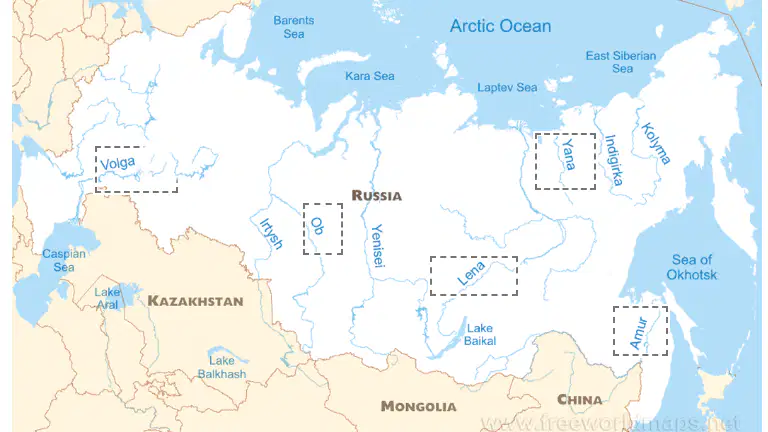
Click on the major river that supports trade and settlement in western Russia.
Volga River
Lena River
Ob River
Yenisei River
Which of the following accurately describe political features of Russia today? Select TWO correct answers.
Vladimir Putin’s leadership is best described as authoritarian.
Russia’s government operates as a totalitarian state with no elections.
Russia has an electoral system and is officially classified as a republic.
Russia is considered a direct democracy where citizens vote on all issues.
Russia’s government is fully democratic with complete political freedom.
Which of the following is a cause for regional conflicts in Bosnia?
An increase in tourism
Demands for Western goods
The Communist form of government
The presence of more than 50 different ethnic groups
The genocide in places such as the Balkans region can be summarized as
Fighting over strategic commodities such as oil and water resources.
European colonists taking land and harming the indigenous population.
Conflicts between ethnic groups in which ethnic cleansing was used to gain land.
The attempts of political leaders to form democracies.
Due to Cold War tensions, the city of Berlin was divided into two sections. Which of the following statements explains possible reasons for this division?
East and West Berlin had similar forms of government and the wall was built to improve government in the city.
The Berlin Wall allowed people to travel freely between the two sides of the city.
The Berlin Wall was constructed as a symbol of city government and as a popular tourist destination.
The man-made Berlin Wall separated democratic West Berlin from Communist East Berlin.
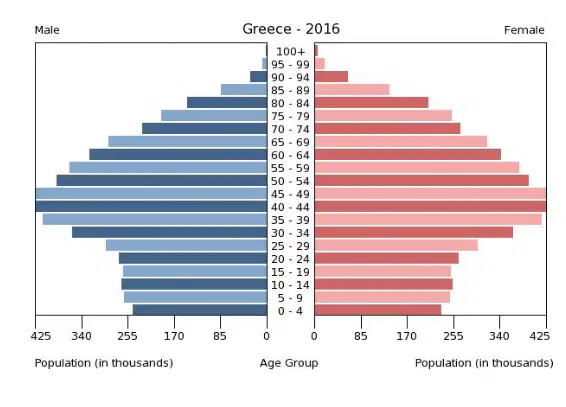
According to the population pyramid above, what government program will Greece need to implement in the future?
HeadStart/Pre-k program.
Mandated vocational training.
Federally funded maternity leave
Healthcare programs for the elderly.
Countries in the Northern European region of Scandinavia (Finland, Sweden, etc.) have government operated schools, universities, and health-care institutions for their people. This is all paid for by very high taxes in the region. These countries also allow their people to own businesses and choose their jobs. What type of economic system does this illustrate?
Mixed socialism and free market
Traditional Economy
Free market
Only socialist
Which Latin American Country is the most populated spanish speaking nation in the world?
Cuba
Mexico
Brazil
Chile
Why would the U.S. and Canada be considered as one region in the world?
Same economic system
Similar cultural traits
Speak a similar language
All of the above
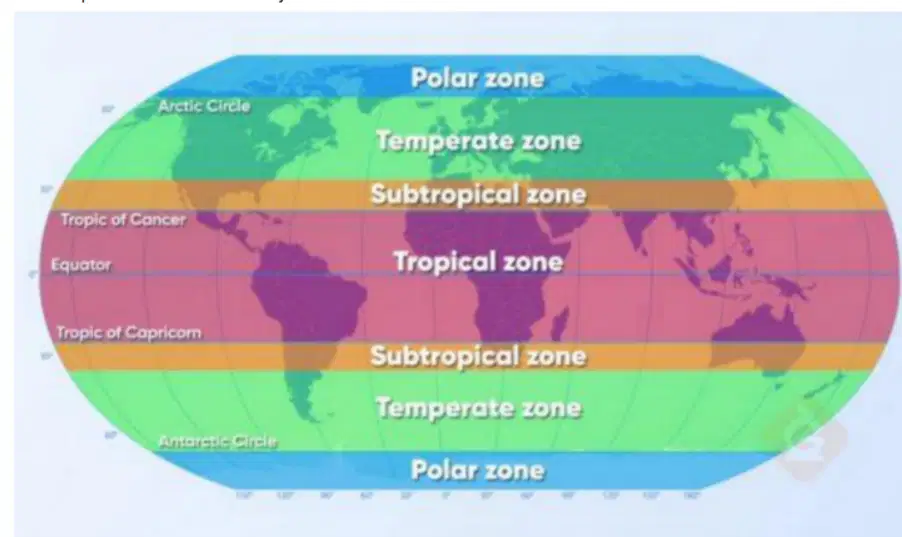
The map below shows the major climate zones on Earth. The primary factor controlling these climate zones is...
Elevation
Longitude
Latitude
Solar time

