
 Worksheets
Law of Universal Gravitation and Hooke's Law Practice
Total questions: 35
Worksheet time: 1hrs 5mins
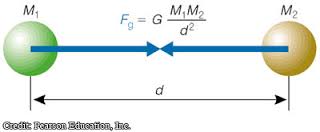
Calculate the gravitational force between two objects when they are 0.750m apart. Each object has a mass of 5.00kg.
2.96x10⁻⁹N
3.00x10⁻⁶N
2.22x10⁻⁹N
2.23x10⁻⁸N

How is the gravitational force between to objects related to their mass
They are directly proportional
They are inversely proportional
They do not affect each other
They are equal

If the distance between 2 masses is increased then the force of gravitation between them will...
increase
decrease
stay the same

If the mass of either m1 or m2 is increased then the force of gravitation between them will...
increase
decrease
stay the same

Which of the following formulas is the correct equation for the law of Universal gravitation?
F=d2GM1M2
F=mg
F=m1m2Gd2
F= F=d2KQ1Q2
Which 2 answers provide the best definition of the value 'k'?
k is the stiffness coefficient
k is the spring constant
k is the specific spring number
k is the kinetic energy needed to stretch the spring
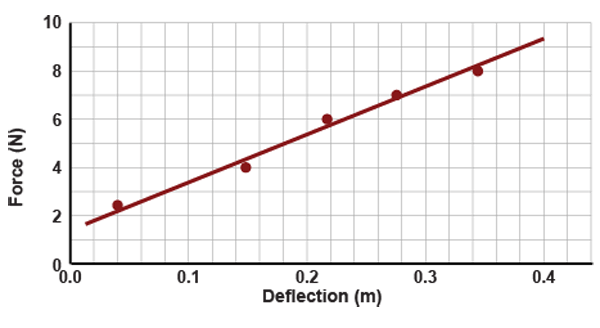

Which of the following best describes the relationship shown in the graph
The greater the force applied to the bungee, the greater the extension
The greater the force applied to the bungee in Newtons, the greater the extension in metres
The less force applied to the bungee, the less it extends
The less force applied to the bungee in Newtons, the less it extends in metres

Select a logical prediction for the investigation.
As the force applied to the spring increases, the extension of the spring will decrease.
As the force applied to the spring increases, the extension of the spring will stay the same
As the force applied to the spring increases, the extension of the spring will also increase.

For this spring, as the force increases, the extension increases proportionally. What would you expect to happen to the extension if the force was doubled?
The extension would stay the same.
The extension would double
The extension would halve
Calculate the gravitational force between two objects when they are 0.750m apart. Each object has a mass of 5.00kg.
2.96x10⁻⁷N
3.00x10⁻⁹N
2.22x10⁻⁹N
2.23x10⁻⁸N
What is the value of the Universal Gravitation Constant (G)?
6.67 x 10^11 Nm²/kg²
9.81 m/sec²
3.5 x 10^22 N
10 m/s²
What is the gravitational field near the surface of the Earth?
9.81 m/sec²
6.67 x 10^11 Nm²/kg²
3.5 x 10^22 N
10 m/s²
What does the gravitational force depend on?
Mass and distance
Velocity and time
Acceleration and force
Energy and power
What is the actual weight of an object?
The gravitational force acting upon a body caused by a planet or star
The psychological illusion and heaviness feeling of an object
The weight calculated by mass times the gravitational field
The weight calculated by mass times the acceleration

Newton's Law of Universal Gravitation affects
All objects with mass in the known universe
All objects and empty space in the known universe
Thoughts and Ideas
Only things that are the color red
If one of two objects increases its mass, it _________ the gravitational pull between the two objects
increases
decreases
has no effect on
eliminates
What is potential energy?
The energy an object has due to its position or condition.
The energy an object has due to its motion.
The energy an object has due to its chemical composition.
The energy as object has due to its atomic structure.
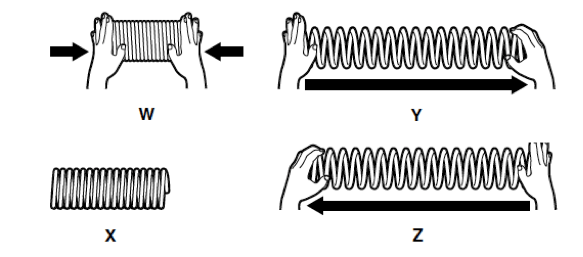
Elastic potential energy is energy stored in an object, such as a spring, due to the object being stretched or compressed. In which position is it most likely that the spring has lost its elastic potential energy?
W
Y
X
Z

