
 Worksheets
Safe Working Load and Working Load Limits Quiz
Total questions: 85
Worksheet time: 43mins
What is the definition of "safe working load"?
The maximum weight a lifting aid can safely handle.
The minimum weight a lifting aid can handle.
The average weight a lifting aid can handle.
The weight a lifting aid can handle under extreme conditions.
What is another term used to refer to "safe working load"?
Load capacity.
Working load limit.
Weight threshold.
Maximum load.
What factors are considered by manufacturers to determine the safe working load?
Material strength, design specifications, and environmental conditions.
Weight of the equipment, user experience, and environmental conditions.
Design specifications, user experience, and equipment cost.
Material strength, equipment cost, and environmental conditions.
What is the working load limit (WLL) for a violet duplex webbing sling in a straight configuration?
1.00 tonne.
2.00 tonnes.
0.80 tonne.
1.40 tonnes.
In a 90° basket configuration, what is the WLL for a yellow polyester round sling?
4.20 tonnes.
6.00 tonnes.
2.40 tonnes.
3.00 tonnes.
Which color-coded sling has the highest WLL in a straight configuration?
Violet.
Orange.
Green.
Yellow.
What is the WLL for a grey duplex webbing sling in a basket x 2 configuration?
5.60 tonnes.
4.00 tonnes.
3.20 tonnes.
7.00 tonnes.
What is the maximum rated capacity of a tower crane as mentioned in the workplace examples?
900 kg
1,000 kg
10,000 kg
25 kg
What is the rated capacity of a polyester lifting sling as per the workplace examples?
1,000 kg
900 kg
10,000 kg
16 kg
According to safety guidelines, what is the maximum safe upper limit for the average man to manually lift?
16 kg
25 kg
10,000 kg
900 kg
What is the maximum safe upper limit for the average woman to manually lift, provided the load is held close to the body and at knuckle height?
25 kg
16 kg
1,000 kg
900 kg
What is the maximum capacity of shelves in a warehouse as mentioned in the workplace examples?
1,000 kg
900 kg
10,000 kg
25 kg
What does Safe Working Load (SWL) refer to?
The maximum output rate achievable under ideal conditions.
A safety term for lifting equipment.
The general term for maximum throughput across all types of equipment.
Continuous operation with perfect machine health.
What does Equipment Capacity assume for its calculation?
Material shortages.
Continuous operation with perfect machine health.
Partial efficiency.
Limited output rate.

Which of the following best describes Equipment Capacity?
A term for lifting equipment safety.
The absolute maximum output rate achievable under ideal conditions.
A term for material shortages.
A term for partial efficiency in operations.
What is one of the potential consequences of exceeding the safety working load?
Legal action
Increased efficiency
Reduced maintenance costs
Improved equipment lifespan
Which of the following is a consequence of exceeding equipment capacitance?
Loss of licence
Increased productivity
Enhanced safety
Reduced wear and tear
What is a shared consequence of both exceeding safety working load and equipment capacitance?
Fines and penalties
Improved performance
Reduced legal obligations
Enhanced durability
Why must more intensive maintenance be performed regularly when equipment capacitance is exceeded?
To prevent excessive wear and tear
To increase the load capacity
To reduce the need for inspections
To improve the speed of operations
What is a potential outcome of catastrophic structural failure due to exceeding the safety working load?
Injury and fatality
Increased productivity
Reduced legal risks
Enhanced equipment lifespan
What is the safe working load for a male to carry?
30kg
16kg
25kg
What is Safe Working Load?
The maximum weight a lifting aid can safely handle
How much the operator can put on the machine
How much the machine can carry
What is equipment capacity?
Using 100% of the machine's carrying capacity
Using 50% of its carrying capacity to ensure it is safe
Point at which the equipment breaks
What is the safest and most efficient sling angle configuration for lifting loads?
Vertical lift
Moderate angles (60°–45°)
Shallow angles (<30°)
Sling Angle Factor (SAF)
At moderate sling angles (60°–45°), how much more tension does each sling leg carry compared to its share?
10% more
15% more
20% more
25% more
What happens to tension in sling legs at shallow angles (<30°)?
Tension decreases
Tension remains constant
Tension doubles
Tension halves
What does the Sling Angle Factor (SAF) represent?
A multiplier used to calculate increased tension based on sling angle
A measure of load weight
A calculation for hardware stress
A safety recommendation for lifting loads
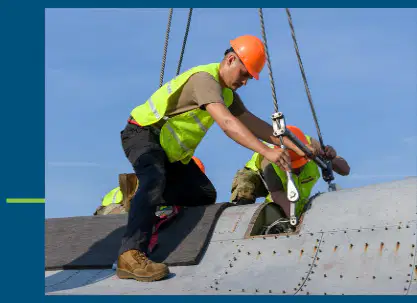
What is a key safety recommendation for using slings to lift loads?
Aim for angles below 30°
Avoid angles close to vertical
Always aim for angles close to vertical
Ignore sling tension calculations
What type of hardware experiences amplified forces at lower sling angles?
Only slings
Shackles, spreader bars, and hooks
Only spreader bars
Only hooks
What is the risk associated with ignoring sling angles during lifting operations?
Increased efficiency in lifting operations
Instant overloading of equipment
Reduced tension in the sling
Improved stability of the load
Why is it important to measure sling length and height before lifting?
To ensure the sling is colorful
To determine the angle and apply Sling Angle Factors (SAF)
To reduce the weight of the load
To increase the speed of lifting
What is the recommended minimum sling angle for safe lifting operations?
15°
30°
45°
60°
What is a key takeaway for ensuring safety in rigging systems?
Focus only on the slings
Consider the entire rigging system, not just the slings
Use slings with bright colors
Avoid measuring sling angles
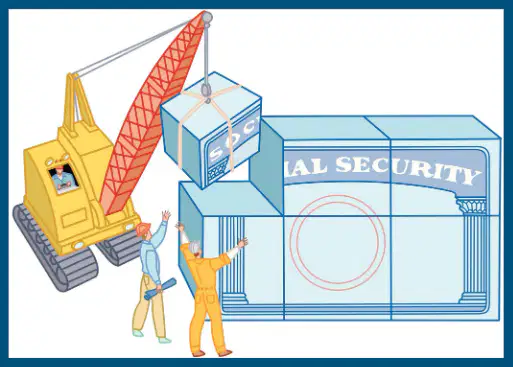
What is the potential consequence of using improper sling angles?
Increased lifting speed
Crane-related fatalities
Reduced load weight
Improved load stability
What is the primary factor to consider when estimating the correct working load limit of a rigging system?
The weight of the load
The sling angle
The length of the sling
The material of the sling
What happens to the tension on the legs of a sling when the sling angle is reduced to 30 degrees?
The tension is halved
The tension remains the same
The tension doubles
The tension decreases slightly
Why do riggers typically keep the sling angle at 60 degrees or higher?
To reduce the length of the sling
To avoid extremely high levels of tension
To increase the working load limit
To make the sling easier to handle
What is the relationship between sling angle and tension described as?
A linear function
A sine function
A logarithmic function
A quadratic function
What is a recommended solution if a sling angle below 30 degrees cannot be avoided?
Use a shorter sling
Use a longer sling
Increase the weight of the load
Decrease the working load limit
What is one of the key principles to consider when lifting a heavy object?
Understand the physics of lifting heavy objects
Lift the object as quickly as possible
Avoid using any tools or equipment
Ignore the weight distribution of the object
Why is it important to ensure load balance when lifting heavy objects?
To prevent tipping and swinging
To increase the weight of the object
To make the object harder to lift
To avoid using lifting beams
What is the load capacity when lifting at a 45° angle, as shown in the diagram?
1,000
707
866
500
Which of the following is a method to avoid unsafe angles when lifting heavy objects?
Use lifting beams to lift heavy objects
Lift objects without planning
Ignore the center of gravity
Avoid padding sharp edges
What should you calculate before lifting a heavy object?
If you'll need a sling, shackle, or hook
The time it will take to lift the object
The number of people required to lift the object
The distance to carry the object
What is the load capacity when lifting at a 30° angle?
1,000
707
500
866
What is the first step to take before performing a manual lift?
Check the load to ensure it is not too heavy.
Plan the route by clearing all obstructions and checking the destination.
Get help or an aid if the load is awkward or heavy.
Bend your knees and hips to lower yourself.
What should you do if the load is awkward or heavy?
Attempt to lift it alone using your leg muscles.
Use a mechanical aid or ask a colleague of similar stature to assist.
Bend your knees and hips to lower yourself.
Carry the load as far away from your body as possible.
What is the recommended stance for maintaining balance during a lift?
Stand with your feet together and knees locked.
Stand close to the load with your feet apart, one leg slightly in front of the other.
Stand far from the load with your feet apart.
Stand with your feet crossed and knees bent.
Why is it important to bend your knees and hips while lifting?
To increase the weight of the load.
To maintain the natural curve of your back and avoid injury.
To make the lift faster.
To reduce the need for assistance.
What is the best way to hold a load while lifting?
Grip the load loosely and keep it away from your body.
Get a firm grip and hug the load close to your body, keeping the heaviest side towards your body.
Hold the load with one hand and balance it on your hip.
Place the load on your shoulder for better support.
What is the recommended way to hold a load during lifting to reduce leverage on your spine?
Keep the load as far from your body as possible.
Keep the load as close to your waist as possible.
Hold the load above your head.
Keep the load at arm's length.
What should you do to lift smoothly and avoid injury?
Use your back muscles to lift the load.
Start by tightening your core/stomach muscles and lift with your legs.
Jerk the load upwards quickly.
Snatch the load to save time.
Where should you look while lifting a load?
Down at the load.
To the side of the load.
Ahead, not down at the load.
Up at the ceiling.
What is the correct way to change direction while carrying a load?
Twist your body to change direction.
Lean sideways while carrying the load.
Move your feet and take small steps.
Turn your shoulders sharply.
What is the first step in setting down a load safely?
Drop the load quickly.
Reverse the lifting process by bending your knees and hips.
Twist your body to place the load.
Slide the load into position without bending.
What should you do if the load needs precise positioning after setting it down?
Adjust the load while holding it in the air.
Put the load down first, then slide it into the final place.
Drop the load into the desired position.
Push the load with your foot.
What is the first step in safe lifting techniques?
Bend your knees and lift with your arms
Plan the lift and clear the path first
Keep the heavy load away from your body
Maintain a relaxed posture while lifting
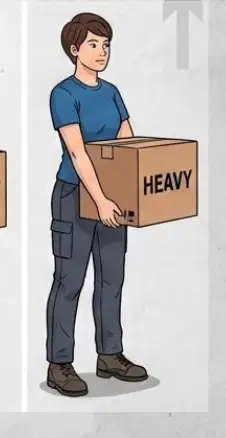
Why is it important to keep the heavy load close to your body while lifting?
To reduce strain on your arms
To maintain balance and reduce the risk of injury
To make the load lighter
To avoid bending your knees
Which part of your body should you primarily use to lift heavy objects?
Your back
Your arms
Your legs
Your shoulders

What posture should you maintain while lifting heavy objects?
A relaxed and slouched posture
A balanced and stable posture
A leaning forward posture
A straight back with stiff knees
What should you always perform before lifting a load?
A thorough risk assessment
A quick stretch
A safety equipment check
A load weight estimation
What is the recommended stance for safe lifting?
Feet together and knees locked
Feet shoulder-width apart and balanced
Feet wide apart and leaning forward
Feet crossed and bent backward
Which part of your body should you use to lift a load safely?
Your arms
Your back
Your legs
Your shoulders
Why is it important to hold the load close to your body while lifting?
To reduce strain on your arms
To maintain balance and control
To avoid dropping the load
To increase lifting speed
When should you use mechanical aids for lifting?
When the load is light
When the load permits easy use
When you are in a hurry
When the load is fragile
What is the correct posture for lifting heavy objects?
Bend your back and lift with your arms.
Keep your back straight and lift with your legs.
Twist your torso while lifting.
Use only your upper body strength to lift.
Why is it important to keep your back straight while lifting heavy objects?
To avoid straining your arms.
To prevent injury to your spine.
To make lifting faster.
To increase the weight you can lift.
Which part of the body should primarily be used to lift heavy objects, as demonstrated in the image?
Arms.
Back.
Legs.
Shoulders.
What is the main safety technique emphasized in the image for manual lifting?
Use your arms to lift.
Keep your back straight and lift with your legs.
Twist your body while lifting.
Lift quickly to avoid strain.
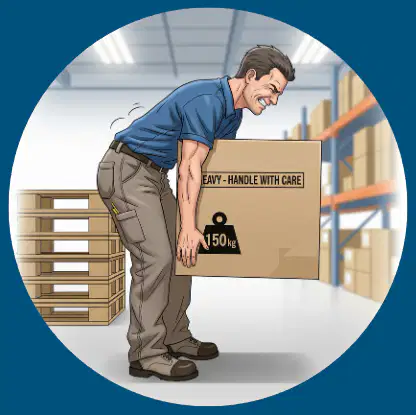
What is one of the consequences of incorrect lifting?
Improved muscle strength
Serious muscle and joint damage
Enhanced flexibility
Reduced risk of injury
What technique should be followed to minimize accident risk while lifting?
Use improper posture
Follow proper technique
Lift with a jerking motion
Avoid bending knees

What is a major risk associated with heavy lifting?
Spinal injuries
Improved posture
Increased energy levels
Enhanced muscle tone
What is one of the long-term consequences of improper lifting techniques?
Chronic back pain
Increased flexibility
Enhanced muscle growth
Reduced fatigue
What is one of the consequences of incorrect lifting?
Improved muscle strength
Serious muscle and joint damage
Enhanced spinal flexibility
Reduced risk of injury
What is a major risk associated with heavy lifting?
Spinal injuries
Increased energy levels
Improved posture
Enhanced joint mobility
What long-term consequence can result from improper lifting techniques?
Chronic back pain
Improved muscle tone
Enhanced flexibility
Reduced fatigue
What is the recommended way to minimize accident risk while lifting?
Lift as quickly as possible
Use proper technique
Avoid lifting altogether
Rely on muscle strength alone
Which of the following hand signals is commonly used in lifting operations?
Lower slow
Jump high
Spin fast
Walk steady
Why are hand signals used in loud work environments or across long distances?
To replace verbal communication when it is ineffective
To entertain workers during breaks
To confuse workers intentionally
To signal the end of a workday
What is the primary purpose of hand signals when large items create blind spots?
To prevent accidents and injuries
To increase the speed of operations
To reduce the need for supervision
To signal the completion of a task
What does the "Start" hand signal indicate in standard hand signals?
To stop all operations
To begin operations
To indicate danger
To lower equipment slowly
Which hand signal is used to indicate "Danger" in standard hand signals?
Start
Stop
Danger
Lower steady
What does the "Lower steady" hand signal represent?
To raise equipment steadily
To lower equipment steadily
To stop all operations
To indicate small movement
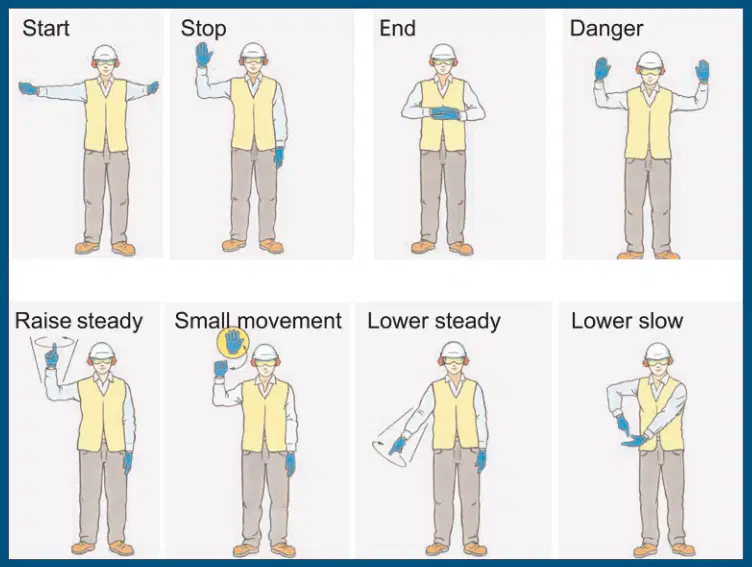
Which hand signal is used to indicate "Small movement" in standard hand signals?
Raise steady
Small movement
End
Danger
What does the "End" hand signal indicate in standard hand signals?
To stop all operations
To indicate danger
To signal the end of operations
To lower equipment slowly