
 Worksheets
Unit 4 Review Transcription/Translation and Mutations
Total questions: 29
Worksheet time: 29mins
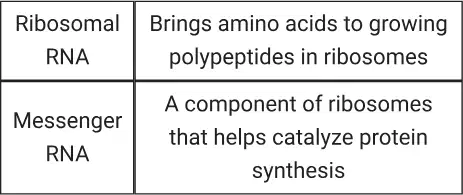
Which table correctly identifies the function of each type of RNA?
Type of RNA | Function Transfer RNA | Carries genetic information from DNA to ribosomes Ribosomal RNA | A component of ribosomes that helps catalyze protein synthesis Messenger RNA | Brings amino acids to growing polypeptides in ribosomes
Type of RNA | Function Transfer RNA | A component of ribosomes that helps catalyze protein synthesis Ribosomal RNA | Brings amino acids to growing polypeptides in ribosomes Messenger RNA | Carries genetic information from DNA to ribosomes
Type of RNA | Function Transfer RNA | Brings amino acids to growing polypeptides in ribosomes Ribosomal RNA | A component of ribosomes that helps catalyze protein synthesis Messenger RNA | Carries genetic information from DNA to ribosomes
Type of RNA | Function Transfer RNA | Carries genetic information from DNA to ribosomes
Part of an important cellular process involving a DNA strand is modeled below. What is the purpose of this cellular process?
Preserving genetic information for future generations
Deleting the information in the sequence produced from the DNA template
Transcribing information in the DNA sequence for use by the cell
Producing more nucleotides for the DNA sequence
Which part of a DNA molecule is responsible for the direct coding of specific traits in an organism?
The number of hydrogen bonds that hold the strands of DNA together.
The number of carbons in the DNA molecule.
The sequence of nucleotide bases in the DNA molecule.
The sequences of phosphates along each DNA strand.
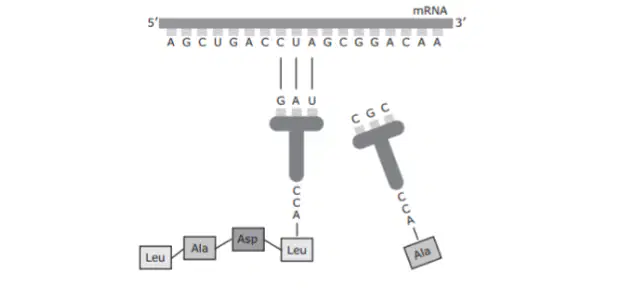
What is the purpose of this process?
To replicate the DNA of an organism before cell division
To assemble nucleotides in an mRNA chain along a DNA template
To synthesize amino acids used to unzip strands of DNA and copy the genetic code
To translate the genetic code into a specific sequence of amino acids
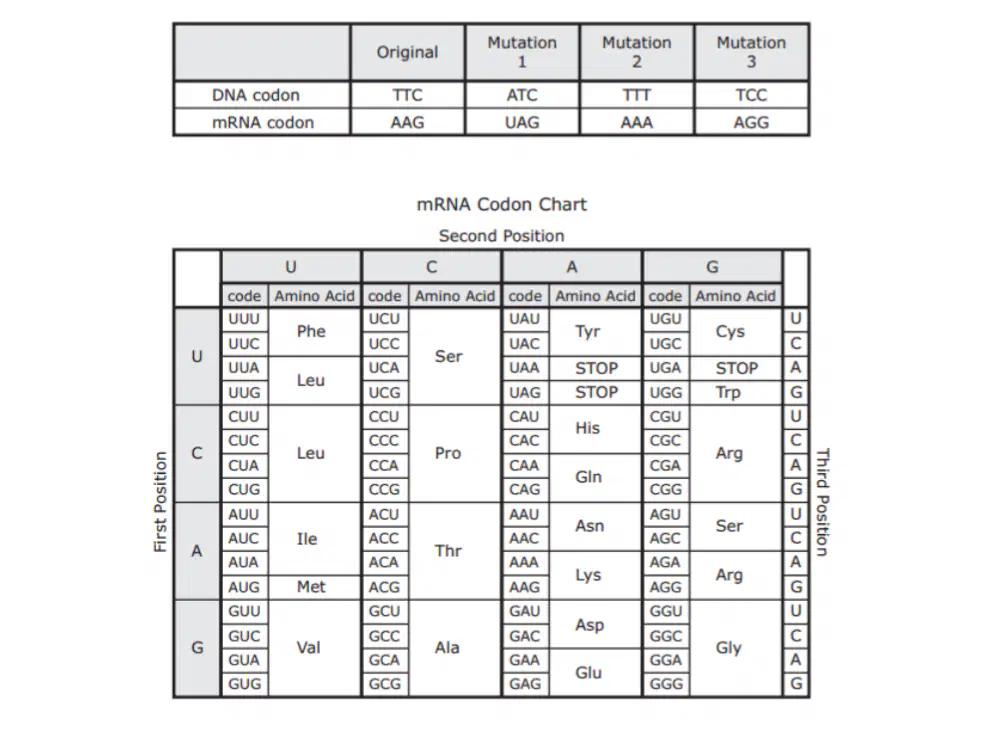
The table shows a DNA sequence and three types of mutations that can change the DNA sequence. Original: DNA codon TTC, mRNA codon AAG Mutation 1: DNA codon ATC, mRNA codon UAG Mutation 2: DNA codon TTT, mRNA codon AAA Mutation 3: DNA codon TCC, mRNA codon AGG Refer to the mRNA Codon Chart to the left. Which mutation will cause translation to stop?
Mutations 1 and 3 only
Mutation 1 only
Mutation 2 only
Mutations 1, 2, and 3
A base sequence of the DNA from a gene is shown.
ATC GGC TA
Due to a mutation, the base sequence was changed as shown.
ATT GGC TA
Which type of mutation has occurred in the gene?
F. Deletion
G. Substitution
H. Insertion
J. Translocation
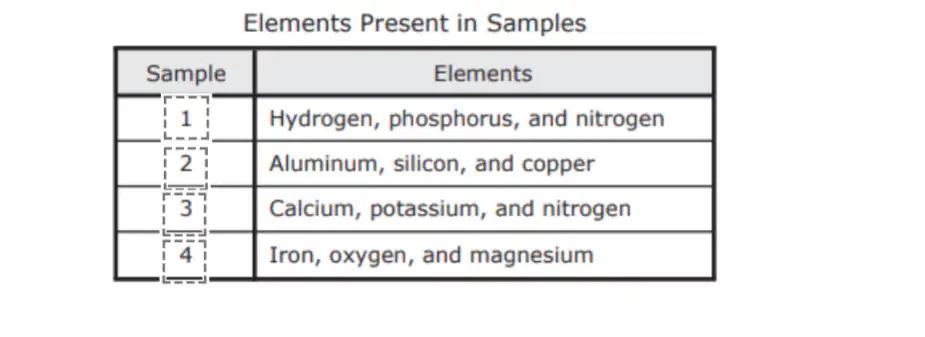
Students are given data from an investigation that identified some of the chemical elements present in four different samples. Which sample was most likely DNA?
Sample 1: Hydrogen, phosphorus, and nitrogen
Sample 2: Aluminum, silicon, and copper
Sample 3: Calcium, potassium, and nitrogen
Sample 4: Iron, oxygen, and magnesium
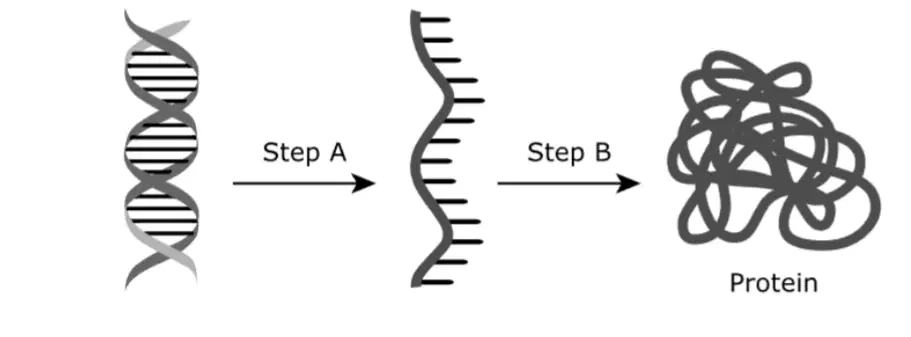
A diagram of the steps in the production of a protein is shown. [Diagram: DNA → Step A → mRNA → Step B → Protein] Which description identifies the purpose of Step A in this process?
To correct mutations in the DNA sequence
To produce an exact copy of the DNA molecule
To copy the DNA of a gene sequence onto a strand of mRNA
To assist in the folding of a protein
Exposure to the building material asbestos has been linked to certain types of cancers. Asbestos causes mutations in the p53 gene, which controls tumor suppression. Which statement best explains why people with cancer due to asbestos exposure did not pass the mutation on to their offspring?
The mutation occurred in gametic cells.
The mutation occurred in somatic cells.
The mutation is recessive.
The mutation is sex-linked.

Two mutations of a genetic sequence are shown. A DNA codon chart is also shown. Which mutation would have the MOST significant impact on the gene product?
Mutation 1
Mutation 2
Both have equal impact
Neither has significant impact

The impact would be so significant because:
it would cause major changes or consequences.
it would have no effect at all.
it would be easily ignored by most people.
it would only affect a small group.
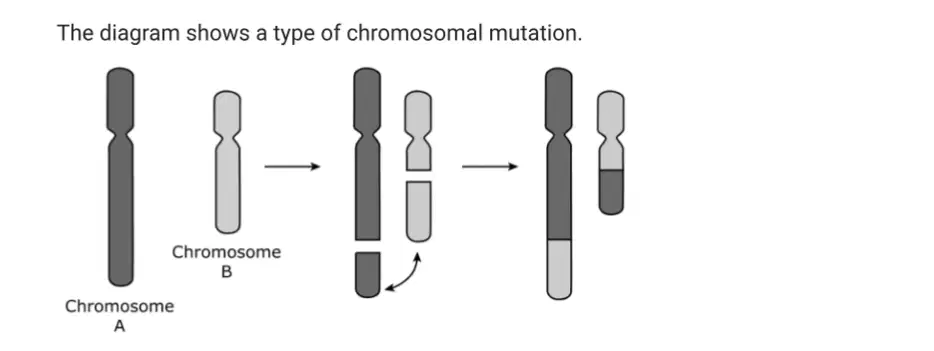
The diagram shows a type of chromosomal mutation. What type of mutation is shown?
Insertion
Deletion
Duplication
Translocation
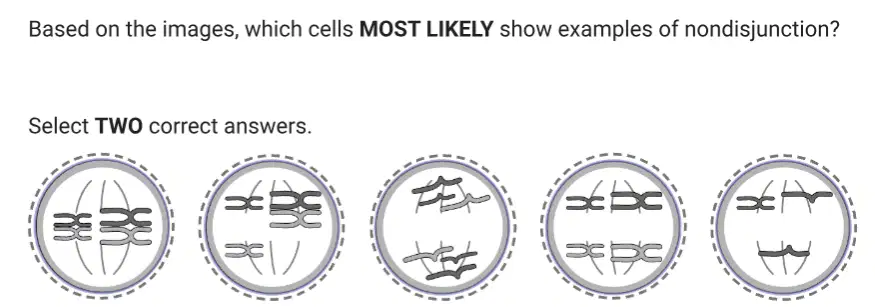
Some inherited health disorders are caused by nondisjunction. During nondisjunction, homologous chromosomes fail to separate properly during the formation of sex cells. Based on the images, which cells MOST LIKELY show examples of nondisjunction?
Image 1
Image 2
Image 3
Image 4
Image 5
Part 1: Students are modeling mRNA during the process of protein synthesis. Which answer choice correctly describes the model of the mRNA strand being transcribed?
The mRNA strand is not complementary to the DNA template strand.
The mRNA strand is complementary to the DNA template strand.
The mRNA strand is an exact copy of the DNA template strand.
The mRNA strand is missing a nitrogenous base.
When the mRNA strand is being transcribed, what happens to the nitrogenous bases?
Uracil instead of adenine is paired with thymine
Uracil instead of guanine is paired with cytosine
Uracil instead of cytosine is paired with guanine
Uracil instead of thymine is paired with adenine
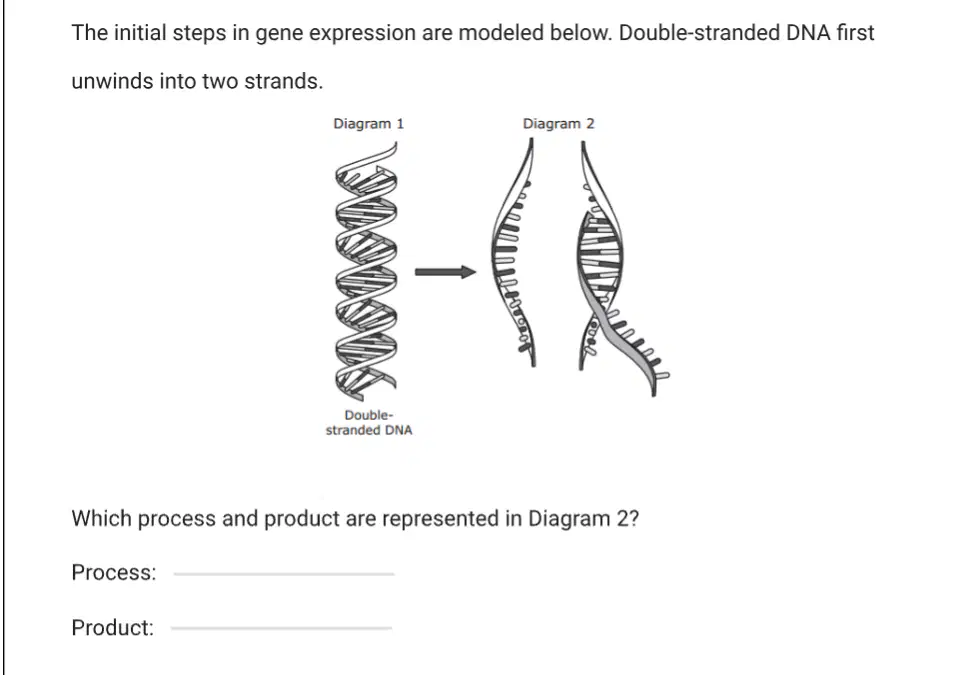
Which process and product are represented in Diagram 2?
Process: transcription Product: mRNA
Process: translation Product: protein
Process: replication Product: DNA
Process: splicing Product: introns
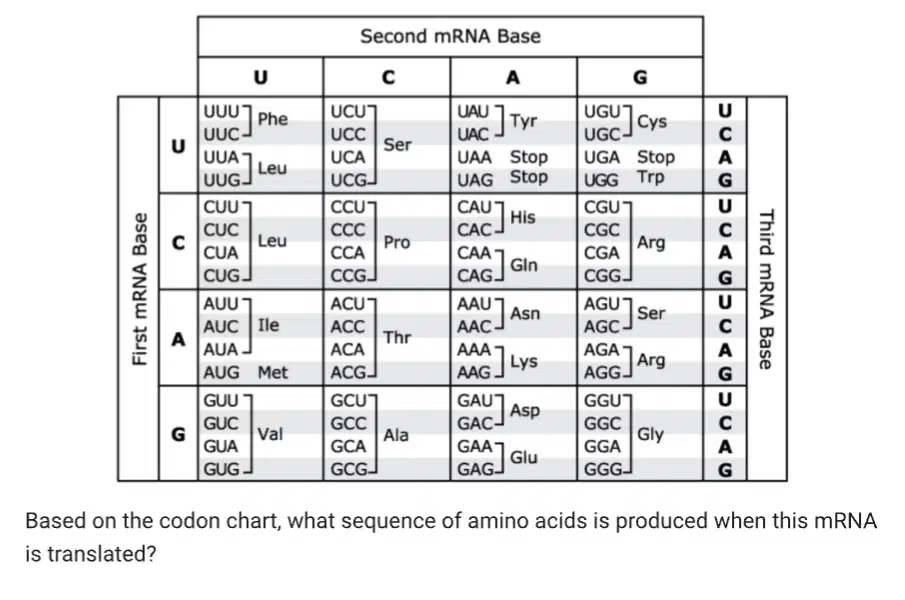
A portion of an mRNA sequence and a codon chart are shown. 5' UCU UGU CGA 3' Based on the codon chart, what sequence of amino acids is produced when this mRNA is translated?
Thr - Asn - Glu
Cys - Phe - Leu
Ser - Cys - Arg
Ser - Trp - Asp
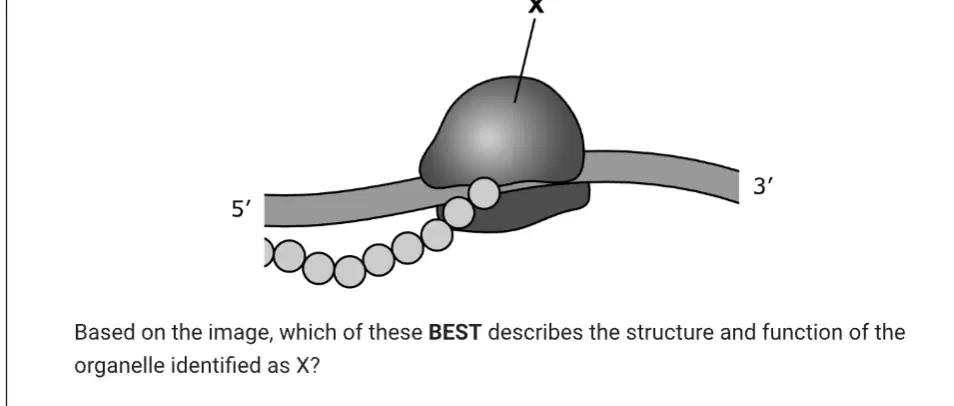
Based on the image, which of these BEST describes the structure and function of the organelle identified as X?
Endoplasmic reticulum, which carries nucleotides as a DNA strand is being transcribed
Endoplasmic reticulum, which carries nucleotides as a DNA strand is being translated
Ribosome, which holds the mRNA in place as amino acids are transported by tRNA
Ribosome, which holds the tRNA in place as amino acids are transported by mRNA
Which statements explain how a mutation in a somatic cell is different from a mutation that occurs in gametes?
A. Somatic cell mutations occur in cells that give rise to gametes. Gamete mutations occur in cells that result in apoptosis.
B. Somatic cell mutations are maintained in the gene pool. Gamete mutations are expelled from the gene pool.
C. Somatic cell mutations are generally not passed to offspring. Gamete mutations are usually passed to offspring.
D. Somatic cell mutations will not be expressed by the individual that contains the mutation. Gamete mutations will be expressed by the individual.
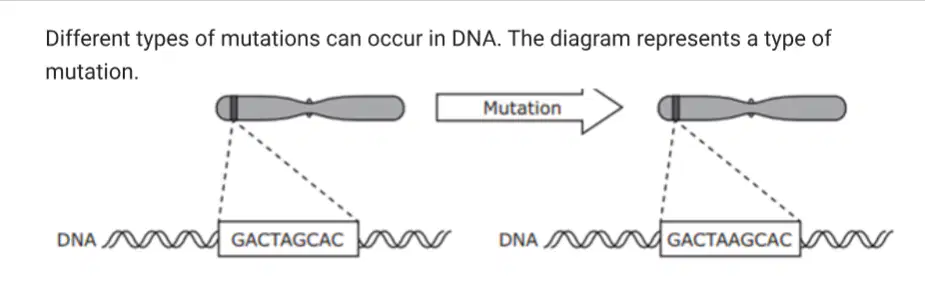
Different types of mutations can occur in DNA. The diagram represents a type of mutation. Which statement describes the mutation in the diagram?
A silent mutation results in the insertion of a different amino acid.
A substitution occurs with the adenine base.
A deletion of a cytosine base occurs.
A base is inserted into one strand of the DNA.
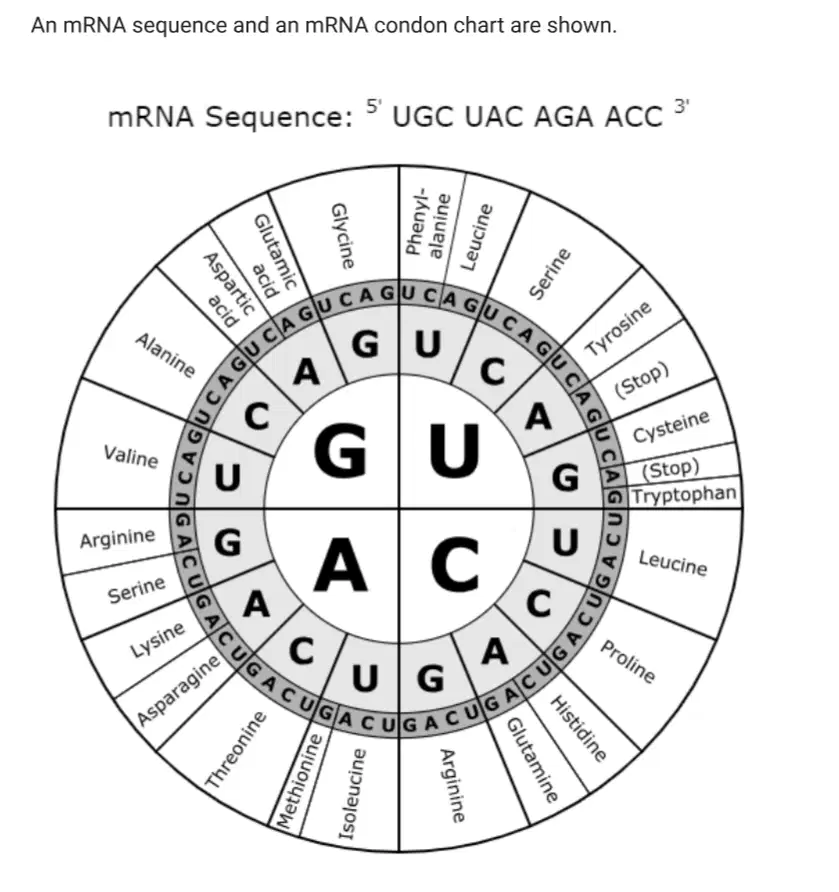
An mRNA sequence and an mRNA codon chart are shown. mRNA Sequence: 5' UGC UAC AGA ACC 3' What is the amino acid sequence that will be translated from the mRNA sequence?
Threonine - Isoleucine - Serine - Tryptophan
Cysteine - Tyrosine - Arginine - Threonine
Serine - Methionine - Tyrosine - Tryptophan
Proline - Arginine - Histidine - Arginine
A scientist examined two populations of the grasshopper species Atractomorpha lata. The scientist found that the population raised in higher temperatures had a higher frequency of brown coloration, while the population raised in lower temperatures had a higher frequency of green coloration. Based on this information, which biological process is affected by temperature in A. lata?
Gene expression
Cell division
ATP production
Metabolism
Which statements best compare the function of an ATP molecule to a DNA molecule?
ATP carries and transmits the genetic information of organisms. DNA serves as a biological catalyst that speeds up the rate of chemical reactions.
ATP provides energy for chemical reactions in the cell. DNA carries and transmits the genetic information of organisms.
ATP serves as a biological catalyst that speeds up the rate of chemical reactions. DNA acts as a structural sugar in the cell walls of plants.
ATP acts as a structural sugar in the cell walls of plants. DNA provides energy for chemical reactions in the cell.
A DNA mutation results in a protein that is the same as the initial protein synthesized before the mutation. Which statement BEST explains this outcome?
One amino acid substitution does not affect protein synthesis.
Different codons can be translated into the same amino acid, so some mutations do not affect protein synthesis.
Only mutations that occur at the chromosomal level change protein function.
Amino acids have similar functions, so their corresponding proteins are unaffected by mutations.
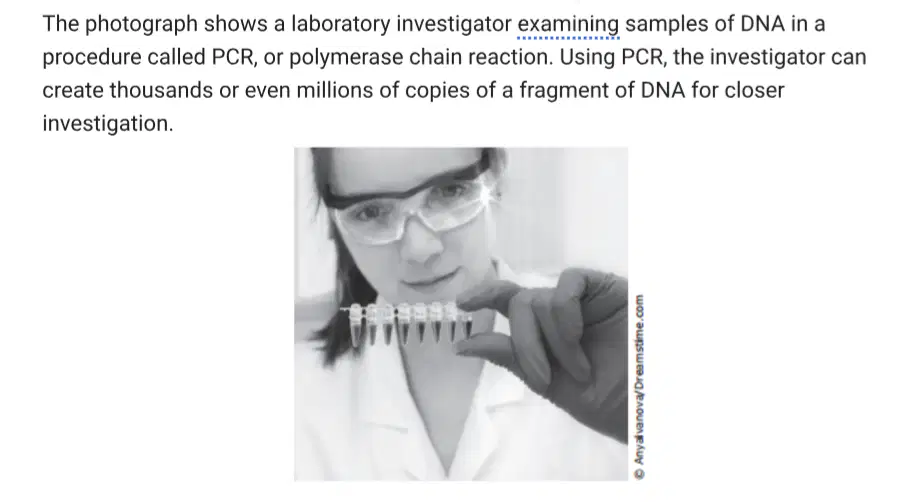
In which of these situations would PCR be most useful?
When only a small amount of DNA is available, such as at a crime scene
When the DNA of identical twins is being mapped
When the genome of a population is being analyzed for preventable diseases
When the blood type of a DNA donor is known
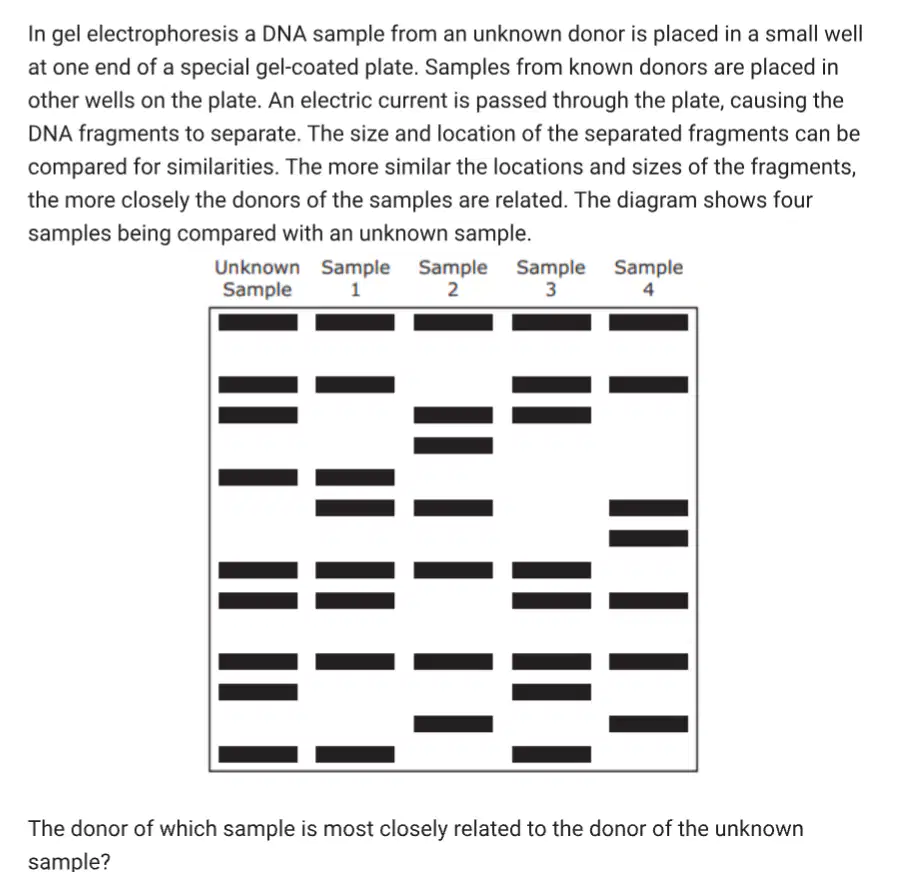
In gel electrophoresis a DNA sample from an unknown donor is placed in a small well at one end of a special gel-coated plate. Samples from known donors are placed in other wells on the plate. An electric current is passed through the plate, causing the DNA fragments to separate. The size and location of the separated fragments can be compared for similarities. The more similar the locations and sizes of the fragments, the more closely the donors of the samples are related. The diagram shows four samples being compared with an unknown sample. The donor of which sample is most closely related to the donor of the unknown sample?
Sample 1
Sample 2
Sample 3
Sample 4
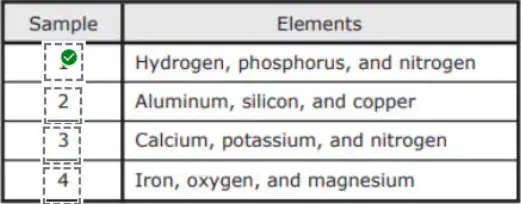
Which elements are present in Sample 1?
Hydrogen, phosphorus, and nitrogen
Hydrogen, oxygen, and sulfur
Carbon, nitrogen, and oxygen
Phosphorus, sulfur, and carbon
The mutation that will have the most significant impact is a frameshift mutation because it changes the reading frame of the genetic code, affecting all downstream amino acids.
A frameshift mutation because it changes the reading frame of the genetic code, affecting all downstream amino acids.
A silent mutation because it does not change the amino acid sequence.
A missense mutation because it only changes one amino acid.
A nonsense mutation because it causes a premature stop codon but does not shift the reading frame.

Select TWO correct answers from the diagrams below.
First diagram
Second diagram
Third diagram
Fourth diagram
Fifth diagram

