
NEW
Font size
 Worksheets
TC1L Quiz 1
Total questions: 20
Worksheet time: 10mins
If U = {x | 1 ≤ x ≤ 10, x ∈ Z}, P = {x | x is even}, and Q = {x | x < 6}, then P' ∩ Q is:
{1, 3, 5}
{1, 3, 5, 7, 9}
{5, 6}
{2, 4, 6}
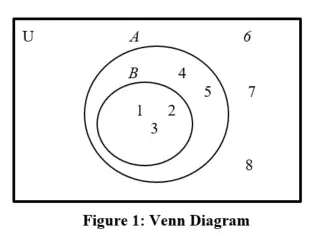
Figure 1 shows the Venn diagram of set A and B. Which of the following is FALSE?
U = {1, 2, 3, 4, 5, 6, 7, 8}
B ⊂ A
A ∩ B ={1, 2, 3}
A ⊂ B
Given a set, A = {m}. Find P(P(A)).
{∅ , {m}}
{∅, {m}, {m, m}, {∅, ∅}}
{∅, {∅}, {{m}}, {∅,{m}}}
{∅, {∅}, {{∅, m}}, {{m,∅}}}
Let A = {a, b, c}. How many subsets does P(P(A)) have?
8
16
64
256
Given R = {(d, f), (d, d), (e, e), (d, e), (e, f)} is a relation on the set {d, e, f}, determine whether R is reflexive and/or transitive.
Reflexive and transitive
Not reflexive and not transitive
Reflexive and not transitive
Not reflexive and transitive
For the relation R={(a,b) | b divides a} on set {1,2,3,4,5,6}, determine the properties of R hold.
Reflexive only
Reflexive and transitive
Symmetric only
Symmetric and transitive
If R = { (x, y) | x < y } on A = {1,2,3}, determine the domain of R .
{1, 2}
{1, 2, 3}
{2, 3}
{1, 3}
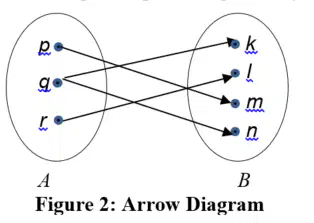
Figure 2 shows an arrow diagram representing a binary relation R from set A to set B.
Which of the following is FALSE about the relation R?
R is the subset of A x B.
R = {(p, m), (q, k), (q,n),( r, l)}
R is a bijective function.
R is not a function.
Which of the following is not a proposition?
The classroom is at the corner building.
There exists a prime number p such that p > 2 .
Let x be an integer greater than 5.
3 + 4 = 7
If p: “It is sunny,” and q: “We go for a walk,” then p ∧ q means:
It is sunny and we cannot go for a walk.
It is sunny or we go for a walk.
It is sunny but we go for a walk.
If it is sunny, then we go for a walk.
If p: “You study hard” and q: “You will pass the test,” then the contrapositive of is p → q :
If you do not study hard, then you will not pass the test.
If you will not pass the test, then you did not study hard.
If you will pass the test, then you studied hard.
You will pass the test if and only if you study hard.
A statement that is always true is called a:
Contradiction
Contingency
Tautology
Proposition
Which of the following is gives a TRUE value?
If 10 is an even number, then 10 > 20
4 - 4 = 0 if and only if 2 + 2 = 4
4+1=7 and 3-7=-5
-3 < -5 or 8 ÷ 2
Which of the following is the correct meaning of the statement: `∀x ∈ ℝ, x² ≥ 0`
There exists a real number whose square is positive.
All real numbers have positive squares.
Every real number has a square that is greater than or equal to zero.
Some real numbers have negative squares.
Which of the following is typically the first step in a proof by mathematical induction?
Show the statement is true for all even numbers.
Assume the statement is true for all values smaller than n.
Prove the statement for the base case (usually n = 1).
Show the statement is true for n + 2.
Which of the following statements correctly describes the difference between an explicit formula and a recursive formula for a sequence?
An explicit formula defines each term directly in terms of its position n, while a recursive formula defines each term using one or more previous terms.
An explicit formula always uses addition, while a recursive formula always uses multiplication.
An explicit formula works only for arithmetic sequences, while a recursive formula works only for geometric sequences.
An explicit formula and a recursive formula are always identical.
Which of the following is a recursive definition of the sequence 5, 10, 20, 40, …?
f(n) = 5n
f(n) = 2f(n-1), with f(1) = 5
f(n) = f(n-1) + 5
f(n) = 5^n
Given the recursive function f(1) = 2, f(n) = 3f(n-1), determine f(4).
18
54
162
486
Consider the recursive sequence: f(0) = 2, f(1) = 4, f(n+1)=f(n)-f(n-1) for n >= 1. Find f(2), f(3) and f(4).
2, 0, −2
6, 8, 10
0, -2, -4
2,2,2
Which is NOT a valid recursive definition?
f(1) = 3, f(n) = f(n-1) + 2
f(n) = 2n
f(1) = 1, f(2) = 1, f(n) = f(n-1) + f(n-2)
f(1) =4, f(n) = n + f(n-1)

