wayground logo

Free Printable Worksheets

Font size

S
M
L
XL
Worksheets

Examen de la Unidad 3

Total questions: 74

Worksheet time: 47mins

Name
Class
Date
1.
What do you call the non-conjugated form of a verb?
a)
conjugation
b)
infinitive
c)
subject pronoun
d)
preterite
2.
YO and TÚ are both...
a)
verbs
b)
adjectives
c)
nouns
d)
pronouns
3.
VERDADERO O FALSO: When you conjugate a verb, that means you're matching it with the gender of the noun.
a)
Verdadero
b)
Falso
4.
a)
montar en bicicleta
b)
cantar
c)
bailar
d)
escribir
5.
a)
estudiar
b)
ver la tele
c)
escuchar música
d)
hablar por teléfono
6.
a)
leer
b)
correr
c)
caminar
d)
beber
7.
a)
comer
b)
leer al béisbol
c)
jugar al béisbol
d)
cocinar
8.
a)
ver la tele
b)
cantar
c)
dibujar
d)
pintar
9.
a)
cocinar
b)
dibujar
c)
comer
d)
correr
10.
a)
comer
b)
beber
c)
bailar
d)
caminar
11.
a)
pintar
b)
dibujar
c)
viajar
d)
estudiar
12.
a)
tocar el piano
b)
jugar al básquetbol
c)
montar a caballo
d)
jugar al fútbol
13.
a)
jugar videojuegos
b)
trabajar
c)
cocinar
d)
jugar al béisbol
14.
a)
beber la tele
b)
bailar la tele
c)
comer la tele
d)
ver la tele
15.
a)
me gusta
b)
le gusta
c)
te gusta
d)
les gusta
16.
a)
les gusta
b)
le gusta
c)
me gusta
d)
os gusta
17.
a)
os gusta
b)
les gusta
c)
nos gusta
d)
te gusta
18.
a)
me gusta
b)
me gusto
c)
gusta
d)
te gusta
19.
a)
le gusta
b)
te gusta
c)
me gusta
d)
os gusta
20.
a)
le gusta
b)
os gusta
c)
te gusta
d)
les gusta
21.
a)
Me gusta acampar.
b)
Te gusta acampar.
c)
Le gusta acampar.
d)
Me gusta acampo.
22.
a)
A ella le gusta esquiar.
b)
A el le gusta esquiar.
c)
A él le gusta esquiar.
d)
A él les gusta esquiar.
23.
a)
Me gusta nadar.
b)
Te gusta nadar.
c)
Les gusta nadar.
d)
Nos gusta nadar.
24.
a)
No gustamos jugar al fútbol.
b)
No nos gusta jugar al fútbol.
c)
Nos gusta jugar al fútbol.
d)
Gustamos jugar al fútbol.
25.
a)
A ellos nos gusta dibujar.
b)
A ellos os gusta dibujar.
c)
A ellos le gusta dibujar.
d)
A ellos les gusta dibujar.
26.
What is a verb?
a)
A word that expresses action or a state of being
b)
A word that stands in for a noun
c)
A person, place, or thing
d)
A word that describes a person, place, or thing
27.
What are the 3 infinitive verb endings in Spanish?
a)
-o, a, x
b)
-ar, -er, -ir
c)
a, b, c
d)
os, as, es
28.
Which of these is a verb in the INFINITIVE form?
a)
vamos
b)
hablan
c)
cocinar
d)
es
29.
What part of the sentence do verbs conjugate to match?
a)
The direct object
b)
The prepositions
c)
The gender of the noun
d)
The person/place/thing that does the action
30.
The subject of a sentence is...
a)
the topic the sentence is about
b)
the person/thing that does the action
c)
the person who is saying the sentence
d)
the location the action takes place
31.
¿Hablas español?
a)
Do they speak Spanish?
b)
Do you speak Spanish?
c)
Does he speak Spanish?
d)
Do you speak English?
32.
Hablamos inglés.
a)
We speak English.
b)
They speak English.
c)
Y'all speak English.
d)
I speak Spanish.
33.
¿Ustedes hablan francés?
a)
Do they speak French?
b)
Does she speak French?
c)
Do y'all speak French?
d)
Should we speak French?
34.
Hablo un poco de italiano.
a)
He speaks a little Italian.
b)
I speak a little Italian.
c)
You speak Italian a lot.
d)
They speak Italian very well.
35.

SUBJECT: Yo / VERB: hablar

(a)  

36.

Nosotros / cocinar

(a)  

37.

Verónica / escuchar

(a)  

38.

Tú / ignorar

(a)  

39.

Mi familia y yo / vivir

(a)  

40.

Tomás y Juan / vivir

(a)  

41.

Daniel y yo / cantar

(a)  

42.

Tú / comer

(a)  

43.
The verbs "SER" and "ESTAR" both mean...
a)
to be
b)
to have
c)
to enjoy
d)
to go
44.
Yo _____ en la clase de español.
a)
soy
b)
estoy
45.
Mi amiga ____ inteligente.
a)
es
b)
está
46.
Nosotros _____ estudiantes.
a)
somos
b)
estamos
47.
José _____ estudiando (studying).
a)
es
b)
está
48.
Madrid ____ en España.
a)
es
b)
está
49.
Ellas ____ hermanas.
a)
son
b)
están
50.
Mi prima __ dentista.
a)
es
b)
está
51.
Ella ____ enferma.
a)
es
b)
está
52.
Hoy ___ miércoles.
a)
es
b)
está
53.
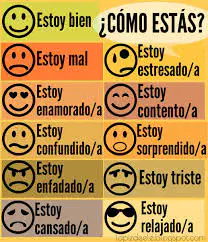
¿Cómo estás hoy? Respond in a full sentence in Spanish.
4 lines
54.
¿De dónde eres 🗺️? Respond in a sentence in Spanish.
4 lines
55.
¿Cómo eres? Describe yourself in Spanish with at least 2 adjectives. You can write 2 separate sentences or put all your adjectives in one sentence.
4 lines
56.

Ser & estar both mean "to be." We use ​ (a)   when talking about characteristics, origin, time, and profession. We use ​ (b)   when talking about condition, mood, and location.

Choose from the below words
ser
estar
tener
ir
57.
For characteristics/descriptions use . . . 
a)
ser
b)
estar
58.

How you feel and where you are- that's when you use...

a)

Ser

b)

Estar

59.

When do we use SER?

a)

conditions

b)

how you feel

c)

where you are

d)

describing someone or something

60.

What is conjugating a verb?

a)

Changing the verb to agree with the subject of the sentence

b)

Changing the verb to match the gender of the noun

c)

Deleting the verb from the sentence and changing it into a noun

d)

Translating the verb to English

61.

Which is an example of a verb in the infinitive form?

a)

To drink

b)

He sleeps

c)

They run

d)

I eat

62.

All infinitive verbs in Spanish end in: -ar / -er / -ir /

a)

True

b)

False

63.

Could "Podur" be an infinitive verb in Spanish?

a)

b)

No

64.

To conjugate, you drop the ending (ar/er/ir) and then add the correct ending. Which are the endings for -ir verbs?

a)

o / as / a / amos / an

b)

o / es / e / emos / en

c)

o / es / e / imos / en

d)

o / is / i / imos / en

65.

Como, Bebo, Uso, Necesito and Tengo are all examples of:

a)

Verbs in the yo / I form

b)

Infinitive verbs

c)

-ar verbs

d)

irregular verbs

66.

Match the subjects with the corresponding form of NECESITAR (to need)

a)

yo

1.

necesito

b)

2.

necesitas

c)

él/ella/usted

3.

necesita

d)

nosotros

4.

necesitamos

e)

ellos/ellas/ustedes

5.

necesitan

67.

Sort the words based on whether they're CONJUGATED or INFINITIVE verbs.

Categorize the following

hablar

necesitar

vivir

beber

hablamos

necesitas

viven

bebe

Infinitive verbs
Conjugated verbs
68.
Identify the correct conjugation endings for -ar verbs.
a)
-o, -es, -e, -emos, -en
b)
-o, -is, -i, -imos, -en
c)
-o, -es, -e, -imos, -en
d)
-o, -as, -a, -amos, -an
69.

Yo ______ en un apartamento.


*I live in an apartment.*

a)

vive

b)

viven

c)

vivo

d)

vives

70.

Mario ______ a la música de Jay-Z.


*Mario listens to Jay-Z's music.*

a)

escucho

b)

escucha

c)

escuchan

d)

escuchas

71.

Sort the following verbs based on their conjugation.

Categorize the following

hablo

necesito

quiero

voy

hablas

necesitas

quieres

vas

habla

necesita

quiere

va

hablamos

necesitamos

queremos

vamos

YO
ÉL/ELLA/USTED
NOSOTROS
72.

Match the -ar verb endings with the correct subjects.

73.

Complete the chart with verb forms.

74.

Match the following

a)

I learn

1.

aprendo

b)

you learn

2.

aprendes

c)

he/she learns

3.

aprende

d)

aprendemos

4.

we learn

e)

aprenden

5.

they/you all learn