
NEW
Font size
 Worksheets
Imperialism SG Study Guide
Total questions: 20
Worksheet time: 10mins
European feeling of racial superiority that contributed to imperialism:
Social Darwinism
Eugenics
Classism
Survival of the fittest
What helped Europe conquer Africa and Asia in the 1800's?
The Enlightenment
The Industrial Revolution
Manifest Destiny
The Scientific Revolution
Conference in which European Powers carved (divided) up Africa?
Seneca Falls
London
Berlin
Paris
Which of the following are the main reasons for European Imperialism during the 1800's?
Mercantilism
Slave Trade
The need for natural resources and markets
Convert people to Christianity
Wars that forced China to open up to European trade:
Opium
Boer
Cocain
Cultural
Type of colonies that allowed conquered people to keep their government:
Indirect
Protectorate
Sphere of influence
Direct
Type of colonies that allowed conquering countries to have complete control over the people they conquered:
Indirect
Protectorate
Sphere of Influence
Direct
Chinese Rebellion that resulted from the signing of the Treaty of Nanking/Nanjing:
Taiping
Shay's
Sepoy
Boxer
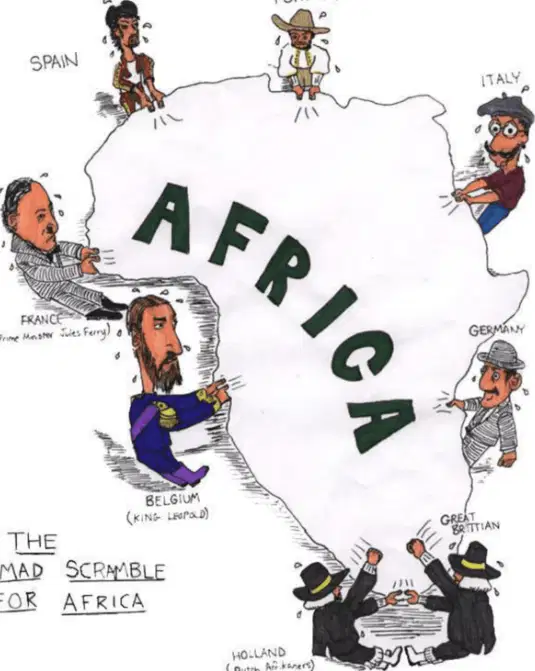
Source analysis: The cartoon titled 'The Mad Scramble for Africa' conveys which message about the involvement of European countries in Africa?
European countries were competing aggressively to claim African territories.
European countries were peacefully negotiating with African leaders.
European countries were uninterested in African resources.
European countries were helping Africa develop independently.
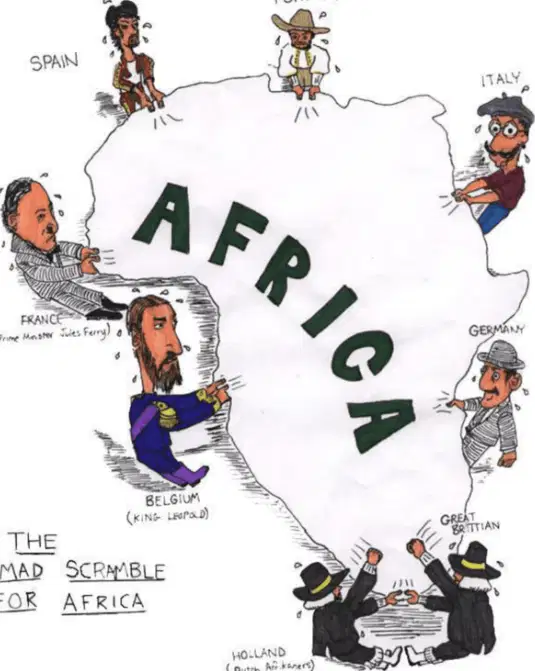
Political impact: The cartoon 'The Mad Scramble for Africa' illustrates the political impact of European involvement in Africa as:
The division and colonization of African territories by European powers.
The unification of African nations under a single government.
The withdrawal of European powers from African affairs.
The establishment of democratic governments by Africans.
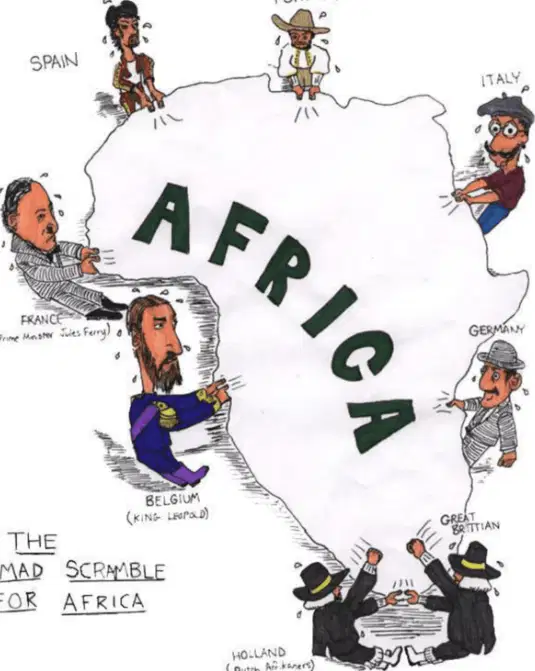
Refer to the cartoon titled 'The Mad Scramble for Africa,' which shows European countries (Spain, Portugal, Italy, Germany, Great Britain, France, Belgium, Holland) surrounding and reaching for Africa. What did Europeans do during the Scramble for Africa?
Europeans sought to civilize Africa
Europeans competed for African land
Europeans wanted to be tourists in Africa
Europeans planned how to help Africa
Which concept, adopted by Europeans, was used to justify the domination of other nations by applying the idea of "survival of the fittest" to human societies and races?
The Enlightenment
Mercantilism
Social Darwinism
Manifest Destiny
What was a primary economic motive for European nations to establish colonies in Africa and Asia during the 1800s?
To secure exclusive trading rights in the Mediterranean.
To find new sources of precious metals like gold and silver.
The growing need for raw materials to fuel industrial production and new markets to sell finished goods.
To transport enslaved people to the Americas.
Besides economic and political motives, what religious and cultural idea was used by Europeans to justify colonizing other regions?
The promotion of democracy
The rejection of Classism
The desire for cultural exchange
The belief that they had a duty to "civilize" and convert non-Western people to Christianity
Which major development in Europe significantly enhanced its ability to conquer and control vast territories in Africa and Asia in the 19th century through superior technology?
The Scientific Revolution
The Boxer Rebellion
The Industrial Revolution
The Renaissance
The political cartoon depicting European powers dividing Africa, labeled "The Scramble for Africa," is most directly associated with which major 19th-century event?
The London Conference
The Paris Treaty
The Seneca Falls Convention
The Berlin Conference
What term describes a form of imperial rule where the conquering nation left the local rulers in place but expected them to follow the advice and decisions of the European governor-general?
Direct Rule
Sphere of Influence
Indirect Rule
Protectorate
When a conquering nation replaces local leaders with its own officials, installing its own bureaucracy and government to maintain total control, what type of colonial administration is this?
Sphere of Influence
Protectorate
Indirect Rule
Direct Rule
Which major Chinese uprising occurred decades after the Treaty of Nanking/Nanjing, fueled by widespread resentment against foreign influence and the weakness of the Qing dynasty?
The Shay's Rebellion
The Sepoy Mutiny
The Taiping Rebellion
The Opium Wars
What major conflict forced the Qing dynasty in China to open up several coastal ports to British trade and cede Hong Kong, dramatically increasing European influence?
The Boer Wars
The Cocaine Wars
The Opium Wars
The Cultural Wars

