
 Worksheets
HSAPSEMESTEREXAM2025
Total questions: 85
Worksheet time: 44mins
Anatomy is best defined as the study of:
Disease
Body structures
Body functions
Chemical reactions
Physiology focuses primarily on:
Structure
Organization
Function
Location
Maintaining a stable internal environment is known as:
Metabolism
Adaptation
Homeostasis
Catabolism
Which feedback loop regulates body temperature?
Positive
Neutral
Negative
Hormonal
Which body cavity contains the heart?
Pleural
Abdominal
Pericardial
Cranial
The plane that divides the body into right and left halves is:
Frontal
Transverse
Sagittal
Oblique
Which imaging technique uses magnets?
CT
X-ray
MRI
PET
Ultrasound is MOST useful for:
Bone fractures
Soft tissue imaging
Brain tumors
Lung disease
The term “proximal” means:
Farther from the body
Toward the midline
Closer to point of attachment
Toward the feet
Which is an example of positive feedback?
Body temperature control
Blood pressure regulation
Childbirth contractions
Blood glucose regulation
Anatomical position includes:
Palms facing backward
Arms at sides, palms forward
Seated posture
Knees bent
Which system regulates hormones?
Nervous
Endocrine
Lymphatic
Immune
An autopsy is performed to:
Treat disease
Determine cause of death
Diagnose infection in living patients
Perform surgery
Which is NOT a function of the integumentary system?
Protection
Vitamin D synthesis
Blood cell production
Sensation
Integumentary System: The outermost skin layer is the:
Dermis
Hypodermis
Epidermis
Papillary layer
Integumentary System: Melanocytes are found in the:
Stratum corneum
Stratum basale
Dermis
Hypodermis
Integumentary System: Goosebumps occur due to contraction of the:
Sebaceous gland
Arrector pili muscle
Sweat gland
Hair follicle
Integumentary System: Oil secreted onto the skin is called:
Keratin
Melanin
Sebum
Sweat
Integumentary System: Loss of melanocytes causes:
Psoriasis
Vitiligo
Acne
Eczema
Integumentary System: The Rule of 9s is used to:
Stage cancer
Estimate burn size
Classify scars
Identify melanoma
Integumentary System: The most dangerous skin cancer is:
Basal cell carcinoma
Squamous cell carcinoma
Melanoma
Sarcoma
Integumentary System: Excessive sweating is known as:
Anhidrosis
Hyperhidrosis
Bromhidrosis
Urticaria
Integumentary System: Acne develops when which gland becomes blocked?
Eccrine
Sebaceous
Apocrine
Sweat
Integumentary System: A scrape is classified as a(n):
Laceration
Avulsion
Abrasion
Puncture
Integumentary System: Keloid scars are:
Flat and pale
Sunken
Raised beyond wound borders
Infected
Integumentary System: Which pigment provides UV protection?
Keratin
Hemoglobin
Melanin
Sebum
Red bone marrow produces:
Fat cells
Blood cells
Cartilage
Calcium
The axial skeleton includes the:
Arms and legs
Pelvis only
Skull and spine
Hands and feet
Which bone type protects organs?
Short
Flat
Long
Sesamoid
The patella is a:
Flat bone
Long bone
Sesamoid bone
Irregular bone
True ribs attach directly to the:
Spine only
Sternum
Cartilage only
Other ribs
Which joint allows the most movement?
Hinge
Pivot
Ball-and-socket
Gliding
Flexion and extension are examples of:
Bone growth
Joint movement
Fracture repair
Ossification
A fracture that pierces the skin is:
Simple
Greenstick
Compound
Comminuted
The FIRST step in bone healing is:
Callus formation
Remodeling
Hematoma formation
Ossification
Osteoporosis causes bones to become:
Flexible
Dense
Brittle
Inflamed
Scoliosis involves abnormal:
Bone thinning
Lateral spinal curvature
Joint fusion
Cartilage loss
Rheumatoid arthritis is:
Degenerative
Autoimmune
Traumatic
Infectious
Bursitis is inflammation of the:
Tendon
Bursa
Ligament
Cartilage
Aging bones fracture more easily because of:
Increased calcium
Loss of density
Muscle growth
Cartilage replacement
Appendicular skeleton assists mainly with:
Protection
Movement
Hormone production
Filtration
Skeletal muscle is:
Involuntary
Voluntary
Cardiac
Smooth
Muscle that bends a joint is a:
Extensor
Flexor
Sphincter
Tensor
Tendons connect:
Bone to bone
Muscle to bone
Muscle to muscle
Bone to cartilage
The strongest tendon is the:
Biceps
Quadriceps
Achilles
Triceps
Involuntary muscle that moves food:
Skeletal
Cardiac
Smooth
Fascia
Muscle tone refers to:
Muscle fatigue
Spasm
Steady, partial muscle contraction
Complete relaxation
Which muscle tissue contracts as a unit?
Skeletal
Cardiac
Smooth
Fascia
Muscle wasting is called:
Hypertrophy
Atrophy
Dystrophy
Fibrosis
Peristalsis occurs in the:
Heart
Arm muscles
Digestive tract
Lungs
Muscle cramps result from:
Complete relaxation
Lack of contraction
Contraction without relaxation
Nerve paralysis
Glycogen is stored in muscle as:
Protein
Fat
Glucose
Mineral
True or False: The epidermis contains blood vessels.
True
False
True or False: The dermis gives skin strength and elasticity.
True
False
True or False: Apocrine glands activate at puberty.
True
False
True or False: Melanoma is the least dangerous skin cancer.
True
False
True or False: Red marrow produces blood cells.
True
False
True or False: The appendicular skeleton includes the spine.
True
False
True or False: Greenstick fractures occur mostly in children.
True
False
True or False: Osteoarthritis is autoimmune.
True
False
True or False: Ligaments connect bone to bone.
True
False
True or False: Tendons connect muscle to bone.
True
False
True or False: Cardiac muscle is voluntary.
True
False
True or False: Smooth muscle is found in organs.
True
False
True or False: Muscle tone helps maintain posture.
True
False
True or False: Hyperhidrosis means lack of sweating.
True
False
True or False: Callus formation occurs after hematoma formation.
True
False
True or False: Ball-and-socket joints allow the most movement.
True
False
True or False: Atrophy involves muscle growth.
True
False
True or False: Fascia surrounds muscle groups.
True
False
True or False: True ribs attach directly to the sternum.
True
False
True or False: The hypodermis stores fat.
True
False
True or False: Sun exposure can increase skin cancer risk.
True
False
What is the function of the integumentary system?
protection
creates movement
production of hormones
send and receives electrical messages

Ribs that are not connected to the sternum are called
true ribs
false ribs
floating ribs
suprasternal ribs
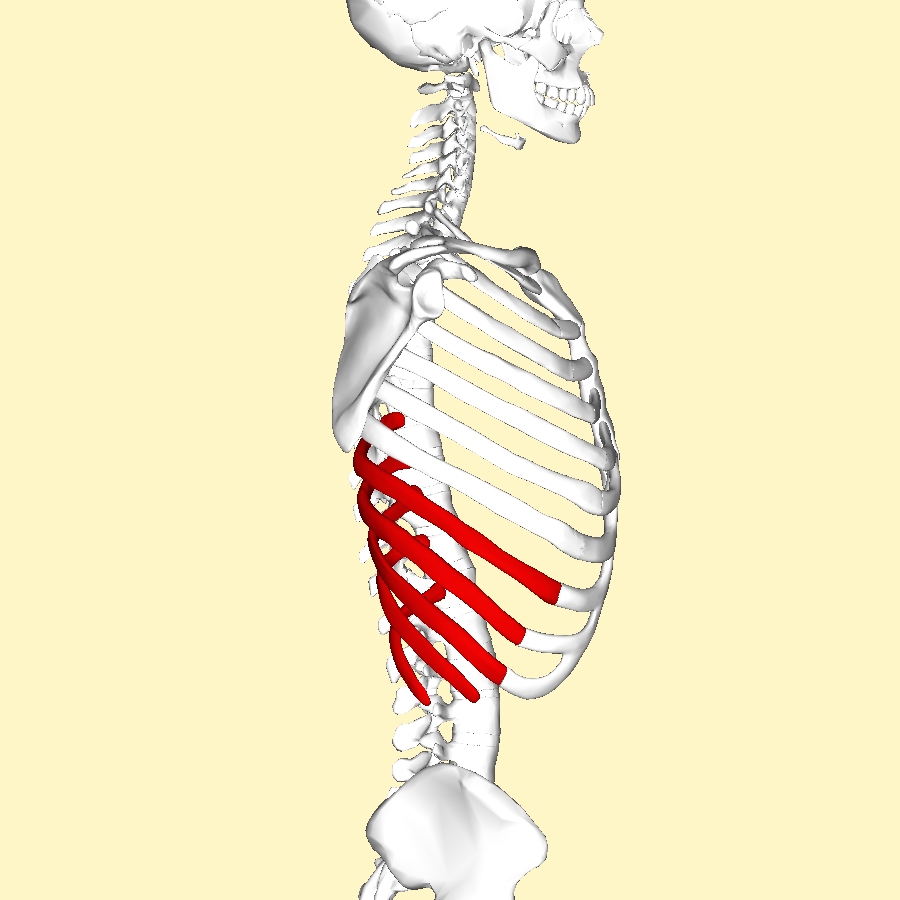
Ribs 8-10 that are connected, via cartilage, to rib pair 7, and are thus indirectly connected to the sternum, are known as
true ribs
false ribs
floating ribs
suprasternal ribs
The heart is an example of a(n)
cell
organ
organelle
organ segment
What does inferior mean?
Below
Above
In front of
Furthest away
Which of these prefixes indicates against?
ad-
ab-
ana-
anti-

This system includes the brain and the spinal cord.
Nervous
Integumentary
Circulatory
Skeletal

