
 Worksheets
US - Unit 4, Pt. 2 Test
Total questions: 23
Worksheet time: 12mins
Name
Class
Date
1.

According to the map, the greatest impediment to people traveling from Illinois to California in the early 1800s was...
a)
the danger of Indian attacks.
b)
a likelihood of bad weather.
c)
the Rocky Mountains and Sierra Nevada Range.
d)
an inability to cross the Mississippi and Missouri rivers.
2.
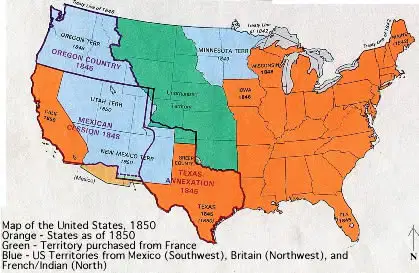
According to this map, the Oregon territory...
a)
was acquired from Britain.
b)
remained in foreign control.
c)
was purchased because of the Mexican War.
d)
was part of the Texas Annexation of 1846.
3.
Manifest Destiny advanced the belief that...
a)
new territory would lead to more slavery.
b)
American expansion was God's will.
c)
slavery should be abolished in the United States.
d)
the Democratic Party would elect the next President.
4.
How did the Missouri Compromise deal with the issue of slavery?
a)
It required all territories to abolish slavery before becoming states.
b)
It made the Mississippi River the divding line between slave states and free states.
c)
It prohibited slavery in the northern part of the former Louisiana Territory, except for Missouri.
d)
It stated that all future states would be required to be slave states except for Missouri.
5.
Which of these was the largest and most constant issue facing the United States during the era of "Manifest Destiny?"
a)
whether labor unions would be allowed to form
b)
whether states would allow women the right to vote
c)
whether Indians would be relocated to North Carolina
d)
whether slavery would spread across the United States
6.
Which is an example of the concept of Manifest Destiny in action?
a)
the Compromise of 1850
b)
the Missouri Compromise
c)
the Transatlantic Slave Trade
d)
the annexation of Mexican territory
7.
Which of these was a major factor in the outcome of the Mexican American War in the mid-1800s?
a)
The Mexican army was using superior weaponry.
b)
The United States troops were greatly outnumbered.
c)
The United States was fighting a defensive war in their homeland.
d)
The Mexican army was plagued by political instability in their government.
8.
Which statement is TRUE regarding the consequences of the Treaty of Guadalupe Hidalgo?
a)
It ended the Mexican War of Independence (from Spain) in 1821.
b)
It created a transcontinental railroad from Chicago, IL to Sacramento, CA.
c)
It established U.S. control over areas now known as New Mexico, Nevada, Utah, and California.
d)
It solidified Mexican authority over Texas and the surrounding area.
9.
What does “popular sovereignty” mean?
a)
Each individual can choose what they want to do for themselves, without it affecting others.
b)
Divide the country into “North” and “South” sections to lessen tensions.
c)
Let the majority make the decision regarding the issue of slavery.
d)
Congress will determine whether or not a state would have slavery.
10.
The strife in "Bleeding Kansas" was associated with a conflict between _____ and _____.
a)
immigrants and nativists
b)
Catholics and Protestants
c)
settlers and native-Americans
d)
anti-slavery free-soilers and pro-slavery supporters
11.
Which TWO choices were significant aspects of the Compromise of 1850?
a)
Slavery was abolished in Washington, D.C.
b)
New Mexico and Utah territories would decide the issue of slavery based on popular sovereignty.
c)
Every state in the United States would decide for itself if it would allow slavery.
d)
Rule that slaves who had been to free states/territories were free people.
e)
California would be admitted to the Union as a free state.
12.
Which BEST describes a result of the U.S. Supreme Court’s decision in the Dred Scott case?
a)
A slave was a U.S. citizen, had the right to sue for freedom in a federal court.
b)
A slave was only a citizen after he or she purchased freedom from their master.
c)
A slave was not a citizen, but rather the property of the owner, and therefore had no right to sue in court.
d)
A slave who lived on free soil for any length of time was free, even if he or she returned to a slave state.
13.
What was John Brown’s goal during his raid at Harpers Ferry, Virginia?
a)
To overthrow the Confederate government and take the capital of the Confederacy.
b)
To start a slave uprising by capturing the federal arsenal there and arming the slaves.
c)
To kickstart the Civil War by instigating the first battle between North and South.
d)
To help the city secede from the Union and resist the U.S. military's attempt to stop the secession.
14.
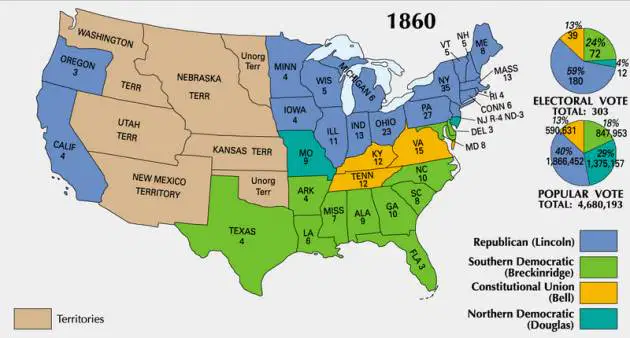
According to this map, which candidate for President received the most support in Southern states?
a)
Bell
b)
Breckenridge
c)
Douglas
d)
Lincoln
15.
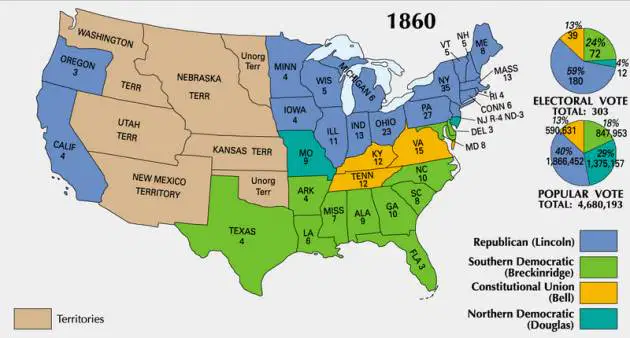
Which statement about U.S. History is proven from studying this map?
**The correct answer has to be something PROVEN BY THE MAP - not just a general true statement!**
a)
Slavery was not yet abolished.
b)
There were deep sectional & political divisions in 1860.
c)
The U.S. had not yet expanded to the west coast.
d)
Electoral votes are not as important as the popular vote.
16.
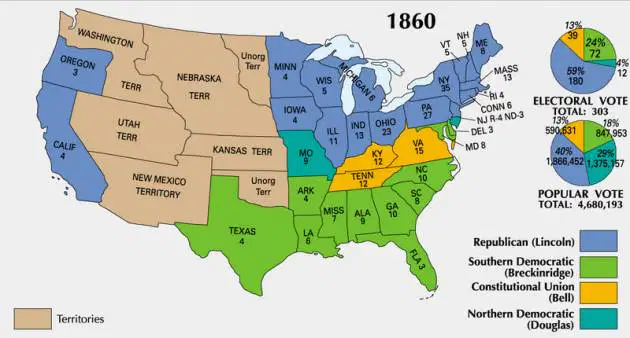
Using this map, it can be determined that...
a)
Southern states did not back the Republican Party.
b)
the border states supported the Northern Democrats
c)
the lack of universal manhood suffrage played a major role in Breckinridge's defeat.
d)
Washington, Utah, Kansas, and other territories refused to participate in the election.
17.
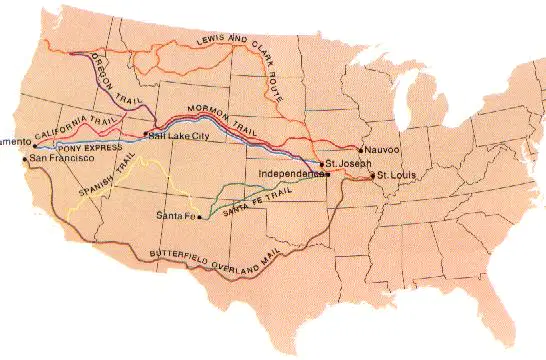
Historically, the map shown is relevant because it shows...
a)
the effect of the "Northwest Ordinance."
b)
trails used in the relocation of Native Americans.
c)
how the United States completed its "Manifest Destiny."
d)
the migration of people out of the California territory.
18.
Choose the THREE items that include a component or characteristic of the Missouri Compromise.
a)
The admission of Maine as a free state and Missouri as a slave state.
b)
The prohibition of slavery north of the 36°30' parallel.
c)
The compromise only applied in the former Louisiana Territory.
d)
The choice of male settlers to determine whether or not a new territory would allow slavery.
e)
The admission of California as a free state, but with one pro and one anti-slavery representative to Congress.
19.
Choose the FOUR answers that correctly describe a reason for settlers moving out West.
a)
Cheap farmland
b)
New economic opportunities
c)
Gold
d)
Freedom from religious persecution
e)
To live among the Native Americans
20.
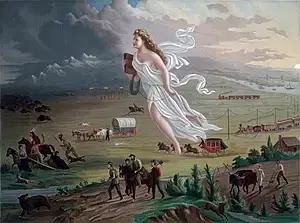
Use the painting below to answer the following question: What idea is the painting “American Progress” by John Gast portraying?
a)
Civil War
b)
Secession
c)
The California Gold Rush
d)
Manifest Destiny
21.
Select the THREE answers that correctly describe reasons for conflict between American settlers in Texas and the Mexican government.
a)
Settlers wanted to bring their slaves, which was illegal in Mexico.
b)
Most settlers were Protestant and did not want to convert to Catholicism, the official religion in Mexico.
c)
American settlers did not want to learn to speak Spanish.
d)
The settlers refused to defend Mexico against Comanche Indian raids.
e)
The Mexican government refused to honor the original prices of land for sale in Texas.
22.
Why did American settlers want to move to Texas when it still belonged to Mexico?
a)
To escape economic hardships in the eastern United States.
b)
To pursue new opportunities in agriculture and land ownership.
c)
To establish their own independent nation.
d)
To access trade routes and markets in Mexico.
23.
Why did President Andrew Jackson not want to annex Texas?
a)
He believed it would lead to war with Mexico and increase North-South tensions.
b)
He opposed the expansion of slavery into new territories.
c)
He saw Texas as a financial burden that would strain the federal budget.
d)
He lacked popular support for annexation.
100 %

