
 Worksheets
Unit 5 South Asia Review
Total questions: 25
Worksheet time: 15mins
Name
Class
Date
1.
Hinduism originated in South Asia, but it was also a major historical and cultural influence on the development of
a)
Northern Eurasia.
b)
Southeast Asia.
c)
Southwest Asia.
d)
East Asia.
2.
The lowest _________, or fixed social class into which a person is born, identified in the Vedas was the _________.
a)
caste; Brahmins
b)
jati; Kshatriyas
c)
caste; Sudras
d)
jati; Vaishyas
3.
Which of the following factors is slowing economic growth in India?
a)
poor infrastructure
b)
its command economy
c)
microlending
d)
outsourcing
4.
a collection of hundreds of sacred hymns composed by the Aryans of ancient India
a)
dalit
b)
caste
c)
tolerance
d)
Veda
5.
fixed social class into which a person is born
a)
veda
b)
guild
c)
caste
d)
citizenship
6.
Which of the following were two great Indus Valley cities?
a)
Mohenjo Daro
b)
Harappa
c)
Asoka
d)
Gupta
7.
Mauryan ruler who was committed to nonviolence and rule based on moral law.
a)
Chandragupta
b)
Chandra Gupta II
c)
Bindusara
d)
Asoka
8.
What did Gandhi hope to achieve through his movement of nonviolent resistance?
a)
independence from Britain
b)
the partition of India
c)
to start a war with Pakistan
d)
to conquer Britain
9.
peaceful protest against laws that are considered unjust
a)
flourish
b)
nonviolent resistance
c)
discrimination
d)
partition
10.
In Buddhism, a state of perfect wisdom free of suffering
a)
ascetic
b)
consequence
c)
nirvana
d)
enlightenment
11.
In Hinduism, the rebirth of a soul in a new body
a)
karma
b)
dharma
c)
guru
d)
reincarnation
12.
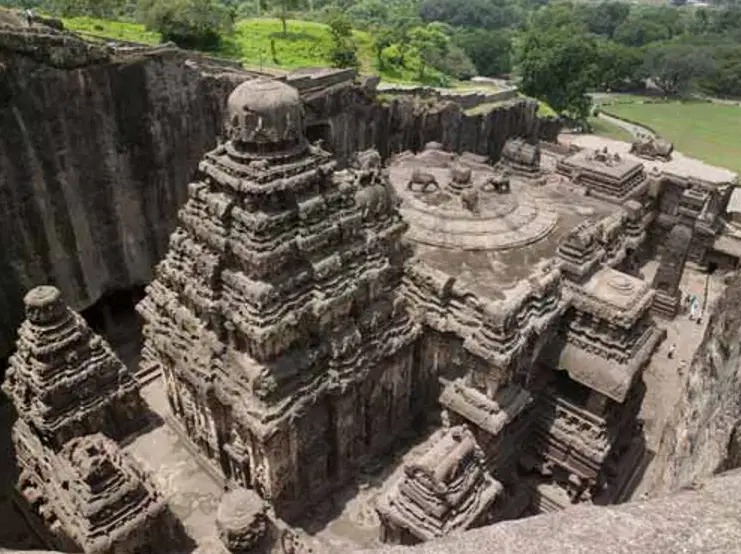
Look at the photograph. What development that occurred under the Guptas is illustrated by this image?
a)
contributions to the decimal system
b)
advances made in metallurgy
c)
the renewed importance of Buddhism
d)
they built impressive temples and monasteries
13.
What is the focus of Mahayana Buddhism?
a)
Buddha's good deeds
b)
Buddha's commitment to a life of poverty
c)
Buddha's compassion
d)
Buddha's writings
14.
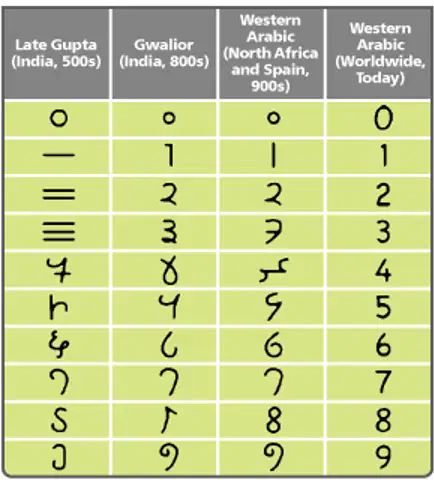
Study the chart. The main purpose of this chart is to show that
a)
North African and Spanish mathematicians significantly changed the numerals that originated in India.
b)
the numerals that we use today originated in ancient India.
c)
Gupta mathematicians did not understand the concept of "zero."
d)
the development of the decimal system transformed mathematics.
15.
Read the passage.
“Beginning with the Soviet invasion of 1979, successive wars virtually destroyed the education system. Most teachers fled the country during the Soviet occupation and the subsequent civil war. By 1996 only about 650 schools were functioning. In 1996 the Taliban regime banned education for females, and the madrassa (mosque school) became the main source of primary and secondary education. . . . In 2007 increased Taliban activity forced the closure of 35 percent of the schools in the southern provinces. . . . Despite renewed emphasis on educating girls, in 2008 the ratio of girls to boys in secondary schools was one to three or four, as rural families continued the tradition of educating only males.”
—Library of Congress, August 2008
Based on the passage, what is the MAIN reason that Afghanistan has a low literacy rate?
a)
disruption of schools
b)
lack of funding for schools
c)
parental indifference to education
d)
lack of teachers
16.
Which of the following statements about modern Buddhism is accurate?
a)
Buddhism is still widely practiced in India.
b)
Few Buddhists live in Asia.
c)
Most Buddhists live in monasteries.
d)
More than two million Buddhists live in the United States.
17.
In Hinduism, a person’s duty to do what is right is called
a)
ahimsa.
b)
dharma.
c)
karma.
d)
moksha.
18.
What was the eventual outcome of the conflict between East Pakistan and West Pakistan in 1971?
a)
India helped West Pakistan gain its independence.
b)
A communist political party took control of East Pakistan.
c)
East Pakistan became the nation of Bangladesh.
d)
The Taliban, a rebel Muslim group, took over Bangladesh.
19.
Read the passage.
“While the proportion of the urban population (28 percent) and of the total poor (25 percent) has remained relatively stable in South Asia as a whole, the region still has the highest number of urban poor in the world. . . . Five of the world's mega cities are located in South Asia and are home to large concentrations of urban poor.”
—World Bank
Which of the following statements BEST describes urban poverty in South Asia?
a)
Urban poverty in South Asia is limited to five mega cities.
b)
South Asian cities have been effective in addressing urban poverty.
c)
Urban poverty in South Asia is likely to remain a serious problem.
d)
The total number of poor people has increased greatly in South Asia.
20.
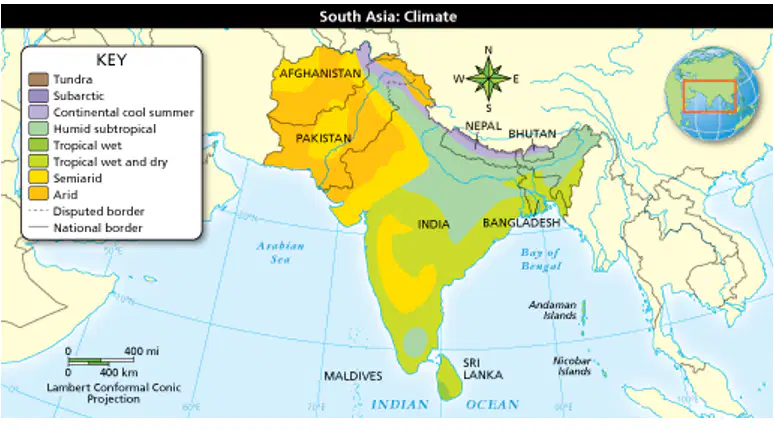
Study the map. Which South Asian country has a climate MOST similar to that of Sri Lanka?
a)
Bangladesh
b)
Pakistan
c)
Nepal
d)
Bhutan
21.
What form of government does India have?
a)
parliamentary democracy
b)
constitutional monarchy
c)
Islamic republic
d)
communist state
22.
Read the passage.
“Civil war also struck Sri Lanka, where the majority are Buddhists who speak Sinhala. Some members of the Hindu minority, which speaks Tamil, began fighting for a separate state in 1983. In 2009, the Sinhala-dominated government took control of rebel areas and declared victory. The war killed an estimated 70,000 people.”
What does this excerpt tell you about the main reason for conflict in Sri Lanka?
a)
competition for economic resources
b)
religious and ethnic tension
c)
terrorist attacks
d)
communist revolutionaries
23.
According to the Four Noble Truths of Buddhism, what must be overcome to end suffering?
a)
all forms of desire
b)
all selfish desires
c)
nirvana
d)
anger
24.

Study the map. Which countries border both India and China. Choose two that apply.
a)
Bhutan
b)
Afghanistan
c)
Pakistan
d)
SRI Lanka
25.
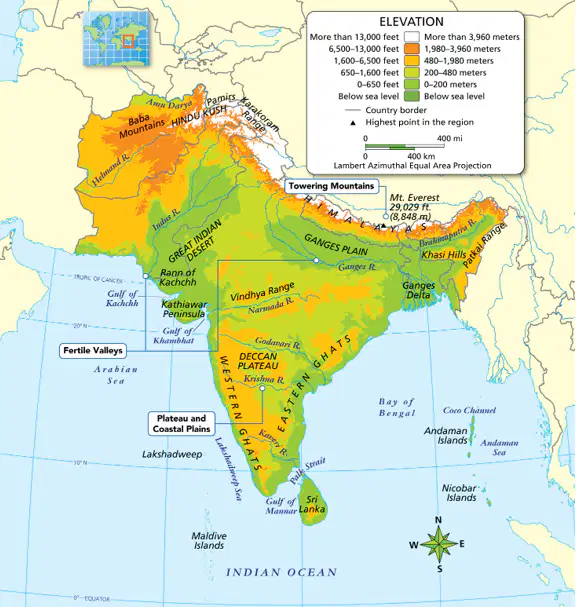
Study the map. What is the highest point in South Asia?
a)
The Himalayas
b)
Mt. Everest
c)
Baba Mountains
d)
Khasi Hills
100 %

