
 Worksheets
Geography Final Exam Worksheet Extraction
Total questions: 70
Worksheet time: 35mins
Geography is the study of plants
True
False
Maps that show what parts of the US say Pop vs. Soda are physical maps
True
False
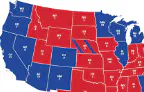
Maps like the one below that show how different regions of the country voted are thematic maps
True
False
A reading of 30 degrees North latitude and 140 degrees East longitude would be
an absolute location
a planar projection
a global reckoning
a relative position
A map that highlights differences in height between mountains and lower regions is called
a political map
a physical map
a thematic map
a menial map
The movement about which geographers talk usually refers to
birthrates and death rates and family size
environmental changes
relative locations of places on the earth
people, goods, and ideas
What does the theme of "region" help geographers do?
Explain how people adapt to their environment
Track the movement of goods and ideas
Describe the exact position of a place
Group areas that share common characteristics
What was the gigantic supercontinent 200 million years ago, consisting of all of Earth's land masses?
Pangea
Asia
America
Pathway
Which of the 5 Themes of geography relates to physical/human characteristics (what you see)?
Region
Place
Movement
Location
The layer of air, water, and other substances above the surface of the earth is the (Word Bank: biosphere, hydrosphere, lithosphere, or atmosphere)
biosphere
hydrosphere
lithosphere
atmosphere
Weather vs. Climate: Choose the term that matches the definition "the day-to-day state of the atmosphere, and its short-term variation in minutes to weeks."
Weather
Climate
Weather vs. Climate: Choose the term that matches the definition "how the atmosphere behaves over relatively long periods of time."
Weather
Climate
The ______ consists of water in oceans, lakes, rivers, and even under the ground (Word Bank: biosphere, hydrosphere, lithosphere, or atmosphere)
biosphere
hydrosphere
lithosphere
atmosphere
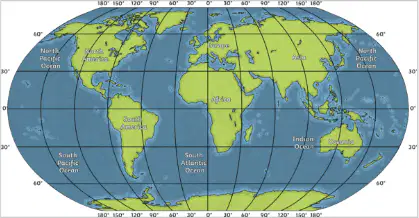
Which line is at 0 degrees latitude?
Prime Meridian
Equator
Tropic of Cancer
International Date Line
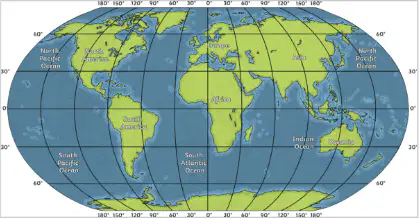
Which line is at 0 degrees longitude?
Equator
Prime Meridian
Arctic Circle
Tropic of Capricorn
The Neolithic Revolution was
The beginning of written records
The first organized religion
The invention of bronze weapons
A shift from hunting and gathering to farming and raising animals
Which of the following was a direct effect of the Neolithic Revolution?
All humans became farmers
Civilizations began to form
People stopped making art
Climate stabilized permanently
What is the best definition of culture?
The way of life shared by a group of people
The technology available in a society
The religion practiced by most people
The government system of a nation
The printing press helped medicine by
Allowing doctors to perform surgery faster
Killing germs
Allowing more information about diseases and treatments to spread
Creating vaccines
Who is considered the Father of Medicine?
Hippocrates
Jonas Salk
Louis Pasteur
Galen
Which cultural trait includes music, movies, books, and paintings?
Social Groups
Daily Life
History
The Arts
In Medieval times, doctors wore special masks during the plague because they believed:
The masks could filter out bad smells thought to spread disease
The masks scared away evil spirits
The masks contained vaccines
The masks carried medicine inside them
What principle is Hammurabi's Code most known for?
Freedom of speech
Trial by jury
Eye for an eye
Innocent until proven guilty
Who invented the printing press in 1440?
Leonardo da Vinci
Martin Luther
Johannes Gutenberg
William Shakespeare
What was the first major book printed with Gutenberg's press?
The Constitution
The Iliad
The Bible
The Qur'an
How many laws were in the Code of Hammurabi?
282
13
67
1
What makes high-speed Maglev trains different from traditional trains?
They float above the tracks using magnets
They only run in tunnels
They use steam power
They are slower but safer
Which situation is an example of culture in daily lives today?
Reading
Watching a movie in class
Paying taxes
Celebrating a holiday
What was the earliest form of human transportation before 3500 BCE?
Horses
Ships
Wagons
Running and walking
Match the Founder to the World Religion: Which founder is associated with Buddhism?
None
Abraham
Muhammad
Jesus
Siddhartha Gautama
Match the Founder to the World Religion: Which founder is associated with Christianity?
None
Abraham
Muhammad
Jesus
Siddhartha Gautama
Match the Founder to the World Religion: Which founder is associated with Hinduism?
None
Abraham
Muhammad
Jesus
Siddhartha Gautama
Match the Founder to the World Religion: Which founder is associated with Islam?
None
Abraham
Muhammad
Jesus
Siddhartha Gautama
Match the Founder to the World Religion: Which founder is associated with Judaism?
None
Abraham
Muhammad
Jesus
Siddhartha Gautama
Laws and teachings said to have been given to Moses by God are basic tenets or beliefs of Judaism. Which set names these laws?
The 5 Precepts
The 4 Noble Truths
The 10 Commandments
The 5 Pillars
Match the World Religion to its world rank by number of adherents: Which religion ranks 1st?
Buddhism
Christianity
Hinduism
Islam
Judaism
Match the World Religion to its world rank by number of adherents: Which religion ranks 2nd?
Buddhism
Christianity
Hinduism
Islam
Judaism
Match the World Religion to its world rank by number of adherents: Which religion ranks 3rd?
Buddhism
Christianity
Hinduism
Islam
Judaism
Match the World Religion to its world rank by number of adherents: Which religion ranks 4th?
Buddhism
Christianity
Hinduism
Islam
Judaism
Match the World Religion to its world rank by number of adherents: Which religion ranks 5th?
Buddhism
Christianity
Hinduism
Islam
Judaism
Polytheism means believing in one God.
True
False
Which religions began in India? Select all that apply.
Christianity
Buddhism
Hinduism
Judaism
Which of the following is the Holy City of Islam?
Cairo
New Delhi
Beijing
Mecca
Match the Sacred Text to the Religion: What is the sacred text of Buddhism?
The Sutras
The Torah
The Vedas
The Bible
The Qur'an
Match the Sacred Text to the Religion: What is the sacred text of Christianity?
The Sutras
The Torah
The Vedas
The Bible
The Qur'an
Match the Sacred Text to the Religion: What is the sacred text of Hinduism?
The Sutras
The Torah
The Vedas
The Bible
The Qur'an
Match the Sacred Text to the Religion: What is the sacred text of Islam?
The Sutras
The Torah
The Vedas
The Bible
The Qur'an
Match the Sacred Text to the Religion: What is the sacred text of Judaism?
The Sutras
The Torah
The Vedas
The Bible
The Qur'an
According to Buddhism, what is the cause of human suffering?
Technology advancing
Natural disasters
Human desires and attachments
Lack of food and water
The Olympics were a festival to honor the...
Hindu Gods
Christian Gods
Buddhist Gods
Greek Gods
Which of the following is a major U.S. import?
Computers
Candles
Airplanes
Corn
What is an import?
A free-trade agreement
Selling goods to another country
A tax placed on goods leaving a country
Buying or bringing products from another country
What is an export?
To send or sell goods to another country
A tax on imports
A good a country refuses to sell
A natural resource only found in one location
What is a tariff?
A discount for exported goods
A fee paid to ship goods
An agreement between countries
A tax placed on imports
How do most goods travel around the world today?
Subway, helicopter, jet ski
Boat, plane, train, truck
Drone, bus, cable car
Foot, bicycle, horseback
What is the purpose of tariffs?
To increase ocean traffic
To make imports cheaper
To encourage buying goods made in other countries
To make imported goods more expensive
The Silk Road was a...
Highways across Europe
Sea routes across the Atlantic
Trade routes connecting Asia, the Middle East, and Europe
A road of Silk (duh)
What does the Suez Canal connect?
Atlantic Ocean (North America) to Mediterranean Sea (Europe)
Atlantic Ocean to Pacific Ocean
Mediterranean Sea (Europe) to Red Sea (Asia)
Indian Ocean to Pacific Ocean
Which country was the starting point of most silk production?
China
India
Egypt
Persia
What does the Panama Canal connect?
Indian Ocean and Mediterranean Sea
Atlantic Ocean and Pacific Ocean
Red Sea and Arabian Sea
Baltic Sea and North Sea
Which of the following goods were traded on the Silk Road?
Wheat and machinery
Silk, spices, and glassware
Smartphones and electronics
Oil and cars
Explain what AND where the Silk Road was and explain two ways how it increased trade (and what they traded) or cultural diffusion. Select all statements that correctly describe it.
It was a network of trade routes connecting Asia, the Middle East, and Europe
It increased trade by exchanging goods such as silk, spices, and glassware
It spread ideas, religions, and technologies between civilizations
It was a single paved highway only inside China
It decreased contact between different regions
Why was the Silk Road important?
It only transported goods within China
It was the first road to connect North and South America
It allowed trade and cultural exchange between different civilizations
It was the world’s largest ocean trade route
Why did silk become valuable in other regions?
It was used as money
It was a rare color
It spoiled easily
Only China knew how to make it
How was the plague mainly spread to humans?
Direct contact with soil
Through contaminated food
Mosquito bites
Fleas living on rats
What was one common but incorrect belief about the cause of the plague?
Pneumonia made it spread faster
Fleas spread bacteria
Ships brought infected rats
Bad smells (miasma) caused the disease
Does the plague still exist today?
Yes, and it is still as deadly as in the past
No, it has been completely eliminated
Yes, but antibiotics make it treatable
Only in Europe
What symptom is associated with the name "Black Death"?
Extremely high fever
Blackened skin caused by internal bleeding
Constant coughing
Swollen throat
What does urban mean?
Related to a city or town
Related to the countryside
Related to oceans and seas
Related to mountains and forests
What is the USMCA and what does it allow to happen?
A trade agreement between the United States, Mexico, and Canada that promotes free trade and reduces tariffs
A military alliance among European nations to share defense
An international climate treaty that reduces greenhouse gas emissions
A tax on imports from Asian countries

