
 Worksheets
Forces & Energy Unit 4 Test 25-26
Total questions: 30
Worksheet time: 15mins
Avery has two different liquids, both at 20°C. Avery heats each liquid to 21°C. It takes more heat to get liquid B from 20°C to 21°C than it does liquid A. What can you tell about the two liquids, now at 21°C? (Remember: Kinetic Energy is how fast the molecules move. Thermal Energy is the total energy in the system.)
Liquid A has more kinetic energy than liquid B.
Liquid B has more kinetic energy than liquid A.
Liquid A has more thermal energy than liquid B.
Liquid B has more thermal energy than liquid A.
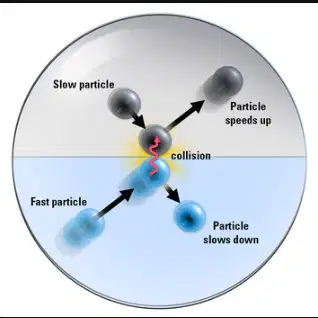
Daniel places a metal spoon with one end in a cup of hot water and the other end sticking out in the air. After a while, he notices that the end of the spoon in the air feels warmer. What event does this situation illustrate?
the transfer of thermal energy through conduction, where the top substance is cooler than the lower substance
thermal equilibrium, where the top substance is cooler than the lower substance
thermal equilibrium, where the top substance is hotter than the lower substance
the transfer of thermal energy through conduction, where the top substance is hotter than the lower substance
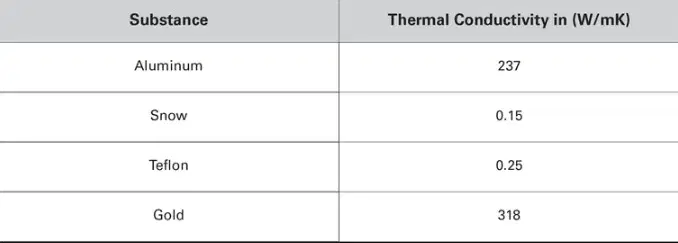
Emma is designing a cooking pot and an oven mitt. She has the table below showing the thermal conductivity of four substances. Which substances should she use to spread heat quickly in the pot, and which ones should she use to protect her hand against heat in the oven mitt?
for both spreading heat and protecting against heat, gold and aluminum
for spreading heat, gold and aluminum; for protecting against heat, snow and Teflon
for spreading heat, aluminum and snow; for protecting against heat, Teflon and gold
for spreading heat, snow and Teflon; for protecting against heat, gold and aluminum
Match each scenario with what happens to the thermal energy as water changes from vapor to liquid.
Thermal energy decreases as water turns from vapor to liquid.
Droplets form on the outside of a cold water bottle as water vapor condenses.
Thermal energy increases as water turns from vapor to liquid.
Water vapor in the air absorbs heat and turns into liquid water with more energy.
Thermal energy becomes equal as water turns from vapor to liquid.
Water vapor changes to liquid water, and the thermal energy before and after is the same.
There is no change in thermal energy as water changes from vapor to liquid.
Water vapor condenses to liquid water, but the thermal energy remains unchanged.
Daniel is comparing a metal spoon and a wooden spoon. Substances with high thermal conductivities transfer thermal energy______ substances that have low thermal conductivities.
into
faster than
slower than
at the same speed as
Jackson is choosing a material to make a cooking pot. Which of the following is MOST likely to have a high thermal conductivity?
fabric
iron
plastic
wood
Henry is building a house and wants to keep it warm in the winter. He is choosing materials for the walls. Which material should he choose if he wants a thermal insulator?
cannot transfer energy.
cannot hold any thermal energy.
is a good conductor of thermal energy.
has a low thermal conductivity.
Ava is preparing tea and has four pots, each containing boiling water. One pot has 1 g of boiling water, another has 10 g, another has 100 g, and the last has 1000 g. Which pot of boiling water has more thermal energy?
1 g of boiling water
10 g of boiling water
100 g of boiling water
1000 g of boiling water
Kai is comparing three different forms of water in his kitchen: 10 kg of ice from the freezer, 10 kg of liquid water from the tap, and 10 kg of steam from a boiling pot. The form of water that has the most thermal energy is (a) .
(Remember: To change from one state to another, there needs to be enough energy to overcome the attraction between bonds.)
Liam is heating a pot of water on the stove. He notices that it takes a lot of thermal energy to raise the temperature of the water. This is because substances with a high heat capacity
need no thermal energy in order to raise their temperatures.
need a little thermal energy in order to raise their temperatures.
need a lot of thermal energy in order to raise their temperature.
can raise the temperatures of other substances with low heat capacities.
William is heating equal masses of water and aluminum on a stove. He notices that it takes more thermal energy to raise the temperature of the water by the same amount as the aluminum. Why does this happen?
Water has a low heat capacity and requires less energy to raise its temperature than aluminum requires.
Water has a high heat capacity and requires less energy to raise its temperature than aluminum requires.
Water has a low heat capacity and requires more energy to raise its temperature than aluminum requires.
Water has a high heat capacity and requires more energy to raise its temperature than aluminum requires.
On a hot summer day, Mia leaves a bowl of water outside. After a while, she notices that some of the water has turned into vapor and disappeared. In order for the liquid water in the bowl to change state into water vapor,
the liquid water needs to lose thermal energy.
the liquid water needs to gain thermal energy.
the liquid water needs to release thermal energy.
the liquid water needs its thermal energy to be activated.
Match each scenario with what happens to thermal energy.
Thermal energy is released.
Water turns into ice in a freezer.
Thermal energy is absorbed.
Ice melts into water at room temperature.
Thermal energy remains the same.
A block of ice stays frozen in a freezer without changing state.
Thermal energy is lost to the system.
Thermal energy escapes from a hot object into the cold surroundings.
Michael pours hot tea into a cup and places a spoon in it. In this system, heat is likely to flow in the following way: (a)
Priya places a metal spoon in a cup of hot tea. Temperature changes when
energy stays in an object or system.
energy is transferred into or out of an object.
an object’s gravitational potential energy changes.
when an object’s electric potential energy changes.
Rohan and Olivia each have a cup of water. After leaving the cups in the same room for a long time, thermal equilibrium is reached. This means that
no thermal energy can be added to a system.
thermal energy in a system is lost to the environment.
the cups will continuously transfer thermal energy between each other.
the cups will remain at the same temperature assuming no energy is added or removed from the system.
Jackson is learning about weather in science class. His teacher asks, "Jackson, can you tell me what temperature is?" Temperature is (a)
Match each scenario below with the correct outcome regarding the interaction between ice cubes and water at room temperature.
Energy from the water will transfer to the ice cubes, causing the ice to melt.
Three ice cubes are placed in a glass of water at room temperature.
Cold from the ice cubes will transfer to the water, causing the water to freeze.
Ice cubes are added to water and the water temperature drops below freezing, forming more ice.
Energy will transfer equally between the ice cubes and the water, causing no change.
Ice cubes and water are mixed, but neither changes temperature or state.
Cold is transferred from the ice/water mixture to the air, causing the air to cool.
The mixture of ice and water causes the surrounding air to become cooler.
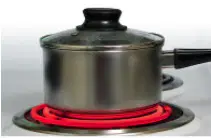
Match each scenario in the stove-pot-water system with the correct method of heat transfer. Drag and drop the correct heat transfer description to each scenario.
Heat is being transferred from the stove to the pot through convection and from the pot to the water through conduction.
Stove to pot: conduction; Pot to water: conduction
Heat is being transferred from the stove to the pot through conduction and from the pot to the water through radiation.
Stove to pot: convection; Pot to water: conduction
Heat is being transferred from the stove to the pot through radiation and from the pot to the water through radiation.
Stove to pot: conduction; Pot to water: radiation
Heat is being transferred from the stove to the pot through conduction and from the pot to the water through conduction.
Stove to pot: radiation; Pot to water: radiation
Abigail wants to warm up her leftover soup using a microwave oven. Which type of heat transfer is taking place when the soup gets heated in the microwave?
conduction
convection
radiation
David notices that when the heater is turned on, warm air comes out from vents near the floor and spreads throughout the room. This process is called?
conduction
convection
radiation
Mia heats a bar of steel to 90º C and then places it in a basin of water at 20º C. What happens next?
the temperature of the steel increases and the temperature of the water decreases
the temperature of the steel and water will remain the same.
the temperature of the steel decreases and the temperature of the water increases
the temperature of the steel decreases and the temperature of the water decreases
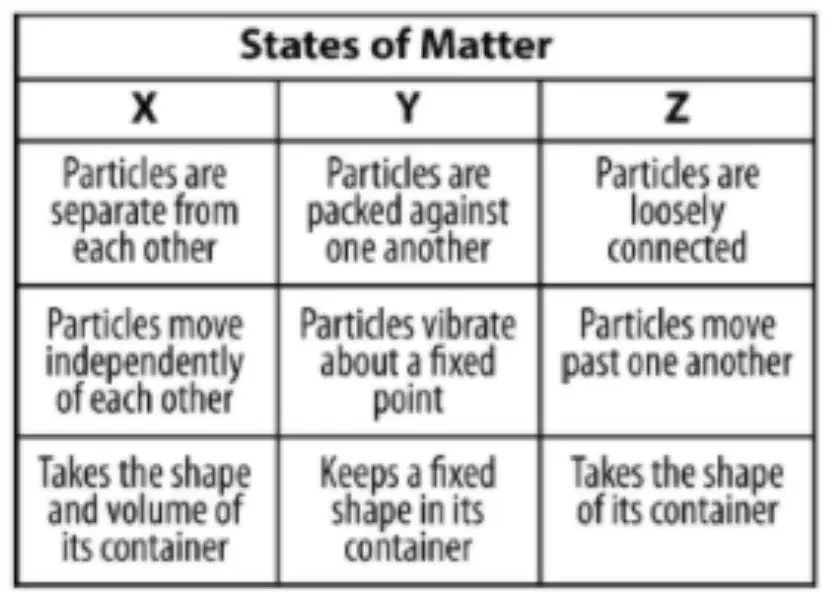
Henry is conducting an experiment and observes three different substances. He records their properties in the chart below. Which of the following identifies the states of matter described in the chart?
X is a gas, Y is a solid, and Z is a liquid.
X is a gas, Y is a liquid, and Z is a solid.
X is a solid, Y is a liquid, and Z is a gas.
X is a liquid, Y is a gas, and Z is a solid.
Zoe is heating a block of ice until it melts into water and then turns into steam. As the ice changes from a solid to a liquid to a gas (in that order), the
energy in the substances decreases.
molecular motion decreases.
energy in the substances increases.
atoms lose atomic mass.
James is conducting an experiment where he observes particles of oxygen and particles of water. If the particles of oxygen have twice as much mass as a particle of water, and their speeds are the same, which has a higher thermal energy?
water particles
oxygen particles
They have the same temperature.
There is not enough information to determine which has a higher temperature.
Match each description with the correct factor that determines a substance's thermal energy.
the substance's state of matter
Whether the substance is solid, liquid, or gas
the substance's mass
How much of the substance is present
what the substance is made of
The chemical composition of the substance
the location of the substance
Where the substance is placed
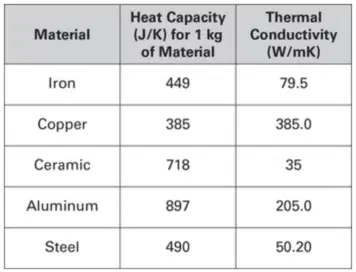
Nora wants to make waffles quickly in the morning before school. She is choosing a material for her new waffle maker and looks at the data table below. Which material should Nora pick so she doesn't have to wait long for her waffles? (Think about this: Do you want to have to wait to get your waffle? Neither does Nora.)
Iron
Copper
Ceramic
Aluminum
Steel

Priya is observing three containers: one with ice cubes, one with water, and one with steam. She notices that the particles in each container move differently. For the particles to change how they move, energy is
added.
removed.
either added or removed.
not a factor. (energy does not affect the changes in state)
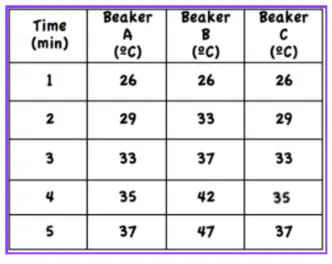
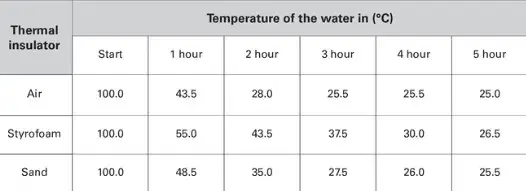
Noah, Aiden, and Avery each have a beaker that contains a clear liquid. The same amount of heat is added to each of their beakers for five minutes. What can you infer about the liquids based on the data table?
The substance in each beaker is different.
The substance in each beaker is the same.
The substances in two of the beaker could be the same.
You cannot make an inference using the data provided.

