
 Worksheets
8.3 Test - Geological Processes
Total questions: 43
Worksheet time: 22mins
Name
Class
Date
1.
What process breaks down rock without changing its chemical composition?
a)
Mechanical weathering
b)
Chemical weathering
c)
Deposition
d)
Sedimentation
2.
Which of the following is an example of mechanical weathering?
a)
Rust forming on iron-containing rocks
b)
Plant roots growing into rock cracks
c)
Acid rain dissolving limestone
d)
Carbonation of rock surfaces
3.
What causes ice wedging to be an effective form of mechanical weathering?
a)
Water becomes more acidic at cold temperatures
b)
Ice has sharp edges that scratch rock surfaces
c)
Water expands approximately 9% when it freezes
d)
Frozen water attracts minerals from surrounding rock
4.
Which weathering process involves oxygen combining with minerals to form new compounds?
a)
Hydrolysis
b)
Carbonation
c)
Oxidation
d)
Abrasion
5.
Which of these is a primary cause of chemical weathering?
a)
Wind blowing sand against rock surfaces
b)
Plant roots growing into cracks
c)
Acid rain dissolving rock minerals
d)
Temperature fluctuations causing expansion and contraction
6.
What is the definition of erosion?
a)
The process of breaking down rock into smaller pieces
b)
The transportation of weathered material from one location to another
c)
The deposition of sediment in new locations
d)
The compaction of sediment into sedimentary rock
7.
Which agent of erosion is responsible for creating most of Earth's valleys?
a)
Gravity
b)
Wind
c)
Glaciers
d)
Running water
8.
What typically happens when a river's velocity decreases?
a)
Increased erosion occurs
b)
Sediment is deposited
c)
The river channel narrows
d)
Water becomes more acidic
9.
How do river meanders form?
a)
When rivers flow straight through flat terrain
b)
When water erodes more on the outside of a curve
c)
When deltas build up at river mouths
d)
When rivers freeze and thaw seasonally
10.
What happens when a river cuts through the narrow neck of a meander?
a)
A waterfall forms
b)
An oxbow lake forms
c)
A delta forms
d)
A canyon forms
11.
What is glacial plucking?
a)
The scraping of rock by debris frozen in a glacier
b)
The process where a glacier freezes to rock and pulls it away as it moves
c)
The deposition of sediment as a glacier melts
d)
The formation of U-shaped valleys
12.
What evidence of glacial erosion appears as scratches and grooves in bedrock?
a)
Moraines
b)
Drumlins
c)
Glacial striations
d)
Eskers
13.
Which landform is created by glacial erosion rather than glacial deposition?
a)
Moraine
b)
Drumlin
c)
U-shaped valley
d)
Esker
14.
How are drumlins formed?
a)
By wind erosion of sand dunes
b)
By river deposition at its mouth
c)
By glaciers reshaping deposits of till
d)
By wave erosion along coastlines
15.
Moraines are formed by:
a)
Wind-blown sand
b)
Glaciers dropping sediment
c)
Underwater canyons
d)
Steam erosion
16.
Kettle lakes form when:
a)
River channels shift
b)
Limestone dissolves
c)
Blocks of ice melt and leave holes
d)
Lava cools and cracks
17.
Normal faults result from:
a)
Compression
b)
Shearing
c)
Tension
d)
Chemical weathering
18.
In a reverse fault, the hanging wall moves:
a)
Down
b)
Sideways
c)
Up
d)
Backward
19.
Strike-slip faults occur due to:
a)
Compression
b)
Shearing
c)
Deposition
d)
Erosion
20.
The block of rock above the fault plane is the:
a)
Footwall
b)
Headwall
c)
Hanging wall
d)
Dome
21.
Which is a constructive force?
a)
Erosion
b)
Deposition
c)
Weathering
d)
Oxidation
22.
Which event can be both constructive and destructive?
a)
Volcanic eruption
b)
Weathering
c)
Abrasion
d)
Flooding
23.
A destructive force is one that:
a)
Builds landforms
b)
Breaks down landforms
c)
Drops sediment
d)
Requires ice
24.
Contour lines close together indicate:
a)
Flat land
b)
Steep slopes
c)
Riverbeds
d)
Depressions
25.
The difference in elevation between contour lines is the:
a)
Index value
b)
Gradient
c)
Contour interval
d)
Slope factor
26.
Closed circles on a topographic map represent:
a)
Hilltops
b)
Lakes
c)
Rivers
d)
Cliffs
27.
On a topographic map, V-shaped contour lines point:
a)
Upstream
b)
Downhill
c)
Toward cities
d)
Toward oceans
28.
Uniformitarianism states that:
a)
Processes today are the same processes that shaped Earth in the past
b)
Earth only changes during large disasters
c)
Erosion no longer happens
d)
Weathering is predictable
29.
Which statement is true?
a)
Weathering moves sediment
b)
Erosion breaks rock
c)
Deposition drops sediment
d)
All three perform the same action
30.
A canyon is mainly formed by:
a)
Glaciers
b)
Running water
c)
Wind
d)
Earthquakes
31.
The energy that drives most erosion and weathering is:
a)
Solar energy
b)
Nuclear energy
c)
Tidal energy
d)
Heat from Earth's interior
32.
Deposition is defined as:
a)
Breaking down rock
b)
Moving sediment
c)
Dropping sediment
d)
Freezing sediment
33.
On a meander, erosion occurs on the:
a)
Inside curve
b)
Outside curve
c)
Bottom
d)
Delta
34.
Contour lines close together on a mountain indicate:
a)
Steep slope
b)
Flat top
c)
U-shaped valley
d)
High water levels
35.
When wind loses energy, it forms:
a)
Meander
b)
Moraine
c)
Sand dune
d)
Kettle lake
36.
Landscapes with moraines, drumlins, and kettle lakes were shaped by:
a)
Rivers
b)
Glaciers
c)
Wind
d)
Volcanoes
37.
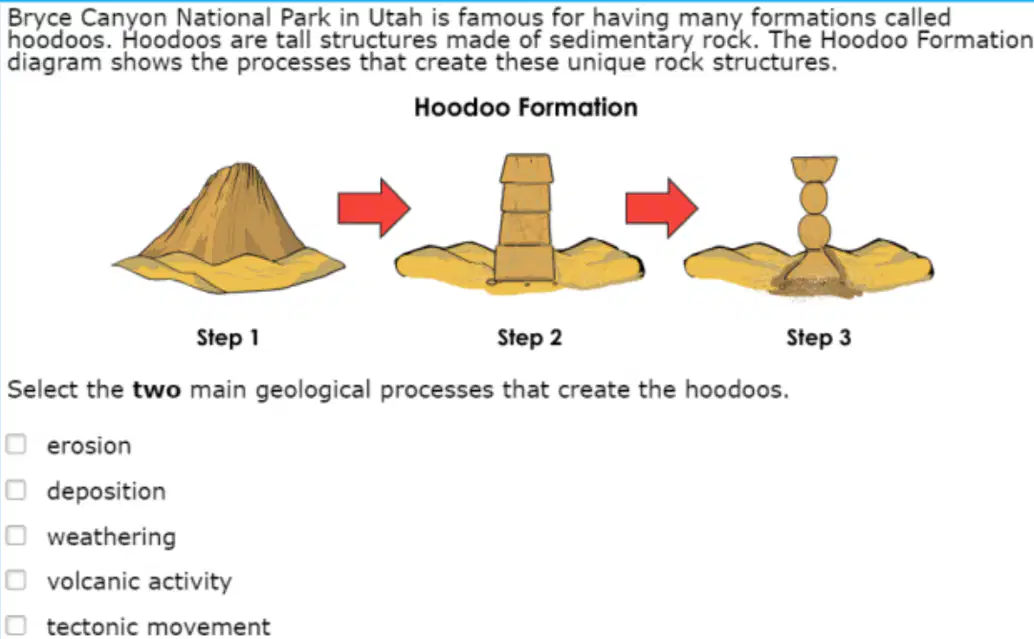
Look at the diagram provided and answer the question shown.
a)
erosion
b)
deposition
c)
weathering
d)
volcanic activity
e)
tectonic movement
38.
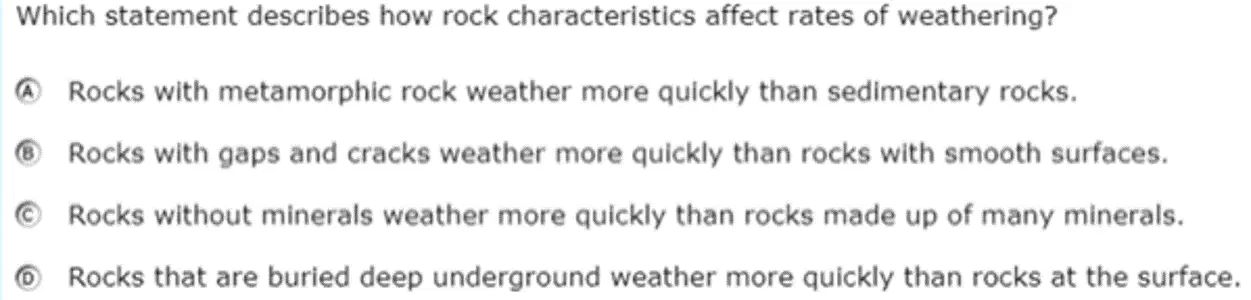
Look at the diagram provided and answer the question shown.
a)
A
b)
B
c)
C
d)
D
39.
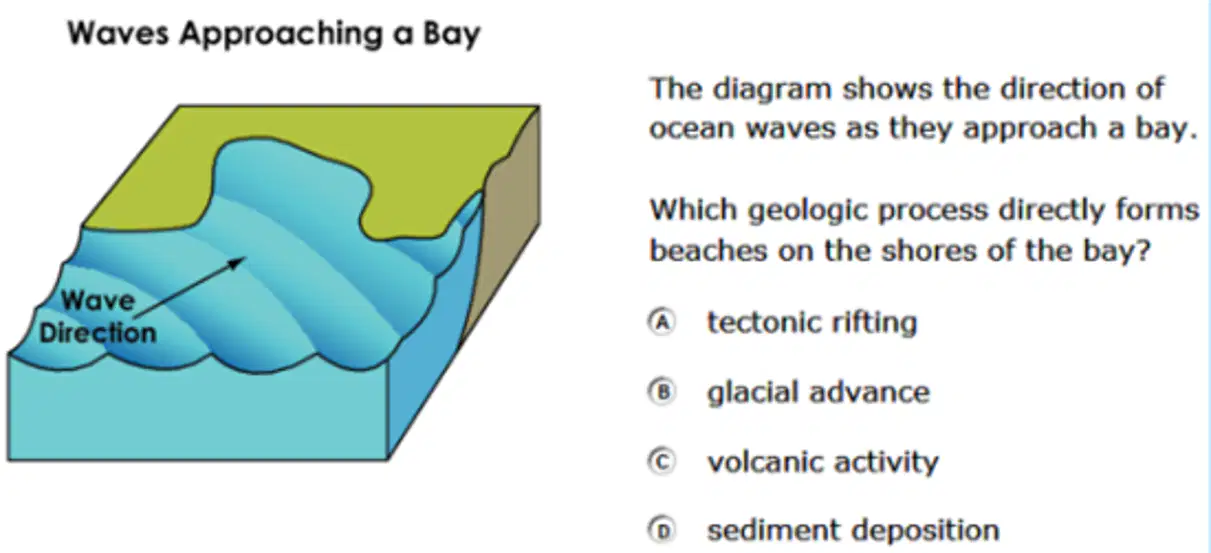
Look at the diagram provided and answer the question shown.
a)
A
b)
B
c)
C
d)
D
40.

Look at the diagram provided and answer the question shown.
a)
A
b)
B
c)
C
d)
D
41.
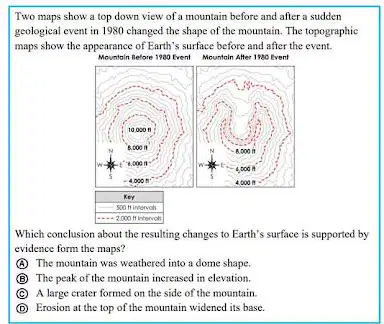
Look at the diagram provided and answer the question shown.
a)
A
b)
B
c)
C
d)
D
42.
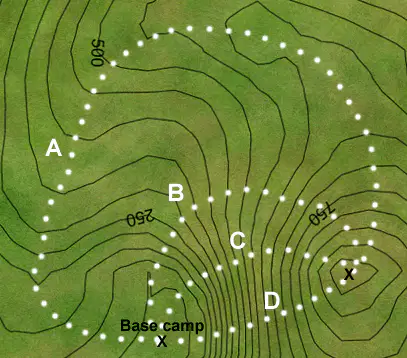
A mountaineer is planning an expedition. He wants to follow the easiest possible path, which means he needs to find the most gentle slope up the mountain. Which route should the mountaineer choose?
a)
Route A
b)
Route B
c)
Route C
d)
Route D
43.
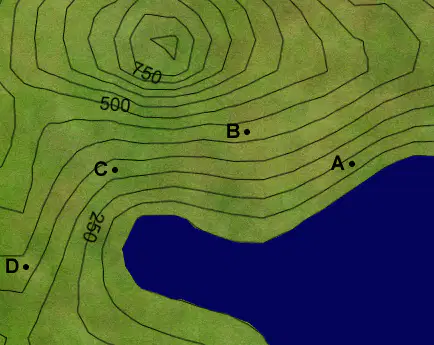
Four houses have been built along the banks of a small lake. Unfortunately for the homeowners, a new dam will slowly raise the level of the lake. In what order will the houses be flooded?
a)
House A will be flooded first, followed by D, then C, and last B.
b)
House A will be flooded first, followed by B, then C, and last D.
c)
House A will be flooded first, followed by B, then D, and last C.
d)
House A will be flooded first, followed by C, then D, and last B.
100 %

