
 Worksheets
VOCAB - Units 1–6 - Cumulative
Total questions: 50
Worksheet time: 27mins
Two angles that are adjacent and whose non-common sides form a straight line.
Vertical Angles
Corresponding Angles
Complementary Angles
Linear Pair
Consecutive Angles
Two non-adjacent angles formed by intersecting lines.
Remote Interior Angles
Exterior Angles
Linear Pair
Vertical Angles
Cross Angles
For two points, (x1,y1) and (x2,y2) , identify the formula (2x1+x2,2y1+y2) .
Slope Formula
Midpoint Formula
Two Points Formula
Distance Formula
Pythagorean Theorem
For AB with A(x1,y1) and B(x2,y2) , identify the formula AB=(x2−x1)2+(y2−y1)2 .
Distance Formula
Pythagorean Theorem
Square of the Sums Formula
Midpoint Formula
Slope Formula
Identify the formula shown: m=x2−x1y2−y1 .
Slope Equation
Midpoint Formula
Maximal Equation
Distance Formula
Pythagorean Theorem
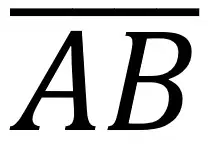
Identify the notation shown:
The slope of the segment with endpoints A and B
The midpoint between endpoints A and B
The length of the segment with the endpoints A and B
The line that passes through the points A and B
The actual segment with the endpoints A and B
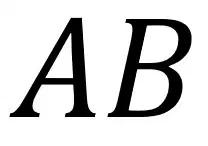
Identify the notation shown:
The slope of the segment with endpoints A and B
The length of the segment with the endpoints A and B
The actual segment with the endpoints A and B
The midpoint between endpoints A and B
The line that passes through the points A and B
This represents the original figure before a transformation is applied.
Coordinate Transformation
Rigid Transformation
Original Transformation
Preimage
Image
This represents the figure after a specific transformation.
Preimage
Original Transformation
Image
Secondary Transformation
Rigid Transformation
A transformation that preserves distance and angles.
Static Change
Rigid Transformation
Dilation Transformation
Optimus Prime
CPCTC
A rigid transformation that moves each point in a shape a specified distance in a specified direction as defined by a vector.
Dilation
Reflection
Translation
Rotation
Glide Reflection
A rigid transformation that moves all points of a shape across a line called the line of symmetry. A point and its corresponding point in the image are each the same distance from the line.
Rotation
Dilation
Glide Reflection
Translation
Reflection
A rigid transformation that shifts t∘ around a given point O .
Translation
Dilation
Glide Reflection
Reflection
Rotation
An instance that disproves a conjecture.
Corollary
Conclusion
Theorem
Conjecture
Counterexample
Is associated with the "if" part of a conditional statement. Represented as p in a logical connective.
Conclusion
Inverse
Hypothesis
Conjecture
Converse
Is associated with the "then" part of a conditional statement. Represented as q in a logical connective.
Conclusion
Hypothesis
Converse
Conjecture
Inverse
A conditional statement is formed by switching the hypothesis and conclusion.
Inverse
Biconditional Statement
Negation
Contrapositive
Converse
A conditional statement is formed by negating both the hypothesis and conclusion.
Negation
Contrapositive
Converse
Inverse
Biconditional Statement
A conditional statement formed by switching the hypothesis and conclusion and then negating them both.
Inverse
Biconditional Statement
Converse
Negation
Contrapositive
A conditional statement in which both the original conditional and its converse are true.
Biconditional Statement
Contrapositive
Negation
Converse
Inverse
An object is congruent to itself.
Distributive Property of Congruence
Symmetric Property of Congruence
Transitive Property of Congruence
Identity Property of Equality
Reflexive Property of Congruence
Two or more lines that lie in the same plane and never intersect.
Intersecting Lines
Perpendicular Lines
Perpendicular Bisectors
Parallel
Colinear
Two lines that intersect and meet to form a right angle.
Colinear
Perpendicular Bisectors
Parallel
Perpendicular Lines
Intersecting Lines
The slope of this line is undefined.
Undefined Line
Negative Line
Horizontal Line
Vertical Line
Positive Line
The slope of this line is zero.
Horizontal Line
Negative Line
Undefined Line
Positive Line
Vertical Line
A segment, ray, or line that intersects another segment at its midpoint and forms a right angle.
Perpendicular Bisector
Right Intersection
Perpendicular Midsegment
Right Midpoint
Midsegment
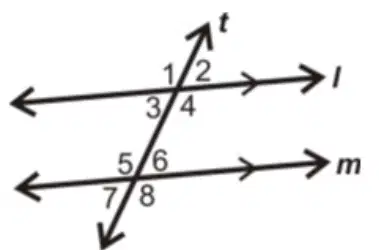
If angle 1 is congruent to angle 8 then lines l and m are parallel.
Consecutive Interior Angles Theorem (Same Side Interior)
Corresponding Angles Postulate
Alternate Interior Angles Theorem
Vertical Angles Theorem
Alternate Exterior Angles Theorem
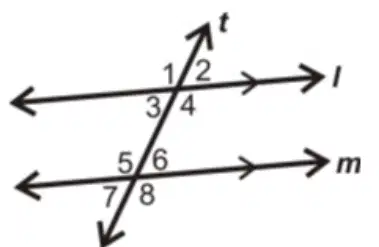
If angle 3 is congruent to angle 6 then lines l and m are parallel.
Vertical Angles Theorem
Corresponding Angles Postulate
Alternate Exterior Angles Theorem
Consecutive Interior Angles Theorem (Same Side Interior)
Alternate Interior Angles Theorem
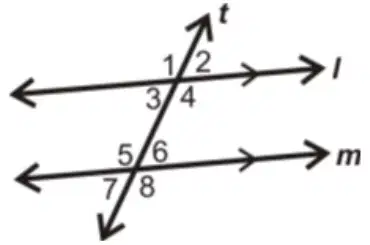
If angle 4 is congruent to angle 8 then lines l and m are parallel.
Corresponding Angles Postulate
Alternate Interior Angles Theorem
Consecutive Interior Angles Theorem (Same Side Interior)
Vertical Angles Theorem
Alternate Exterior Angles Theorem
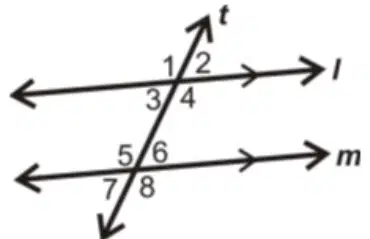
If angle 3 is supplementary to angle 5 then lines l and m are parallel.
Alternate Interior Angles Theorem
Vertical Angles Theorem
Consecutive Interior Angles Theorem (Same Side Interior)
Alternate Exterior Angles Theorem
Corresponding Angles Postulate
The Interior Angles of a Triangle add up to 180 degrees.
Supplementary Angles
Triangle Inequality Theorem
Interior Angles Theorem
Equilateral Triangle Theorem
Triangle Sum Theorem
If two triangles are congruent, then corresponding parts are also congruent.
CPCTC
Triangle Congruency Theorem
Definition of Corresponding Parts
Definition of Congruency
Corresponding Parts Postulate
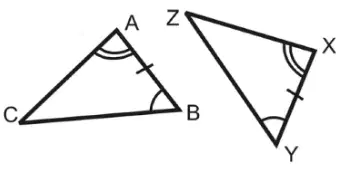
These triangles are congruent using:
SSS Triangle Congruence
AAS Triangle Congruence
ASA Triangle Congruence
SAS Triangle Congruence
SSA Triangle Congruence
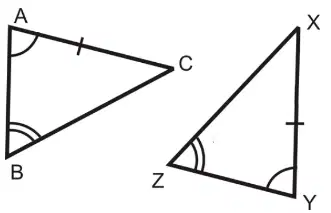
These triangles are congruent using:
SAS Triangle Congruence
AAS Triangle Congruence
SSS Triangle Congruence
ASA Triangle Congruence
SSA Triangle Congruence
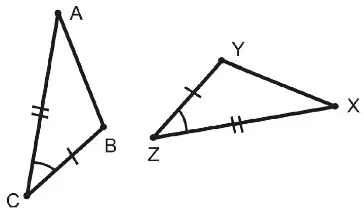
These triangles are congruent using: Two separate triangles are shown. Left triangle has vertices labeled A (top), B (middle left), and C (bottom left). Side AB has a double tick mark and side BC has a single tick mark. Right triangle has vertices labeled X (right), Y (upper left), and Z (lower left). Side ZX has a double tick mark and side ZY has a single tick mark. No right-angle markings are shown.
SSA Triangle Congruence
ASA Triangle Congruence
AAS Triangle Congruence
SAS Triangle Congruence
SSS Triangle Congruence
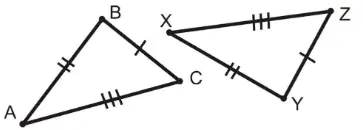
These triangles are congruent using: Two triangles are shown with all three corresponding sides marked with single, double, and triple tick marks respectively. Left triangle is labeled A, B, C and right triangle is labeled X, Y, Z.
ASA Triangle Congruence
AAS Triangle Congruence
SAS Triangle Congruence
SSA Triangle Congruence
SSS Triangle Congruence
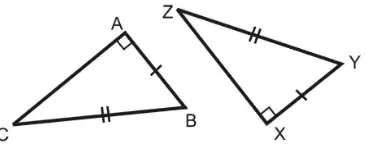
These triangles are congruent using: Two triangles are shown. Left triangle has vertices C, B, A; right triangle has vertices X, Y, Z. Two angles on the right triangle are marked with arcs, and one corresponding side has a tick mark showing it lies between the marked angles.
HL Triangle Congruence
SSA Triangle Congruence
SAS Triangle Congruence
AAS Triangle Congruence
ASA Triangle Congruence
Two angles that are adjacent and whose non-common sides form a straight line.
Vertical Angles
Linear Pair
Consecutive Angles
Corresponding Angles
Complementary Angles
Two non-adjacent angles formed by intersecting lines.
Cross Angles
Remote Interior Angles
Linear Pair
Exterior Angles
Vertical Angles

The measure of the likelihood that an event will occur. The chance that an event will happen. A ratio of chance/all chances.
odds
probability
outcomes
tree diagram
A ratio of the number of ways an event can occur to the number of ways it cannot occur.
Odds
Chance
Outcome
Probability
Probability that is based on repeated trials of an experiment
probability
experimental probability
theoretical probability
fundamental counting principle
Compound Event
Combination of two or more events using the word and or the word or.
A single event that cannot be broken down further.
An event that occurs only once in a probability experiment.
A situation where two events cannot happen at the same time.
Dependent
Events that do affect each other.
Events that do not affect each other.
Events that are completely random.
Events that are independent of each other.
Complement
Elements from the universal set that are NOT in that set.
Elements that are part of the universal set.
Elements that are equal to the universal set.
Elements that are subsets of the universal set.
Independent
Events that do not affect each other.
Events that are dependent on each other.
Events that occur at the same time.
Events that are mutually exclusive.
Mutually Exclusive
Events that can occur at the same time.
Events with no common outcome.
Events that are dependent on each other.
Events that are equally likely to happen.
Conditional Probability
The probability an event will occur given that an event has already occurred.
The probability of two independent events occurring together.
The probability of an event occurring without any conditions.
The probability of an event occurring in the future.

