
 Worksheets
Aquatic Accumulation Review Worksheet
Total questions: 216
Worksheet time: 3hrs 54mins
Absorption
conversion of sound or light energy into heat
a device that generates underwater sound from special transducers and analyzes the returning echoes to gain information of geological, biological, or military importance.
the dark ocean below the depth to which light can penetrate
attachment of water molecules to other substances by hydrogen bonds; wetting.
Adhesion
conversion of sound or light energy into heat
dark ocean below the depth to which light can penetrate
a device that generates underwater sound from special transducers and analyzes the returning echoes to gain information of geological, biological, or military importance.
attachment of water molecules to other substances by hydrogen bonds; wetting.
24. Aphotic Zone
the dark ocean below the depth to which light can penetrate
a device that generates underwater sound from special transducers and analyzes the returning echoes to gain information of geological, biological, or military importance.
attachment of water molecules to other substances by hydrogen bonds, wetting.
conversion of sound or light energy into heat
Chemical bond
the smallest particle of an element that exhibits the characteristics of that element.
attachment of water molecules to each other by hydrogen bonds.
the amount of heat needed to raise the temperature of 1 gram of pure water by 1 degree Celsius.
an energy relationship that holds two atoms together as a result of changes in their electron distribution.
Cohesion
the amount of heat needed to raise the temperature of 1 gram of pure water by 1 degree Celsius.
an energy relationship that holds two atoms together as a result of changes in their electron distribution.
the smallest particle of an element that exhibits the characteristics of that element.
attachment of water molecules to each other by hydrogen bonds.
29. Compound
an arbitrary measure of temperature.
the zone of the ocean below the pycnocline, in which there is little additional change of density with increasing depth, contains about 80% of the world's water.
a substance composed of two or more elements in a fixed proportion
a chemical bond formed between two atoms by electron sharing
Covalent bond
an arbitrary measure of temperature.
a chemical bond formed between two atoms by electron sharing
the zone of the ocean below the pycnocline, in which there is little additional change of density with increasing depth, contains about 80% of the world's water.
a substance composed of two or more elements in a fixed proportion
Deep zone
a substance composed of two or more elements in a fixed proportion
an arbitrary measure of temperature.
the zone of the ocean below the pycnocline, in which there is little additional change of density with increasing depth, contains about 80% of the world's water.
a chemical bond formed between two atoms by electron sharing
Density
the mass per unit volume of a substance, usually expressed by grams per cubic centimeter.
a substance composed of identical atoms that cannot be broken down into simpler substances by chemical means
a graph showing the relationship between a fluid's temperature or salinity and its density.
a tiny negatively charged particle in an atom responsible for chemical bonding
Freezing point --
the heat, measured in calories, required to raise 1 gram of a substance 1 degree Celsius. The input of 1 calorie of heat energy raises the temperature of 1 gram of pure water by 1 degree Celsius.
the temperature at which a solid can begin to form as a liquid is cooled
a form of energy produced by the random vibration of atoms or molecules.
the zone of the ocean in which salinity increases rapidly with depth
Halocline --
a form of energy produced by the random vibration of atoms or molecules.
the heat, measured in calories, required to raise 1 gram of a substance 1 degree Celsius. The input of 1 calorie of heat energy raises the temperature of 1 gram of pure water by 1 degree Celsius.
the temperature at which a solid can begin to form as a liquid is cooled
the zone of the ocean in which salinity increases rapidly with depth
Heat capacity --
the zone of the ocean in which salinity increases rapidly with depth
a form of energy produced by the random vibration of atoms or molecules.
the heat, measured in calories, required to raise 1 gram of a substance 1 degree Celsius. The input of 1 calorie of heat energy raises the temperature of 1 gram of pure water by 1 degree Celsius.
the temperature at which a solid can begin to form as a liquid is cooled
Hydrogen bond –
heat added to a liquid during evaporation (or released from a gas during condensation) that produces a change in state but not a change in temperature. For pure water, 585 calories per gram at 20 degrees Celsius.
heat removed from a liquid during freezing (or added to a solid during thawing) that produces a change in state but not a change in temperature. For pure water, 80 calories per gram at 0 degrees Celsius.
a relatively weak bond formed between a partially positive hydrogen atom and a partially negative oxygen, fluorine, or nitrogen atom of an adjacent molecule.
heat added to a liquid during evaporation (or released from a gas during condensation) that produces a change in state but not a change in temperature. For pure water, 540 calories per gram at 100 degrees Celsius.
Adhesion –
the dark ocean below the depth to which light can penetrate
attachment of water molecules to other substances by hydrogen bonds; wetting.
a device that generates underwater sound from special transducers and analyzes the returning echoes to gain information of geological, biological, or military importance.
conversion of sound or light energy into heat.
Latent heat of evaporation –
heat added to a liquid during evaporation (or released from a gas during condensation) that produces a change in state but not a change in temperature. For pure water, 540 calories per gram at 100 degrees Celsius.
a relatively weak bond formed between a partially positive hydrogen atom and a partially negative oxygen, fluorine, or nitrogen atom of an adjacent molecule.
heat added to a liquid during evaporation (or released from a gas during condensation) that produces a change in state but not a change in temperature. For pure water, 585 calories per gram at 20 degrees Celsius.
heat removed from a liquid during freezing (or added to a solid during thawing) that produces a change in state but not a change in temperature. For pure water, 80 calories per gram at 0 degrees Celsius.
Latent heat of fusion –
heat added to a liquid during evaporation (or released from a gas during condensation) that produces a change in state but not a change in temperature. For pure water, 540 calories per gram at 100 degrees Celsius.
heat removed from a liquid during freezing (or added to a solid during thawing) that produces a change in state but not a change in temperature. For pure water, 80 calories per gram at 0 degrees Celsius.
heat added to a liquid during evaporation (or released from a gas during condensation) that produces a change in state but not a change in temperature. For pure water, 585 calories per gram at 20 degrees Celsius.
a relatively weak bond formed between a partially positive hydrogen atom and a partially negative oxygen, fluorine, or nitrogen atom of an adjacent molecule.
Latent heat of vaporization –
heat added to a liquid during evaporation (or released from a gas during condensation) that produces a change in state but not a change in temperature. For pure water, 540 calories per gram at 100 degrees Celsius.
a relatively weak bond formed between a partially positive hydrogen atom and a partially negative oxygen, fluorine, or nitrogen atom of an adjacent molecule.
heat removed from a liquid during freezing (or released from a gas during condensation) that produces a change in state but not a change in temperature. For pure water, 80 calories per gram at 0 degrees Celsius.
heat added to a liquid during evaporation (or released from a gas during condensation) that produces a change in state but not a change in temperature. For pure water, 585 calories per gram at 20 degrees Celsius.
Light –
same as surface zone.
a group of atoms held together by chemical bonds. The smallest unit of a compound that retains the characteristics of the compound.
the small, denser, positively charged center of an atom that contains the protons and neutrons.
electromagnetic radiation propagated as small, nearly mass-less particles that behave like both a wave and a stream of particles.
Mixed layer –
same as surface zone.
the small, denser, positively charged center of an atom that contains the protons and neutrons.
a group of atoms held together by chemical bonds. The smallest unit of a compound that retains the characteristics of the compound.
electromagnetic radiation propagated as small, nearly mass-less particles that behave like both a wave and a stream of particles.
Molecule –
the small, denser, positively charged center of an atom that contains the protons and neutrons.
electromagnetic radiation propagated as small, nearly mass-less particles that behave like both a wave and a stream of particles.
same as surface zone.
a group of atoms held together by chemical bonds. The smallest unit of a compound that retains the characteristics of the compound.
Nucleus –
electromagnetic radiation propagated as small, nearly mass-less particles that behave like both a wave and a stream of particles.
the small, denser, positively charged center of an atom that contains the protons and neutrons.
same as surface zone.
a group of atoms held together by chemical bonds. The smallest unit of a compound that retains the characteristics of the compound.
What does the theory of continental drift state?
The Earth is broken into lithospheric plates that move due to convection currents
The continents were once joined in a supercontinent and have moved over time
Continents are stationary and do not move
none of the above

Most geologists think that the movement of Earth's plates is caused by ______.
conduction
subduction
continental drift
convection.
What are the two types of crust?
ocean and upper
lower and upper
continental and oceanic
pizza and subway
The movement of the tectonic plates is caused by
the rotation of the Earth.
convection currents in the Asthenosphere
the Moho discontinuity.
the gravity of the iron-nickel core.

Observe this diagram of a plate boundary. One statement BEST describes what is happening.
the denser oceanic crust is subducting under the less dense oceanic crust
volcanic islands are forming
the tectonic plates are moving away from each other
the oceanic crust is melting.
The idea that continents were once part of a single landmass that broke apart and moved
Transform
Tectonic Plates
Continental Drift
Forms where plates are moving away from each other
Transform
Divergent
Convergent
Formed where two sections of Earth's crust are colliding
Convergent
Transform
Divergent
The earth is composed of three main layers, except for ____?
Mantle
Crust
Core
Lithosphere
____, a hypothesis that new sea floor is created at mid-ocean ridges and that in the process the continents are pushed apart from each other.
PLATE TECTONICS
SEISMOMETER
SEA-FLOOR SPREADING
FAULTS
The three types of plate boundaries are
Push, pull, slide
Convergent, divergent, change
Convergent, divergent, transform
Divergent, allegiant, insurgent
What is common at convergent boundaries?
Valleys
Mountains
Rivers
Canyons
What happens often at transform boundaries?
Rain
Hurricanes
Earthquakes
Volcanic activity
The crust is
Layer of molten metal.
Outermost layer of the Earth.
Made up of the lithosphere and asthenosphere.
Innermost layer of solid metal.
The lower mantle is
Innermost layer of solid metal.
Made up of the lithosphere and asthenosphere.
Solid material extending to Earth's core.
Layer of molten metal.
The outer core is
Layer of molten metal.
Outermost layer of the Earth.
Solid material extending to Earth's core.
Outermost layer of solid metal.
The inner core is
Outermost layer of the Earth.
Layer of molten metal.
Made up of the lithosphere and asthenosphere.
Innermost layer of solid metal.
The land mass where all of the continents were once together in one large continent is called
Laurasia
Pangaea
Eurasia
Gondwana
Tectonic plates consist of
oceanic crust
continental crust
both continental and oceanic crust
mesosphere
The fact that similar fossils are found on both sides of the ocean is evidence of
magnetic reversal
global positioning
oceanic drift
continental drift
How fast the continents move?
3-4 inches per week
3-4 inches per year
3-4 inches per day
3-4 inches per month
Transform boundaries are most likely to produce what phenomenon?
earthquakes
deep sea trenches
volcanoes
underwater mountain ranges

What boundary creates mountains?
transform
convergent
divergent
fast
What forms at a divergent boundary between two oceanic plates?
rift valley
trench
mid-ocean ridge
mountain
A rift valley occurs at a ______ boundary.
convergent
transform
divergent
horizontal
A trench forms at a ______ boundary.
transform
vertical
convergent
divergent

What is happening at point B?
convection
subduction
a divergent boundary
an earthquake

Name the boundary shown in the diagram.
divergent
subduction
convergent
transform
Boundary between 2 plates that are sliding past one another:
Reverse fault
Divergent boundary
Convergent boundary
Transform fault boundary
Which layer of Earth flows slowly and causes the crust to move?
Crust
Outer core
Mantle
Inner Core

One piece of evidence for Plate Tectonics is that--
some continents appear to fit together like a puzzle.
the continents are no longer moving.
all continents have formed from volcanic eruptions.
we have video footage of the plates actually moving.
Which of the following is NOT evidence to support the theory of plate tectonics?
Sand Erosion
Continental fit
Glaciers
Fossils

What type of boundary is shown in the diagram?
Divergent
Slide/Transform
Convergent

What type of boundary is shown in the diagram?
Divergent
Convergent
Slide/Transform
What is Wegener's idea that continents are slowly moving over Earth's surface called?
faults
continental drift
plates
divergence
Earth's ________________ is liquid.
b) outer core
a) crust
c) mantle
d) inner core
The asthenosphere is the layer of the Earth just below the _________________.
lithosphere
mantle
crust
core
The ridge in the middle of the Atlantic Ocean formed along a _________________
divergent
convergent
Which of the following makes up most of Earth's mass?
outer core
mantle
crust
inner core
The part of the Earth on which the tectonic plates are able to move is the--
subduction zone
mesosphere
lithosphere
asthenosphere
The ancient continent that contained all the landmasses is called--
Panthalassa
Gondwana
Pangaea
Laurasia
The type of tectonic plate boundary involving a collision between two tectonic plates is--
normal
convergent
transform
divergent
The type of tectonic plate boundary that sometimes has a subduction zone is--
normal
convergent
divergent
transform
The San Andreas fault is an example of a--
convergent boundary
transform boundary
plate boundary
divergent boundary
Continental mountain ranges are associated with--
plate boundaries
divergent boundaries
convergent boundaries
transform boundaries
Rift valleys and mid-ocean ridges are associated with--
convergent boundaries
transform boundaries
divergent boundaries
plate boundaries
Which of the following causes Earth's tectonic plates to move?
Faults in mountain ranges
Energy from the sun
Magnetic pole reversal
Convection currents in the mantle
What event will happen at a transform boundary?
Mid-ocean ridges will form
Volcanoes will form
Earthquake
Mountains will form
How is possible for new crust to be formed without increasing the surface area of the Earth?
New crust is underwater where it sinks
Crust is destroyed at the same time it is created
New crust breaks more easily than the old crust
A fire erupts in the classroom. You should immediately...
notify the teacher.
run for the fire extinguisher.
throw water on the fire.
open the windows.
Approved eye protection (such as goggles) are worn in the laboratory...
to avoid eye squinting.
to improve your vision.
only if you do not have glasses.
any time chemicals, heat, or glassware are used.
If you do not understand a direction or part of a laboratory procedure, you should...
figure it out as you do the lab.
try several methods until something works.
ask the teacher before proceeding.
skip it and go on to the next.
After completing an experiment, all chemical wastes should be...
left at your lab station for the next class.
disposed of according to your teacher's directions.
dumped in the sink.
taken home.
If you have been injured in the laboratory (cut, burned, etc.), you should...
visit the school nurse after class.
see a doctor after school.
tell the teacher at once.
apply first aid yourself.
Long hair in the laboratory must be...
cut short.
held away from the experiment with one hand.
always neatly groomed.
tied back of kept entirely out of the way with a hair band, etc.
Which of the following should not be worn during a laboratory activity?
loose clothing
dangling jewelry
sandals
All of the above
Horseplay, practical jokes, or pranks in the classroom are...
Always against the rules.
okay.
not dangerous.
okay if you are working alone.
Horseplay, practical jokes, or pranks in the classroom are...
Always against the rules.
okay.
not dangerous.
okay if you are working alone.
When handling animals, students should
open cages only with permission.
not tease or handle animals roughly.
report bites or scratches to the teacher immediately.
All of the above.
When you finish working with chemicals, biological specimens, and other lab substances, always
treat your hands with skin lotion.
wash your hands thoroughly with soap and water.
wipe your hands on a towel.
wipe your hands on your clothes.
If a piece of equipment is not working properly, stop, turn it off, and tell
the principle.
your lab partner.
your best friend in the class.
the teacher.
The following activity is permitted in the laboratory:
chewing gum
eating
drinking
none of the above
When using a razor blade or scalpel, always cut materials...
away from you.
towards you.
in your hand.
perpendicular.
Before you leave the science room, you should...
clean your work area and equipment.
return all equipment to the proper storage area.
wash your hands with soap and water.
all of the above.
True of False: All chemicals in the lab, including food and store-bought chemicals, should be treated as if they could be hazardous.
True
False
True or False: Work areas should be kept clean and tidy.
True
False
True or False: Laboratory work may be started immediately upon entering the class even if the teacher is not yet present.
True
False
True or False: You can remove chemicals, specimens (for dissections), or other equipment from the lab.
True
False
True or False: Always carry a microscope using both hands.
True
False
True or False: You do not need to read the lab procedure before starting the lab.
True
False
True or False: Unauthorized experiments are not allowed to be done at any time.
True
False
True or False: You are allowed to enter the chemical preparation/storage are any time you need to get an item.
True
False
True or False: You are allowed to enter the chemical preparation/storage are any time you need to get an item.
True
False
True or False: It is okay to pick up broken glass with your bare hands and put it in the trash.
True
False
True or False: It is okay to pick up broken glass with your bare hands and put it in the trash.
True
False
True or False: Do not leave a lit burner unattended.
True
False
Before using a microscope, you should—
check for frayed cords or exposed wires.
make sure your work area is dry.
make sure your hands are dry.
all of the above.
If you do not understand a direction or part of a lab procedure, you should—
Figure it out as you do the lab
Try several methods until something works
ask the instructor before proceeding
skip it and go on to the next part
After completing an experiment, all chemical wastes should be—
Left at your lab station for the next class
Disposed of according to your instructor's directions
Dumped in the sink
Taken home
If you have been injured in a laboratory by a cut or burn, first you should—
Visit the school nurse after class
See a doctor after school
Tell the science teacher at once
Apply first aid to yourself
Sharp objects in the laboratory should be carried by
holding the handle with the tip pointed up.
holding the handle with the tip pointed down.
holding the handle with the tip pointed toward your body.
holding the blade
When you first enter a laboratory, you should—
arrange and move items to the way you think is best.
finish eating quickly so you have enough time to complete the lab.
wait for your teacher’s instructions to begin without touching anything.
put your sandals on so that you don’t get hot.

According to this diagram, plants use nitrogen to make ________
bacteria
proteins
animals
decomposers

According to this diagram, animals get proteins from eating ______________
decomposers
bacteria
plants
sunlight

According to this diagram, plants absorb ______________
nitrates
animals
nitrogen fixing bacteria
decomposers
Both plants and animals use nitrogen to make _________ and __________
nitrates and lightning
proteins and DNA
water and air
gas and liquids

A correct path that nitrogen could take would be _____
air -> animals->plants->bacteria
animals->air->bacteria->plants
air -> bacteria ->plants -> animals
bacteria ->air -> animals->plants

True or False: Bacteria fix nitrogen from the atmosphere into a form plants can use
True
False

True or False:
Bacteria release nitrogen from dead organisms into the soil
True
False

True or False:
Bacteria create a form of nitrogen that animals can use directly
True
False

True or False:
Bacteria kill plants so that animals may use the nitrogen in an ecosystem
True
False

Nitrates are poisonous to fish. What should you add more of to get rid of nitrates without having to change the water in your fish tank?
More fish
Nitrobacter bacteria
Nitrosomonas bacteria
Plants

What would happen to this nitrogen cycle if a virus killed all the bacteria?
Nitrogen would just keep on cycling
The cycle would stop
Plants would take over for the bacteria
Fish would grow more because there's no bacteria

What would happen to the plants in this nitrogen cycle if all the bacteria died?
They would not get the nitrogen they need to make DNA and proteins
They would get their nitrogen from eating animals
They would get their nitrogen from the atmosphere
They would turn the poop into fish food

What would happen to the animals in this aquarium if all the bacteria died?
They would live longer because the bacteria couldn't harm them
They would die because there would be excess ammonia in the tank.
They would just move to another tank
They would start eating their own poop to clean the tank
Dead plants, animals, and animal waste are converted to ammonium by _____________________
plant roots
lightning
bacteria and fungi decomposers
denitrifying bacteria

To have less nitrite in this cycle, you would need to have _______________________
Fewer plants
More nitrosomonas or less nitrobacter
Less nitrosomonas or more nitrobacter
More of all the bacteria

To have less nitrate in this cycle you would have to have _________________________
More plants or more nitrobacter
More plants or more nitrosomonas
More plants or less nitrobacter
Less nitrobacter and fewer plants
Soil
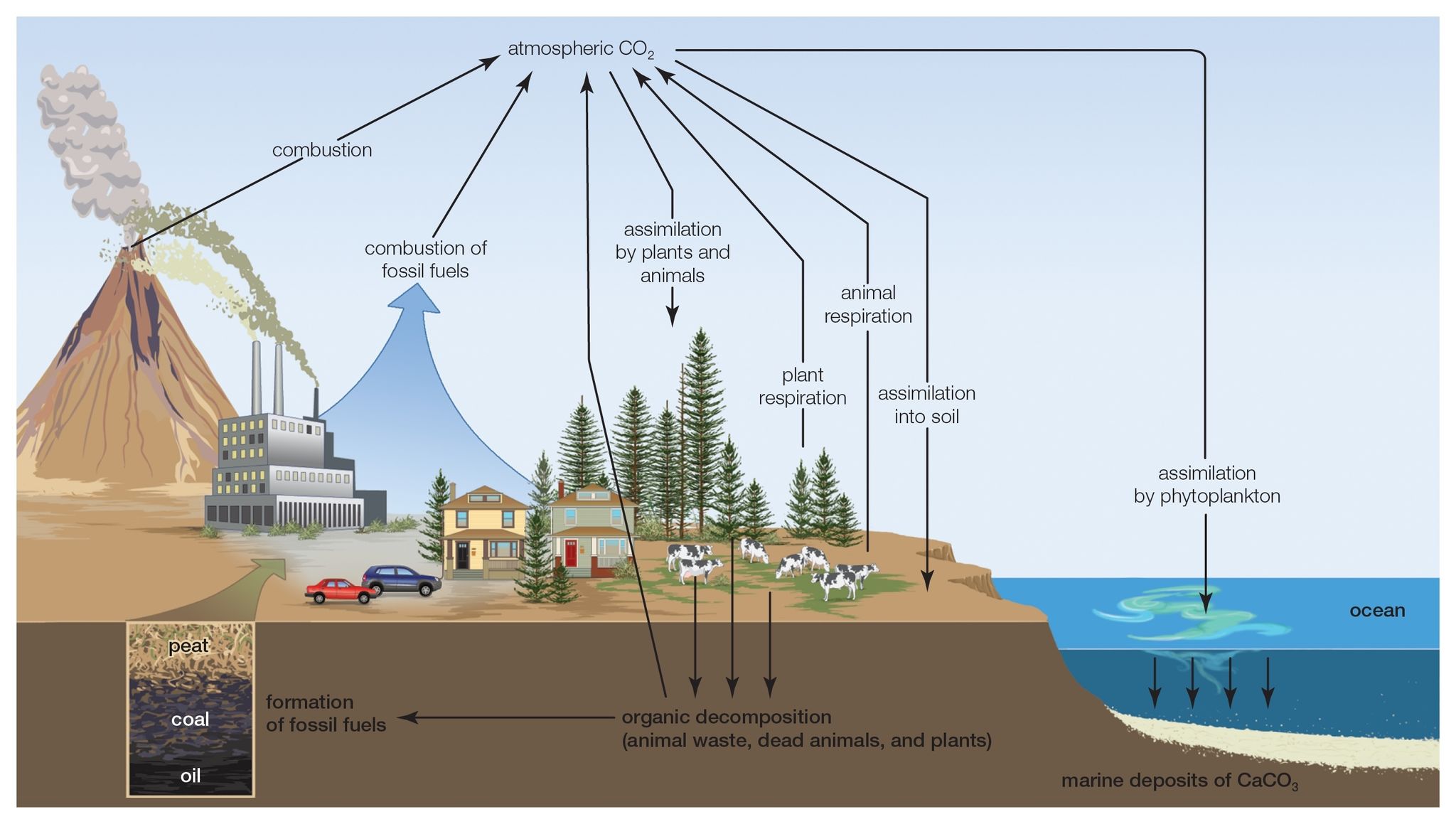
Which process contributes carbon dioxide to the atmosphere?
respiration
photosynthesis
tree farms
Which process removes carbon dioxide from the atmosphere?
deforestation
tree farms
burning fossil fuels
cellular respiration
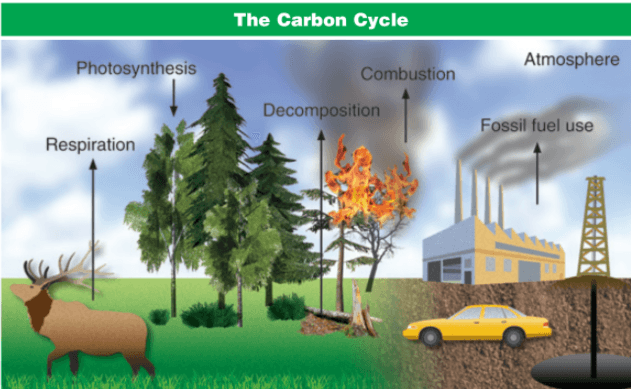
Which gas do plants release, that humans depend on for survival?
Water
Carbon Dioxide
Oxygen
Sugar
Which statement is an example of how carbon moves through a food chain as part of the cycle?
Producers release carbon dioxide, and consumers take it it.
Producers take in carbon dioxide, and consumers release it.
Producers take in carbon from the soil, and they release it when they decompose.
Producers release carbon into the soil, and consumers take it in from the soil.
What type of organism receives carbon present in dead plants and animals?
producer
primary consumer
secondary consumer
decomposer
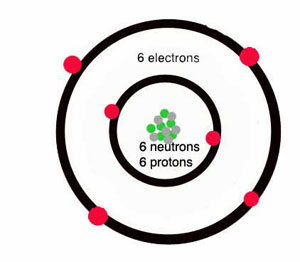
The circulation of the element Carbon among Earth's atmosphere, land, oceans, and organisms is called _____________.
the Carbon Cycle
the Oxygen Cycle
the Carbon dioxide Cycle
the Water Cycle
Which of the following are fossil fuels?
Coal, water, oil
Oxygen, coal, oil
Coal, Oil, Natural Gas
None of the above
Carbon atoms cannot be created or destroyed
True
False
Not enough information to answer
What are trade winds?
Winds that blow from south to north
Winds that blow from north to south
Winds that blow from east to west
Winds that blow from west to east
What happens during El Niño?
Trade winds strengthen and warm surface water moves eastward
Trade winds weaken and warm surface water moves westward
Trade winds strengthen and warm surface water moves westward
Trade winds weaken and warm surface water moves eastward
What are the climate impacts of El Niño?
Flooding in the Southern United States and warmer, drier conditions in the Pacific Northwest
Drought in the Southern United States and cooler temperatures, heavy rains, and flooding in the Pacific Northwest
Drought in the Southern United States and warmer, drier conditions in the Pacific Northwest
Flooding in the Southern United States and cooler temperatures, heavy rains, and flooding in the Pacific Northwest
What happens during La Niña?
Trade winds weaken and warm surface water moves eastward
Trade winds strengthen and warm surface water moves westward
Trade winds strengthen and warm surface water moves eastward
Trade winds weaken and warm surface water moves westward
What are the climate impacts of La Niña?
Flooding in the Southern United States and cooler temperatures, heavy rains, and flooding in the Pacific Northwest
Flooding in the Southern United States and warmer, drier conditions in the Pacific Northwest
Drought in the Southern United States and cooler temperatures, heavy rains, and flooding in the Pacific Northwest
Drought in the Southern United States and warmer, drier conditions in the Pacific Northwest
What is the relationship between El Niño and La Niña?
They have no relationship
El Niño and La Niña are the same phenomenon
El Niño and La Niña are opposite phases of a cycle
El Niño and La Niña occur simultaneously
What can El Niño and La Niña influence?
Only weather in Asia
Only weather in the United States
Only ocean temperatures
Extreme weather, food production, water supply, and human health
What is the impact of El Niño on the jet stream?
Weakening and southward shift
Intensification and southward shift
Weakening and northward shift
Intensification and northward shift
What is the impact of La Niña on the jet stream?
Intensification and northward shift
Weakening and northward shift
Intensification and southward shift
Weakening and southward shift
What happens when trade winds become stronger than normal?
They blow cool water back into the eastern Pacific and restart the upwelling of warm water in the western Pacific
They blow cool water back into the western Pacific and restart the upwelling of warm water in the eastern Pacific
They blow warm water back into the western Pacific and restart the upwelling of cool water in the eastern Pacific
They blow warm water back into the eastern Pacific and restart the upwelling of cool water in the western Pacific


This graphic diagrams a _______________________.
Food Web
Food Chain
Food Pyramid
Food Buffet


This is an example of which type of symbiosis?


Snails die and leave behind their shells.Hermit crabs find shells left by snails that have died and move in.
Where are you most likely to find a watershed?
In a lake
At the top of a mountain
at the bottom of a valley
everywhere
What definition best describes a watershed?
An area where water infiltrates soil
An area where aquatic plants live and thrive
An area where snow melts and changes the liquid into water
an area that collects precipitation and drains it to the lowest point
Which of the following human activities is LEAST likely to impact a watershed?
Flying in an airplane
Cutting down trees
Fertilizing towns
Reading a book
The boundaries of a watershed are determined by...
elevation
soil type
the amount of water that flows
the kind of organisms in the area
Which statement about water pollution is true?
pollution affects only the surgace of the water
pollution cannot be dissolved in water
pollution impacts both surface water and groundwater
pollution cannot travel through soil to groundwater
What do we call an area that catches water that falls to the Earth's surface and drains it over land or underground
watershed
drain pipe
funnel
stomata
As water flows it picks up...
fertilizers, oils and pesticides
sugar and spice and everything nice
sunshine, sugar, and carbon dioxide
oxygen and carbon dioxide
Watersheds are the areas that drain all the water that falls on land and are vital to life because they support
habitats
ponds
clouds
rainbows
Fertilizer can runoff land into water and cause some aquatic plants to
grow out of control
do nothing
pack their bags and move away
file a complaint with the EPA
How can you help protect watersheds (select ALL correct answers!)
clean up after your pet
stop littering
reduce amount of fertilizers and pesticides
nothing
Water travels to the lowest point because of a powerful force called
gravity
love
Spidey Sense
Riparian
Aquifers and Springs are examples of
groundwater
surface water
water table
An underground layer of permeable rock or sand that collects, holds, and conducts water is a(n)...
Lake
Pond
Aquifer
River
When an aquifer's water table reaches the surface... the groundwater is released as surface water into which TWO? [PICK 2]
Rivers
Swimming Pools
Lakes
Parking Lots
What percentage of Texas's irrigation water come from the Ogallala Aquifer?
20%
40%
60%
80%
Groundwater can flow like a river through large openings in underground ______ and marble.
Limestone
Diamonds
Coal
Concrete
Which of the following is NOT a Texas Aquifer Type?
Unconfined Aquifer
Confined (Artesian) Aquifer
Karst Aquifer
Glacier Aquifer
Springs are places where water from an aquifer flows to the surface... springs often form along ______.
Faults
Roads
Volcanos
Buildings
True/False.
Aquifers do NOT have pollutants such as gas, oil, fertilizers, and chemicals.
True
False
True/False
Aquifers are underground so there are no photosynthetic plants and no dissolved oxygen found in them.
True
False
True/False
Groundwater is recharged at the same rate it is pumped out of the ground.
True
False
We can conserve groundwater by all of the below EXCEPT-
Taking chemicals to hazardous waste disposal sites
using less fertilizer and herbicides
using impermeable materials for building
using less water from the aquifer
A confined aquifer has several parts including:
Permeable material, karst, and springs
recharge zone, permeable material, and springs
impermeable material, recharge zone, springs
permeable material, impermeable material, recharge zone and springs
Animals in ecosystems in aquifers are adapted to which of the following conditions?
Nutrient poor conditions
Aerobic conditions
no light
Nutrient poor conditions and no light
The headwaters of a river is often found at-
A spring
An unconfined aquifer
A recharge zone
A low recharge aquifer
Aquifers are habitat for unique aquatic organisms that require clean, clear, free flowing water. These ecosystems are predictable environments with constant temperature. How would drought affect these ecosystems?
Increase temperature
Decrease Spring flow
increase carrying capacity
decrease aerobic conditions
What do you call an area where water fills all of the open spaces in sediment and rock?
Zone of Aeration
Water Table
Zone of Saturation
River
What is found on top of the zone of saturation and below the zone of aeration?
River
Lake
Water basin
Water table
Why do you need to bore a hole into the zone of saturation to create a well?
It is because the well needs to be deep enough.
It is because the zone of saturation is rich in minerals.
It is because the zone of saturation contains water.
It is because the water in the zone of saturation is clean.
Which of the following is NOT a threat to ground water?
Overuse
Contamination
Land subsidence
Weathering

If a well is over-pumped... what could happen?
there will be more groundwater
less groundwater + aquifers will dry out
the water table does not change
Which spring is located close to the Texas State University campus in San Marcos, TX?
Comal Spring
San Marcos Spring
Barton Spring
Salado Spring
Which spring is locate in New Brauanfels,TX and is the largest spring west of the Mississippi River?
Comal Spring
San Marcos Spring
Barton Spring
Salado Spring
Which spring is located in Austin, TX? It is the 5th largest in the state and is used for swimming?
Comal Spring
San Marcos Spring
Barton Spring
Salado Spring

