
 Worksheets
Common Assessment 3 2025
Total questions: 35
Worksheet time: 18mins
What motivated US President Andrew Jackson to move the Cherokee westward?
Pressure from white settlers to break treaties and take valuable land.
To ensure the protection of Native Americans from French settlement.
to establish new trade networks with other Tribes.
as a reward for Native Americans with new territories west of the Mississippi.
"I believed that I was called by God to lead my people out of bondage and to strike a blow for freedom against the institution of slavery."
- Excerpt from a letter written by Nat Turner in 1831, explaining his rebellion
What can be inferred about Nat Turner's motivations for leading the rebellion?
Turner believed the rebellion was a divine mission to free enslaved people and end slavery.
Turner sought political freedom for enslaved people through peaceful negotiation.
Turner was attempting to gain independence for himself.
Turner was seeking legal rights for enslaved people.

The flyer highlights a meeting because of John Brown’s scheduled execution. What was the purpose of the meeting?
To celebrate the peaceful end on the issue of slavery.
To protest his execution and to fight against slavery in the name of God.
To support the expansion of slavery into new territories.
To encourage enslaved people to remain obedient and accept that they would be slaves their entire life.
What was the impact of the “relocation" on Native American communities?
Native Americans experienced a peaceful journey to their new lands.
Native Americans suffered during the long journey, with hardship, loss of life, and cultural disruption.
The relocation was met with celebration and excitement.
They quickly adapted to the new lands.
“I will show the world that I am not a coward, but a man, and that I am capable of doing as much for my freedom as any other man.”
- Quote credited to Denmark Vesey, 1822
Why did many slave owners in South Carolina begin to change attitudes towards slaves and their basic freedoms?
They feared that enslaved people were beginning to challenge slavery and demand their freedom.
They believed that enslaved people would eventually accept their status and stop fighting for their freedom.
They were inspired by Denmark Vesey’s leadership and decided to give enslaved people more rights and freedoms.
They saw that freeing slaves would improve the economy and social conditions in South Carolina.
Which of the following best explains how Native American culture changed as a result of the Indian Removal Act?
Native American tribes were able to maintain their traditional practices and lifestyles in the new territories.
The forced relocation led to the loss of Native American lands, causing disruption to their society.
The relocation process improved relationships between Native Americans and white settlers.
Native American societies thrived in the new territories.
Sarah Grimke continued to fight for women’s rights and the fair treatment of African Americans for the rest of her life. She was the vice president of the Massachusetts Woman Suffrage Association in 1868. A few years later, she led a group of women in Hyde Park, Boston to vote in the local election even though it was against the law. What actions did Sarah Grimke and others participate in, to attempt to spread awareness about the importance of women’s suffrage?
They held rallies and parades across the country to demand voting rights.
They voted in elections even though it was illegal for women.
They were elected to political office to change voting laws.
They asked Congress to create new voting laws for women.
How did this Supreme Court decision reflect a change in the federal government’s support of Native Americans?
The state governments followed all court rulings and allowed Native Americans their land.
The decision supported Native American rights, but the federal government didn’t enforce it.
The decision gave states control over Native American affairs, which led to Native Americans getting their land back.
The decision fully recognized Native American rights, including citizenship, by both the state and federal governments.
How did the abolitionist movement continuously challenge the denial of natural rights for enslaved people during westward expansion?
They pushed for the immediate abolition of slavery in all new states and territories.
They advocated for the emancipation but supported the expansion of slavery into western territories.
They focused on promoting Native American rights instead.
Abolitionists agreed with the expansion of slavery.
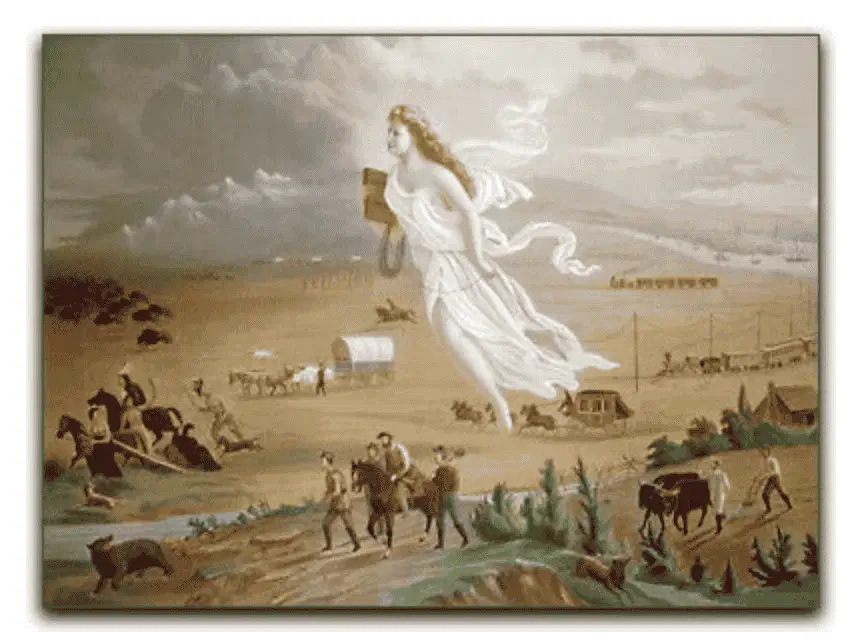
How does the painting describe possible motivations for settlers to move to western territories?
The west was land completely unsettled by any population.
Many who owned farms moved west due to the large amounts of land available
Native Americans invited settlers west.
While the government did not encourage westward expansion, many settlers moved west for adventure and possibly gold.
What was the importance of cotton in 1861?
Cotton was the largest and most profitable cash crop.
Those who farmed cotton were all forced to leave the South due to the outlawing of the slave trade.
Cotton plantations owners began a new campaign to realign themselves with the King of England.
Cotton plantation owners were unhappy with the limited amount of profit that the crop gave them.
Which factors most contributed to the expansion of Southern farming to the West during the period of westward expansion?
The availability of fertile land in the West encouraged Southern farmers to establish cotton plantations in new territories.
The discovery of gold.
The invention of new farming equipment eliminated the need for enslaved labor.
Industrial growth in the North reduced the need for agricultural expansion in the South.
How were the growth of large-scale plantations in South Carolina and the rise of Northern factories impacted during the antebellum era?
The growth of plantations led to a decrease in the demand for cotton, weakening Northern factories.
plantations in South Carolina fueled Northern factory growth and increased wealth for both
Northern factories shifted to agricultural production, reducing the importance of cotton.
Large-scale plantations in South Carolina had little impact on the development of Northern factories.
Why was the South’s economy dependent on an enslaved labor system before the Civil War?
Enslaved labor provided the expertise needed for industrial manufacturing.
The agricultural economy relied on the forced labor of enslaved people.
The south lacked natural resources and relied entirely on enslaved people to import goods.
Enslaved labor systems were introduced to reduce the costs of industrial machinery.
How were South Carolina farmers impacted by the shift from rice to cotton?
Farmers struggled as cotton had little value compared to rice in the global market.
The shift allowed farmers to rebuild their economy, as cotton required less infrastructure than rice
Farmers switched to cotton, which became a profitable cash crop, replacing rice.
The shift caused farmers to abandon agricultural production.
How did the rise and fall of rice and cotton impact South Carolina’s economic development?
The decline in cash crops made South Carolina more competitive in global markets.
The success of cash crops like rice and cotton prevented economic challenges in South Carolina.
The dependence on cash crops created initial wealth but left the economy vulnerable
The failure of cash crops encouraged South Carolina to diversify its economy immediately and avoid further decline.
What are TWO possible reasons that Vicksburg and Gettysburg are considered turning points of the Civil War? (Choose TWO)
Show the continuation of the Anaconda Plan.
Lee and other Confederate leaders eventually abandoned their plan.
Northern troops continued to lose important battles.
Southern political leaders immediately began to draw up plans to surrender after.
All slaves in all parts of the Confederacy and the United States were freed after the events of Antietam.
Why was the capture of Port Royal a priority for the United States forces in their battle against the Confederacy?
Port Royal was traditionally the power-center of South Carolina.
Port Royal was the Confederate capital of South Carolina during the war.
Port Royal was used as a Southern port to resupply its ships and launch attacks on the Confederacy.
Port Royal was rich with minerals and other expensive materials.
What was the key impact of the H.L. Hunley attack on the Union blockade?
The attack demonstrated the importance of submarine warfare.
The H.L. Hunley’s success led to an immediate surrender of the Union.
The attack resulted in a rapid shift in naval tactics, with both sides abandoning traditional ships in favor of submarines.
The H.L. Hunley's attack had no significant impact on naval warfare strategies in future conflicts.
What was the main goal of the Missouri Compromise?
To end slavery in the United States.
To maintain the balance between free and slave states.
To declare independence from the federal government.
To promote the construction of railroads.
Which statement best describes the purposes of the Missouri Compromise, the Compromise of 1850, and the Kansas-Nebraska Act of 1854?
They aimed to eliminate slavery in the United States.
They were designed to resolved conflicts over the expansion of slavery.
They were supported only by Southern politicians.
They resulted in the immediate secession of Southern states.
How did John C Calhoun feel about the impact of the tariff on the nation?
The tariff united the country under a common cause, strengthening both geographical divisions.
The tariff caused a division between two major regions of the country.
The tariff had no significant effect on the political landscape of the country.
The tariff was only a minor issue and did not affect public opinion or geographical boundaries.
Why were many who opposed slavery upset by the Fugitive Slave Law?
The law requited a jury trial for accused slaves, which led to delays in capturing runaway slaves.
The law allowed slaveholders to reclaim runaway slaves without proof or legal process.
The law required runaway slaves to be transported to those in the North, even if they had lived free in Southern states for many years.
The law imposed severe punishments on people who returned runaway slaves.
How did South Carolina's response to Lincoln's election compare to its response during the Nullification Crisis?
Both responses emphasized the state's rights to resist federal authority.
Both responses were supported by the majority of Northern citizens.
Both led to widespread military intervention by the federal government.
Both were aimed at increasing the power of the federal government.
Which of the following statements best describes the Dred Scott decision?
It united Northern and Southern states in their views on slavery.
It further polarized the North and South, leading to the Civil War.
It had minimal impact on the national debate over slavery.
It was widely accepted by both Northern and Southern leaders.
What did “free-soilers” believe about the issue of slavery in the United States?
Slavery could stay within the Southern United States, but new territories would not be allowed to own slaves.
All slavery should be banned in the United States.
Northern states could have limited amounts of slaves if they agreed to let the slaves live in a semi-free environment, owning land.
Because of limited nutrients within the soil, large plantations were not allowed to move west of the Mississippi River.
How did the Kansas-Nebraska Act differ from many earlier attempts at compromise over the issue of slavery?
Responses
It practiced popular sovereignty, placing the issue of slavery in the voters hands.
It had no legal authority to outlaw slavery or to extend the right to own slaves into any territory.
It had almost unanimous support in both the northern and southern areas of the country.
It was the first time that southern slave owners were forced to provide suitable accommodations for slaves.
What was General Sherman’s idea of warfare in the South?
He believed the Southern population should be treated with kindness because the decision to go to war was not theirs.
He sided with the Southern generals.
He believed that war should have very little limits so that the South would be demoralized and weakened.
He often attempted to wage war economically through extra tariffs on any imported goods passing through ports.
If the Anaconda Plan strategy had been fully successful, what would have been the most likely consequence for the Confederacy?
It would have strengthened the Confederacy's resolve to fight harder.
It would have cut off the Confederacy's access to international trade and supplies.
It would have immediately ended slavery in all Confederate states.
It would have forced the Confederacy to invade Northern states.
How did the attack on Fort Sumter contribute to the start of the Civil War?
It was the first time the United States government declared war on a foreign country.
The attack angered both sides, leading to an escalation in tensions and additional states seceding.
It led to the immediate end of slavery in the South.
The attack caused Northern states to agree to allow slavery in the South with certain limitations.
How did the 54th Massachusetts Regiment contribute to the Union’s efforts during the Civil War?
The 54th Massachusetts was the first all-black regiment, and their success proved African Americans could serve in the army
The 54th Massachusetts was an elite unit made up entirely of Native American soldiers, and they won the Battle of Fort Wagner with minimal casualties.
The 54th Massachusetts suffered tremendous military casualties and after this battle, many African Americans were reluctant to join the war effort.
The 54th Massachusetts had very little impact on the war effort, both during the battle of Fort Wagner or afterwards due to the inability of the regiment to fight effectively.
What was the significance of Robert Smalls’ theft of the CSS Planter?
Smalls was able to gift the ship to the Union and relay inside information to them.
Smalls left with parts for the highly valuable H.L. Hunley.
Smalls was unsuccessful and never trusted for naval missions again.
Smalls failed when he became violently seasick and was unable to raise the flag of surrender.
How did the Union victories at Charleston and Columbia affect South Carolina? (Choose 2)
The Union victories significantly weakened the Confederate government’s control over South Carolina.
The siege of Charleston and capture of Columbia had very little impact.
The Union’s total war strategy led to widespread destruction of South Carolina’s economy, roads, bridges, and railroads.
Many former plantations were redistributed to freed African Americans.
The Union victories led to increased resistance among Confederate sympathizers, resulting in guerilla warfare against Union forces in the area.
How did the cotton gin make the process of harvesting cotton easier?
The cotton gin easily removed the seeds from the cotton bolls.

