
 Worksheets
Muscle Phys Quiz
Total questions: 30
Worksheet time: 10mins
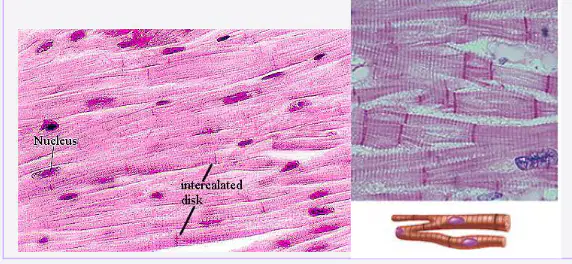
Which type of muscle is found in the walls of the heart and has intercalated discs?
Skeletal
Smooth
Cardiac
Voluntary
What role do tendons play in stabilizing joints?
Tendons extend over the joint
Tendons produce heat
Tendons maintain blood pressure
Tendons create motion
Which type of muscle is the only one under conscious control?
Cardiac muscles
Smooth muscles
Skeletal muscles
Involuntary muscles
What is the name of the connective tissue layer that covers each muscle fiber?
Epimysium
Perimysium
Endomysium
Myofibril
Which of the following is a unique oxygen-binding protein found in the sarcoplasm of muscle cells?
Hemoglobin
Myoglobin
Actin
Myosin
What is the function of the T tubule in muscle cells?
It defines the boundaries of each sarcomere.
It carries electrical signals into the cell to trigger contraction.
It contains thick filaments (myosin) with no overlap.
It runs down the center of the sarcomere.
What does the I-band in a sarcomere contain?
Thick filaments (myosin) with no overlap
Thin filaments (actin)
Both thick and thin filaments
The center of the sarcomere
What is the H-zone in a sarcomere?
It contains thick filaments (myosin) with no overlap.
It defines the boundaries of each sarcomere.
It contains both thick and thin filaments.
It runs down the center of the sarcomere.
What is the A-band in a sarcomere?
It contains only thin filaments (actin).
It contains only thick filaments (myosin).
It contains both thick and thin filaments and spans the H-zone.
It defines the boundaries of each sarcomere.
What are the two types of filaments found in myofibrils?
Actin and myosin
Troponin and tropomyosin
ATP and calcium
Sarcomeres and z-lines
What is the function of the sarcoplasmic reticulum (SR) in muscle cells?
It stores and releases calcium during contraction
It produces ATP for muscle contraction
It forms the z-line in sarcomeres
It binds actin and myosin together
What is the region called where only thick filaments are present in a sarcomere?
A band
I band
H zone
Z disc
What is the role of calcium ions in the process of muscle contraction?
They generate nerve impulses
They diffuse into the T-tubules
They trigger the contraction of muscle fibers
They block the sarcoplasmic reticulum
What action is performed by myosin heads during muscle contraction?
Myosin heads push actin filaments .
Myosin heads pull actin filaments .
Myosin heads release calcium ions.
Myosin heads bind to tropomyosin.
What happens when ATP binds to myosin during muscle contraction?
The cross bridge forms between actin and myosin.
The cross bridge releases, and actin and myosin unbind.
ATP is hydrolyzed into ADP and P.
Calcium binds to the thin filament.
What is required for muscle contraction to continue?
A continuous supply of calcium
A continuous supply of oxygen
A continuous supply of glucose
A continuous supply of sodium
What happens to the binding site on actin during muscle relaxation?
It becomes exposed
It is blocked
It binds to myosin
It releases calcium ions
What is the first step in initiating muscle contraction through action potentials?
Calcium binds to actin and myosin
ACh release through exocytosis across synaptic cleft
Nerve impulse arrives at neuromuscular junction
Depolarization causes calcium to be released
Which ion is responsible for triggering the release of synaptic vesicles at the neuromuscular junction?
Sodium (Na⁺)
Potassium (K⁺)
Calcium (Ca²⁺)
Chloride (Cl⁻)
What happens during anaerobic respiration in muscles?
Oxygen is efficiently transferred to muscle fibers
Lactic acid builds up, causing temporarily sore muscles
ATP is used efficiently for cross-bridges
Calcium levels increase in muscle tissues
What is a characteristic of fast-twitch muscle fibers?
They are aerobic.
They have explosive power.
They are for endurance.
They have steady power.

Which of the following describes the sarcolemma?
dense outer layer of connective tissue that surrounds the entire muscle tissue
connective tissue that surrounds groups of 10 to 100 or more muscle fibers
specialized plasma membrane that surrounds each muscle fiber
cytoplasm of the muscle fiber


What is used / released when ADP becomes ATP?
phosphate released / energy used
phosphate used / energy used
phosphate released / energy released
phosphate used / energy released
___are regulatory proteins that cover the myosin binding site on the actin.
troponin-tropomyosin
sarcomere
sarcolemma
sarcoplasmic reticulum
______ occurs when a muscle is overstretched by tension or forced to contract against too much resistance
Muscle soreness
Muscle cramp
Muscle strain
_____ occur mostly in muscle groups that are overloaded and fatigued during high demand activities
Muscle cramps
Contusion
Bursitis
Uses oxygen
aerobic
anaerobic
both
Which of the below is a consequence of lactic acid production?
Increased flexibility of muscles
Increased strength
Increased muscular pain & fatigue

