
Font size
 Worksheets
Am Hist 1 Semester Test (Units 1-5)
Total questions: 66
Worksheet time: 33mins
Exploration Matching
Reached Newfoundland in 932 CE.
The Vikings
Christopher Columbus
Amerigo Vespucci
Hernan Cortez
Robert LaSalle
Exploration Matching
Landed in the Caribbean in 1492.
The Vikings
Christopher Columbus
Amerigo Vespucci
Hernan Cortez
Robert LaSalle
Exploration Matching
Italian navigator and writer on a Spanish ship.
The Vikings
Christopher Columbus
Amerigo Vespucci
Hernan Cortez
Robert LaSalle
Exploration Matching
Claimed Mexico for Spain.
The Vikings
Christopher Columbus
Amerigo Vespucci
Hernan Cortez
Robert LaSalle
Exploration Matching
Claimed Louisiana for France.
The Vikings
Christopher Columbus
Amerigo Vespucci
Hernan Cortez
Robert LaSalle
In your own words (2-3 sentences) what was the Columbian Exchange?
The Natives American sided with whom during the French and Indian War?
The British
The colonists
The French
Neither
What statement best describes French relations with American Indian tribes compared to the British?
The French treated them worse by enslaving them and taking their lands.
The French forced the Natives to convert to Christianity
The French continuously fought against the Native Americans in bloody wars
The French treated the Natives with respect and were peaceful
Under the Articles of Confederation, each state's power in Congress was based on:
one vote per state.
the state's size.
the state's total population.
the state's voting population.
Why did our founding fathers originally not want a strong government?
They wanted a government similar to that of Britain
They were all Federalists
They were anarchists
They were afraid of creating another king-like government
What did Shay’s Rebellion show America about its government under the Articles of Confederation?
The US Government is too strong
State’s had too much power
The US Government is too weak
States are too weak
The _____________________ combined both of the plans proposed at the Constitutional Convention, the Virginia Plan and the New Jersey Plan, and created a two house Congress. One with equal representation and one based on population.
⅗ Compromise
Great Compromise
Compromise of 1775
Constitutional Compromise
Checks and balances refer to…
The institutional checks of power between the three branches of government
The money system used for weighing gold
The powers of the President over the states
The inability of certain rich fat cats to balance their bank accounts
Passed by Congress on September 25, 1789, the Bill of Rights are the
Pre-amble
Articles of Confederation
First 10 amendments of the Constitution
Reasons the Constitution was written
The Federalist papers written by John Jay, Alexander Hamilton and James Madison, which appeared in the New York newspapers from 1787 to 1788 were aimed to
Challenge the Constitution
Defend the Constitution
Defend the British government
Challenge the British government
The ________________________ branch has the power to make laws.
Legislative
Executive
Judicial
Senate
The president is elected to a term of:
two years.
four years.
six years.
eight years.
The "supreme law of the land" in America is:
the Constitution.
the Bill of Rights.
the Articles of Confederacy.
the Preamble.
The three main branches of the U.S. government are:
the House of Representatives, Senate, and Supreme Court.
the president, Senate, and Supreme Court.
executive, legislative, and judiciary
state, local, and federal
The _________________________ branch has the power to veto laws.
Legislative
Executive
Judicial
Extra: Our country has how many total Senators?
2
50
100
Depends on a state’s population
Which of the following is NOT true of Alexander Hamilton when he was Secretary of the Treasury?
He said: "A national debt, if it is not excessive, will be to us a national blessing."
Argued that all the states fought for freedom, so the federal government should assume all state debts.
Supported the idea of a National Bank.
All of the above are true.
What was the purpose of the Bill of Rights? (In your own words 2-3 sentences)
What debate did the Great Compromise solve? (In your own words 2-3 sentences)
Which of the Amendments is the most important to you personally and why? (In your own words 2-3 sentences)
The War of 1812 was fought between the United States and -
France
Spain
Mexico
Great Britain
The Missouri Compromise
Outlawed Slavery
Admitted Missouri as a slave state and Main as a free state
Was favored by everyone in the U.S.
Prohibited slavery in the rest of the Louisiana Purchase
B and D Only
What was the Monroe Doctrine? (In 2-3 Sentences)
Which treaty ended the War of 1812?
Treat of Ghent
Treaty of Paris
Treaty of Guadalupe-Hidalgo
Treaty of Versailles
Why was the presidency of James Monroe referred to as the “Era of Good Feelings?”
most of the country was enjoying the economic benefits of slavery
there was political unity and prosperity (success) and no fighting
there was excellent relations between the Americans and Natives
the slave trade had been banned in all areas of the United States
America's first two political parties were the -
a. Federalists and Nationalists
b. Federalists and Democratic-Republicans
c. Democrats and Republicans
d. Republicans and Nationalists
The Supreme Court case Marbury v. Madison (1803) is most closely associated with-
a. Interstate commerce
b. Foreign tariffs
c. Judicial review
d. The rights of indentured servants
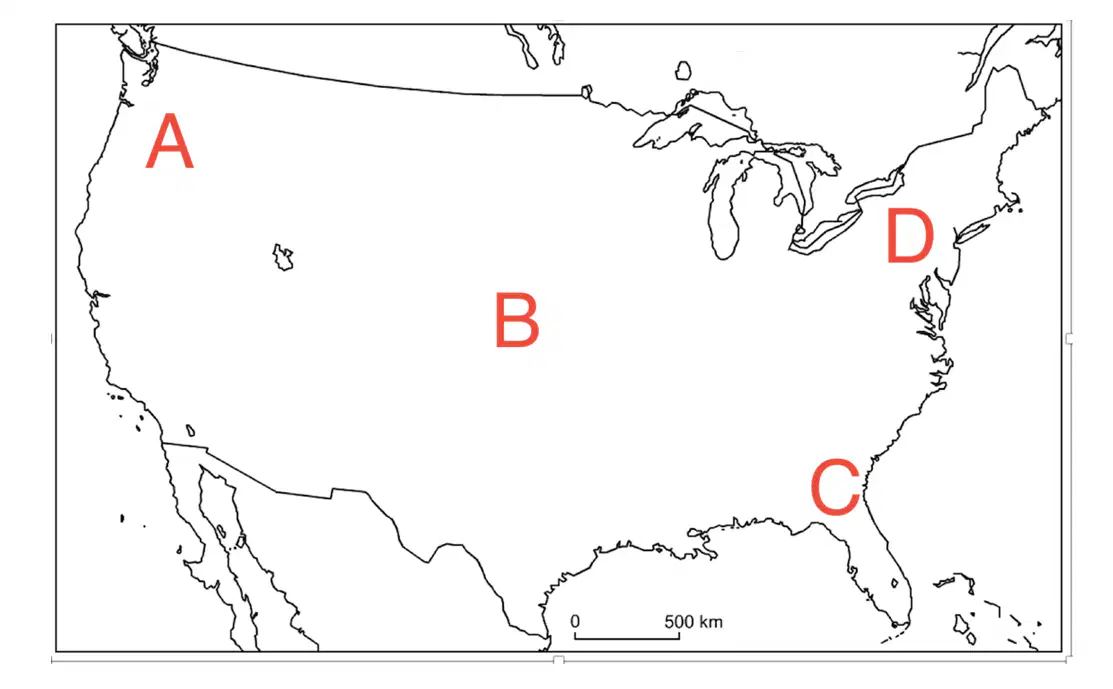
On the below map, which letter shows the approximate location of the Louisiana Purchase?
a. A
b. B
c. C
d. D
"Judicial review" is the process of--
a. Reviewing the work of federal judges and ambassadors.
b. Determining if a law is constitutional or not.
c. Evaluating the strength of state laws and judiciaries.
d. Establishing a new federal jurisdiction.
What was "impressment?" (In 2-3 Sentences)
Matching: Battles of the War of 1812
Francis Scott Key witnessed the battle and wrote a poem, which became the United States' National Anthem.
Battle of Fort McHenry
Battle of New Orleans
Battle of York
Matching: Battles of the War of 1812
Occurred after the Treaty of Ghent because word of the treaty had not yet reached the battle site.
Battle of Fort McHenry
Battle of New Orleans
Battle of York
Matching: Battles of the War of 1812
Important American victory; the British fort nearest the battle site were burned to the ground.and town
Battle of Fort McHenry
Battle of New Orleans
Battle of York
Henry Clay's "American System" for uniting the country following the War of 1812 included --
a. Ending all tariffs
b. Improvements to American infrastructure such as roads, canals, and railways.
c. The purchase of Hawaii, Guam, and the Virgin Islands from Spain.
d. Ending slavery across the United States.
The new territory brought into the U.S. by the Adams-Onis Treaty with Spain was--
a. New Mexico
b. Florida
c. Arizona
d. California
Alexander Hamilton's reason/s for supporting the idea of a National Bank was/were-
a. He wanted a bank that could print a national currency.
b. He thought it would make repaying the American war debt easier.
c. He felt that it would be a source of expanding capital for the growing U.S. economy.
d. All of the above
What was a result of the Whiskey Rebellion?
Set an example of federal law, authority, and follow-through
Made Whiskey cheaper
The farmers beat the army in a rebellion
Washington has to resign as president
After the XYZ affair when foreign ministers demanded bribes a Quasi-War broke out between the U.S. and WHO?
Great Britian
France
Spain
Barbary Pirates
The Alien & Sedition Acts empowered the President to deport "dangerous" aliens and made it criminal to make false statements critical of the government. How did the Democractic-Republicans see these Acts?
Necessary to keep the peace
Not a good idea by John Adams but what must be done
Bad but because John Adams was one of them, they had to accept it
A measure against freedom of speech
What was the effect of the French and Indian War being very costly?
The British turned to slavery to make money
The British passed new taxes on the colonists
The British began to sell part of its American lands to other countries
The French passed new taxes on the colonists
The policy practiced by England during the 17th & 18th centuries of not enforcing laws and leaving the American colonies relatively free to do as they pleased was known as:
Mercantilism
Great Awakening
Salutary Neglect
Navigation Acts
Which of the following acts limited colonists’ westward movement past the Appalachian Mountains?
Stamp Act
Intolerable Act
Declaration of Boundaries
Proclamation of 1763
Where were the first shots fired in the Revolutionary War?
Lexington and Concord
Saratoga
Yorktown
Breed’s Hill
What was the name of the radical group founded by Samuel Adams in response to higher British taxes?
Ku Klux Klan
Adams’ Raiders
Freedom Fighters
Sons of Liberty
Which event FIRST showed that tensions between the British and colonists would turn violent
Boston Tea Party
Boston Massacre
Lexington and Concord
Second Continental Congress
A former French and Indian War commander, this Virginia planter and politician was appointed commander in chief of the Continental Army during the Revolutionary War.
George Washington
Benedict Arnold
John Adams
Horatio Gates
This group of colonists sided with the views of Franklin, Patrick Henry, Thomas Paine and Thomas Jefferson during the war.
Tories
Loyalists
Separatists
Patriots
At the conclusion of the American Revolution…
The Colonists are forced to continue paying taxes to the British
The British has complete control over the colonies
The British agreed to recognize America as a new and separate country
America was now the strongest country in the world
Common Sense, written by Thomas Paine, was written to
encourage colonists to declare their independence
help fund the Lewis and Clark expedition
tell the colonists they had no sense in America
help the French win the French and Indian war
What was not a purpose of the Declaration of Independence?
Describe all the ways Britain had gone against colonists’ rights
Explain everyone has rights that a government should not ever break
Declare war on Britain
Cut ties with Britain and declare independence
Which group helped the colonists during the American Revolution by training them and increasing naval power?
British
French
Germans
Native Americans
Name 3 Important Battles of the Revolutionary War
On Christmas Night 1776, George Washington led troops across what river?
The Hudson River
The Potomac River
the Delaware River
The Cedar River
What British leader surrendered at the Battle of Yorktown?
Cornwallis
Burgoyne
Howe
Washington
What Document was Signed to officially recognize the independence of the U.S. from Great Britain?
Treaty of Versailles
The Constitution
The Declaration of Independence
The Treaty of Paris
Bacon’s Rebellion exemplified -
the growing power of former indentured servants
the colonial resentment over the Stamp Act
England’s anger over the Puritan control of Massachusetts
the ability of African slaves to rise up and rebel
Who benefited most from the system of mercantilism?
Colonies
Mother Countries
Native Americans
Africans
What was the Great Awakening
A religious revival in all Thirteen Colonies.
The rebellion of Wampanoag peoples in the New England Colonies.
The European decision to force the Iroquois people out of the Middle Colonies.
A Revival of Catholicism in Georgia
List the 13 Colonies
The Middle Passage was the:
a. land route across the isthmus of Panama to the Pacific Ocean.
b. trade route that brought captured and enslaved Africans across the Atlantic.
c. trade route that brought valuable tobacco and other crops to Europe.
d. French route from New Orleans up the Mississippi River.
What was the Triangle of Trade? (Include what parts of the world it was between and what was traded)

