
 Worksheets
1-15
Total questions: 165
Worksheet time: 1hrs 23mins
Which of the following can use economic principles to improve how they make important decisions?
A.
managers in businesses.
B.
individuals
C.
government policymakers
D.
All of the above.
Question content area top
Part 1
What is an economic model?
It is a simplified version of some aspect of economic life used to analyze an economic issue.
It is a description of an economic issue that includes all possible related information.
It is a detailed version of some aspect of economic life used to analyze an economic issue.
It is a description of an economic issue based on official government information.
Which of the following is a macroeconomic question?
What factors determine the price of iPhones?
What determines the wages and benefits of flight attendants?
How is the production quantity of wireless earbuds determined?
What determines the unemployment rate?
Which of the following contributes to the efficiency of markets?
Governments play an active role in the
day−to−day
operations of market
Markets are able to bring about an equitable distribution of goods and services.
Markets promote competition and voluntary exchange.
Markets promote equal standards of living.
What does the term "marginal" mean in economics?
an additional or extra
the edge of a market
.
illegal
secondary
Which of the following best describes an assumption economists make about human behavior?
They assume that individuals act rationally all the time in all circumstances.
They assume that people take into account the question of fairness in all decisions they make.
They assume that individuals act randomly
They assume that rational behavior is useful in explaining choices people make even though people may not behave rationally all the time.
Which of the following is an example of an economic
trade−off
that a firm has to make?
deciding what profit margin it desires for its products
whether or not consumers will buy its products
deciding why consumers want its products
whether it is cheaper to produce with more machines or with more workers
The term "market" in economics refers to
an organization which sells goods and services.
a legal institution where exchange can take place.
a group of buyers and sellers of a product and the arrangement by which they come together to trade.
a place where money changes hands.
Ted quits his
$60,000minus−aminus−year
job to be a
stayminus−atminus−home
dad. What is the opportunity cost of his decision?
the value he attributes to the joy of parenting
depends on the "going rate" for
stay−at−home
dads
at least $60,000
zero since he will no longer be earning a salary
Opportunity cost is defined as
the benefit of an activity.
the total value of all alternatives that must be given up to engage in an activity.
the highest valued alternative that must be given up to engage in an activity.
the monetary expense associated with an activity.
Allocative efficiency is achieved when
there are no shortages or surpluses in the market.
firms produce the goods and services that consumers value most.
firms produce goods and services at the lowest cost.
goods and services are fairly distributed among consumers in an economy
In a market economy, who decides what goods and services will be produced?
only the producers
consumers and producers
only consumers
the government
Economic models
A.
are simplified versions of reality.
B.
make no assumptions in order to remain as accurate as possible.
C.
can not be used to analyze
realminus−world
issues.
D.
magnify the complexity of economic issues in order to provide useful data.
Which of the following is a positive economic statement?
U.S. firms should not be allowed to outsource production of goods and services.
The government should close income tax loopholes.
If the price of gasoline rises, a smaller quantity of it will be bought.
Everyone should live at the same standard of living.
Question content area top
Part 1
Which of the following is a problem inherent in centrally planned economies?
A.
Production managers are more concerned with satisfying government's orders than with satisfying consumer wants.
B.
There are no problems and everyone, including consumers, is satisfied.
C.
Unemployment is too high.
D.
There is too much production of
low−cost,
high−quality
goods and services.
A successful market economy requires well defined property rights and
A.
an independent court system to adjudicate disputes based on the law.
B.
a safety net to ensure that those who cannot participate in the market economy can earn an income.
C.
balanced supplies of all factors of production.
D.
detailed government regulations.

The table above shows the number of labor hours required to produce a wristwatch and a pound of rice in Japan and Thailand.
If the two countries specialize and trade, who should export wristwatches
There is no basis for trade between the two countries.
Japan
Thailand
They should both be importing wristwatches.
If you can produce more of something than others with the same resources, you have
A.
a comparative advantage.
B.
an absolute advantage.
C.
a
free−market
economy
D.
an efficient production system.
A production possibilities frontier with a ________ shape indicates increasing opportunity costs as more and more of one good is produced.
bowed outward
linear
perfectly horizontal
.
bowed inward
Question content area top
Part 1
Specializing in the production of a good or service in which one has a comparative advantage enables a country to do which of the following?
never have to engage in trade with other nations
consume a combination of goods that lies outside its own production possibilities frontier
produce a combination of goods that lies outside its own production possibilities frontier
increase the variety of products that it can produce with a decrease in resources
If the best lawyer in town is also the best at making cappuccino, then according to the theory of comparative advantage, this person should
specialize in being a lawyer because its opportunity cost is lower.
pursue the activity she enjoys more.
specialize in making cappuccino because demand is higher for cappuccino than for legal services.
split her time evenly between being a lawyer and making cappuccino.
Carmelita can perform either a combination of 35 manicures and 70 pedicures or a combination of 50 manicures and 45 pedicures. If she now performs 35 manicures and 70 pedicures, what is the opportunity cost of performing an additional 15 manicures?
5 pedicures
20 pedicures
25 pedicures
45 pedicures
For each watch that Switzerland produces, it gives up the opportunity to make 50 pounds of chocolate. Germany can produce 1 watch for every 100 pounds of chocolate it produces. Which of the following is true about the comparative advantage between the two countries?
Switzerland has the comparative advantage in chocolate.
Switzerland has the comparative advantage in watches.
Germany has the comparative advantage in watches and chocolate.
Germany has the comparative advantage in watches.
Comparative advantage means
the ability to produce a good or service at a lower opportunity cost than any other producer.
the ability to produce a good or service at a higher opportunity cost than any other producer.
compared to others you are better at producing a product.
the ability to produce more of a product with the same amount of resources than any other producer.
The slope of a production possibilities frontier measures the ________ of producing one more unit of a good.
opportunity cost
marginal revenue
marginal cost
total revenue
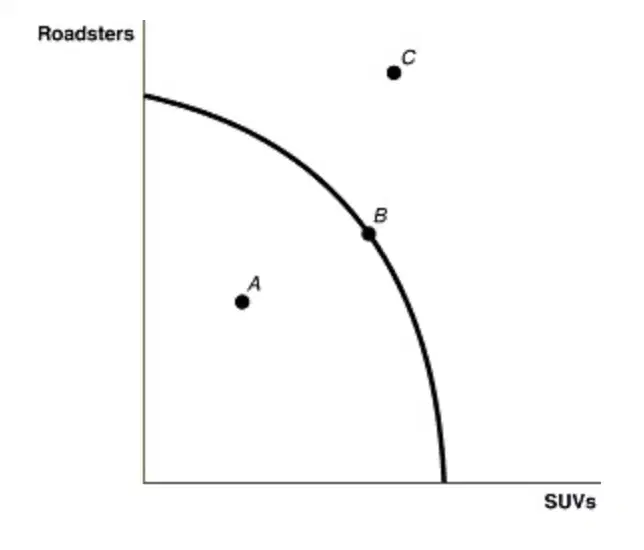
________ is (are) inefficient in that not all resources are being used.
Points A and C
Point B
Point C
Point A
The production possibilities frontier shows
the maximum attainable combinations of two products that may be produced in a particular time period with available resources.
what people want firms to produce in a particular time period.
what an equitable distribution of products among citizens would be.
the various products that can be produced now and in the future.
Which of the following is a factor of production?
the janitor at the local elementary school
a sofa produced by a furniture manufacturer
$500 in cash
20 shares of Microsoft stock
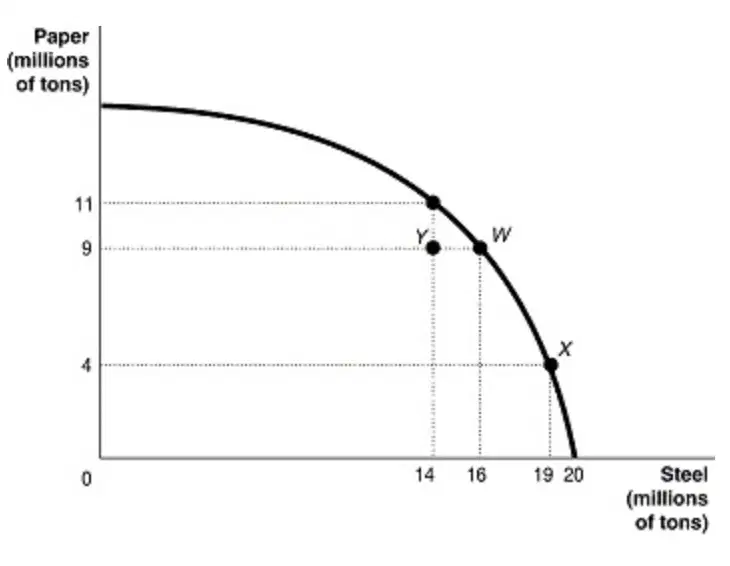
If the economy is currently producing at point
X,
what is the opportunity cost of moving to point
W?
Part 2
19 million tons of steel
5 million tons of paper
3 million tons of steel
9 million tons of paper
An outward shift of a nation's production possibilities frontier can occur due to
a natural disaster like a hurricane or bad earthquake.
a change in the amounts of one good desired.
a reduction in unemployment.
an increase in the labor force.
Protectionism is the use of ________ to protect domestic firms from foreign competition.
cheap labor
trade barriers
military force
dumping
Whenever a buyer and a seller agree to trade, both must believe they will be made better off
unless the buyer resides in a different country than the seller. International trade may make the buyer or seller worse off.
unless one party is richer than the other.
whether the buyer and seller live in the same (or different) city or country.
only if the buyer and seller live in countries with market economies.
Free trade refers to trade between countries
that is without restrictions.
that is licensed by both governments.
of products which are free to
low−income
consumers.
that is without shipping costs.
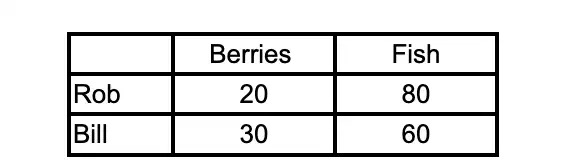
Rob Crusoe and Bill Friday spent their
week−long
vacation on a desert island where they had to find and prepare their own food. Rob and Bill spent one day each fishing and picking berries. The table lists the pounds of output Rob and Bill produced.
Use the table above to select the statement that accurately interprets the data in the table.
Bill has a greater opportunity cost than Rob for picking berries.
Bill's opportunity cost for catching fish is less than Rob's.
Rob has a greater opportunity cost than Bill for picking berries.
Bill's opportunity cost for picking berries and catching fish are both greater than Rob's.
A tax imposed by a government on imports of a good into a country is called
a tariff.
an import quota.
an import levy.
an import fine.
Dumping refers to
selling a product for a price below its cost of production.
selling inferior products to unsuspecting consumers.
exporting products that do not meet domestic safety standards.
illegally avoiding tariffs by selling products on the black market.
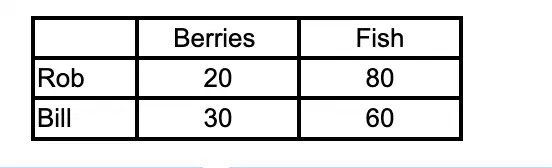
Rob Crusoe and Bill Friday spent their
week−long
vacation on a desert island where they had to find and prepare their own food. Rob and Bill spent one day each fishing and picking berries. The table lists the pounds of output Rob and Bill produced.
Use the table above to select the statement that accurately interprets the data in the table.
Bill has an absolute advantage in picking berries and Rob has an absolute advantage in catching fish.
Rob has an absolute advantage in picking berries and Bill has an absolute advantage in catching fish
Rob has an absolute advantage in picking berries and catching fish.
Bill has an absolute advantage in picking berries and catching fish.
Imports are goods and services bought domestically
and not subject to tariffs.
but produced in other countries.
and resold at a profit.
and produced domestically.
Countries gain from specializing in producing goods in which they have ________ and trading for goods in which other countries have ________.
a comparative advantage; a comparative advantage
an absolute advantage; an absolute advantage
a comparative advantage; an absolute advantage
an absolute advantage; a comparative advantage
Which of the following is common to both tariffs and quotas?
Tariffs and quotas are both used as a means to increase government revenue.
Tariffs and quotas are both designed to reduce foreign competition faced by domestic firms.
Tariffs and quotas both increase economic efficiency.
Tariffs and quotas are both examples of voluntary export restraints.
Examples of comparative advantage show how trade between two countries can make each better off. Compared to their
preminus−trade
positions, trade makes both countries better off because in each country
wages are higher.
total welfare is greater.
total employment is greater.
total consumption of goods is greater.
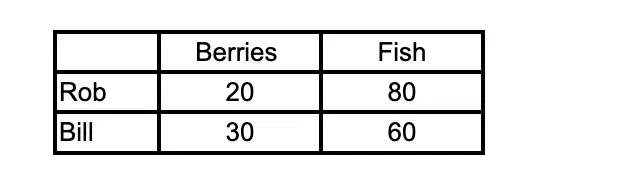
Rob Crusoe and Bill Friday spent their
weekminus−long
vacation on a desert island where they had to find and prepare their own food. Rob and Bill spent one day each fishing and picking berries. The table lists the pounds of output Rob and Bill produced.
Use the table above to select the statement that accurately interprets the data in the table.
Part 2
Rob has a comparative advantage in picking berries.
Bill has a comparative advantage in picking berries.
Bill has a comparative advantage in catching fish.
Rob has a comparative advantage in catching fish and picking berries.
A quota is
a tax imposed by a government on goods imported into a country.
a subsidy granted to importers of a vital input.
a limit placed on the quantity of goods that can be imported into a country.
a health and safety restriction imposed on an imported product.
An economic principle that explains why people pursue different occupations is
absolute advantage.
comparative advantage.
international trade.
NAFTA.
Trade that is within a country or between countries is based on the principle of
scarcity.
absolute advantage.
comparative advantage.
competition.
Question content area top
Part 1
If the United States lifts the embargo on Cuban products, what will happen in the U.S. market for Cuban cigars?
The demand curve will shift to the right.
The demand curve will shift to the left.
The supply curve will shift to the left.
The supply curve will shift to the right.
Which of the following would cause both the equilibrium price and equilibrium quantity of barley (assume that barley is an inferior good) to increase?
a drought that sharply reduces barley output
unusually good weather that results in a bumper crop of barley
a decrease in consumer income
an increase in consumer income
A change in which variable will change the market demand for a product?
A.
the number of firms in the market
B.
expected future prices
C.
the price of the product
D.
the quantity of the product supplied
In September, buyers of silver expect that the price of silver will rise in October. What happens in the silver market in September, holding all else constant?
The quantity demanded decreases.
The demand curve shifts to the left.
The demand curve shifts to the right.
The quantity demanded increases.
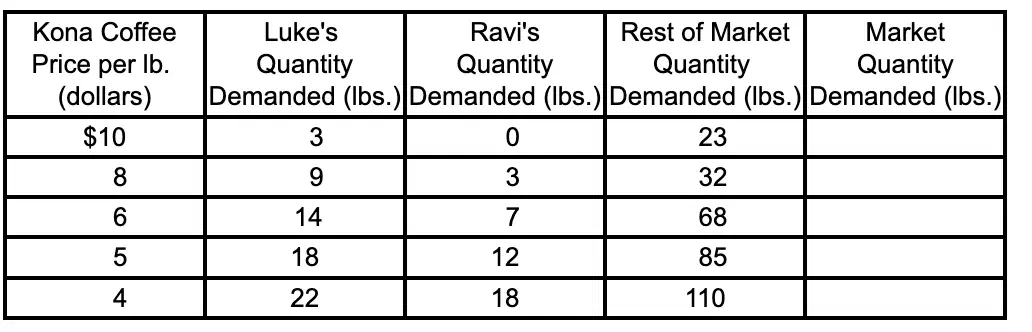
The table above shows the demand schedules for Kona coffee of two individuals (Luke and Ravi) and the rest of the market. At a price of $6, the quantity demanded in the market would be
36 lbs.
68 lbs.
89 lbs.
123 lbs.
Which of the following would cause the equilibrium price of ketchup to increase and the equilibrium quantity of ketchup to decrease?
an increase in the price of mustard, a substitute for ketchup
a decrease in the price of tomatoes
an increase in the price of tomatoes
an increase in the price of french fries, a complement for ketchup
Suppose that when the price of hamburgers increases, the Ruiz family increases their purchases of hot dogs. To the Ruiz family,
hamburgers and hot dogs are complements.
hamburgers and hot dogs are substitutes.
hamburgers and hot dogs are normal goods.
hamburgers and hot dogs are inferior goods.
Farmers can plant either corn or soybeans in their fields. Which of the following would cause the supply of soybeans to increase?
an increase in the demand for corn
a decrease in the price of corn
an increase in the price of soybeans
an increase in the price of soybean seeds
A supply curve
is a curve that shows the relationship between the price of a product and the quantity of the product that producers and consumers are willing to exchange.
is a curve that shows the relationship between the price of a product and the quantity of the product supplied.
is a table that shows the relationship between the price of a product and the quantity of the product supplied.
is the relationship between the supply of a good and the cost of producing the good.
Water bottles are considered normal goods. This means that as income increases,
Part 2
demand for water bottles should decrease.
supply of water bottles should increase.
demand for water bottles should increase.
supply of water bottles should decrease.
Which of the following would cause an increase in the supply of cheese?
an increase in the price of cheese
an increase the price of a product that producers sell instead of cheese
an increase in the number of firms that produce cheese
a decrease in the price of wine (assuming that cheese and wine are complements)
If in the market for apples the supply has decreased, then
there has been a movement upwards along the supply curve for apples.
the supply curve for apples has shifted to the left.
there has been a movement downwards along the supply curve for apples.
the supply curve for apples has shifted to the right.
At market equilibrium,
surpluses are greater than shortages.
quantity demanded equals quantity supplied.
demand equals supply.
shortages are greater than surpluses.
A(n) ________ is represented by a rightward shift of the demand curve while a(n) ________ is represented by a movement along a given demand curve.
increase in demand; increase in quantity demanded
increase in quantity demanded; increase in demand
decrease in demand; decrease in quantity demanded
increase in demand; decrease in demand
A firm has an incentive to decrease supply now and increase supply in the future if it expects that
more firms will enter the market in the future.
the prices of inputs used to produce the product will rise in the future.
the price of its product will be lower in the future than it is today.
the price of its product will be higher in the future than it is today.
Your answer is correct.
During a business cycle expansion, total production ________ and total employment ___________.
Part 2
decreases; decreases
decreases; increases
increases; increases
increases; decreases
Macroeconomics seeks to understand
economic growth, business cycles, and inflation.
product demand, product cost, and profit maximization.
public choices, private choices, and consumer maximization.
industry sales, marketing strategies, and corporate growth.
In calculating gross domestic product, the Bureau of Economic Analysis uses the sum of the market value of final goods and services produced. This means that the BEA
values goods and services at their market prices, multiplies them by the quantity produced, and then adds them up.
simply counts the total number of goods and services produced in the marketplace and then adds them up.
values goods at their market prices, multiplies them by the quantity produced, and then adds them up.
simply counts the total number of goods produced in the market place and then adds them up.
The nominal GDP of the United States in 2022 was approximately $25.5 trillion. This means that
the value of output in 2022 was around $25.5 trillion.
total spending in 2022 was around $25.5 trillion.
total income in 2022 was around $25.5 trillion.
All of the above are true.
nvestment, as defined by economists, would include the purchase of a
share of stock in ExxonMobil.
corporate bond.
government bond.
computer by an accounting firm.
To calculate GDP by the expenditure method one must add
consumption spending, investment spending, government purchases, and exports.
labor, natural resources, entrepreneurship, and capital.
wages, rents, interest, and profits.
consumption spending, investment spending, government purchases, and net exports.
In 2022, which component of GDP had a negative value?
government purchases
consumption
net exports
investment
What is the largest component of spending in the U.S.?
government purchases
investment spending
consumption spending
net investment spending
________ is/are the payment for the factor of production ________.
Profit; entrepreneurship
Interest; labor
Rent; capital
Wages; capital
Government spending ________ is included in gross domestic product.
at state and local levels of government only
on defense goods only
at federal, state, and local levels of government
at the federal level of government only
In a small economy, consumption spending is $6,000, government purchases are $1,200, gross investment is $1,500, exports are $2,000, and imports are $1,000. What is gross domestic product?
$9,700
$9,800
$10,800
$11,700
The size of the underground economy would tend to increase if the government of a country
decreased government regulations on businesses.
legalized prostitution.
increased income tax rates.
legalized drugs.
If real GDP increases we know for sure that
output has risen.
prices have risen but output has remained constant.
prices have risen.
prices have remained constant.
The GDP deflator is equal to
real GDP divided by nominal GDP.
nominal GDP divided by real GDP, multiplied by 100
real GDP divided by nominal GDP, multiplied by 100.
nominal GDP divided by real GDP.
Disposable personal income equals personal income
minus government transfer payments plus personal tax payments.
minus personal tax payments.
minus personal tax payments plus government transfer payments
plus government transfer payments.
The labor force equals the number of people
in the
working−age
population.
.
employed plus unemployed.
unemployed.
employed.

Assume the market basket for the consumer price index has two
productslong dash—meat
and
potatoeslong dash—with
the following values in 2017 and 2024 for price and quantity:
The Consumer Price Index for 2024 equals
129.
135.
125
141
According to the text, economists consider full employment to occur when
Part 2
the unemployment rate consists of only frictional and structural unemployment.
frictional unemployment equals zero.
everyone who wants a job has a job.
the sum of frictional unemployment and structural unemployment equals zero.
If firms pay what are called "efficiency wages", they pay wages that
Part 2
motivate workers to increase their productivity.
.
are lower than average to ensure maximum profit.
will eventually lower the unemployment rate.
lower the cost of production to the firm.
Question content area
Part 1
If the nominal rate of interest is 6.5% and the inflation rate is 3.0%, what is the real rate of interest?
–9.5%
-3.5%
1.5%
3.5%
If the minimum wage is set above the market wage,
Part 2
highly−skilled
workers will have a harder time finding jobs.
unemployment will rise.
the quantity of labor supplied will be below the quantity of labor demanded.
all of the above are correct.
Which of the following is the smallest portion of the market basket of goods that makes up the CPI?
food and beverages
housing
apparel
transportation
Assume the average annual CPI values for 2023 and 2024 were 207.3 and 215.3, respectively. What was the percent increase in the CPI between these two years?
Part 2
3.86
1.04
8.0
0.96
Cyclical unemployment is the result of
the search process of matching workers with jobs.
a slowdown in the economy.
a persistent mismatch between the skills and characteristics of workers and the requirements of the jobs.
the ups and downs in inflation.
The Bureau of Labor Statistics would categorize a retiree who is not working as _________.
Part 2
employed
a discouraged worker
unemployed
out of the labor force
If your nominal wage rises faster than the price level, we can say your real wage has ________ and the purchasing power of your income has ________.
Part 2
fallen; risen
risen; risen
fallen; fallen
risen; fallen
If advances in robotics, automation, and artificial intelligence lead to the elimination of jobs, and the people who held those jobs need to learn new skills to find new jobs, those people would be considered
Part 2
seasonally unemployed.
cyclically unemployed.
frictionally unemployed.
structurally unemployed.
What is outlet bias?
the tendency for households to spend their money at discount stores as prices rise
the tendency for the quality of products to improve over time even though the CPI does not measure changes in quality
the tendency for consumers to purchase newer, more technologically advanced products even though they have higher prices
the tendency for households to spend more money over time
Which of the following causes the unemployment rate to understate the true extent of joblessness?
A drug dealer reports herself as unemployed.
Discouraged workers are not counted as unemployed.
Persons who collect unemployment benefits report themselves to be searching for a job.
Many full-time workers really want to be part-time workers.

Consider the data in the table above for a simple economy. The unemployment rate for this simple economy equals
100/1,000 x 100
100/1,100 x 100
100/20,000 x 100
100/15,000 x 100
A good measure of the standard of living is
nominal GDP per capita.
real GDP per capita.
total real GDP.
total nominal GDP.
According to the "Rule of 70", how many years will it take for real GDP per capita to double when the growth rate of real GDP per capita is 5%?
Part 2
less than 1 year
14 years
35 years
5 years
Since 1900, real GDP in the U.S. has grown
Part 2
in a random unpredictable manner relative to the population.
more rapidly than the population.
more slowly than the population.
as rapidly as the population.
Which of the following is an example of human capital?
a factory building
a computer
.
a college education
a software program
The total amount of physical capital available in a country is know as the country's
capital stock.
investment.
.
labor productivity.
savings.
Borrowers are ________ of loanable funds, and lenders are ________ of loanable funds.
suppliers; demanders
suppliers; suppliers
demanders; demanders
demanders; suppliers
Technological advances generally result in
decreased incomes.
increased average number of hours worked per day.
increased life expectancy.
increased infant mortality rates.
Countries with high rates of economic growth tend to have
a lower life expectancy at birth.
longer workweeks.
a labor force that is more productive.
a declining incidence of business cycle fluctuations.
When the economy enters a recessionary phase of the business cycle, unemployment tends to
decrease.
be unchanged.
increase
change in the same direction as the rate of inflation.
The response of investment spending to an increase in the government budget deficit is called
expansionary investment.
income minus net taxes.
crowding out
private dissaving.
An increase in the demand for loanable funds will occur if there is
a decrease in the real interest rate.
an increase in the real interest rate.
an increase in the nominal interest rate accompanied by an equal increase in inflation.
an increase in expected profits from firm investment projects.
There is a federal budget deficit when
taxes are too high.
the government spends less that it collects in taxes.
the government spends more that it collects in taxes.
the government spends the same amount it collects in taxes.
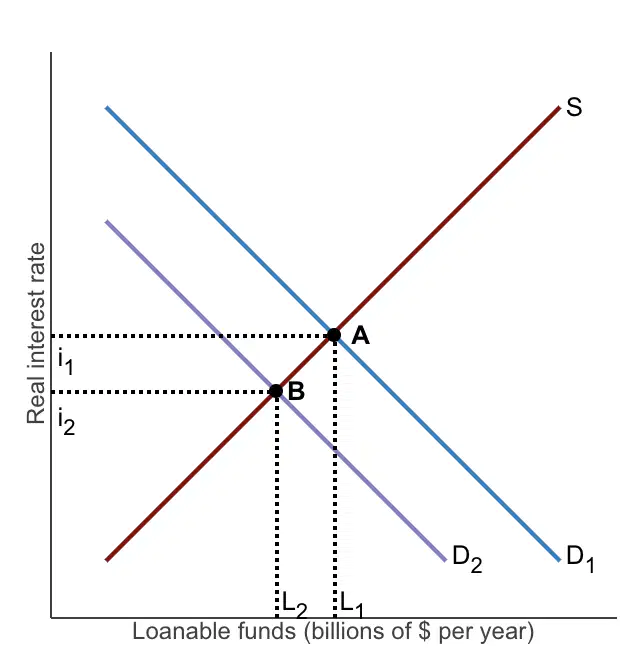
Refer to the diagram. Which of the following is consistent with the diagram?
Part 2
Investment spending is declining due to crowding out
The government runs a budget surplus.
New government regulations decrease the profitability of new investment.
An expected expansion increases the profitability of new investment.
If real GDP per capita measured in 2009 dollars was $6,000 in 1950 and $48,000 in 2024, we would say that in 2024, the average American could buy ________ times as many goods and services as the average American in 1950.
12
1/8
8
4
Which of the following increases labor productivity?
a decline in health of the population
an increase in the aggregate hours of work
decreases in the availability of computers and factory buildings
inventions of new machinery, equipment, or software
Over the past 60 years, deaths among children have
.
declined in most high-income countries and have remained relatively unchanged in most low-income countries.
declined in nearly all countries, including most low-income countries.
remained relatively unchanged in most high-income countries and have declined in most low-income countries.
declined in most high-income countries and have risen in most low-income countries.
Disease, poor nutrition, and substandard health care in developing nations can reduce growth in an economy by
reducing human capital.
increasing labor productivity.
increasing technological change.
reducing physical capital.
When additions of input to a fixed quantity of another input lead to progressively smaller increases in output, we say we are facing
accelerating returns.
decreasing production.
negative returns.
diminishing returns.
The term "brain drain" refers to
the negative impact on brain function of an individual's overinvestment in human capital.
the diminishing returns to studying for an exam.
highly educated individuals who leave developing countries for
high−income
countries
the decreased quality of the
collegeminus−educated
workforce.
According to Joseph Schumpeter, economic growth is achieved through
Part 2
removing the entrepreneur from the production function.
focusing only on making old products better rather than inventing new ones.
a process termed creative destruction.
centralizing economic production.
Countries that are more globalized tend to have
Part 2
a higher likelihood of war or revolution.
lower levels of real GDP per capita.
higher growth rates in real GDP per capita.
lower levels of foreign direct investment.
High income countries have _________ and _________ as compared to developing countries.
low rates of savings; low rates of growth
low rates of savings; high rates of growth
high rates of savings; high rates of growth
high rates of savings; low rates of growth
The purchase or building by a corporation of a facility in a foreign country is called
Part 2
globally−directed
investment.
foreign portfolio investment.
foreign direct investment.
foreign capital depreciation.
Enforcing property rights in an economy will
decrease the level of foreign portfolio investment.
encourage corruption and expand the underground economy.
raise the level of investment.
cause the market system to work less efficiently.
The best measure of a country's standard of living is
real GDP per capita.
real GDP per labor hour.
real GDP per unit of capital.
total nominal GDP.
According to new growth theory,
centrally-planned economies are the most efficient.
technological change is influenced by economic incentives.
growth in real GDP per capita occurs only if there are increasing returns.
economic growth is determined by forces outside the control of the market system.
How can freedom of the press promote economic growth?
A free press can be more easily swayed to report only one side of any issue.
A free press reduces the likelihood that judges will protect private property rights.
A free press can act as a watchdog for corruption, increasing the chances for economic growth.
A free press does not promote economic growth.

Refer to the diagram to the right. Based on the per-worker production function, if the economy raises capital per hour worked from $35,000 to $40,000, by how much will real GDP per hour worked increase?
2000
5000
150
1850
The period of time from 1,000,000 B.C. to 1300 A.D. was a period of
moderate economic growth.
rapid and sustained economic growth.
no sustained economic growth
slow and steady economic growth.
Significant economic growth did not begin in the world until
Part 2
1000 A.D.
1820 A.D.
1750 A.D.
the 20th century A.D.
Assuming the economy is initially at full employment, a decrease in aggregate demand in the economy will have what effect on macroeconomic equilibrium in the long run?
Part 2
The price level will rise, and the level of GDP will fall.
The price level will fall, and the level of GDP will fall.
The price level will fall, and the level of GDP will be unaffected.
The price level will rise, and the level of GDP will be unaffected.
An increase in aggregate demand results in a(n) ________ in the ________.
Part 2
recession; short run
recession; long run
expansion; long run
expansion; short run

Refer to the figure to the right. Ceteris paribus, a decrease in government spending would be represented by a movement from
AD1
to
AD2.
AD2
to
AD1.
point A to point
B.
point B to point
A.
In the dynamic aggregated demand and aggregate supply model, inflation occurs if
the AD curve shifts to the left and the SRAS curve shifts to the right.
the AD curve shifts to the left and the LRAS curve shifts to the right.
the SRAS curve shifts more to the right than the AD curve.
the AD curve shifts more to the right than the LRAS curve.
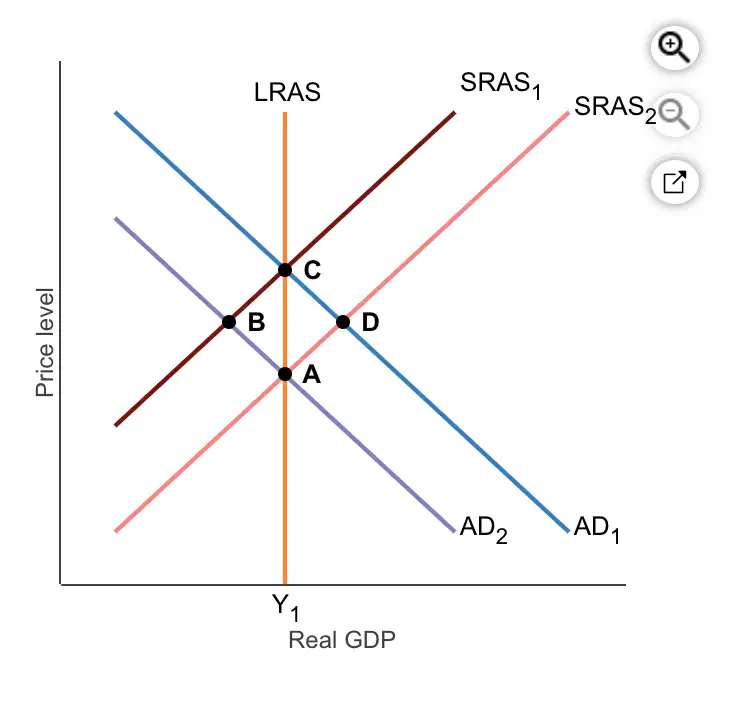
Refer to the figure. Suppose the economy is at point
A.
If the economy experiences a negative supply shock, where will the eventual short-run equilibrium be?
A
B
C
D
Changes in the price level
increase the level of aggregate supply in the long run only at very high levels of output.
.
do not affect the level of aggregate supply in the long run.
increase the level of aggregate supply in the long run.
decrease the level of aggregate supply in the long run.
Suppose a developing country receives more machinery and capital equipment as foreign entrepreneurs increase the amount of investment in the economy. As a result,
the long run aggregate supply curve will shift to the left.
the economy will move up along the long run aggregate supply curve.
the long run aggregate supply curve will shift to the right.
the economy will move down along the long run aggregate supply curve.
Which of the following will shift the aggregate demand curve to the left, ceteris
paribus?
an increase in interest rates
an increase in disposable income
an increase in expected profits for firms
an increase in net exports
Higher personal income taxes
Part 2
increase aggregate demand.
increase disposable income.
decrease aggregate demand.
both B and C.
Interest rates in the economy have fallen. How will this affect aggregate demand and equilibrium in the short run?
Part 2
Aggregate demand will rise, the equilibrium price level will rise, and the equilibrium level of GDP will rise.
Aggregate demand will fall, the equilibrium price level will rise, and the equilibrium level of GDP will fall.
Aggregate demand will rise, the equilibrium price level will fall, and the equilibrium level of GDP will rise.
Aggregate demand will fall, the equilibrium price level will fall, and the equilibrium level of GDP will fall.
Stagflation occurs when
inflation rises and GDP rises.
inflation falls and GDP falls.
inflation rises and GDP falls.
inflation falls and GDP rises.
Potential GDP refers to the level of
nominal GDP in the long run.
nominal GDP in the short run.
real GDP in the short run.
real GDP in the long run.
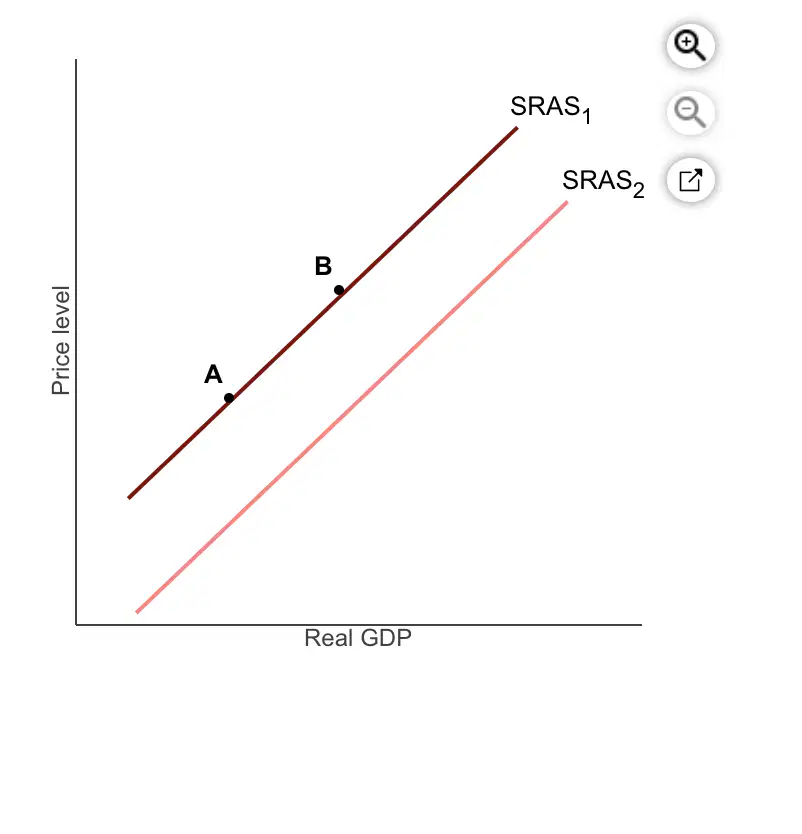
Refer to the figure to the right. Ceteris
paribus,
an increase in the labor force would be represented by a movement from
SRAS1
to
SRAS2.
SRAS2
to
SRAS1.
point A to point
B.
point B to point
A.
Which of the following is one explanation as to why the aggregate demand curve slopes downward?
Decreases in the U.S. price level relative to the price level in other countries lower net exports.
Decreases in the price level raise the interest rate and increase investment spending.
Decreases in the price level raise real wealth and increase consumption spending.
Decreases in the price level raise the interest rate and increase consumption spending.
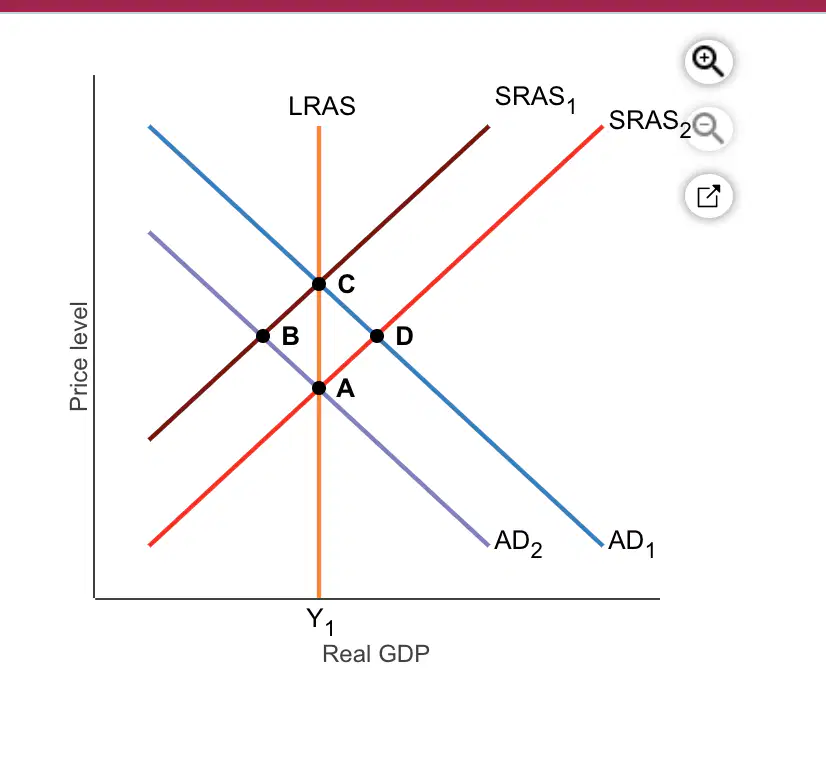
Refer to the diagram to the right. Suppose the economy is at point A. If investment spending increases in the economy, where will the eventual long run equilibrium be?
A
B
C
D
Which of the following assets is most liquid?
a house
stock
money
bond
A central bank can help stop a bank panic by
calling in consumer loans.
raising the required reserve ratio.
acting as a lender of last resort.
decreasing income taxes.
Question content area
Part 1
The seven members of the Board of Governors of the Federal Reserve are appointed by
Part 2
the Governors of the States.
Congress.
leaders in the banking industry
the President.
The new Keynesians emphasize the importance of
rational expectations.
the monetary growth rule.
real causes of the business cycle.
sticky wages and prices.
Dollar bills in the modern economy serve as money because
Part 2
people have confidence that others will accept them as money.
they have value as a commodity independent of their use as money.
they are backed by the gold stored in Fort Knox.
they can be redeemed for gold by the central bank.
If workers and firms have rational expectations, they form their expectations using
only information provided to them by the government.
only information gathered from random sources.
all the information available to them.
only information from the past.
The statement, "My iPhone is worth $700" represents money's function as
Part 2
a unit of account.
a standard of deferred payment.
a medium of exchange.
a store of value.
The most liquid measure of money supply is
M2
M1
M3
M10
L
If a person withdraws $500 from his/her savings account and puts it in his/her checking account, then M1 will ________ and M2 will ________.
increase; not change
not change; increase
increase; decrease
not change; not change
Question content area
Part 1
Silver is an example of a
Part 2
fiat money.
representative money.
commodity money.
barter money.
How many Federal Reserve Districts are there in the Federal Reserve System?
Part 2
1
6
12
18
Typically, a bank's largest asset is its
loans
holdings of securities.
deposits of its customers.
reserves
Question content area
Part 1
When banks make loans, they
Part 2
increase the money supply.
decrease deposits.
increase reserves.
decrease the money supply.
Bank reserves include
vault cash and deposits with the Federal Reserve.
vault cash and loans to bank customers.
loans to bank customers and deposits with the Federal Reserve.
customer checking accounts and vault cash
In 1980, one Zimbabwean dollar was worth 1.47 U.S. dollars. By the end of 2008, the exchange rate was one U.S. dollar to 2 billion Zimbabwean dollars. When an economy experiences rapid increases in the price level such as what occurred in Zimbabwe, the economy is said to experience
stagflation.
inflation
hyperinflation
deflation
Inflation targeting refers to conducting ________ policy so as to commit the central bank to achieving a ________.
monetary; publicly announced level of inflation
monetary; zero inflation rate
fiscal; zero inflation rate
fiscal; publicly announced level of inflation
To reduce the inflation rate, the Fed would implement a(n) ________ monetary policy by ________ its target for the federal funds rate.
expansionary; raising
expansionary; lowering
contractionary; raising
contractionary; lowering

In the federal funds market represented in the figure, the discount rate is represented by
A
B
C
D
Statements by the Federal Open Market Committee about how it will conduct monetary policy in the future describes the monetary policy tool called
forward guidance.
floor operations.
gerrymandering.
quantitative easing.
Which of the following statements about inflation targeting is true?
Inflation targeting by the central banks in other countries has not lowered inflation.
.
Inflation targeting would not reduce the flexibility of monetary policy to address other policy goals.
Inflation targeting would make it easier for households and firms to form accurate expectations of future inflation, improving their planning and the efficiency of the economy.
Inflation targeting would not allow the central bank the flexibility to take action against a severe recession.
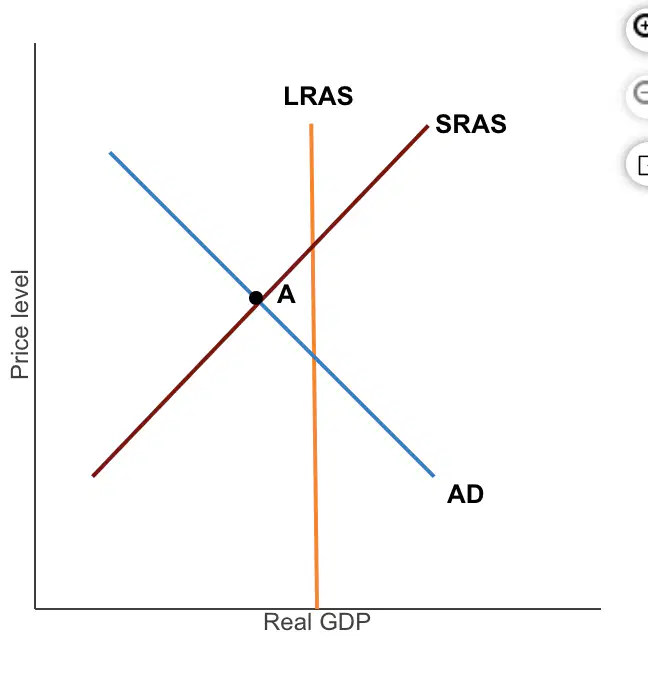
In the figure, if the economy is at point
A,
the appropriate monetary policy by the Federal Reserve would be to
lower interest rates.
lower income taxes.
raise income taxes
raise income taxes
The Fed's preferred measure of inflation is
the GDP deflator.
the consumer price index.
the index of leading economic indicators.
the core personal consumption expenditures price index.
Monetary policy refers to the actions the
Federal Reserve takes to manage government spending and taxes to pursue its economic objectives.
President and Congress take to manage interest rates to pursue their economic objectives.
President and Congress take to manage government spending and taxes to pursue their economic objectives.
Federal Reserve takes to manage interest rates to pursue its economic objectives.
Your roommate is having trouble grasping how monetary policy works. Which of the following explanations could you use to correctly describe the mechanism in which the Fed can affect the economy through monetary policy? Increasing the money supply
lowers the interest rate, raises the value of the dollar, lowers the prices of exports, and raises net exports.
lowers the interest rate, and firms increase investment spending.
raises the interest rate and consumers decrease spending on durable goods.
causes people to spend more because they have more money.
The main way the Fed can influence aggregate demand is through its ability to affect
the money supply.
interest rates.
the unemployment rate.
the demand for money.
Which of the following describes what the Fed would do to pursue an expansionary monetary policy?
The Fed would lower the interest rate on reserve balances (IORB) to achieve a new, lower target for the federal funds rate.
The Fed would lower the interest rate on reserve balances (IORB) to achieve a new, higher target for the federal funds rate.
The Fed would raise the interest rate on reserve balances (IORB) to achieve a new, higher target for the federal funds rate.
The Fed would raise the interest rate on reserve balances (IORB) to achieve a new, lower target for the federal funds rate.

Question content area
Part 1
In the federal funds market represented in the figure, the interest rate on reserve balances is represented by
A
B
C
D
The federal funds rate is the interest rate
the Fed pays to banks on reserve balances.
the Fed charges banks for overnight loans.
the Fed pays for overnight reverse repurchase agreements
banks charge each other for overnight loans.
When the Federal Reserve was established in 1913, its main policy goal was
encouraging strong economic growth.
keeping employment high.
preventing bank panics.
promoting price stability.
To increase the equilibrium federal funds rate in an ample-reserves regime, the Fed would
raise the discount rate.
raise the interest rate on reserve balances.
conduct an open market sale of treasury securities.
make an open market purchase of Treasury securities.

