
 Worksheets
Characteristics of Civilization and Sumerian Written Language
Total questions: 38
Worksheet time: 57mins
What is the name of the written language created by the Sumerians?
Hieroglyphics
Cuneiform
Latin
Sanskrit
What was cuneiform primarily used for?
Writing stories and poems
Keeping permanent records
Creating art and designs
Teaching children to read
Which of the following is an example of a pictograph?
A symbol for water
A mathematical equation
A paragraph of text
A musical note
Who were the Sumerian Scribes?
Farmers who grew crops
Warriors who fought in battles
Important record keepers
Traders who sold goods
Why were things carved into stone by the Sumerians?
To decorate their homes
To ensure people would never forget
To create toys for children
To build strong walls
What do we tend to think of as technology today?
The latest 'Tech' like TVs, computers, and software.
Only tools used in ancient times.
Anything that does not make life easier.
Only books and paper.
What was technology considered to be before modern 'Tech'?
Anything that made people's lives easier.
Only electronic devices.
Only machines and gadgets.
Anything that made life harder.
Which of the following is a technological advancement made by the Sumerians?
The Compass
The Wheel
The Printing Press
The Telescope
What was one of the key innovations by the Sumerians in agriculture?
Irrigation Systems
Solar Panels
Fertilizer Machines
Greenhouses
Which of the following structures is associated with Sumerian technological advancements?
Arches
Skyscrapers
Suspension Bridges
Domes
What farming tool was developed by the Sumerians?
Plow
Tractor
Harvester
Seeder
What are some examples of arts included in a highly developed culture?
Paintings, Architecture, and Music
Sports, Technology, and Science
Literature, Mathematics, and Physics
Agriculture, Trade, and Economy
Who were included as artisans in ancient times?
Metalworkers and designers
Farmers and traders
Soldiers and hunters
Teachers and scribes
What structures did architects design in ancient times?
Temples and ziggurats
Houses and markets
Bridges and roads
Ships and harbors
What was music believed to bring?
Entertainment for sculptors
Joy to gods and people
Decorations for temples
Rituals for feasts

What is a common feature of all civilizations?
All civilizations have advanced technology.
All civilizations have some kind of religious system.
All civilizations have a monarchy.
All civilizations have the same language.

What do all religions include?
A set of beliefs in a god or gods and various forms of worship.
A set of rules for government.
A focus on science and technology.
A belief in only one god.
What role did religious beliefs play in the daily life of people in Sumer?
They had no influence on daily life.
They influenced many parts of daily life.
They were only important during festivals.
They were ignored by the people.
What was one of the effects of religion on the people of Sumer?
It helped people connect to one another.
It caused people to live in isolation.
It made people stop working together.
It had no effect on the people.
What activities were part of Sumerian religious ceremonies?
Sports competitions
Music and sometimes human sacrifice
Trade and commerce
Farming and irrigation
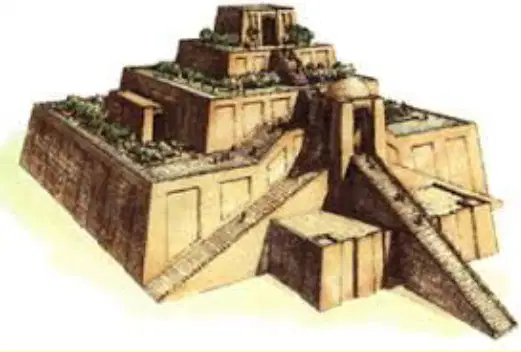
What were the religious towers built by kings called?
Pyramids
Ziggurats
Temples
Castles
Why did ziggurats have stairs?
So kings could climb to the top for a better view
So gods could walk down to Earth and priests could walk up to ask for blessings
To make it easier to build the structure
To store food and supplies
Why do civilizations have a system of government?
To make life chaotic
To make life orderly
To create confusion
To avoid rules
What type of government did Sumerian city-states have?
Democracy
Monarchy
Republic
What did Sumerian kings believe about their authority?
They were chosen by the people.
They were supported by the Gods.
They were elected through voting.
They were born into royalty.
What was one of the main responsibilities of Sumerian kings?
Enforcing laws and collecting taxes.
Farming and trading goods.
Building houses for citizens.
Writing poetry and songs.
What does a complex organization of different jobs at different levels represent?
Social structure
Economic system
Government hierarchy
Educational system
What is the role of every person in a social structure?
To compete for higher levels
To make sure the society succeeds
To focus only on their own needs
To eliminate lower levels
What do higher levels in a social structure represent?
Less money and lower status
More money and higher status
Equal money and status for all
No money and no status
Which class is at the bottom of the social structure pyramid?
Upper Class
Middle Class
Lower Class
Slaves
Why do social structures use a pyramid shape?
Because pyramids are easy to draw.
Because the higher you go up, the less people there are.
Because pyramids are strong structures.
Because pyramids represent equality.
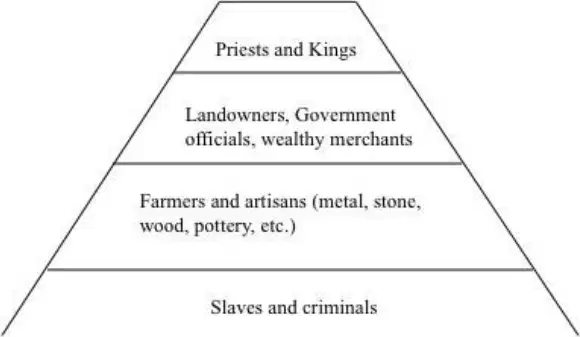
What group of people was at the top of the Sumerian social structure?
Farmers and Artisans
Priests and Kings
Slaves and Criminals
Landowners and Merchants
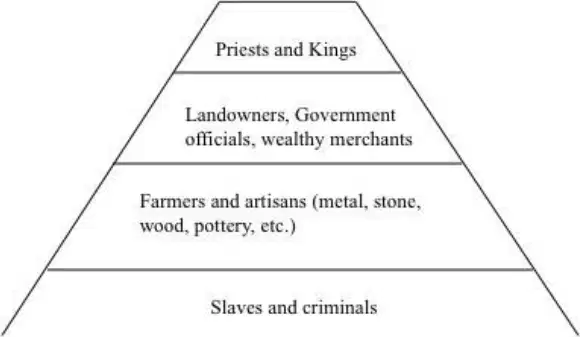
Which of the following groups were part of the working class in the Sumerian social structure?
Farmers and Artisans
Priests and Kings
Slaves and Criminals
None of the above
Why do civilizations need a stable food supply?
To survive and grow
To build houses
To travel long distances
To create art
What does food limit in a society?
The number of animals in the area
The number of people a society can support
The amount of water available
The number of schools in a city
What were the two key ideas the Sumerians developed to create a stable food supply?
Irrigation systems and plow
Irrigation systems and wheel
Plow and writing system
Wheel and writing system
What is the purpose of an irrigation system?
To transport goods
To provide water for crops
To build houses
To prepare soil for seeds
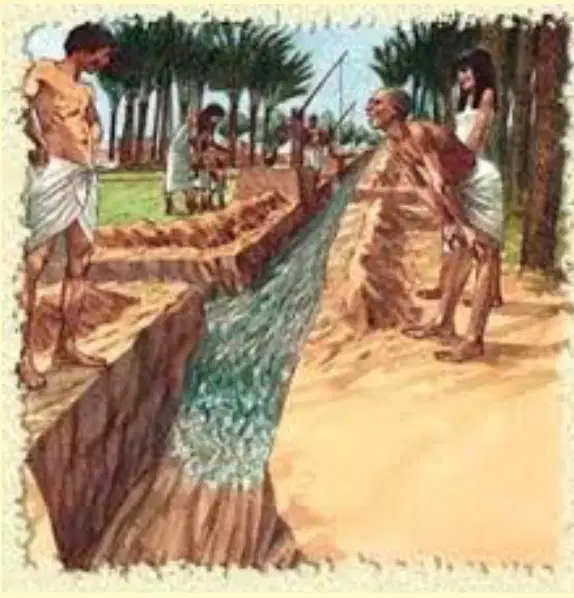
What did the Sumerians build to provide their crops with a regular water supply?
Networks of canals, dams, and reservoirs
Networks of wells and fountains
Networks of rivers and lakes
Networks of pipelines and tanks

