
 Worksheets
Definition and Types of Compensation
Total questions: 79
Worksheet time: 40mins
Which statement best defines employee compensation in a business context?
Benefits provided during recruitment events
Money given for overtime hours only
Only wages and salaries paid each month
All forms of pay or rewards from employment
Which items are classified as direct financial payments?
Flexible work scheduling
Wages or salaries
Insurance coverage
Paid vacation
Commission or incentives
Which option is an indirect financial payment?
Onsite gym access during breaks
Performance bonus for quarterly results
Recognition certificate at annual gala
Employer-paid health insurance coverage
An employee receives a year-end bonus and monthly salary. How should these be categorized?
Salary is indirect; bonus is non-financial
Both are direct financial payments
Bonus is indirect; salary is non-financial
Salary is direct; bonus is direct
Which example best illustrates non-financial compensation?
Paid vacation time each summer
Flexible work scheduling options
Sales commission on each deal
Employer-funded insurance plan
Which combination correctly pairs compensation type with example?
Direct financial — insurance coverage
Non-financial — wages or salaries
Direct financial — onsite gym
Indirect financial — paid vacation
A company introduces onsite gyms to improve satisfaction. What compensation type is this?
Direct financial payment
Indirect financial payment
Non-financial payment
Deferred financial payment
Which set includes only compensation elements with monetary value paid directly to employees?
Wages, commission, bonuses
Insurance, paid vacation, wages
Flexible scheduling, bonuses, gyms
Commission, gyms, insurance
Which payment method primarily compensates employees for time spent working rather than output quantity?
Performance bonus schemes
Sales commission structures
Time related pay systems
Piece rated pay systems
A salesperson earns a percentage of each sale. What type of direct financial payment is this?
Fixed salary arrangement
Time related wage system
Incentive or commission
Year-end bonus payment
Which options describe pay tied to performance rather than just hours worked?
Manager performance incentives
Incentive or commission programs
Piece rated payment systems
Standard hourly wages
An employee receives an extra payment for completing a project exceptionally well. This payment is best classified as:
Routine salary disbursement
Base pay adjustment
Time related wage increase
Performance-based bonus
Which statement correctly contrasts time-related and piece-rated systems?
Time-related pays per hour; piece-rated pays per unit
Time-related pays per unit; piece-rated pays per hour
Both pay per performance; neither pays per time
Both pay fixed salary regardless of output
Which statement best distinguishes indirect financial payments from non-financial payments in employee compensation?
Indirect mandates government benefits, non-financial removes salary
Indirect pays hourly bonuses, non-financial provides overtime cash
Indirect reduces taxes owed, non-financial increases wages directly
Indirect gives cash equivalents, non-financial gives experiences
An employer expands benefits without increasing salaries. Which options are examples of benefits that fit this approach? Select all that apply.
Paid time off and flexible schedules
Health insurance coverage for employees
Monthly cash wage supplements
Tuition reimbursement for professional courses
Why are most employer-provided benefits categorized as indirect financial payments or non-financial payments?
They compensate without direct wage payments
They always exceed base pay amounts
They are legally required for all firms
They replace performance-based bonuses
Which statement best describes normal weekly working hours historically practiced in Malaysia?
About 48 hours per week, six days
About 36 hours per week, four days
About 40 hours per week, five days
About 56 hours per week, seven days
An employee works beyond normal hours on an ordinary working day. What overtime multiplier applies to the hourly rate?
3 times the normal hourly rate
2 times the normal hourly rate
1.5 times the normal hourly rate
1.25 times the normal hourly rate
Which overtime rate applies when work is performed on a designated rest day?
3 times the normal hourly rate
1.5 times the normal hourly rate
2 times the normal hourly rate
2.5 times the normal hourly rate
Public holiday overtime in Malaysia is typically compensated at what rate?
Equal to the normal hourly rate
1.5 times the normal hourly rate
2 times the normal hourly rate
3 times the normal hourly rate
Which situation exemplifies shift work?
Workers choose any start time daily
All staff follow the same fixed schedule
Two teams rotate outside standard hours
Employees work fewer hours weekly
What distinguishes flexitime from other working hour systems?
Workers decide start and stop within limits
Employer fixes all start and end times
Work occurs only on nights and weekends
Hours always exceed normal weekly limits
Which statement best defines part-time work in this context?
Work with variable night shifts each week
Work requiring overtime on public holidays
Work measured by tasks completed daily
Work with weekly hours below full-time
Select all scenarios that correctly match the overtime multipliers in Malaysia.
Ordinary day overtime paid at 1.5x
Rest day overtime paid at 2x
Flexitime overtime paid at 2.5x
Public holiday overtime paid at 3x
Which scenario best illustrates a split shift arrangement?
Working 9am–5pm with a paid lunch
Working 10am–2pm, break 2pm–5pm, 5pm–9pm
Working nights permanently, 11pm–7am daily
Working different shifts each day of week
In a split shift, the long break between work blocks is typically
Counted as on-call duty
Unpaid time off work
Paid as overtime hours
Converted into flex hours later
A global remote worker attends morning meetings 7am–10am, then resumes 2pm–7pm. What total hours do they work in the day?
Nine hours total
Eight hours total
Seven hours total
Six hours total
Which statement accurately defines a rotating shift?
Employees work two blocks separated by a long break
Employees swap shifts only during holidays
Employees change shifts across different days
Employees keep the same fixed shift weekly
Select all characteristics commonly associated with rotating shifts.
May rotate daily, weekly, or monthly
Always include unpaid mid-day breaks
Often disrupt sleep patterns
Require employees to change departments
Which option best contrasts rotating and permanent shifts?
Rotating shifts vary; permanent shifts stay constant
Rotating shifts require fewer staff overall
Both rotate monthly by policy
Permanent shifts always include split breaks
A restaurant cook works 10am–2pm, off 2pm–5pm, then 5pm–9pm. What business need does this schedule primarily address?
Inventory audits at midnight hours
Covering lunch and dinner rush periods
Mandatory training during off days
Reducing total weekly headcount

Which statement best describes statutory benefits in employment?
Benefits offered only to managerial staff
Benefits voluntarily provided by employers
Benefits mandated under specific labor laws
Benefits negotiated in individual contracts

Which Acts commonly underpin statutory employee benefits in Malaysia?
SOCSO Act
Company Income Tax Act
Employment Act
EPF Act
An employer introduces free gym memberships. How should this benefit be classified?
Statutory benefit under Employment Act
Statutory benefit under SOCSO Act
Non-statutory benefit, employer discretionary
Statutory benefit under EPF Act

Select all examples that fit non-statutory benefits.
Performance bonuses
Flexible working hours
Government-mandated social insurance
Mandatory provident fund contributions
How many days of maternity leave are female employees entitled to under the updated Employment Act in Malaysia?
98 days total entitlement
88 days total entitlement
90 days total entitlement
100 days total entitlement
Which statement best describes statutory paternity leave entitlement in Malaysia?
Fourteen days per confinement maximum
Seven days per year maximum
Ten days per confinement maximum
Seven days per confinement maximum
What is the minimum weekly rest entitlement for employees covered by Malaysia’s Employment Act?
Two rest days each week
One rest day each week
One rest day each month
Alternate weekly rest days
In Peninsular Malaysia, what is the minimum number of paid gazetted public holidays per year?
Sixteen days annually
Fourteen days annually
Eleven days annually
Nine days annually
How many paid public holidays are the minimum in Sabah each year?
Eleven days minimum
Sixteen days minimum
Fourteen days minimum
Twelve days minimum
How many paid public holidays are the minimum in Sarawak each year?
Fourteen days minimum
Eighteen days minimum
Sixteen days minimum
Eleven days minimum
An employee with less than 2 years’ service is entitled to how many days of paid annual leave per year?
8 days per year
10 days per year
12 days per year
6 days per year
For employees with 2–5 years of service, what is the annual leave entitlement?
10 days each year
12 days each year
14 days each year
16 days each year
Employees with more than 5 years’ service receive how many days of paid annual leave per year?
16 days annually
18 days annually
20 days annually
14 days annually
What is the paid sick leave entitlement for employees with less than 2 years of service?
12 days per year
14 days per year
16 days per year
18 days per year
For employees with 2–5 years of service, how many days of paid sick leave are provided annually?
16 days each year
18 days each year
22 days each year
20 days each year
What is the maximum number of sick leave days per year if an employee is hospitalized?
30 days maximum
45 days maximum
60 days maximum
75 days maximum
Which statement best describes the core purpose of the Employees Provident Fund (EPF)?
To subsidize employer payroll costs
To ensure retirement savings for workers at age 60
To fund public healthcare and schooling
To provide short-term unemployment assistance
To insure workers against workplace injuries only
An employee aged 35 earns RM1,000 monthly. What is the employee’s EPF contribution and which account does it go to?
RM120 to 2nd account
RM110 to 2nd account
RM120 to 1st account
RM110 to 1st account
Which group is generally not required to become EPF members?
Private sector clerks
Domestic servants
Retail supervisors
Manufacturing technicians
What EPF withdrawal condition is highlighted for active workers?
Withdraw at age 55 while still working
Withdraw only after age 60
Withdraw after ten years of service
Withdraw only if unemployed
Withdraw anytime with employer consent
For employees below 60, what are the statutory EPF contribution rates?
Employer 1.25% of wages
Employee 11% of wages
Employer 12% of wages
Employee 0.5% of wages
What is the primary aim of SOCSO contributions?
To guarantee retirement annuities
To cover work accidents and occupational diseases
To subsidize union membership fees
To fund public sector pensions
Under SOCSO Employment Injury and Invalidity Schemes (below 60), what are the contribution rates?
Employer 1.75% and Employee 0.5%
Employer 12% and Employee 11%
Employer 0.5% and Employee 1.75%
Employer 1.25% only
A 58-year-old employee earns RM1,000 monthly. Calculate net salary after EPF (employee) and SOCSO (employee) deductions shown: EPF 11%, SOCSO 0.5%.
RM890 net salary
RM900 net salary
RM885 net salary
RM895 net salary
For employees aged 60 and above who are still working, how is SOCSO Employment Injury Scheme funded?
Employee 1.25% only
Employer 1.25% only
Employee 0.5% and Employer 1.75%
Shared 0.625% each
Which option best illustrates a non-statutory time-off payment an employer might offer?
Paid leave for marriage ceremonies
Unpaid leave for routine errands
Mandatory overtime without pay
Government-funded holiday allowance
Health care benefits are often valued by employees primarily because of which factor?
Rising cost of medical care
Declining need for medical visits
Guaranteed government coverage
Elimination of private clinics
Employer-provided insurance typically includes which categories beyond social security?
Life insurance group policies
Accident insurance group policies
Pet insurance wellness plans
Travel insurance for vacations
Financial services offered to employees commonly include which support?
Loans to buy houses and cars
Free luxury vacations annually
Speculative stock grants weekly
Lottery tickets as incentives
Which scenario best fits educational assistance as a non-statutory benefit?
Access to libraries and digital learning files
Government vouchers for public transit
Free gym memberships every weekend
Mandatory unpaid training after hours
An employer increasing its EPF contribution on behalf of employees is an example of which benefit area?
Health care benefits category
Retirement benefits category
Financial services category
Subsidies and services category
Which options are typical employee subsidies and services? Select all that apply.
Transportation to and from work
Personal home renovation grants
Canteens for meals
Childcare facilities
Which item is LEAST likely to be covered by employer loans in typical financial services?
Purchase of family houses
Purchase of daily groceries
Purchase of private cars
Purchase of personal computers
Choose the best distinction between statutory and non-statutory benefits in this context.
Non-statutory benefits are voluntary employer offerings
Non-statutory benefits are government-mandated programs
Statutory benefits exclude insurance options entirely
Statutory benefits always include club memberships
Which combination best matches categories with examples of non-statutory benefits?
Mandatory taxes deducted from payroll
Time-off payments for personal emergencies
Health care payments for medical services
Educational assistance via learning resources
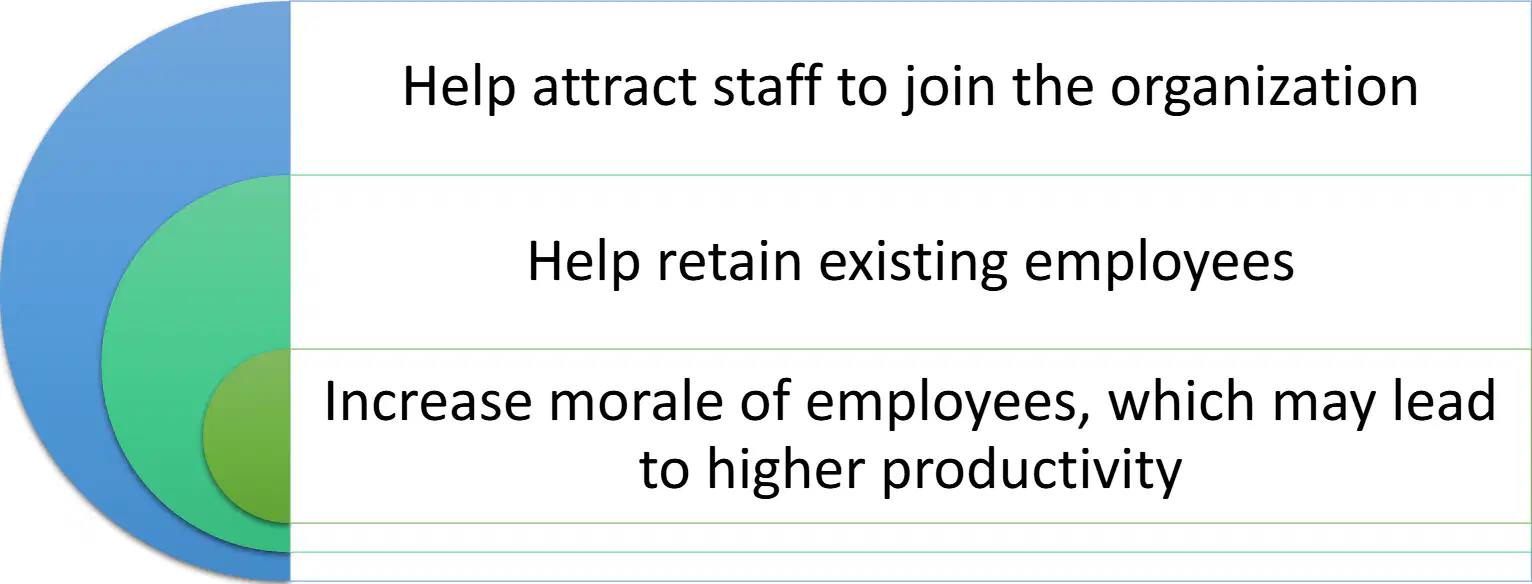
Which outcome is most directly linked to higher employee morale from a strong benefits package?
Immediate revenue growth in new markets
Lower onboarding costs across departments
Reduced absenteeism and higher productivity
Faster product development timelines
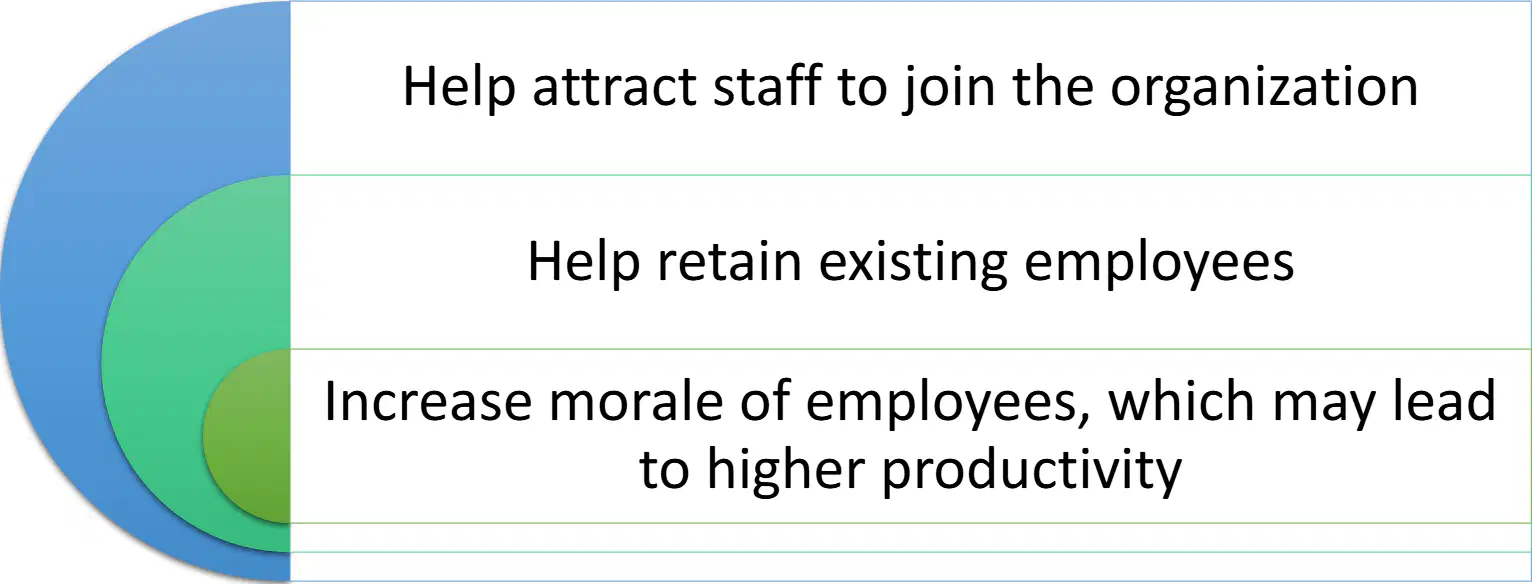
An organization wants to reduce turnover. Which benefits-related focus is most relevant to that goal?
Productivity increases through performance bonuses
Employee morale via social events
Employee retention through valued benefits
Employee attraction through market-leading perks
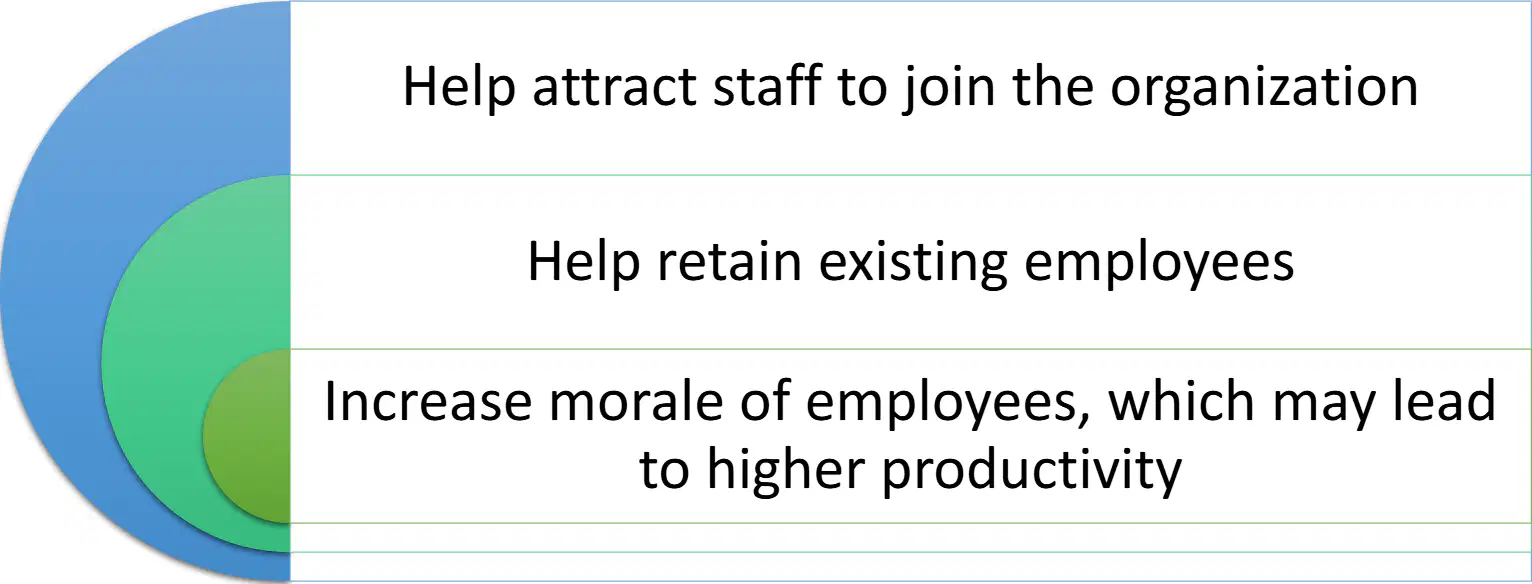
Select all reasons benefits matter for organizations.
They eliminate the need for competitive pay
They increase morale which can raise productivity
They help retain existing employees
They help attract new staff
Which outcome best reflects the purpose of incentives in a reward system?
Reduce workload across teams
Drive behaviour to higher levels
Limit competition between peers
Encourage employees to avoid risks
A company wants its reward scheme to be effective. Which features should it emphasize?
Let many employees be winners
Be perceived as fair
Drive suitable behaviours
Offer unpredictable payouts
Which statement describes a key benefit of well-designed performance incentives?
They reduce collaboration permanently
They eliminate pay differences
They minimize employee ambition
They help retain the best performers
Which pair correctly lists the two broad types of rewards used by organizations?
Intrinsic and extrinsic only
Cash and equity only
Financial and non-financial
Short-term and long-term
Which tactic would most directly create healthy competition through rewards?
Reward only seniority consistently
Rotate prizes regardless of results
Tie bonuses to measurable performance
Publish random monthly winners
An employee’s salary rises following strong performance. What type of reward is this?
Wage increment
Job enrichment
Flexible scheduling
Recognition certificate
Why might wage increments motivate employees to work harder?
They guarantee lifetime employment
They remove team objectives
They link pay to performance
They reduce job complexity
A one-time payment for outstanding performance in a specific activity is best described as:
Salary adjustment
Performance bonus
Retention bonus
Commission plan
Which items are non-financial rewards rather than financial?
Professional development
Public recognition
Wage increments
Cash bonuses
To be perceived as attractive, a reward scheme should primarily:
Match employee preferences
Ignore market practices
Focus only on cost cutting
Avoid clear performance links

