
 Worksheets
Unit 6.3 Post Test Study Guide
Total questions: 58
Worksheet time: 32mins
Why does the Sun heat Earth unevenly?
Because of Earth's tilt, curvature, and surface materials
Because of Earth's distance from the Sun
Because of Earth's atmosphere
Because of Earth's gravity
What does uneven heating of Earth cause?
Differences in temperature and air pressure
Differences in gravity
Differences in Earth's rotation
Differences in Earth's orbit
Fill in the blank: Uneven heating of Earth creates ________, global wind patterns, and ocean currents.
Wind
Mountains
Rainbows
Volcanoes
Which heats up and cools down faster?
Land
Water
During the daytime, air moves from ________ to ________.
sea to land
land to sea
mountain to valley
valley to mountain
During the nighttime, air moves from ________ to ________.
land to sea
sea to land
mountain to valley
valley to mountain
Global winds are caused by:
Uneven heating of Earth and Coriolis Effect
Earth's gravity and rotation
Ocean currents and temperature
Earth's magnetic field
Air moves from ________ pressure to ________ pressure.
high pressure to low pressure
low pressure to high pressure
medium pressure to high pressure
low pressure to medium pressure
At the poles, is the air pressure high or low?
High pressure
Low pressure
Medium pressure
No pressure
What are ocean currents driven by?
Wind
Convection
Salinity
All of the above
Warm currents bring ______ climates.
mild, wet
cold, dry
hot, arid
freezing, snowy
Cold currents bring ______ climates.
cool, dry
warm, wet
hot, humid
mild, rainy
Surface water is usually ______.
warm
cold
salty
frozen
Deep water is usually ______.
cold
hot
dry
sticky
Temperature differences create ______ currents that move water vertically (up and down).
density
tidal
surface
wave
Coastal cities have ______ temperatures because water absorbs and releases heat slowly.
moderate
extreme
unstable
frigid
Which state has a wider temperature range due to being far from the ocean?
Florida
North Dakota
What is the energy source for the water cycle?
the Sun
the Moon
the Wind
the Oceans
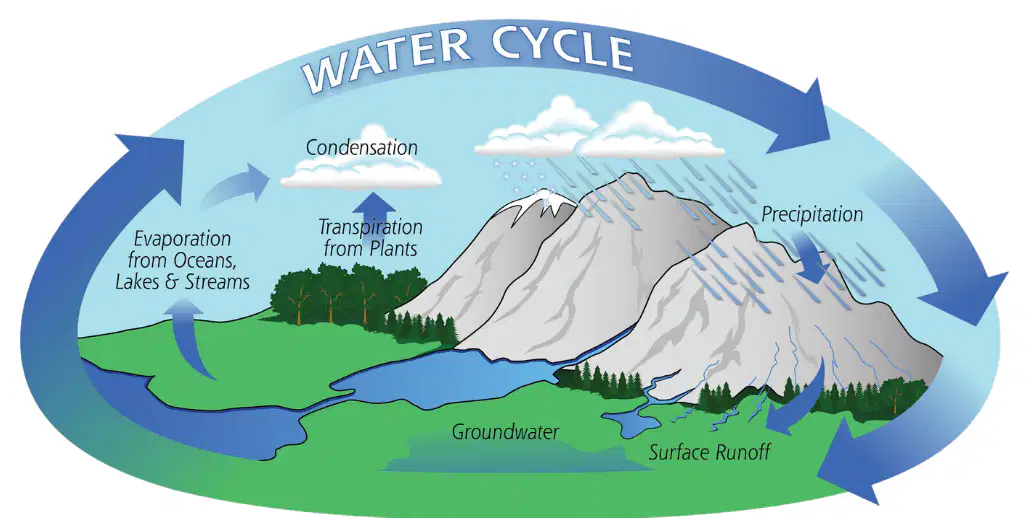
In the water cycle, what is the process called when liquid water turns into vapor?
Evaporation
Condensation
Precipitation
Transpiration
Fill in the blank: __________ is the process where plants release water vapor.
Transpiration
Photosynthesis
Respiration
Condensation
Fill in the blank: __________ is when vapor turns into clouds.
Condensation
Evaporation
Precipitation
Sublimation
Fill in the blank: __________ is the term for rain, snow, sleet, or hail falling from the sky.
Precipitation
Evaporation
Condensation
Transpiration
Fill in the blank: __________ is when water flows across land.
Runoff
Evaporation
Condensation
Precipitation
Fill in the blank: __________ is water stored underground.
Groundwater
Rainwater
Surface water
Evaporation
Which type of pressure system is associated with clear skies and calm weather?
High pressure (H)
Low pressure (L)
Cold front
Warm front
Which type of pressure system is associated with cloudy, rainy, and stormy weather?
High pressure (H)
Low pressure (L)
Cold front
Warm front
Which type of front brings cooler temperatures within 24 hours?
High pressure (H)
Low pressure (L)
Cold front
Warm front
Which type of front brings warmer, wetter weather?
High pressure (H)
Low pressure (L)
Cold front
Warm front
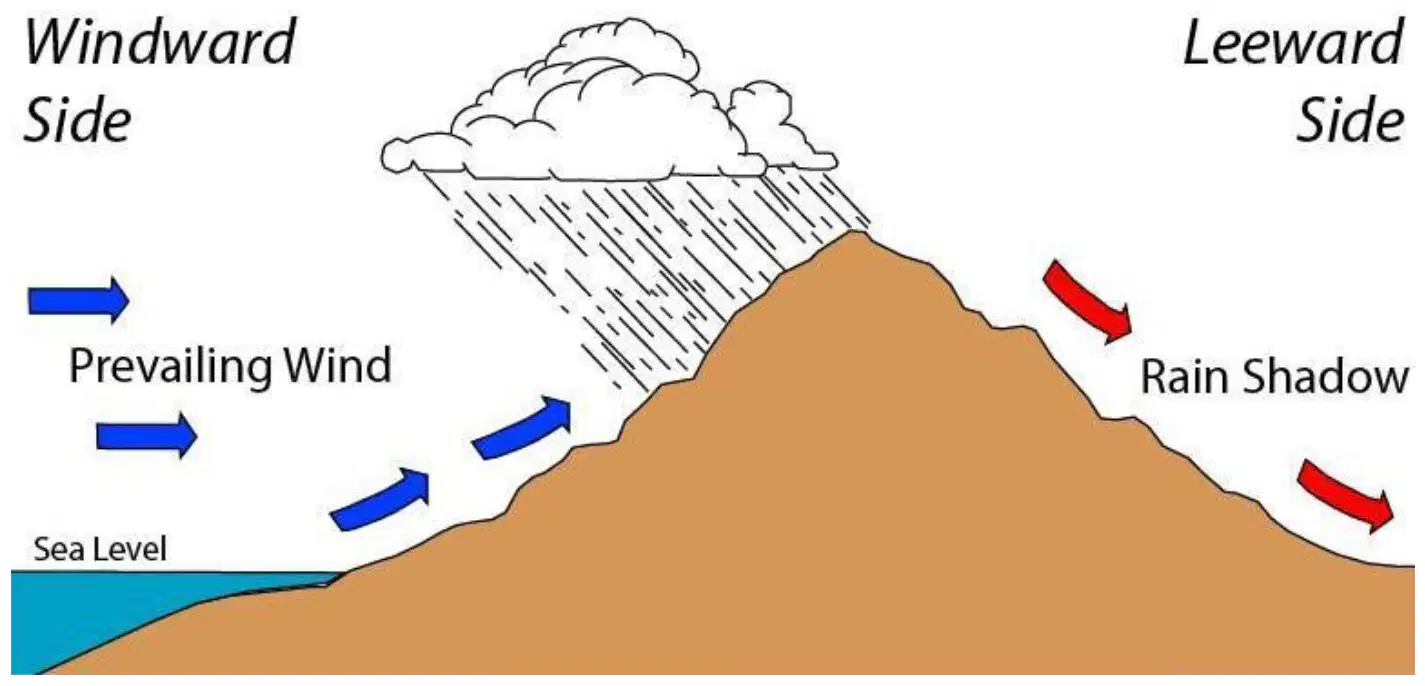
On which side of the mountain does the rain shadow occur?
Windward Side
Leeward Side
Convection: ____________ (Fill in the definition)
Movement caused by warm air/water rising and cold air/water sinking
Transfer of energy through direct contact of particles
Transfer of energy by electromagnetic waves
Movement of particles from high to low concentration
Density: ____________ (Fill in the definition)
How compact matter is; denser water sinks
The amount of heat in a substance
The speed at which an object moves
The color of an object
Coriolis Effect: ____________ (Fill in the definition)
The curving of winds and currents due to Earth's rotation
The increase in temperature due to greenhouse gases
The movement of tectonic plates causing earthquakes
The process of water evaporating from oceans
Ocean Current: ____________ (Fill in the definition)
Continuous movement of ocean water driven by wind, temperature, and salinity
Sudden rise of ocean water due to underwater earthquakes
Temporary increase in sea level caused by storms
Layer of warm water floating above cold water in the ocean
Evaporation: ____________ (Fill in the definition)
Liquid water changes to vapor
Vapor changes to liquid water
Solid ice changes to vapor
Liquid water freezes into ice
Transpiration: ____________ (Fill in the definition)
Plants releasing water vapor
Plants absorbing sunlight
Plants taking in carbon dioxide
Plants producing seeds
Condensation: ____________ (Fill in the definition)
Water vapor cooling and forming clouds
Water turning into ice directly
Clouds turning into rain
Sunlight evaporating water
Precipitation: ____________ (Fill in the definition)
Rain, snow, sleet, or hail
Evaporation of water from leaves
Movement of tectonic plates
Photosynthesis in plants
Runoff: ____________ (Fill in the definition)
Water running over land back to rivers/oceans
Water evaporating from the surface
Water freezing into ice
Water being absorbed by plants
High-pressure system: ____________ (Fill in the definition)
Sinking air bringing fair weather
Rising air causing storms
Warm air meeting cold air
Rapidly falling temperatures
Low-pressure system: ____________ (Fill in the definition)
Rising air bringing clouds and rain
Sinking air bringing clear skies
No change in weather conditions
High temperatures and dry weather
Sea breeze: ____________ (Fill in the definition)
Daytime wind from ocean → land
Nighttime wind from land → ocean
Wind blowing from mountains to valleys
Wind blowing from desert to forest
Land breeze: ____________ (Fill in the definition)
Nighttime wind from land → ocean
Daytime wind from ocean → land
Nighttime wind from ocean → land
Daytime wind from land → ocean
During the day, wind blows:
From land → water
From water → land
Both directions
It does not move
Global wind patterns are caused by
Ocean currents
Uneven heating of Earth
Coriolis effect
Hurricanes
Air pressure is highest at the poles. Wind moves:
Cold air from poles → equator
Warm air from poles → equator
Cold air from equator → poles
Warm air from equator → poles
Salt water sinks because:
It is hotter
It traps heat
It dissolves faster
It is denser
Warm water rises at the equator. Cool water sinks at poles. This describes:
Local surface waves
Tropical mixing only
Convection currents in oceans
Hurricanes
Deep ocean water is colder than surface water. This temperature difference causes:
A. Tides
B. Cyclones
C. Waves
D. Currents
Wind blowing warm water toward Indonesia results in:
Peru = wet; Indonesia = dry
Both dry
Peru = dry; Indonesia = wet
Both wet
Miami Beach has moderate temperatures because:
Less rainfall
Gulf Stream warm current
Dry air mass
Atlantic cold air
The Sun’s role in the water cycle:
Precipitation only
Without the Sun, cycle stops
Needed only for clouds
Needed only for runoff
High pressure = ____ ; Low pressure = ___
Stormy; calm
Calm; stormy
Both stormy
Both calm
A cold front approaching city P will likely make temperatures:
Drop
Rise
Stay the same
Become stormy then hot
Label the diagram.
Colder
Warmer
Click the location on the globe where you would find the warmest temperatures

What type of front is currently passing over Dallas, TX? (a)
What type of front will pass over Savannah, GA? (a)
Cold Front
Stationary Front
Occluded Front
Warm Front

Mr. Cottingham’s class built a homemade barometer to track the air pressure throughout the day. As they made markings on the paper they noticed that the air pressure was lower and lower throughout the day. They can use this data to predict (a) .

