
 Worksheets
ANIMAL FARM REVISION GRADE 8
Total questions: 41
Worksheet time: 17mins
Select all statements that accurately describe George Orwell.
His pen name was George Orwell; his birth name was Eric Arthur Blair.
He was a Victorian poet known for writing epics about kings.
He wrote Animal Farm and Nineteen Eighty-Four.
He served as a colonial police officer in Burma before becoming a writer.
What is an allegory?
A story with hidden meaning that teaches a moral lesson
A direct reference to a historical event
The author's main message in a text
A brief introduction to a literary work
Circle the correct answer. The author's purpose refers to:
The moral of the story
The historical context
The reason why the author wrote the text
The characters in the story
Circle the correct answer. A prologue is:
The middle section of a story
The final chapter
An introductory section before the main work
A list of vocabulary words
Circle the correct answer. When you make an educated guess based on evidence in the text, you are making:
A fable
An allegory
A satire
An inference
A fable is best described as:
A lengthy novel
A short story that teaches a moral lesson
A political commentary
a story which has animals instead of humans
Circle the correct answer. Satire is best defined as:
The use of humor to criticize or mock
A story's introduction
The author's word choice
A historical reference
Circle the correct answer. Which of these would most likely contain an allegory?
A newspaper article
A scientific report
A story about animals representing human behavior
A dictionary entry
Circle the correct answer. The term "diction" specifically refers to:
The structure of a story
The choice and use of words
The moral of a story
The author's background
Circle the correct answer. What does "adversary" mean?
A close friend
An opponent or enemy
A neutral party
A family member
Circle the correct answer. The word "charismatic" describes someone who:
Is antisocial
Lacks confidence
Has compelling charm and personality
Works slowly
Circle the correct answer. A "dissident" is someone who:
Follows all rules
Opposes official policy
Supports the government
Remains neutral
Circle the correct answer. A "ruthless" person is:
Very kind
Having no pity
Easily frightened
Quite generous
Circle the correct answer. To act "shrewdly" means to:
Behave foolishly
Act impulsively
Be honest
Act with clever judgment
Circle the correct answer. "Toil" refers to:
Hard work
Easy tasks
Quick breaks
Light exercise
Circle the correct answer. Something "treacherous" is:
Safe and secure
Trustworthy
Dangerous and deceptive
Straightforward
Circle the correct answer. A "tyrannical" ruler is:
Democratic
Oppressive and cruel
Fair and just
Weak and ineffective
Circle the correct answer. "Exploitation" means:
Fair treatment
Equal sharing
Taking unfair advantage
Helping others

Match the character or group to the historical description provided.
Josef Stalin
Napoleon
Snowball
Squealer
The Dogs
Mollie
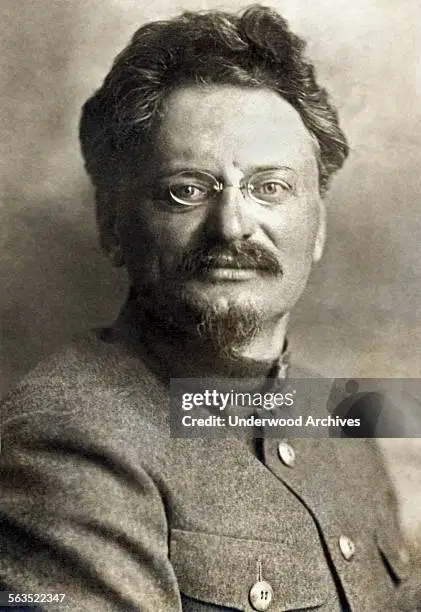
Match the character or group to the historical description provided. Leon Trotsky: A genuine communist leader who followed Marx's ideas and wanted to improve life for the lower classes in Russia.
Napoleon
Snowball
Squealer
The Pigs
Neighbouring farms and farmers
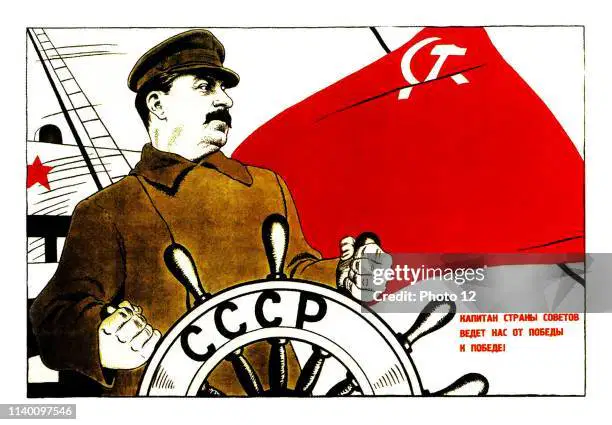
Stalin's Propaganda machine: used the language of persuasion to avoid rebellion from the population.
Choose the Animal Farm character who represents this.
Squealer
Napoleon
Snowball
Benjamin

Communism, by which workers would no longer work for capitalists and all of them would be equal. Choose the Animal Farm idea that represents this.
Animalism
Totalitarianism
Feudalism
Capitalism
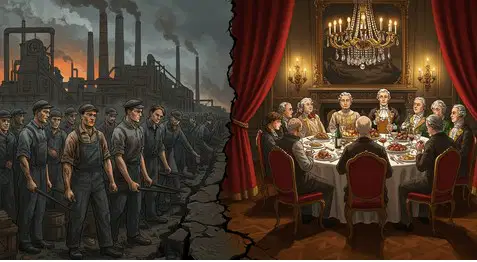
The Russian working class (the proletariat):
exploited by Stalin and remaining loyal to him,
even after he betrayed them.
Choose the Animal Farm figure who represents this.
Boxer
Mollie
Mr. Jones
Squealer
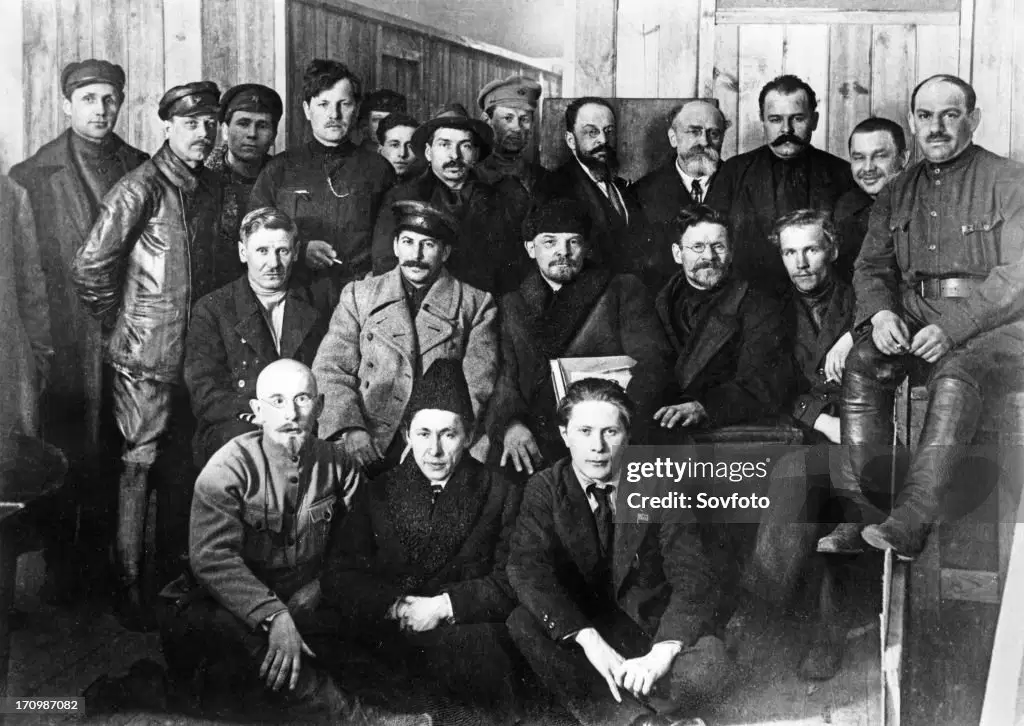
The Communist Party: representing the party and perhaps the Russian Parliament.
Choose the Animal Farm group that represents this.
The pigs
The sheep
The hens
The dogs

The Russian middle class (bourgeoisie): resistant to change and caring only about their own well‑being. Choose the Animal Farm character who represents this.
Mollie
Clover
Boxer
Muriel

The KGB: a secret violent police force that helped Stalin remain in power. Choose the Animal Farm force that represents this.
The dogs raised by Napoleon
The sheep chanting slogans
The pigeons sent to spread news
The horses pulling the plow

The United Kingdom and Germany: represented by the neighbouring farms. Choose the best Animal Farm correspondence.
Mr. Pilkington and Mr. Frederick
Mr. Jones and Mr. Whymper
Napoleon and Snowball
Mr. Frederick and Mr. Jones
The Intellectuals or Cynics: cynical people who never embraced the revolution. Choose the Animal Farm character who represents this.
Benjamin
Boxer
Squealer
Mr. Whymper
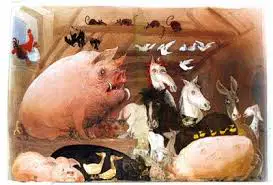
Chapter 1. Why did Old Major call the animals to the barn for a secret meeting?
To share his dream of rebellion and teach the song Beasts of England
To divide the farm into private plots for each animal
To announce Mr. Jones's plan to sell the farm
To punish the hens for breaking the rules
Chapter 2. Who were the three leaders of the revolution, and who were its main supporters on the farm?
Leaders: Napoleon, Snowball, and Squealer; supporters: Boxer, Clover, and the other working animals
Leaders: Mr. Jones, Mr. Frederick, and Mr. Pilkington; supporters: the human neighbors
Leaders: Boxer, Benjamin, and Mollie; supporters: the pigeons
Leaders: Muriel, Clover, and Moses; supporters: the dogs
Chapter 3. After the revolution, how did each of the three leaders behave?
Snowball organized committees and plans, Napoleon focused on consolidating power and training the puppies, and Squealer spread persuasive explanations
Napoleon wrote the commandments, Snowball hid in the farmhouse, and Squealer stopped speaking to the animals
Snowball and Napoleon worked together smoothly while Squealer did the farm's physical labor
Squealer became the elected leader while Napoleon and Snowball served as guards
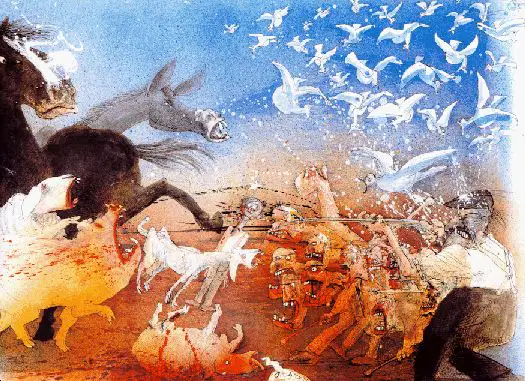
Chapter 4. Why did the Battle of the Cowshed take place, and how did it end?
Humans tried to retake the farm; the animals defeated them and kept control
Animals attacked a neighboring farm for more food; the humans repelled them
The hens rebelled against rations; the dogs restored order peacefully
Mr. Jones came to apologize; the animals accepted and surrendered the farm

Chapter 5. What happened to Snowball, and why?
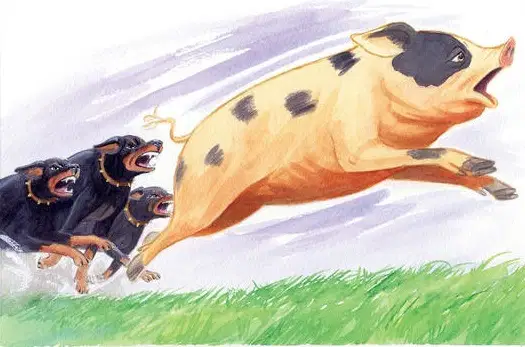
He was chased off the farm by Napoleon's dogs so Napoleon could seize power
He resigned voluntarily to study windmill designs in another town
He became farmer alongside Mr. Jones to improve production
He was elected leader in a fair vote and built the windmill

Chapter 6. Why were Napoleon's decisions in contrast with the glorious past of the Revolution?
He pursued personal power, traded with humans, and altered rules, undermining revolutionary ideals
He kept every commandment unchanged and expanded equality across the farm
He stepped down to allow free elections each season
He banned all technological improvements like the windmill
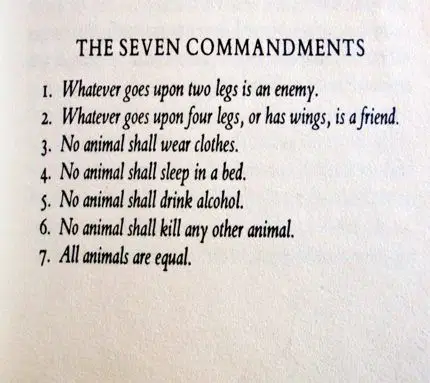
Chapter 7. In what ways were the ideals of the Revolution betrayed?
The pigs took privileges, rewrote commandments, and exploited other animals while acting like humans
All animals shared equally in work and food as originally promised
Humans returned to teach the animals literacy and medicine
The farm was given back to Mr. Jones voluntarily
Chapter 8. How did Napoleon increase his power on the farm?
By using the dogs for intimidation, Squealer for propaganda, and purges to silence dissent
By creating a democratic council with secret ballots and term limits
By giving up authority to Snowball and the hens
By inviting the humans to govern the farm directly
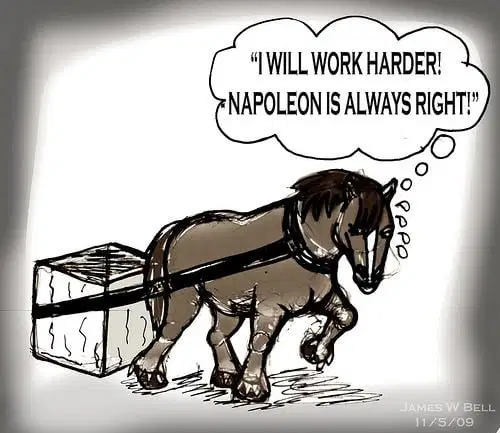
Chapter 9. What happened to Boxer?
He was sold to the knacker under the pretense of being sent to the veterinarian and died working for the farm
He retired comfortably and lived out his days in the pasture
He escaped to another farm and started a new rebellion
He became a pig's bodyguard and survived unharmed
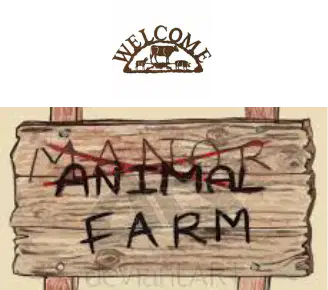
Chapter 10. At the end, why did Napoleon rename the farm Manor Farm?
To signal the pigs' alliance with human farmers and the abandonment of revolutionary ideals
To honor Old Major and his teachings more formally
Because the animals voted to return to the old ways of Mr. Jones
To commemorate victory over the neighboring farms
Which statement best explains how Napoleon's character evolves throughout Animal Farm?
He shifts from a revolutionary leader to a tyrant, accumulating power through fear, propaganda, and privilege
He grows more democratic, expanding voting rights and limiting his own authority
He becomes disillusioned and leaves the farm to live alone in the woods
He transforms into a pacifist who abolishes the use of the dogs and weaponry
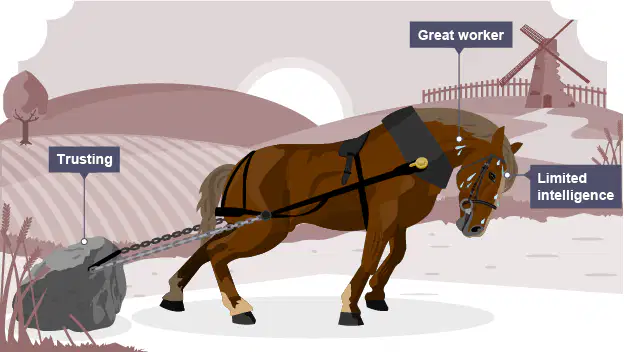
Which analysis best shows how Boxer represents the theme of sacrifice and loyalty on the farm?
His mottoes and tireless work for the farm, followed by his betrayal and sale, show blind loyalty exploited by those in power
He teaches reading classes at night to empower all animals equally
He secretly plots with Snowball to overthrow Napoleon but refuses to fight
He hoards extra rations to prepare for a personal escape from the farm
Which comparison best highlights Snowball's character and leadership style in the early days of the farm?
Snowball is energetic and innovative, organizing committees and plans, while Napoleon is calculating and power‑driven, using the dogs to dominate
Snowball rules by fear with the dogs, while Napoleon focuses on education and debate
Both Snowball and Napoleon avoid planning and leave Squealer to run the farm alone
Snowball rejects the windmill as useless while Napoleon designs it and builds consensus

