
NEW
Font size
 Worksheets
Life and Times of Jesus: Quiz
Total questions: 69
Worksheet time: 35mins
Where did Jesus live?
Egypt
Rome
Palestine
Greece
Which empire ruled in Palestine during the time of Jesus, and which King was in charge when Jesus was born?
Greek Empire, King Alexander
Roman Empire, King Herod
Persian Empire, King Cyrus
Egyptian Empire, King Tutankhamun
How did the Jews who lived in Palestine generally feel about Roman rule?
They liked the Romans and supported their rule.
They did not like the Romans and opposed their rule.
They were indifferent to Roman rule.
They wanted to become Roman citizens.
What did the Jews think about paying taxes to Roman authorities, and why?
They liked paying taxes because it helped the poor.
They hated it because it contributed to the Romans and their rule.
They did not care about paying taxes.
They paid taxes willingly to support the Roman army.
Who were the Sadducees?
Members of the Jewish council, a Jewish sect.
Roman soldiers in Judea.
Followers of Jesus.
Leaders of the Zealots.
What was the Sanhedrin?
The Jewish council.
A Roman military group.
A temple in Jerusalem.
A book of ancient scriptures.
What did the Jews hope for during the time of Roman rule?
That the Romans would leave or be forced out.
That the Romans would build new temples.
That the Romans would become Jewish.
That the Romans would increase taxes.
What was the basis for the Jewish hope that a Messiah would save them?
Ancient scriptures promised a Messiah.
Roman laws required a Messiah.
Greek philosophers predicted a Messiah.
The Sanhedrin elected a Messiah.
According to ancient Jewish beliefs, what roles could the Messiah have?
Priest, warrior, or king.
Farmer, merchant, or scribe.
Roman governor, soldier, or senator.
Prophet, poet, or artist.
Which Jewish group believed in fighting to get rid of the Romans?
Zealots
Sadducees
Pharisees
Sanhedrin
What did the Sadducees believe in?
The first five books of the Old Testament.
The teachings of Jesus.
The writings of Greek philosophers.
The laws of the Roman Empire.
How did the Pharisees differ from the Sadducees in their beliefs?
Pharisees believed in the coming of the Messiah and followed the Law of Moses.
Pharisees rejected all ancient scriptures.
Pharisees supported Roman rule.
Pharisees were a military group.
Why did the Zealots oppose the Romans?
They believed in fighting to get rid of the Romans.
They wanted to become Roman citizens.
They wanted to build Roman temples.
They wanted to trade with the Romans.
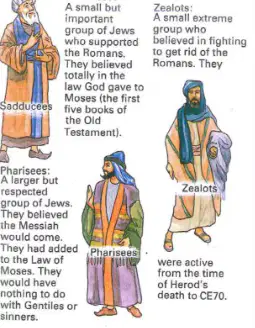
Based on the information, which Jewish group would have had nothing to do with Gentiles or non-Jews?
Pharisees
Sadducees
Zealots
Romans
Which book is considered the holy Jewish book containing the first five books of the Hebrew Bible?
Torah
Quran
Bible
Vedas
What is the name of the Jewish place of worship where people gather for religious activities?
Mosque
Synagogue
Church
Temple
Which group in Palestine at the time of Jesus was known for accepting only the written Torah and collaborating with the Romans?
Pharisees
Sadducees
Zealots
Samaritans
Who were the rabbis, and what role did they play in Jewish society during the time of Jesus?
They were Roman soldiers who enforced laws.
They were Jewish teachers who led synagogue worship and acted as judges.
They were merchants who traded goods in Jerusalem.
They were priests who performed sacrifices in the Temple.
Which group was known for strict observance of the Sabbath and advocated the violent overthrow of Rome?
Essenes
Zealots
Samaritans
Sadducees
What was the main difference between the Pharisees and Sadducees regarding the Torah?
Pharisees accepted only the written Torah, while Sadducees accepted oral traditions.
Sadducees accepted only the written Torah, while Pharisees accepted oral traditions and additional teachings.
Both accepted only oral traditions.
Both rejected the Torah.
Why did the Essenes withdraw from mainstream Jewish life?
They wanted to collaborate with the Romans.
They accused mainstream Judaism of corruption and faithlessness.
They wanted to become priests in the Temple.
They sought to become Pharisees.
What was the significance of the dispersion (diaspora) of Jews after the exile?
It led to the destruction of the Temple.
It resulted in Jews living throughout the world, with at least a million Jews worldwide by Jesus' time.
It caused the rise of the Roman Empire.
It ended Jewish religious practices.
Which council did the Sadducees and Pharisees dominate in Jerusalem?
Roman Senate
Sanhedrin Council
Council of Nicaea
Jewish Assembly
What was the relationship between Samaritans and other people in Palestine during the time of Jesus?
They were highly respected and loved by all.
There was deep-rooted enmity between Samaritans and everybody else in Palestine.
They ruled over Jerusalem.
They collaborated with the Romans.
What does the term "Diaspora after the exile of the Jews in Babylon" refer to?
Many Jews living outside Palestine and spreading the word of Jews
Jews returning to Palestine after exile
Jews building new temples in Babylon
Jews converting to other religions
Who are considered "Gentiles" in Jewish history?
Typical Non-Jews
Jewish priests
Roman soldiers
Members of the Sanhedrin
What was the main role of the Sanhedrin?
Where they spoke in the council
Leading armies in battle
Building temples
Writing religious texts
Which group was known for being the richest and working with Romans?
Sadducees
Pharisees
Zealots
Samaritans
Which group followed God's every word and even made their own laws?
Pharisees
Essenes
Zealots
Sadducees
Who were the Essenes and what was their main characteristic?
Very spiritual, wanted other groups to stop being loud, many moved away
Violent, wanted to kick out Romans
Rich, worked with Romans
Hated, mixed race
Which group wanted to kick out the Romans and was known for being violent?
Zealots
Sadducees
Pharisees
Samaritans
Who were the Samaritans and how were they viewed by others?
They were often hated, mixed race
They were the richest, high priests
They followed God's every word
They were very spiritual and moved away
What is the difference between a God-fearer and a Gentile?
There is no difference; God-fearers are the same as Gentiles
God-fearers are Jewish priests, Gentiles are non-Jews
God-fearers are Romans, Gentiles are Jews
God-fearers are violent, Gentiles are peaceful
Based on the information provided, how might the differences between the Pharisees, Sadducees, Essenes, and Zealots have affected their views on what the Jews were waiting for?
Each group had different ideas about the messiah and the future of the Jews
All groups agreed on every religious belief
Only the Zealots wanted change, others did not care
The Sadducees and Pharisees always worked together
Which term refers to the story about the birth of Jesus?
Nativity
Gospel
Resurrection
Parable
How many of the four gospels mention the nativity of Jesus?
One
Two
Three
Four
What does the word "gospel" mean in Old English?
Birth
Good news
Miracle
Prayer
According to the Bible, did wise men visit baby Jesus in a stable?
Yes, they did
No, they did not
Only shepherds visited
Only angels visited
Why might someone be surprised when reading the two original Bible texts about the birth of Jesus?
They are identical
They are quite different from each other
They do not mention Jesus
They only mention wise men

Which element in the typical nativity scene shown is stated as inaccurate according to the Bible?
Angels appearing
Wise men visiting baby Jesus in a stable
Animals present
Mary and Joseph present
Who was the angel sent by God to Nazareth to deliver a message to Mary?
Gabriel
Michael
Raphael
Uriel
According to the Luke account, what did the angel tell Mary about the child she would bear?
He will be called the Son of the Most High.
He will be a great prophet.
He will be a wise teacher.
He will be a powerful king.
Why did Joseph travel from Nazareth to Bethlehem?
To register for the census
To visit relatives
To escape danger
To find work
What sign did the angel give the shepherds to identify the Savior?
A baby wrapped in cloths and lying in a manger
A star shining above a house
A dove flying overhead
A golden crown on a child
Explain why the shepherds were initially afraid when the angel appeared to them in the fields.
Because the glory of the Lord shone around them
Because they saw wild animals
Because they heard thunder
Because they were lost
What was the message the angel gave to the shepherds about the birth of Jesus?
Good news that will cause great joy for all the people
A warning of danger
Instructions to travel to Egypt
A prophecy about a future king
Based on the Luke account, discuss the significance of Jesus being born in a manger rather than a palace.
It symbolizes humility and accessibility to all people.
It shows that Jesus was not important.
It means there was a shortage of palaces.
It indicates that Mary and Joseph were lost.
Analyze how the announcement of Jesus' birth to shepherds reflects the message of Christianity.
It emphasizes that the message is for everyone, including the humble and lowly.
It shows that only the rich are important.
It means only shepherds were present at the time.
It suggests that angels only visit people at night.
Which Gospel account describes the visit of the wise men to see Jesus after his birth?
Luke
Matthew
Mark
John
According to the Gospel of Matthew, what name did the angel tell Joseph to give to Mary's son?
Emmanuel
John
Jesus
David
In the Gospel of Luke, who visited the baby Jesus after his birth?
Wise men
Shepherds
Priests
Soldiers
What prophecy is quoted in Matthew to explain the birthplace of Jesus?
Out of Egypt I called my son
A virgin shall conceive and bear a son
But you, O Bethlehem, in the land of Judah, are by no means least among the rulers of Judah
Glory to God in the highest
Why did Joseph take Mary and Jesus to Egypt according to Matthew's account?
To pay taxes
To escape Herod's plan to kill the child
To visit relatives
To find a place to stay
Which event is common to both the Luke and Matthew accounts of Jesus' birth?
The visit of the wise men
The announcement by an angel
The flight to Egypt
The killing of children in Bethlehem
Compare the roles of Joseph in the birth narratives of Matthew and Luke. What is a key difference in how Joseph is portrayed?
In Matthew, Joseph is visited by an angel in a dream; in Luke, Joseph is not visited by an angel.
In both accounts, Joseph is a king.
In Luke, Joseph is the main narrator; in Matthew, he is not mentioned.
In both accounts, Joseph is a shepherd.
What is the significance of the gifts brought by the wise men in Matthew's account?
They symbolize Jesus' future roles as king, priest, and sacrifice.
They are ordinary gifts for a newborn.
They were required by law.
They were gifts for Mary only.
Using evidence from both accounts, explain why the birth of Jesus is considered a fulfillment of prophecy.
Both accounts mention prophecies from the Old Testament that are fulfilled by the events surrounding Jesus' birth.
Only Matthew mentions prophecy, while Luke does not.
The birth of Jesus is not related to any prophecy.
The prophecies are about other people, not Jesus.
If you were to highlight events that only occur in the Luke account, which of the following would you choose?
The visit of the shepherds
The flight to Egypt
The gifts of gold, frankincense, and myrrh
The killing of children in Bethlehem
How does Luke's account of the birth of Jesus show his focus on Jesus being there for EVERYONE'S Salvation, especially those in poverty and hardship?
By emphasizing Jesus' royal lineage and kingship
By focusing on Jesus' birth in humble circumstances and for all people
By describing Jesus as a political leader
By only mentioning the wealthy visitors to Jesus
How does Matthew's account of the birth of Jesus reflect his intention to show Jesus fulfilling Jewish prophecy and the idea of a battle of 'good versus evil'?
By describing Jesus as a Roman emperor
By emphasizing Jesus as the KING of the Jews and highlighting conflict with evil forces
By focusing on Jesus' teachings about peace
By only mentioning Jesus' miracles
What does the incarnation of God ("the Word became flesh and dwelt amongst us") demonstrate to Christians?
God's compassion and willingness to experience life as a human being
The importance of following the Ten Commandments
The need for regular prayer
The significance of church attendance
According to Christian belief, why is it important that Jesus became human?
So Christians can feel God can truly empathise with them
To establish a new set of commandments
To create a new holiday
To change the language of worship
Which prophecy from Isaiah is seen as a sign of Jesus' identity in Christianity?
"For unto us a Child is born, unto us a Son is given"
Moses parted the Red Sea
David defeated Goliath
Noah built an ark
What does repairing the relationship between God and Man through Jesus mean for Christians?
All human beings can have a relationship with God and eternal life
Only priests can communicate with God
People must sacrifice animals to be forgiven
Only those who live in Jerusalem are saved
How does Jesus' life provide an example to Christians?
It shows how God wants humans to behave
It teaches how to build churches
It explains how to perform miracles
It describes how to write religious texts
Why is Jesus described as "the bread that gives life" and "the light of the world"?
He fulfills human need for spiritual food and gives hope
He was a famous chef
He invented electricity
He wrote a book about nutrition
What is the significance of Jesus providing hope for eternal life and relationship with God?
Christians believe they can have eternal life and a relationship with God
Christians must live in isolation
Christians are required to fast every day
Christians do not believe in life after death
How can Christians better know how to act in fulfillment of God's wishes according to Jesus' teachings?
By following Jesus' words and understanding their own nature
By ignoring religious texts
By only attending church on holidays
By focusing solely on Old Testament laws
Explain, using evidence, why the birth of Jesus is important for Christians. (Strategic Thinking)
The birth of Jesus is important because it fulfills prophecy, demonstrates God's compassion, and provides hope for eternal life. Evidence includes the incarnation, fulfillment of Isaiah's prophecy, and Jesus' teachings about spiritual food and eternal life.
The birth of Jesus is important because it created a new holiday for Christians.
The birth of Jesus is important because it changed the language of worship in churches.
The birth of Jesus is important because it led to the building of more churches.

