wayground logo

Free Printable Worksheets

Font size

S
M
L
XL
Worksheets

Spinal Reflex

Total questions: 25

Worksheet time: 2hrs 5mins

Name
Class
Date
1.

What are the correct labels for this diagram? (starting top left and rotating anticlockwise)

a)

midbrain; hindbrain; cerebral cortex; brain stem; corpus callosum; forebrain; pons

b)

frontal lobe; parietal lobe; occipital lobe; temporal lobe; left hemisphere; right hemisphere; amygdala

c)

corpus callosum; cerebral cortex; thalamus; pons; optic nerve; central fissure; cerebellum

d)

cerebral cortex; thalamus; hypothalamus; pons; reticular formation; medulla; brain stem

2.
Differentiate between the cerebrum and cerebellum.
a)
The cerebellum is part of the forebrain and coordinates body movement; the cerebrum is part of the hindbrain and is divided into the left and right hemispheres.
b)
The cerebrum is part of the forebrain and is divided into the left and right hemispheres; the cerebellum is part of the hindbrain and coordinates body movement.
c)
The cerebrum is part of the forebrain and is divided into the left and right hemispheres; the cerebellum covers the whole brain.
d)
The cerebrum is part of the hindbrain and is divided into the left and right hemispheres; the cerebellum covers the whole brain and coordinates body movement.
3.

What type of neuron is shown at A?

a)

motor neuron

b)

sensory neuron

c)

interneuron

d)

ganglion

4.

People with damage to the area shown, may:

a)

lack foresight and will likely make mistakes in planning

b)

have difficulty recognising faces and paintings

c)

unable to perceive visual stimuli

d)

feel numbness in parts of their body

5.

Identify the area in green.

a)

Premotor association area

b)

Primary motor cortex

c)

Prefrontal area

d)

Primary somatosensory cortex

6.

Identify the area responsible for processing complex auditory information including speech and music

a)

Broca's Area

b)

Wernicke's Area

c)

Primary Auditory Cortex

d)

Auditory Association Area

7.
Processes visual information
a)
Frontal Lobe
b)
Temporal Lobe
c)
Occipital Lobe
d)
Parietal Lobe
8.
Known as the "Little brain" and is in charge of balance and coordinating movements:
a)
Thalamus
b)
Reticular Formation
c)
Hypothalamus
d)
Cerebellum
9.
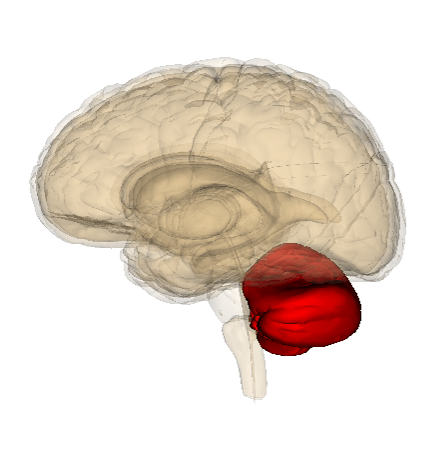
The red portion is the ________
a)
Cerebrum
b)
Cerebellum
c)
Brain Stem
d)
Diencephalon
10.

Which lobe is responsible for thinking, planning, problem solving, emotions, behavior control and decision making?

a)

Parietal Lobe

b)

Temporal Lobe

c)

Frontal Lobe

d)

Occipital Lobe

11.

Which statement best describes a reflex?

a)

Slow response that you have to think about

b)

Rapid response to protect body from harm

12.
What makes up the CNS
a)
brain and spinal cord
b)
brain and neurons
c)
brain
d)
spine and neurons
13.

Which type of neuron causes a muscle to contract in a reflex arc?

a)

Motor Neuron

b)

Sensory Neuron

c)

Interneuron

d)

Effector

14.

What is the final component of a reflex arc?

a)

Effector

b)

Receptor

c)

Afferent Pathway

15.

In a reflex arc, the sensory neuron leads to the ___________ and the motor neuron leads to the __________

a)

Spinal cord, CNS

b)

CNS, muscle

c)

Spinal cord, muscle

d)

Muscle, CNS

16.
Main organ of the nervous system. protected by the skull, and made of neurons, it is the control center for all actions, thoughts and emotions.
a)
brain
b)
electrical impulse
c)
gland
d)
heart
17.

Identify structure B

a)

dendrite of the sensory neuron

b)

axon of sensory neuron

c)

dendrite of motor neuron

d)

axon of motor neuron

18.

Identify structure E

a)

dendrite of sensory neuron

b)

axon of sensory neuron

c)

dendrite of motor neuron

d)

axon of motor neuron

19.
What is the largest part of the brain?
a)
Cerebrum
b)
Cerebellum
c)
Brainstem
d)
Diencephalon
20.

Contains the medulla oblongata, pons and midbrain.

a)

diencephalon

b)

brain stem

c)

cerebrum

d)

cerebellum

21.
The part of the brain that controls conscious thoughts, senses, language  and memories.
a)
Cerebellum
b)
Cerebrum
c)
Dendrites
d)
Brain Stem
22.
Connected to spinal cord, controls heartbeat, breathing, blood pressure, digestion.
a)
Nerves
b)
Brain Stem
c)
Dendrites
d)
Brain
23.
What is an example of a reflex?
a)
singing
b)
sneezing
c)
kicking a ball
24.
What is the central nervous system (CNS) made of?
a)
brain and spinal cord
b)
brain and cranial nerves
c)
spinal cord and spinal nerves
d)
cranial nerves and spinal nerves
25.
In this picture, the green line represents 
a)
motor neuron
b)
sensory neuron
c)
interneuron
d)
receptor