
 Worksheets
Unit 2 WWI Test
Total questions: 42
Worksheet time: 21mins
Name
Class
Date
1.
How did nationalism contribute as a cause of WWI?
a)
Nationalism led to competition among different countries
b)
Nationalism encouraged militarism, the building up of nations armies
c)
Nationalism blinded people to the similarities they had with other countries
d)
All of the above
2.
What is the policy where a country glorifies power by building up its army and navy?
a)
Nationalism
b)
Militarism
c)
Patriotism
d)
Imperialism
3.
What region of Europe was known as the “Powder Keg” region?
a)
Austria-Hungary/ Eastern Europe
b)
France/Western Europe
c)
Italy/Southern Europe
d)
Belgium/Northern Europe
4.
Which countries were part of the Triple Alliance at the beginning of WWI?
a)
France, Germany, Russia
b)
Britain, Austria-Hungary, Italy
c)
France, Austria-Hungary, United States
d)
Germany, Austria-Hungary, Italy
5.
Which of the following was NOT a part of the Triple Entente at the beginning of WWI?
a)
Russia
b)
Germany
c)
Britain
d)
France
6.
What was the primary concern of the members of the Triple Entente?
a)
The growing military power of Germany
b)
The Serbian’s response to the Austria-Hungary ultimatum
c)
Keeping the United States from getting involved in the war
d)
Allowing Russia to get involved with European politics
7.
What event started the sequence of events that led to World War I?
a)
The assisination of ArchDuke Ferdinand of Austria by the Black Hand
b)
Germany using their newly developed Navy to bomb a British Ship
c)
ArchDuke Ferdinand killing the Black Hand leader
d)
France declaring war on Germany
8.
__________________ was the first country to declare war in WWI when they declared war against Serbia.
a)
Belgium
b)
France
c)
Germany
d)
Austria-Hungary
9.
Which of the following best shows how entangling alliances helped lead to WWI?
a)
Like governments tried to push their style of governments onto other countries
b)
Economic alliances cut out parts of Europe and made them feel left out and mad
c)
Countries were bound by their alliances to take up for each other so when one got involved others had to rally to help them out
d)
Countries that were industrialized worked together to overtake those that weren’t
10.
What does the acronym “MAIN” stand for when discussing the root causes for WWI?
a)
Mobilization, Alliances, Imperialism, Nationalism
b)
Militarism, Alliances, Industrialism, Nationalism
c)
Militarism, Aggression, Industrialism, Nationalism
d)
Militarism, Alliances, Imperialism, Nationalism
11.
The use of repeating rifles, maxim machine guns, and other other improved military equipment is why WWI is considered to be the first great ______________ war.
a)
Imperialized
b)
Industrialized/Modern
c)
European
d)
Nationalistic
12.
Which of the following countries was competing militarily during the late 1800’s-early 1900’s?
a)
Germany
b)
Britain
c)
France
d)
All of the above
13.
Which of the following nations had the largest army in 1914 prior to the beginning of WWI?
a)
Russia
b)
Germany
c)
Britain
d)
United States of America
14.
What country switched sides during the war and what was their motivation for doing it?
a)
Russia - because they knew/thought the Germans were going to win the war
b)
Italy - because the members of the other alliance promised them land in what was Austria - Hungary
c)
US - because Germany began attacking American troops
d)
England - because France refused any of their military strategies.
15.
Which of the following countries made up the Triple Entente?
a)
Ottoman Empire, Germany, France
b)
Russia, Great Britain, France
c)
Italy, Germany, Russia
d)
Germany, Ottoman Empire, Austria-Hungary
16.
Which of the following countries dropped out of the war in late 1917 because of a Revolution?
a)
Italy
b)
Japan
c)
Austria-Hungary
d)
Russia
17.
What was the overall goal of the Schlieffen Plan?
a)
To defeat France immediately.
b)
To defeat Russia immediately.
c)
To defeat Germany immediately.
d)
To defeat Austria-Hungary immediately.
18.
How did trench warfare change the nature of fighting during World War I?
a)
Armies had to abandon the use of heavy artillery.
b)
Paratroopers were used to get behind enemy lines.
c)
Troops were forced into defensive positions leading to a stalemate.
d)
Civilians were forced to engage in military activities that increased casualties.
19.
Because of the way warfare was fought on the western front, how did we describe early fighting during WWI on that front?
a)
Victory for Germany.
b)
Victory for Great Britain.
c)
Stalemate
d)
Both sides were making gains.
20.
What is the best way to describe “No Man’s Land?”
a)
The area inside the trenches where very few deaths of WWI occurred.
b)
The areas in the ocean where U-Boat attacks were most common.
c)
The area in between the trenches where most deaths of WWI occurred.
d)
All of the above
21.
The gathering and movement of troops for war.
a)
Mobilization
b)
Isolationism
c)
Pacifism
d)
Monroe Doctrine
22.
When America doesn't interfere with European affairs is called?
a)
Mobilization
b)
Isolationism
c)
Pacifism
d)
Monroe Doctrine
23.
With the Zimmerman telegram, which country did Germany try and persuade to declare war on the United States?
a)
Japan
b)
Canada
c)
Mexico
d)
Italy
24.
Which of the following most accurately describes Russia during WWI?
a)
Russia was the sole reason that the Allied Powers won WWI.
b)
Russia switched sides and joined the Central Powers.
c)
Due to revolution and economic problems Russia had to drop out of the war in 1917.
d)
At the end of the war, Russia became the dominant world power and threatened to invade Western Europe.
25.
What are reparations?
a)
Payments to cover war damages.
b)
Declines in military goods.
c)
Increases in prices of industrial items.
d)
Compensation for debt during times of recession.
26.
What was Woodrow Wilson’s Proposal at the end of the war in terms of reaching long term peace?
a)
95 Theses
b)
14 Point Plan
c)
12 Bullitt List
d)
4 Grand Thoughts
27.
Which of the following is true about how each country approached the Peace Conference in Paris to discuss the terms of the treaty to end the War?
a)
All countries came in with different ideas about what should happen to the losers of the war
b)
Germany showed up uninvited to try and defend their actions
c)
The countries in attendance wanting to go easy on Germany
d)
The Peace Conference was canceled
28.
Which of the following was not a stipulation for Germany of the Treaty that ended WWI?
a)
Make reparations to Allied countries
b)
Reduce the size of their Army, Navy and Airforce
c)
Admit they were at fault for the war
d)
Allow the country to be ruled by a committee made up of members from the Allied countries
29.
What was the name of the Treaty that officially ended the war and was given and had to be signed by all countries of the Axis alliance?
a)
Treaty of Verdun
b)
Treaty of Versailles
c)
Treaty of London
d)
Treaty of Munich
30.
Which countries were NOT involved in the peace making ideas even though they were on the Triple Entente’s side at the end of the war?
a)
Britain and Germany
b)
Russia and Japan
c)
Japan and Italy
d)
Italy and Austria
31.
What event in post-World War I Germany was motivated by the conditions imposed by the Treaty of Versailles?
a)
the rise of Adolf Hitler to power
b)
the German exit from the Warsaw Pact
c)
the selection of Josef Stalin as the political leader
d)
the separation of the country into East and West Germany
32.
What was one outcome of the disappointment with European leadership during World War I?
a)
the mass exodus of British and French citizens to the United States
b)
the expansion of the Austria-Hungary and Ottoman Empires
c)
the rise of totalitarian dictators in Germany and Italy
d)
the acceleration of imperialism in Africa and Asia
33.
Look at the chart below.
Value of German Currency, 1914-1923
Year
Number of German
Marks to the U.S. Dollar
1914 4.2
1919 14.0
1921 39.5
1923 4,620,455.0
This information shows why many Germans after World War I were
a)
sympathetic to the restoration of traditional government.
b)
seeking leaders who would improve the economy.
c)
apologetic about the actions that had caused the war.
d)
convinced that pacifism would guarantee future security.
34.
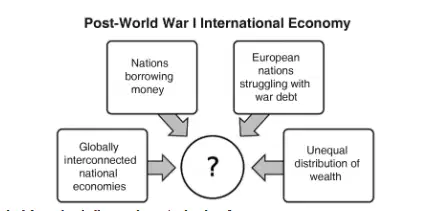
What resulted from the challenges shown in the chart?
a)
worldwide economic depression
b)
rapid expansion of American industries
c)
trade embargoes on communist nations
d)
free trade embargoes in North America
35.
The Allied and Associated Governments affirm and Germany accepts the responsibility of Germany and her allies for causing all the loss and damage to which the Allied and Associated Governments and their nationals have been subjected as a consequence of the war. . . .
—The Treaty of Versailles, 1919
Based on the excerpt, what was a purpose of the treaty?
a)
to change the government of Germany
b)
to repair the economy of Germany
c)
to set up alliances with Germany
d)
to set punishments for Germany
36.
Germany has despoiled her neighbours of everything she could make use of or carry away. Germany has destroyed the shipping of all nations in the high seas, where there was no chance of rescue for their passengers and crews. It is only justice that restitution [payment] should be made, and that these wronged peoples should be safeguarded for a time from the competition of a nation whose industries are intact and have even been fortified by machinery stolen from occupied territories.
—from an Allied letter in support of the draft peace terms to end World War I, 1919
The excerpt supports which idea about the Allies’ view of Germany?
a)
Germany required resources.
b)
Germany deserved punishment.
c)
Germany held disputed territory.
d)
Germany captured prisoners of war.
37.
European nations responded to Wilson’s idea as stated in this excerpt by
Point 12 - The Turkish portion of the present Ottoman Empire should be assured a secure sovereignty, but the other nationalities which are now under Turkish rule should be assured an undoubted security of life and an absolutely unmolested opportunity of autonomous development. . . .
—Woodrow Wilson’s Fourteen Points, 1918
a)
demanding the surrender of aggressor nations.
b)
establishing the mandate system.
c)
forming an international court.
d)
forcing the demobilization of allied troops.
38.
We were aghast when we read in documents the demands made upon us, the victorious violence of our enemies. The more deeply we penetrate into the spirit of this treaty, the more convinced we become of the impossibility of carrying it out. The exactions [requirements] of this treaty are more than the German people can bear.
—from a letter from the German delegation on a draft treaty of peace to end World War I, 1919
Based on the excerpt, which of these best describes the position of the German delegation?
a)
Germany was prepared to continue the war.
b)
Germany was planning to meet its obligations.
c)
Germany was the victim of unreasonable demands.
d)
Germany was confident in the abilities of its people.
39.

Which result best completes this diagram?
a)
Russian revolutionaries reentered the war on the side of the Germans.
b)
Germany sent troops to support Russian revolutionaries.
c)
Russian soldiers obtained land grants for serving in the war.
d)
Germany shifted its forces to the Western Front.
40.
Article 1
Germany, Austria-Hungary, Bulgaria and Turkey on the one hand and Russia on the other declare that the condition of war between them has ceased. They have decided to live in peace and accord in the future.
Article 5
Russia will, without delay, proceed to demobilize her army, including those army units newly formed by her present government.
—Treaty of Brest-Litovsk, March 3, 1918
Why did this treaty affect the course of World War I?
a)
It increased the possibility of trench warfare in the East.
b)
It led to the resurgence of the Allied resistance.
c)
It led to the end of fighting on the Eastern Front.
d)
It convinced the United States to enter the war.
41.
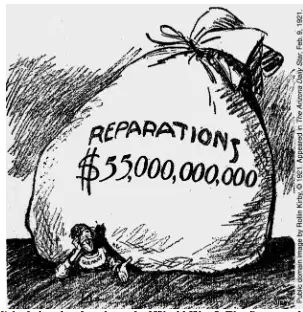
The cartoon was published shortly after the end of World War I. The figure under the bag represents Germany.
How did the situation pictured in the cartoon create conflict?
a)
Germany split into two nations following a civil war.
b)
Germany used its new wealth to build advanced weapons.
c)
Germany failed to meet the terms of an international treaty.
d)
Germany tried to establish colonies in areas controlled by its enemies.
42.
Use the list to answer the question.
Some Terms of the Treaty of Versailles, 1919
• the German army was limited to 10,000 men
• Germany surrendered its overseas colonies
• ?
Which statement best completes the list?
a)
Germany was prevented from operating factories
b)
Germany was required to join the League of Nations
c)
Germany had to accept sole responsibility for the war
d)
Germany was required to hold a vote on a new government
100 %

