
NEW
Font size
 Worksheets
DNA Structure and Replication
Total questions: 26
Worksheet time: 13mins
The two strands of a DNA molecule are held together by _______ bonds between their nitrogen base pairs.
peptide
hydrogen
covalent
ionic
Which of the following is not a base found in DNA?
adenine
thymine
uracil
cytosine
What part of a nucleotide accounts for the genetic variation between individuals?
phosphate
nitrogenous base
sugar
deoxyribose
If a template strand of DNA has the sequence TTACCG, the complimentary sequence of the other strand will be:
AATGGG
AACGGC
AATGGC
TTACCG
Once replication in a DNA molecule is complete, each new DNA molecule contains:
two new strands
3 exact copies of strands
one new and one old
two old strands
In a molecule of double stranded DNA, the amount of Adenine present is always equal to the amount of:
guanine
thymine
uracil
cytosine
In DNA replication, which enzyme is responsible for building the new DNA strand?
polymerase
helicase
ligase
primase
The process of creating a new DNA double helix from an older DNA molecule is called:
translation
transcription
replication
What are the components of a DNA nucleotide?
Amino acid, sugar, phosphate
sugar, phosphate, nitrogenous base
phosphate, lipid, nitrogenous base
Nitrogenous base, amino acid, sugar
Which DNA bases are paired correctly?
A + U
C + G
T + G
C + A
A + G
T + C
A + T
C + G
What type of sugar is found in DNA?
glucose
ribose
lactose
deoxyribose
Which of the following best describes a DNA molecule?
made of amino acids
contains ribose
contains Uracil
double helix
Which of the following units are repeatedly joined together to form a strand of DNA?
fatty acids
nucleotides
polysaccharides
amino acids
Why is DNA important?
It is very small and very complicated
It's in everything
It serves as the blueprint for traits of all living things
because we eat it everyday for energy
Which 2 molecules form the sides (backbone) of the DNA ladder?
deoxyribose sugar and phosphate
deoxyribose sugar and a hydrogen bond
deoxyribose sugar and adenine
deoxyribose sugar and the nucleus
Which organelle is DNA usually found in?
mitochondria
chloroplast
nucleus
cell membrane
Nitrogenous bases are joined by which type of bond?
polar bonds
hydrogen bonds
covalent bonds
ionic bonds
The enzyme that unzips the DNA to prepare for replication
synthase
replicase
polymerase
helicase
DNA replication results in two DNA molecules that consists of:
one with two new strands and the other with two original strands
each one with two new strands
each one with one new strand and one original strand
each one with two original strands
In what phase of the cell cycle does DNA replication take place?
G2
G1
S
M
What are the three components of a nucleotide?
sugar, oxygen, nitrogen base
sugar, nitrogen base, phosphate
sugar, hydrogen, nitrogen base
sugar, phosphate, protein
Which term best fits the following definition: The chemicals that make up the rungs of the DNA ladder, A-T and C-G match.
protein
Nitrogen base
Nucleotide
Codon
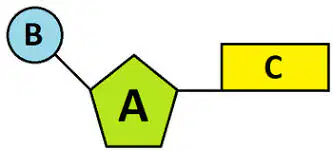
What is the name for A (if this is DNA)
Deoxyribose
Phosphate
Nitrogen Base
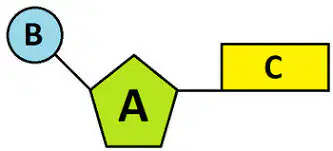
What is the name for A (if this is RNA)?
Ribose
Deoxyribose
Phosphate
Nitrogen Base
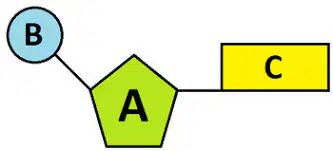
What is the name for B?
Ribose
Deoxyribose
Phosphate
Nitrogen Base
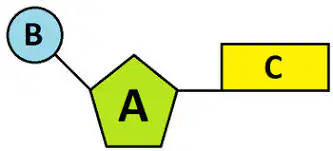
What is the name for C?
Deoxyribose
Phosphate
Nitrogen Base

