
 Worksheets
It's the Final Countdown!
Total questions: 40
Worksheet time: 21mins

What type of heat transfer occurs in the Earth's mantle, causing the continuous shift in Earth's surface?
Conduction
Convection
Radiation
The heat transfer that occurs in the Earth's mantle, causing the continuous shift in Earth's surface is Convection because...
The particles in the semi-fluid layer move freely; when the liquid is heated, it rises, and when it cools, it sinks back down.
The particles in the semi-fluid layer touch other particles causing thermal energy to transfer and move in a circular pattern.
The particles in the semi-fluid layer absorb energy; when the energy is released, it moves in all directions.
The particles in the semi-fluid layer move freely; when the liquid is heated, it sinks, and when it cools, it rises to the top.
The Olympic Mountains formed along the west coast of the United States at the boundary between the Juan de Fuca Plate and the North American Plate. Which type of boundary MOST LIKELY exists between the Juan de Fuca Plate and the North American Plate?
Convergent boundary, where the plates are moving toward each other
Convergent boundary, where the plates are moving parallel to each other
Transform boundary, where the plates are moving closer to each other
Transform boundary, where the plates are sliding past each other
Scientists have found some of the same types of rock containing the same types of fossil species on the and the Antarctica plate. Which explanation does this information support?
Both continents gradually increased in size over time
Both continents attached were by glacial ice millions of years ago.
Both continents were attached but drifted away from each other over time.
Both continents were underwater millions of years ago.
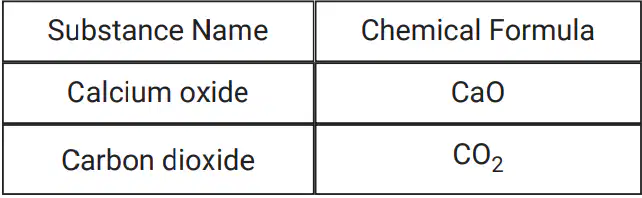
Two chemical formulas are shown in the table.
Which of the following statements BEST represents the classification of the two chemical formulas?
Two elements
One element and one compound
Two compounds
One element and one atom
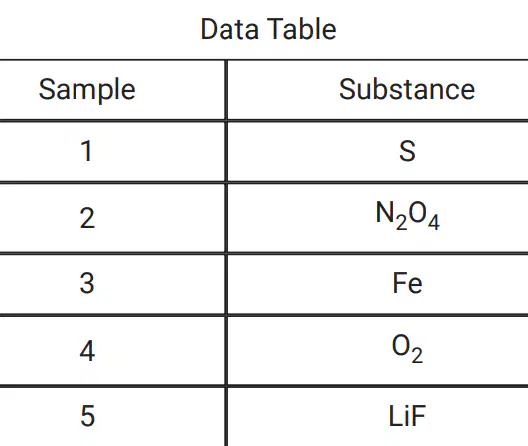
Some students observe the physical properties of five different substances to determine if the substances are elements or compounds.
Which TWO samples represent a compound?
Sample 1
Sample 2
Sample 3
Sample 4
Sample 5
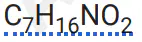
How many atoms in all are in this molecule?
26
25
24
23

Which substance listed in the chart is made up of the most atoms?
Carbonic acid
Nitric acid
Phosphoric acid
Sulfuric acid
A student is using colored beads to make a model of aluminum sulfate, Al2 (SO4)3. Aluminum atoms are represented by blue beads, sulfur atoms by yellow beads, and oxygen atoms by green beads.
What combination of beads should the student use for the model?
6 blue, 3 yellow, and 7 green
2 blue, 1 yellow, and 4 green
2 blue, 3 yellow, and 12 green
6 blue, 12 yellow, and 12 green
Which statement describes an action that is MOST LIKELY a result of a chemical change?
A pan of water was heated on a stove, and steam formed.
A liquid was mixed with another liquid, and a precipitate formed.
A liquid was sprayed into the air, and a sweet odor occurred.
A child blew through a wand filled with soap, and bubbles were produced.
Students are baking a cake. They mix together all the necessary ingredients and pour them into a pan. Then they place the pan into the oven to cook for 40 minutes.
Which statement BEST explains why baking a cake is evidence of a chemical reaction?
The state of matter of some of the ingredients changed while being cooked.
The total mass of the ingredients was the same before and after they were cooked.
The temperature of the ingredients increased as they absorbed thermal energy from the oven
The ingredients formed a new substance after they were cooked in the oven.
Matter can undergo physical or chemical changes.
Which of these are examples of physical changes?
Select TWO correct answers.
Burning wood
Breaking an egg
Cooking an egg
Freezing a popsicle
Rusting iron
A saltwater solution sits on a science lab table for one week, causing some of the solvent to evaporate. Which statement BEST describes how the concentration of the saltwater solution will change?
The concentration will decrease.
The concentration will first increase, then decrease.
The concentration will remain the same.
The concentration will increase

During a lab investigation, students observed four cups containing different amounts of red food coloring in 60 mL of water. What is the solvent and the solute?
The Solvent is the water and the Solute is the red food coloring
The Solute is the water and the Solvent is the red food coloring
During a lab investigation, students observed four cups containing different amounts of red food coloring in 60 mL of water. What can be added to dilute Sample A?
Add more water to it
Add more food coloring to it
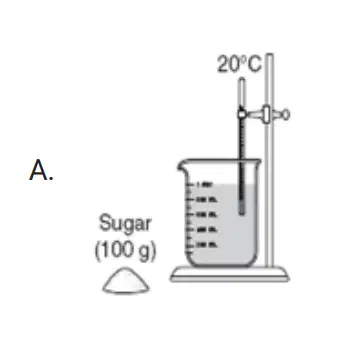
Students performed a lab investigation to determine how temperature, surface area, and agitation affect the rate at which a solid solute dissolves in an aqueous solution. The students poured 100 g of into one liter of water. Which of the following models will the rate of sugar dissolution be the fastest?
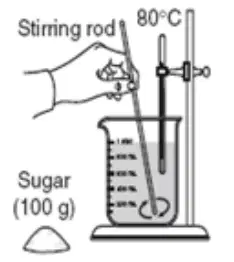

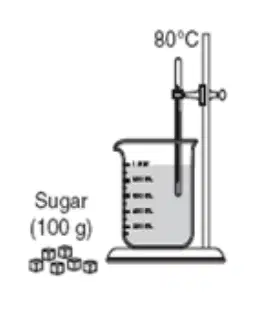
A student adds one teaspoon of rock salt to a bottle of cold water and shakes the bottle. Which of the following BEST explains why shaking the bottle of water will affect the dissolving rate of the salt?
Shaking the bottle of water exposes the rock salt to the solvent faster.
Shaking the bottle of water causes the water to evaporate faster allowing the rock salt to dissolve.
Shaking the bottle of water exposes the rock salt to the water, creating a precipitate.
Shaking the bottle of water helps the water temperature stay cold allowing the rock salt to dissolve.

The table shows the motion data for two objects during two trials of an investigation.
Which object travels at the greater average speed?
Object 1
Object 2
Both travel at the same speed
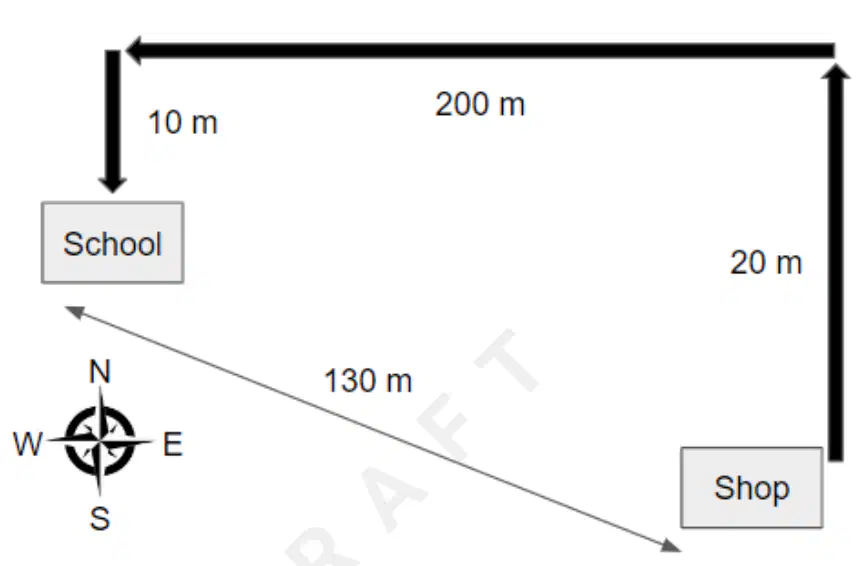
A student walks from the shop to the school. The student's path was 20 m north, 200 m west, and 10 m south. What is the students displacement?
130
230
A student walks from the shop to the school. The student's path was 20 m north, 200 m west, and 10 m south. What is the students traveled distance?
130
230

What happens during 0-6 hours?
The car is traveling at a constant speed of 50 km/hr.
The car stops for 5 hours.
The car travels 200 km in 5 hours.
What happens during 6-11 hours?
The car is traveling at a constant speed of 50 km/hr.
The car stops for 5 hours.
The car travels 200 km in 5 hours.
What happens during 11-16 hours?
The car is traveling at a constant speed of 50 km/hr.
The car stops for 5 hours.
The car travels 200 km in 5 hours.

Which of these BEST describes the motion of the toy train?
The toy train speeds up while going forward and then slows down.
The toy train slows down while going forward and then moves backward.
The toy train moves forward at a constant speed, slows down, and then stops.
The toy train moves forward at an increasing speed, stops, and then moves forward.

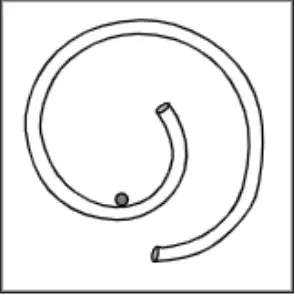
A plastic tube is arranged on a lab tabletop as shown. A small sphere enters one end of the tube with enough speed to come out the other end of the tube.
Which diagram shows where the sphere will go first when it leaves the tube?



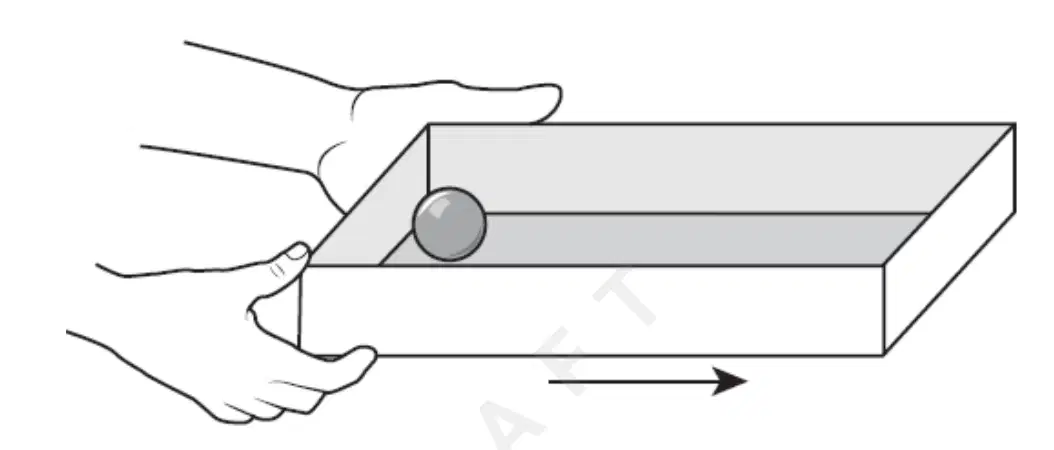
A steel ball is at one end of a box that is moving forward as shown. The box suddenly stops
According to Newton’s first law, what happens to the steel ball just after the box stops?
A. Because of friction, the ball continues rolling forward at the same speed.
B. Because of friction, the ball rolls forward at an increased speed.
C. Because of inertia, the ball continues rolling forward at the same speed.
D. Because of inertia, the ball rolls forward at an increased speed.

Students performed an investigation on how thermal energy reaches an equilibrium. The diagram shows the progression of their investigation.
Students pour water into a beaker and then add an ice cube. After several minutes, the ice cube begins to melt. Which statement BEST describes what happened?
A. The ice cube transfers cold to the water.
B. The water transfers cold to the ice cube.
C. The ice cube transfers thermal energy to the water.
D. The water transfers thermal energy to the ice cube.
Students perform an investigation to determine how kinetic energy and temperature relate. The investigation setup is shown.
What is the relationship between temperature and the kinetic energy of the particles within a substance?
Select 2 correct answers
As the thermal energy within the substance increases, the particles will move faster
When the thermal energy decreases, the particles will move slower
As the thermal energy within the substance increases, the particles will move slower
When the thermal energy decreases, the particles will move faster
Which of the following BEST describes fossil evidence that supports that Earth has changed over time?
Fossils of oceanic fish species are found on the ocean floor
Fossils of the same species of extinct plants are found on two different continents separated by oceans.
Fossils of different species of extinct birds are found on two different continents separated by oceans.
The same species of a plant is currently growing on two different continents in different ecosystems.
A hot spot is a large plume of magma that rises from deep within Earth. A line of volcanoes develops as a plate moves over a hot spot. Which statement is true if an island chain forms due to a hot spot?
A. The oldest island will be the most active volcano.
B. The oldest island will be the largest.
C. The oldest island will be located farthest from the hot spot.
D. The oldest island will be located nearest the hot spot.
Seismologists study the causes and effects of earthquakes to better understand Earth's dynamic processes. They use a variety of tools to monitor seismic activity and analyze data to predict future earthquakes to try to reduce their impacts. By collecting data and developing models, seismologists aim to improve early warning systems and contribute to the design of earthquake resistant structures, ultimately enhancing public safety and resilience.
What should seismologists study to ensure they can uncover patterns of earthquakes?
A. The elliptical revolution of the Earth around the Sun.
B. The movement of plate tectonics in the lithosphere.
C. The role of oceans in climate and weather patterns.
D. The effect of deforestation on ecosystems.
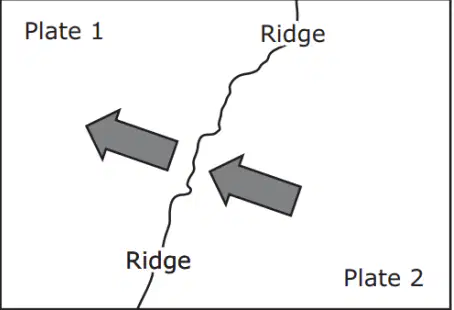
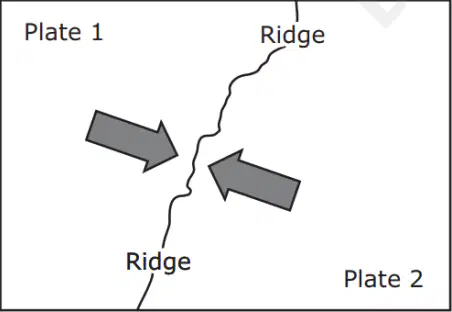
An ocean ridge is located at the boundary of two tectonic plates. Which diagram correctly models the relative plate motion on each side of an ocean ridge?


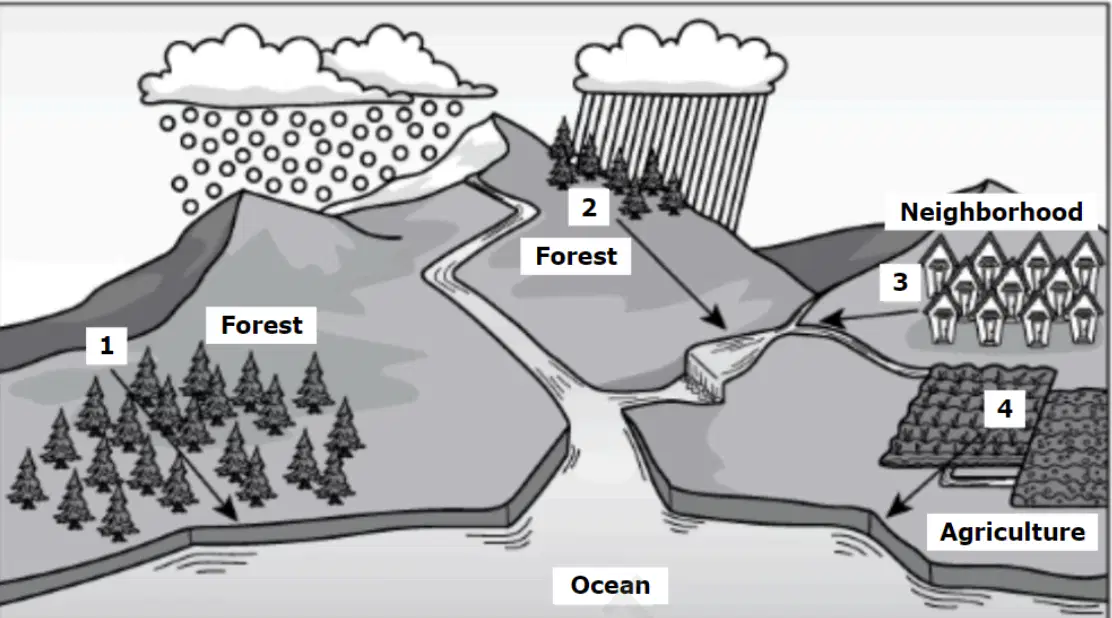
Runoff from which locations on the diagram would likely result in the MOST pollution entering the ocean?
1 and 2
2 and 3
3 and 4
1 and 4
Groundwater and surface water are both sources of water in communities. Which of the following could help prevent water contamination in the community?
Select TWO correct answers.
A. Recycling motor oil in designated containers
B. Washing cars in the street
C. Throwing away used batteries in landfills
D. Limiting the use of pesticides and fertilizers
E. Pouring small amounts of sewage into a river

The model shows an area near a lake. Community leaders are planning new laws to help protect the lake from pollution. One proposed law will make it illegal to dump trash on the shore of the lake, but the law still allows trash to be placed in the area labeled "Flow-through wetland".
Which statement about the proposed law is supported by the model?
A. The proposed law will protect the lake because plant roots between the wetland and the lake will stop pollution from entering the lake.
B. The proposed law will not protect the lake because animals that live in or near the lake will add pollution to the lake.
C. The proposed law will not protect the lake because groundwater will carry pollution from the wetland directly into the lake.
D. The proposed law will protect the lake because the high elevation of the water table will block pollution from entering the lake
Which statement describes a negative effect of overfishing?
A. The air quality will become worse.
B. The ocean temperatures will increase, impacting the fish population.
C. The amount of land pollution will increase.
D. The amount of fish will decrease, impacting the ocean food chain.
Humans catch marine fish at a faster rate than the fish are able to reproduce.
Positive Effect
Negative Effect
Humans raise fish in a hatchery for commercial sale.
Positive Effect
Negative Effect
Humans construct artificial reefs to increase fish populations.
Positive Effect
Negative Effect
Humans create runoff pollution from industrial and farming sites.
Positive Effect
Negative Effect

