
 Worksheets
Biology 1 Midterm Study Guide (Grade 9)
Total questions: 32
Worksheet time: 16mins
Define Biology.
Study of the living world
Study of nonliving matter only
Study of celestial bodies
Study of chemical reactions only
Define manipulated variable (independent variable).
What the scientist changes
What is measured as the outcome
A variable kept constant for comparison
The variable that results from chance
Define responding variable (dependent variable).
What is measured as the outcome
What the scientist changes
A factor kept the same across groups
The control setup with no treatment
Define control in an experiment.
A setup without the independent variable used to compare results
The measured outcome of an experiment
The variable the scientist changes
Random error that affects results
You give one plant fertilizer and compare how tall it grows to a plant that has not been fertilized. In this scenario, identify the manipulated variable.
Fertilizer
Height of the plant
Plant without fertilizer
Amount of sunlight
You give one plant fertilizer and compare how tall it grows to a plant that has not been fertilized. In this scenario, identify the responding variable.
Height of the plant
Fertilizer
Plant without fertilizer
Type of soil
You give one plant fertilizer and compare how tall it grows to a plant that has not been fertilized. In this scenario, identify the control.
Plant without fertilizer
Plant with fertilizer
Amount of water
Plant height
Define biotic factor and give an example.
A living factor such as plants or animals
A nonliving factor such as sunlight
A measurement of population size
A laboratory control group
Define abiotic factor and give an example.
A nonliving factor such as temperature, sunlight, or water
A living factor such as a predator
A decomposer that recycles nutrients
A behavioral response to a stimulus
Define homeostasis.
The process of maintaining a stable internal environment
The rapid change of internal conditions
The transfer of energy between trophic levels
The interaction between predators and prey
Give an example of a stimulus and explain how an organism would respond.
Light causes pupils to constrict
Cold causes sweating
Food odor causes plants to photosynthesize less
Noise causes heart rate to stop
Explain an example of how any organism might maintain homeostasis.
Humans sweat when too hot to bring body temperature back toward 98.6∘ Fahrenheit
Humans shiver to raise body temperature above 120∘ Fahrenheit
Humans breathe faster to decrease oxygen levels in blood
Humans stop drinking water to maintain hydration
List the levels of organization in order of complexity from largest to smallest.
Biosphere, biome, ecosystem, community, population, species
Species, population, community, ecosystem, biome, biosphere
Biome, community, population, species, biosphere, ecosystem
Ecosystem, biosphere, biome, community, species, population
Where does most of the energy on Earth come from?
The Sun
Earth’s core
The Moon
Ocean tides
Define autotroph/producer and give an example.
An organism that produces its own food, such as a plant
An organism that consumes other organisms, such as a wolf
A decomposer that breaks down matter, such as fungi
A predator that hunts prey, such as a fox
Define heterotroph/consumer and give an example.
An organism that consumes living things, such as a carnivore
An organism that makes its own food, such as a plant
A rock or mineral that affects organisms
A molecule that stores genetic information
Briefly describe the job of a decomposer.
Breaks down organic matter
Produces its own food from sunlight
Hunts and eats prey
Competes for mates
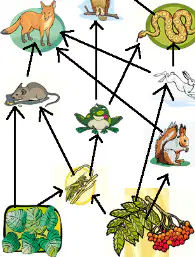
In the food web diagram, identify a primary consumer.
Grasshopper
Fox
Snake
Owl
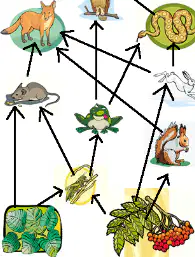
In the food web diagram, identify a secondary consumer.
Frog
Grasshopper
Rabbit
Plant
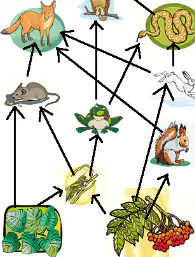
In the food web diagram, identify a tertiary consumer.
Fox
Squirrel
Rabbit
Grass
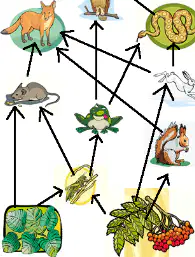
In the food web diagram, identify the quaternary consumer.
Owl
Mouse
Frog
Snake
If a disease killed many grasshoppers in this food web, predict what would happen.
The frog population may decrease
Plant biomass would immediately vanish
Snake populations must increase uncontrollably
Foxes would switch to eating grass only
What percentage of energy transfers to each level in a food chain or food web?
10%
50%
25%
100%
If the bottom level is 5000 , what would each level be up to the 4th level, using typical energy transfer?
5000→500→50→5
5000→2500→1250→625
5000→1000→100→10
5000→750→75→7.5
What are some reasons a population may increase? Select all that apply.
Immigration
Abundant food, space, or resources
Fewer predators
Emigration
Increased disease
Define invasive species.
A non-native species that causes ecological problems
A native species with a large population
A predator that hunts in packs
Any species with a short lifespan
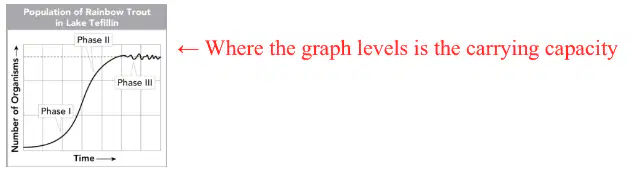
What is carrying capacity, and when does it occur in the rainbow trout population graph? Select all that apply.
The maximum number of individuals an environment can support
The point where the graph levels off
The first point where the population is zero
The steepest increasing part of the curve
Define limiting factors.
Factors that decrease the growth of a population
Factors that guarantee exponential growth
Any random change with no effect on population size
Only abiotic factors that never involve organisms
Which of the following are examples of limiting factors? Select all that apply.
Predation
Emigration (exit the area)
Competition
Natural disaster
Increased human activity
Describe the predator-prey relationship.
If predator numbers increase, prey numbers tend to decrease, and vice versa
If predator numbers increase, prey numbers always increase
Predators and prey never affect each other’s populations
Predators only eat producers
What is a keystone species? Select the correct definition and example(s).
A species that the ecosystem depends on
Sea otter on the Pacific Coast
Yellowstone gray wolf
A species with the largest body size in the ecosystem
Explain trophic cascade. Choose the best description with an example.
A dramatic ecosystem change following the removal of a keystone species; e.g., removing gray wolves led to more elk and fewer plants
A gradual climate shift due to ocean currents; e.g., El Niño warming waters
A seasonal migration of predators following prey; e.g., wolves tracking elk each winter
A simple food chain with one predator and one prey with no wider effects

