
 Worksheets
8.ESS.4: Relative Dating
Total questions: 20
Worksheet time: 33mins
Name
Class
Date
1.

According to the law of superposition, the oldest fossils are found
a)
At the top of the rock layers
b)
Near the bottom of the rock layers
c)
In the middle of the rock layers
d)
Somewhat near the surface
2.
A break in the geologic record that is made when rock layers are eroded over a long period of time
a)
Law of Superposition
b)
Law of Crosscutting
c)
Relative Dating
d)
Unconformity
3.

Analyze the seashell found in the white layer. Which statement is true of the rock layer that contains this fossil?
a)
It could also contain a fossil from the bottom layer.
b)
It is older than the layers below it.
c)
It is younger than the layers above it.
d)
It is older than the layers above it.
4.
The Law of Superposition helps scientists to determine what?
a)
The absolute age of rock layers
b)
The age of fossils
c)
The relative age of rock layers
d)
the super powers of rocks
5.
States that younger rocks lie above older rocks if the layers have not been disturbed
a)
Law of crosscutting
b)
Law of superposition
c)
Relative Dating
d)
Unconformity
6.
What is the law of superposition?
a)
The age of sedimentary rock not found in the original layers.
b)
Metamorphic rock is younger than the nearby igneous rock.
c)
Sedimentary rock in it's original position is older than layers above it.
d)
Metamorphic rock is older because it was deposited to nearby sedimentary rock.
7.

What is the correct order of the rock layers from oldest to youngest?
a)
B, C, D, E, A
b)
A, B, C, D, E
c)
E, D, C, B, A
d)
B, C, D, A, E
8.
How do geologists use relative dating?
a)
Placing rocks in order from youngest to oldest
b)
Placing rocks in order by minerals they contain
c)
Classifying rocks by different textures
d)
Classifying rocks by different isotopes
9.
Relative dating of rock layers tells us that the deeper we dig, _______.
a)
the younger the rocks get
b)
the smellier the rocks get
c)
the harder the rocks get
d)
the older the rocks get
10.
An ordered arrangement of rock layers that is based on the relative ages of the rocks
a)
Superposition
b)
Unconformity
c)
Layered
d)
Geologic Column
11.
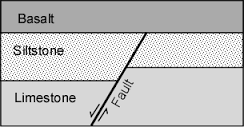
What are the relative ages of the features in order from oldest to youngest?
a)
Limestone, Basalt, Fault, Siltstone
b)
Siltstone, Fault, Basalt, Limestone
c)
Limestone, Fault, Basalt, Siltstone
d)
Limestone, Siltstone, Fault, Basalt
12.
Gaps in rock layers caused by erosion are called
a)
law of superposition
b)
unconformities
c)
uniformitarianism
d)
relative dating
13.
What can be used to determine the relative ages of rock layers?
a)
Living animals
b)
Living plants
c)
Minerals
d)
Index Fossils
14.

Is extrusion E older or younger than layer D?
a)
older
b)
younger
15.

According to the law of superposition, which layer is the youngest?
a)
A
b)
B
c)
C
16.
How do scientists use fossils to determine the relative ages of rock layers?
a)
by comparing all the fossils in one rock layer
b)
by comparing fossils in many different rock layers
c)
by determining the positions of fossils in many different rock layers
d)
by locating other areas of the world where the same fossils are found
17.

Could the Trilobite be considered an index fossil in this diagram?
a)
Yes
b)
No
18.

Which of the following is the oldest?
a)
Layer s
b)
Intrusion D
c)
Intrusion H
d)
Layer A
19.
Traces or remains of organisms that lived long ago
a)
Fossil
b)
Unconformity
c)
Superposition
d)
Column
20.
Placing rock layers from two different regions in order from youngest to oldest is an example of what?
a)
geologic column
b)
geologic record
c)
fossil record
d)
topographic map
100 %

