
 Worksheets
2024-25 Biology Midterm
Total questions: 70
Worksheet time: 35mins
Name
Class
Date
1.
The combination of chemical reactions through which an organism builds up or breaks down materials as it carries out its life processes is called?
a)
homeostasis
b)
metabolism
c)
growth
d)
I have no clue...please, I beg for your forgiveness!
2.
Which of the following is NOT a way that science influences society?
a)
Science provides answers to some of society’s practical problems
b)
Science gives society answers to difficult ethical issues
c)
Science advances technology that is useful to society
d)
Science increases society’s understanding of how people affect the environment
3.
How does sharing ideas through peer-reviewed articles help advance science?
a)
Peer-reviewed articles are published only when the ideas they contain have been accepted by most scientists
b)
Experiments in peer-reviewed articles do not need to be repeated
c)
Scientists reading the articles may come up with new questions to study
d)
Ideas in the articles always support and strengthen dominant theories
4.
How does studying science help you be a better member of society?
a)
Learning the biases of science will help you know what is right or wrong
b)
Understanding how science works will help you make better decisions
c)
Memorizing science facts will help you become more intelligent
d)
Knowing science will help you live without the aid of technology
5.
Which of the following is NOT a characteristic of all living things?
a)
growth and development
b)
response to the environment
c)
ability to move from place to place
d)
ability to reproduce
6.
The process by which organisms keep everything inside their bodies within certain limits is called ________________.
a)
photosynthesis
b)
evolution
c)
metabolism
d)
homeostasis
7.
A student sees a bee on a flower. The student wonders how the bee finds flowers. This student is displaying the scientific attitude of?
a)
skepticism
b)
curiosity
c)
open-mindedness
d)
creativity
8.
What is a stimulus?
a)
something that causes a thing to become alive
b)
money
c)
something that causes a thing to react
d)
something that causes a living thing to react
9.
Science can show us what we can do, but ____________ within society determines what we should do.
a)
God
b)
genetic engineers
c)
ethics
d)
politicians
10.
After a scientist publishes a paper, someone else finds evidence that the paper’s hypothesis may not be correct. The scientist is unhappy but studies the new evidence anyway. The scientist is showing which scientific attitude?
a)
creativity
b)
open-mindedness
c)
curiosity
d)
skepticism
11.
What property of water allows the temperature of water remain relatively cool on a hot summer day?
a)
heat absorbtion
b)
heat capacity
c)
temperature inversion
d)
cohesion
12.
pH is the measurement of the concentration of _____ ions of a solution.
a)
OH-
b)
H+
c)
Both H+ and OH-
d)
water
13.
___________ stop sudden changes in pH.
a)
calcium
b)
neutral solutions
c)
buffers
d)
nucleic acids
14.
Fats, oils, and waxes are kinds of ___________.
a)
fats
b)
carbohydrates
c)
amino acids
d)
lipids
15.
During a(n) _____________, some chemical bonds are formed and others are broken.
a)
enzyme
b)
chemical operation
c)
chemical change
d)
chemical reaction
16.
Oil does not dissolve in water because it is _____________.
a)
polar
b)
oleophobic
c)
non-polar
d)
unstable
17.
Nucleic acids store genetic information.
a)
True
b)
False
18.
Enzymes are called natures catalyst because they slow down chemical reactions within living things so they do not overheat.
a)
True
b)
False
19.
Which of the following is not a macromolecule?
a)
Protein
b)
oil
c)
starch
d)
salt
20.
Denaturation of an enzyme often occurs when too much heat is applied to the enzyme. This causes the enzyme to become ____________.
a)
more effective
b)
less effective
c)
does not change the activity
d)
lowers activation energy
21.
The cell membrane contains channels and pumps that help move materials from one side to the other. What are these channels and pumps made of?
a)
carbohydrates
b)
bilipids
c)
lipids
d)
proteins
22.
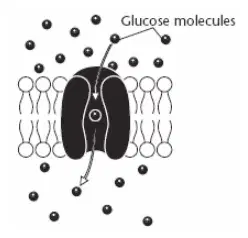
Which means of particle transport is shown in the Figure below?
a)
diffusion
b)
facilitated diffusion
c)
osmosis
d)
active transport
23.
To respond to a chemical signal, a cell must have a ________ to which the signaling molecule can bind.
a)
wierless receiver
b)
receptor
c)
hand
d)
active cite
24.
Which means of particle transport requires the input of energy from the cell?
a)
diffusion
b)
facilitated diffusion
c)
osmosis
d)
active transport
25.
A group of similar cells that perform a particular function is called __________.
a)
an organ
b)
a tissue
c)
an organ system
d)
a division of labor
26.
Some materials can move across the cell membrane against a concentration gradient by __________.
a)
Active transport
b)
growing arms
c)
passive transport
d)
hiering a shipping company
27.
The cells of multicellular organisms communicate with one another by means of _______________ that are passed from one cell to another.
a)
homeostasis
b)
chemical signals
c)
electrical signals
d)
water pressure
28.
Which list represents the levels of organization in a multicellular organism from the simplest level to the most complex level?
a)
cell, tissue, organ system, organ
b)
organ system, organ, tissue, cell
c)
tissue, organ, organ system, cell
d)
cell, tissue, organ, organ system
29.
Some materials can move across the cell membrane against a concentration gradient by _______________.
a)
osmosis
b)
active transport
c)
diffusion
d)
making new cells
30.
Which of the following is NOT a principle of the cell theory?
a)
Cells are the basic units of life
b)
All living things are made of cells
c)
All cells are able to reproduce
d)
All cells are produced from existing cells
31.
The diffusion of water across a selectively permeable membrane is called ______________.
a)
osmotic pressure
b)
pinocytosis
c)
osmosis
d)
active transport
32.
A(n) __________ is a possible explanation for a set of observations.
a)
hypothesis
b)
theory
c)
experiment
d)
scientific methodology
33.
A point of view that is personal rather than scientific is a ___________.
a)
fact
b)
lie
c)
bias
d)
wrong
34.
A well tested explanation that unifies a broad range of observations that allows a scientist to make an accurate prediction is called a _________________.
a)
hypothesis
b)
bias
c)
theory
d)
evolution
35.
Suppose that a scientist proposes a hypothesis about how a newly discovered virus affects humans. Other virus researchers would likely _________________.
a)
reject the hypothesis right away
b)
change the hypothesis to fit their own findings
c)
design new experiments to test the proposed hypothesis
d)
assume that the hypothesis is true for all viruses
36.
A(n) ____________ is the basic unit of Matter.
a)
Cell
b)
snowflake
c)
atom
d)
electron
37.
What bond is formed between water molecules?
a)
covalent Bond
b)
magnetic bonds
c)
hydrogen bonds
d)
ionic bonds
38.
Sodium and chlorine form a(n) ____________ when an electron moves from the sodium atom to the choline atom.
a)
ionic bond
b)
electron bond
c)
covalent bond
d)
hydrogen bond
39.
A ______________ is formed from the sharing of electrons.
a)
hydrogen bond
b)
ionic bond
c)
covalent bond
d)
proton bond
40.
The elements or compounds that enter into a chemical reaction are called _____________.
a)
products
b)
reactors
c)
enzymes
d)
reactants
41.
________________ are negatively charged and move around the nucleus of an atom.
a)
electrons
b)
protons
c)
neutrons
d)
nucleus
42.
Which of the following enclose their DNA in a nucleus?
a)
prokaryotes
b)
eukaryotes
c)
bacteria
d)
viruses
43.
Air has a higher concentration of oxygen molecules than does the cytoplasm of your lung cells. Where in your lungs will there be a net increase of oxygen?
a)
in the air breathed in
b)
outside of the lung cells
c)
in the air breathed out
d)
inside of the lung cells
44.
An egg is placed in syrup. Which of the following is true?
a)
The syrup is hypotonic to the egg so water would move into the egg
b)
The syrup is hypertonic to the egg so water would move into the egg
c)
The syrup is hypotonic to the egg so water would move out of the egg
d)
The syrup is hypertonic to the egg so water would move out of the egg
45.
Organelle where cellular respiration occures. AKA power house of the cell.
a)
Chloroplast
b)
Mitochondria
c)
Nucleus
d)
Cytoplasm
46.
Organelle where solar energy is converted to chemical energy; also makes plants green.
a)
Mitochondria
b)
Nucleus
c)
Cytoplasm
d)
Chloroplasts
47.
Enzyme-filled organelles serving as "clean-up crews" digesting organic molecules for the cell's use.
a)
Vacuole
b)
Lysosome
c)
Nucleus
d)
Cytoplasm
48.
________ are small particles in the cell on which proteins are assembled; made of RNA and protein. Free floating or attached to the rough ER.
a)
Rabbits
b)
Ribognomes
c)
Ribosomes
d)
Rivulettes
49.
Organelle associated with the Endoplasmic Reticulum that modifyies, sorts, and packages proteins and other materials for storage or secretion.
a)
The Golgi apparatus
b)
Rough Endoplasmic Reticulum
c)
Smooth Endoplasmic Reticulum
d)
Lysosome
50.
Organell made of lipids and protein, regulates everything that enters/leaves cell, gives animal cell its shape, and protects animal cell.
a)
Cytoplasm
b)
Cytoskeleton
c)
Cell Membrane
d)
Cell Wall
51.
________ is part of the plant and bacteria cells, made of cellulose, and gives cell shape and protection.
a)
Cytoplasm
b)
Cytoskeleton
c)
Cell Membrane
d)
Cell Wall
52.
An atom of Calcium has 20 protons. How many electrons does it have?
4 lines
53.
There are four scientific attitudes we discussed in class. which one do you think is most important? Why do you think it is the most important attitude?
4 lines
54.
Which characteristic of living things is important to the survival of a group of animals rather than an individual member of this group? Why?
4 lines
55.
Explain why water molecules are polar.
4 lines
56.
Is water an atom, element, or compound? Defend your answer.
4 lines
57.
What is the difference between an element and a compound?
4 lines
58.
Why is skepticism a good quality in a scientist?
4 lines
59.
What is the difference between a saturated and unsaturated fat in regard to the chemical structure?
4 lines
60.
Osmosis:
What happens to a cell when it is placed in a hypertonic solution? Include movement of water and condition of the cell as water moves to achieve equilibrium.
4 lines
61.
Identify and describe the process a cell uses to remove unwanted or excess materials from within the cell. Two possible answers, but you only need to describe one.
4 lines
62.
Most sports drinks are isotonic in relation to human body fluids. Explain why athletes should drink solutions that are isotonic to body fluids when they exercise rather than ones that are hypotonic to body fluids.
4 lines
63.
When you add water to an acid the pH increases and when you add water to a Base the pH decreases. Why?
4 lines
64.
What are the monomers for each of the polymers listed? Carbohydrate, Lipid, Protein, Nucleic acid
4 lines
65.
There are eight characteristics of life that must all be met to determine if something is alive. Many of those qualities cannot be directly observed without the use of scientific equipment or research. Identify four characteristics that you can observe unaided by equipment or research.
4 lines
66.
Describe what happens to the movement of water molecules across the cell membrane when equilibrium is reached.
4 lines
67.
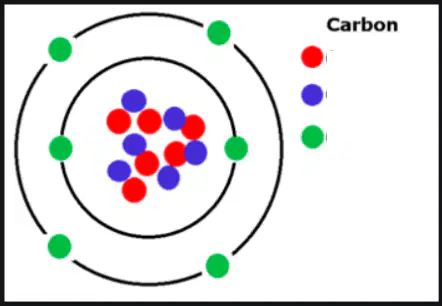
This image is a model of a Carbon Atom. Please identify the following and give the overall charge: Red circles, Blue Circles (these ones have no charge), Green Circles.
4 lines
68.
During digestion our bodies break macromolecules down into more manageable molecules, typically monomers. Water is very important in the chemical process of breaking down monomers into polymers. 1) What is the chemical reaction called 2) Describe why water is vital to the process
4 lines
69.
If you went to the hospital in a dehydrated state what type of IV solution would you be given? (Hypertonic/Hypotonic/Isotonic)
Using osmosis describe why this would be the best solution.
4 lines
70.
Taking Biology or other sciences should inform you to make better decisions for yourself and society. Youtube has many "True Science" videos out there. Why is it important to study biology with all of this free and usually entertaining information?
4 lines
100 %

