
 Worksheets
Grade 5 World History I - 2.2 Review
Total questions: 10
Worksheet time: 7mins
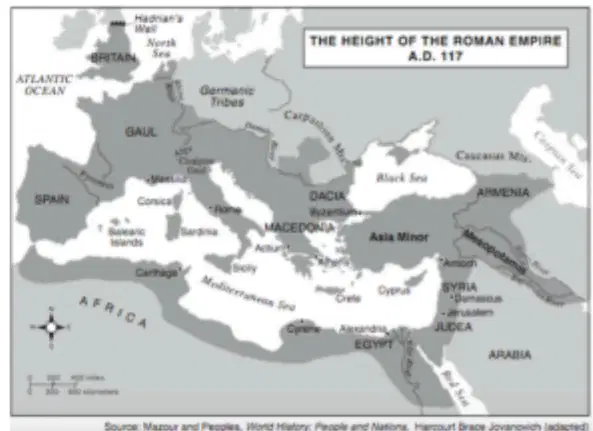
Which statement is best supported by the information on this map?
The Roman Empire extended over three continents.
Rivers kept invaders out of the Roman Empire.
Alexandria served as the eastern capital of the Roman Empire.
Carthage was eventually destroyed by the Romans.
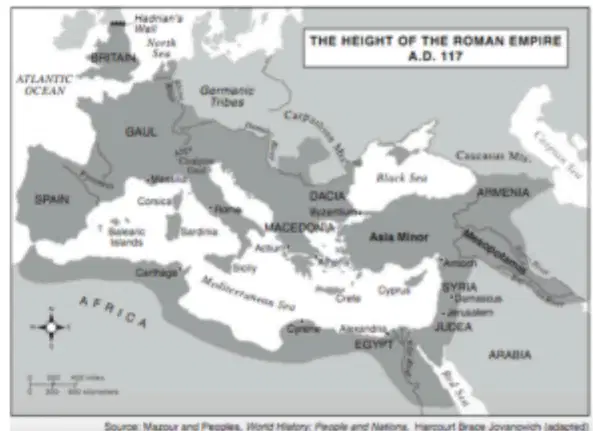
Based on the information provided by this map, which body of water was most likely the center of Roman civilization?
Mediterranean Sea
Atlantic Ocean
Red Sea
Black Sea
How did the Han's imperial Mandate of Heaven differ from Roman emperors imperial Mandate of Heaven?
Even though both were used to legitimize their power, only Roman emperors relied on their divinity alone to remain in power.
Roman emperors used their divine title to justify their rule, while the Mandate of Heaven only made Chinese emperors religious leaders.
While both justified their respective rules, the Romans' claims were permanent and the Mandate of Heaven could be lost.
The Mandate of Heaven justified the emperor’s political rule. Roman emperors’ claims to a divine connection made them the head of the Roman religion.
One way in which the Han dynasty and the Roman Empire were similar is that both:
governed large areas around the Mediterranean Sea.
created democratic societies in which people elected their government officials.
developed a social system in which great equality existed.
promoted unity and communication by building a strong system of roads.
Which of the following civilizations changed from a republic to an empire?
Rome
Carthage
Greece
Persia
Duiker and Spielvogel, The Essential World History, 2014.
In the course of the third century, the Roman Empire came to near collapse. Military monarchy … which restored order after a series of civil wars [wars between two groups in the same country], was followed by military chaos.For the next 49 years, the Roman imperial throne was occupied by anyone who had the military strength to take
it—a total of 22 emperors. … At the same time, the empire was threatened by a series of invasions, no doubt worsened by the civil wars. … There was a noticeable decline in trade and small industry, and the labor shortage caused by the plague affected both military recruiting and the economy. Armies were needed more than ever, but money problems made it difficult to pay and sign up more soldiers. By the mid-third century, the state had to hire Germans to fight under Roman commanders.
All of the following factors related to the fall of Rome are supported by the passage above. Which of the following is NOT an internal factor?
A. Political instability
B. Labor shortage
C. Invasion
D. Economic instability
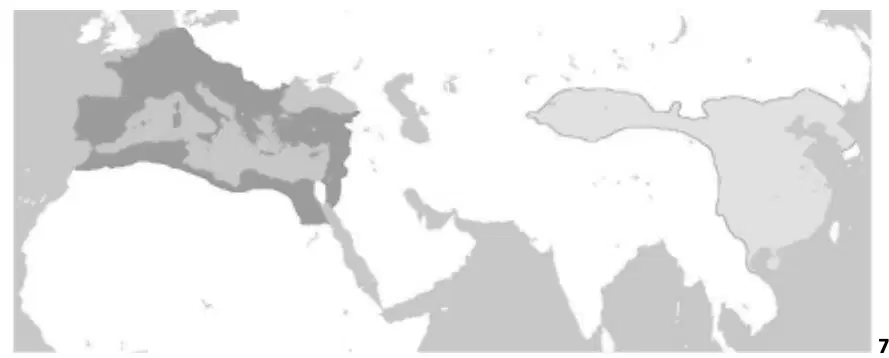
The two states represented by the shaded areas on the left and right of Eurasia on the map above are:
A. Roman Empire and Maurya Empire.
B. Persian Empire and Han Dynasty China.
C. Persian Empire and Maurya Empire.
D. Roman Empire and Han Dynasty China.
Each of the following represent a long- or short-term cause of the decline of the Roman Republic EXCEPT:
A. growing wealth inequality between the elites and lower classes.
B. invasions by Germanic tribes from Northern Europe.
C. political gridlock and inaction preventing necessary reforms.
D. increasing power in the hands of elite individuals.
"Classical Greece" by C.M. Bowra (1965).
The Athenian Assembly was open to all free male citizens of adult age, regardless of income or class. It met 40 times a year, usually at a place called the Pnyx, a natural amphitheater on one of the hills west of the Acropolis. In theory, any member of the Assembly could speak about anything. But for practical reasons, [the Assembly] also had an official agenda [schedule or plan]. This was prepared by a Council composed of 500 men, 50 from each of the ten Athenian tribes. They were chosen by lot [random lottery] from a list of volunteers, all of them citizens over the age of 30. … After an interval they might serve a second year, but they could never serve for more than two.
Which civilization created practices similar to the ones described above?
Ancient China
Ancient India
Byzantine Empire
Ancient Rome
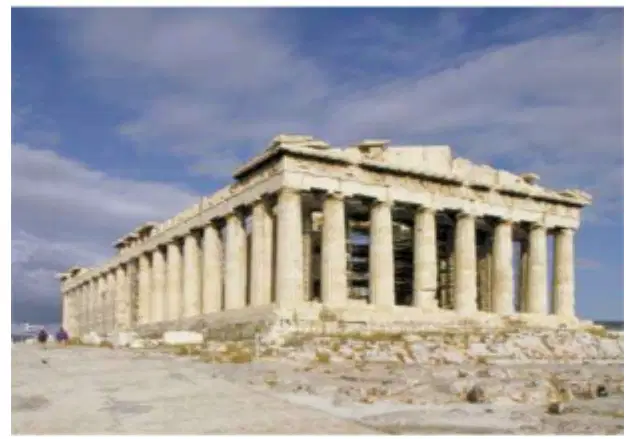
What inference can be drawn about Greek and Roman civilizations based on this art and architecture?
Roman civilization was more advanced in sculpture than Greek civilization.
Fortification and protection were highly important to both Greek and Roman civilizations.
Greek civilization had more organized labor systems than Roman civilization.
Both Roman and Greek civilization dedicated great attention to religion.

