wayground logo

Free Printable Worksheets

Font size

S
M
L
XL
Worksheets

Chemistry Midterm Exam Review

Total questions: 121

Worksheet time: 2hrs 26mins

Name
Class
Date
1.
What is this?
a)
Measuring tube
b)
Test tube
c)
Graduated Cylinder
d)
Pipette
2.
What is used to protect your eyes from chemicals, broken glass, and fire?
a)
Fire blanket
b)
Eye wash
c)
Goggles
d)
Flask
3.

What is the name of this lab equipment?

a)

Erlenmeyer Flask

b)

Beaker

c)

Graduated Cylinder

d)

Pipet

4.
a)
Beaker
b)
Erlenmeyer Flask
c)
Graduated Cylinder
d)
Volumteric Flask
5.
a)

Test Tube

b)

Graduated Cylinder

c)

Erlenmeyer Flask

d)

Beaker

6.
Solve and give your answer with the correct number of significant figures
24.28 + 12.5
a)
3.687 x 101
b)
36.8
c)
37
d)
3.70x101
7.
How many significant figures does the following number have: 0.002040
a)
6
b)
4
c)
3
d)
2
8.
Determine the number of Significant Figures in 506020-km.
a)
5
b)
4
c)
3
d)
2
9.
calculate the following to the correct number of sig figs.
0.00401  x  2.00  x  501
a)
4.02
b)
4
c)
4.0
d)
4.0180
10.
calculate the following to the correct number of sig figs.
13.2017/ 17.10
a)
.772
b)
.7720
c)
.772030
d)
.77
11.
Solve and round accordingly.
25.0 x 17 = ?
a)
430
b)
425
c)
425.0
d)
430.0
12.
How many sig figs are there?
100.00
a)
1
b)
3
c)
4
d)
5
13.

1 km = ________ m

a)

1

b)

10

c)

100

d)

1000

14.

1 m = _____ cm

a)

1

b)

10

c)

100

d)

1,000

15.

1 m = ____ mm

a)

1

b)

10

c)

100

d)

1,000

16.

What unit of measurement is the biggest?

a)

Millimeters

b)

Meters

c)

Kilometers

d)

Centimeters

17.

The rule used to change from one unit of measurement to another.

a)

Meters

b)

Base Units

c)

Metric System

d)

Conversion Factor

18.

How many minutes are in a school year, 187 days?

a)

269,280 min.

b)

16, 200 min.

c)

16, 156 min.

d)

269,000 min.

19.

This past summer our rain gauge collected 0.80 yards of rain. Express this amount in centimeters.

a)

73 cm

b)

73.2 cm

c)

74 cm

d)

73.152 cm

20.

What does the prefix "micro-" represent?

a)

1,000,000

b)

1/1,000,000

c)

10,000,000

d)

100,000

21.

Because our goal in life is to make other people better, you get paid $5.00 every time you do something nice for someone else. You do a minimum of 25 nice things everyday for 1 year. How much money would you make a year?

a)

$45, 625

b)

$1,820

c)

$1,826

d)

$45,600

22.

The type of variable that responds to the experiment and is what you measure to determine if your hypothesis is true.

a)

Independent

b)

Dependent

c)

Control

d)

Constant

23.
The type of variable that you change or manipulate in an experiment.  It is what you are testing.
a)
Independent
b)
Dependent
c)
Control
24.
The parts of the experiment that must be kept the same.
a)
Constants
b)
independent
c)
Dependent
25.
The purpose of the control group is:
a)
Used for comparisons
b)
Application of the I.V.
c)
Application both the I.V. and D.V.
d)
Application of all constants.
26.
If I water the plant more often, then it will grow taller.  Name the independent variable.
a)
The height of the plant
b)
The size of the pot
c)
The amount of water
d)
The amount of light.
27.
If I water the plant more often, then it will grow taller.  Name the dependent variable.
a)
The amount of water.
b)
The amount of soil.
c)
The height of the plant.
d)
The amount of water.
28.
If you were testing how well different dish soaps cleaned grease, the independent variable would be the:
a)
dish type
b)
amount of grease
c)
dish soap type
d)
grease type
29.

Thomas tests different types of liquids to see which will grow his plants the most. He has water, soda, milk, and no liquid at all. What is the control group?

a)

Water

b)

Soda

c)

Milk

d)

No liquid

30.
Three baseball players investigate to see who can throw a baseball the farthest. They mark off an area on the playground for their investigation. Which should they keep constant?
a)
height of the players
b)
color of the balls thrown
c)
order in which the players throw
d)
spot from which the players throw
31.
Substance that consists of one type of atom.  It is a pure substance. Found on the Periodic Table. 
a)
Element
b)
Compound
c)
Mixture
d)
I don't know
32.
Combinations of 2 or more substances (elements and compounds) that are physically blended together. 
a)
Compound
b)
Mixture
c)
Element
d)
Substance
33.
If a mixture has components you can see it is a...
a)
solution
b)
compound
c)
homogeneous mixture
d)
heterogeneous mixture
34.
What is the term for combining 2 or more DIFFERENT atoms together?
a)
atoms
b)
elements
c)
molecules
d)
compounds
35.
What type of matter is copper wire?
a)
Element
b)
Compound
c)
Heterogeneous Mixture
d)
Homogeneous Mixture
36.
The smallest particles having the same properties of an element is a (an)
a)
molecules
b)
ions and charged electrons
c)
atoms
d)
elements
37.

Which set of properties, intensive or extensive, are based on the size of a sample?

a)

intensive

b)

extensive

38.

What kind of physical property is this? Color

a)

intensive

b)

extensive

39.

What kind of physical property is this? Density

a)

intensive

b)

extensive

40.

What kind of physical property is this? Boiling Point

a)

intensive

b)

extensive

41.

What kind of physical property is this? Volume

a)

intensive

b)

extensive

42.

True or False: Filtration can be used to separate solutions

a)

True

b)

False

43.

Select all the examples of mixtures below:

a)

Air

b)

Salt water

c)

Pure honey

d)

Calcium carbonate

44.

What is the physical property that fractional distillation depends on?

a)

different boiling points

b)

different melting points

c)

different solubilities

d)

different densities

45.

This separation technique separates two insoluble liquids with different densities.

a)

Decanting

b)

Magentism

c)

Filtering

d)

Evaporating and Condensing

46.

This separation technique separates solids from liquids.

a)

filtering

b)

decanting

c)

magnetism

d)

crying

47.

What kind of change results in a new substance?

a)

Chemical change

b)

Physical change

48.

Roasting a marsh mellow

a)

chemical change

b)

physical change

49.

ice cream melting

a)

chemical change

b)

physical change

50.

glass breaking

a)

chemical

b)

physical

51.

burning of wood

a)

chemical

b)

physical

52.

nail rusting

a)

chemical

b)

physical

53.

bread molding

a)

chemical

b)

physical

54.

Boiling Water

a)

Physical Change

b)

Chemical Change

55.

Frying an Egg

a)

Physical Change

b)

Chemical Change

56.

Salt dissolving in water

a)

Physical Change

b)

Chemical Change

57.
Examples are water (H2O) and carbon dioxide (CO2).
a)
elements
b)
mixtures
c)
compounds
58.
This picture represents which of the following?
a)
element
b)
compound
c)
mixture
59.
This picture represents which of the following?
a)
element
b)
compound
c)
mixture
60.
What is gold?
a)
element
b)
compound
c)
mixture
61.
What is sugar?
a)
element
b)
compound
c)
mixture
62.
Identify
a)
Element
b)
Compound 
c)
Mixture
63.

Which class of elements are malleable, ductile, shiny when clean and polished, good conductors of heat and electricity, and reacts with acids to form hydrogen gas?

a)

metals

b)

nonmetals

c)

metalloids

d)

ions

64.

What is the name of Group 1 elements?

a)

Alkali Metals

b)

Alkaline Earth Metals

c)

Transition Metals

d)

Halogens

65.

Where are metalloids located on the Periodic Table?

a)

In the s block.

b)

In the f block.

c)

In the d block.

d)

The elements that touch the staircase except aluminum.

66.

Vertical columns on the periodic table are called ___?

a)

groups

b)

periods

c)

rows

d)

families

67.

Which color on the image of the periodic table corresponds with the halogens.

a)

red

b)

black

c)

blue

d)

orange

68.

Which color on the image of the periodic table corresponds with the noble gases.

a)

red

b)

black

c)

blue

d)

orange

69.

Which color on the image of the periodic table corresponds with the transition metals.

a)

red

b)

black

c)

blue

d)

orange

70.

Which color on the image of the periodic table corresponds with the metalloids.

a)

bright yellow

b)

gold

c)

teal

d)

light blue

71.

Horizontal rows on the periodic table are called ___?

a)

groups

b)

periods

c)

rows

d)

families

72.

Where are the protons located in an atom?

a)

In the nucleus

b)

In the electron cloud

c)

In the empty space

73.

For an atom to be neutral (no charge), it must have an equal number of _____ and ______.

a)

protons and neutrons

b)

protons, neutrons, and electrons

c)

protons and electrons

74.

An atom's atomic number comes from its number of ________.

a)

electrons

b)

protons

c)

neutrons

75.
A tiny but very dense, positively charged portion of the atom that holds most of the atomic mass
a)
Electron Shells
b)
Orbitals
c)
Electron Cloud
d)
Nucleus
76.

What charge does an atom have when it GAINS electrons?

a)

Positive

b)

Negative

c)

Neutral

77.

What is the mass number of bromine?

a)

35

b)

45

c)

80

d)

79.904

78.

How many neutrons does this bromine atom have?

a)

35

b)

45

c)

80

79.

What two particles determine the mass number?

a)

Protons and electrons

b)

Electrons and neutrons

c)

Protons and neutrons

80.

What changes in an ion?

a)

The number of electrons

b)

The number of protons

c)

The number of neutrons

81.
A neutral atom would become an ion that has a charge of 2+ by 
a)
Losing two protons
b)
Losing two neutrons
c)
Losing two electrons
82.

How many electrons in an oxygen ion (O-2)?

a)

8

b)

7

c)

10

d)

16

83.

How many protons, neutrons, and electrons?

a)

proton = 6, neutron = 4, electron = 1

b)

proton = 4, neutron = 4, electron = 5

c)

proton = 1, neutron = 6, electron = 10

d)

proton = 4, neutron = 2, electron = 3

84.

When an ion has a positive charge it is called ______________ and when an ion has a negative charge it is calle _________________.

a)

Positron, Negatron

b)

Neutral, anion

c)

Cation, anion

d)

Cation, Negatron

85.

Three isotopes of argon occur in nature—36Ar, 38Ar, and 40Ar. Calculate the average atomic mass of argon to two decimal places, given the following relative atomic masses and abundances of each of the isotopes: argon-36 0.337%, argon-38 0.063%, and argon-40 99.600%

a)

54.37

b)

40.00

c)

39.99

d)

3998

86.
4.35% of all X atoms have a mass of 39.946 amu. 83.79% have a mass of 41.941 amu, 9.50% have a mass of 42.941 amu, and 2.36% have a mass of 43.939 amu. What is the average atomic mass of atom X?
a)
41.97 amu
b)
42.19 amu
c)
10.43 amu
d)
40.04 amu
87.
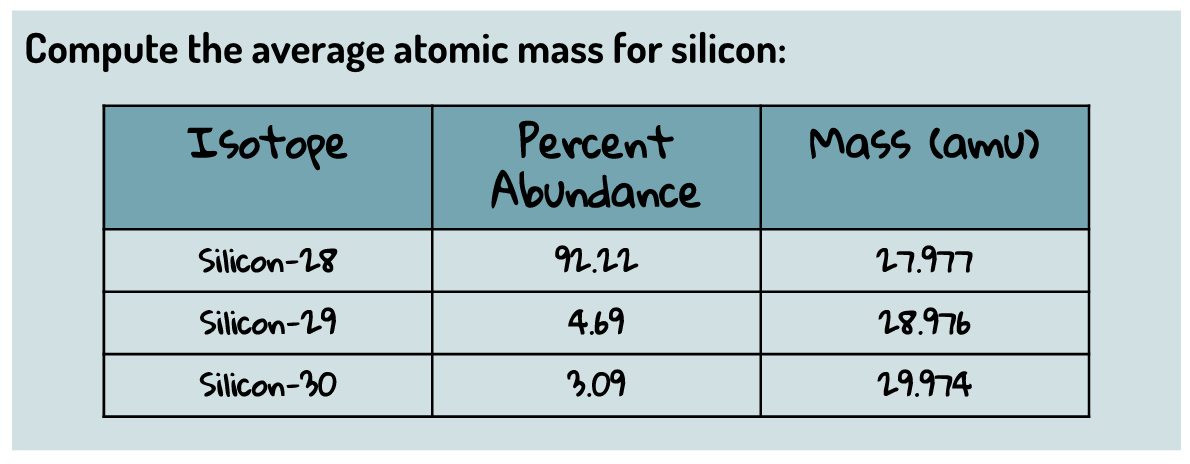
Compute the average atomic mass for silicon:
a)
27.977
b)
28.09
c)
28.976
d)
The average mass cannot be determined from provided information.
88.
An isotope has three forms.  30% have a mass of 4 amu, 20% have a mass of 5 amu and 50% have a mass of 3 amu.  Average atomic mass will be closest to
a)
2 amu
b)
3 amu
c)
4 amu
d)
5 amu
89.

From his Gold Foil Experiment he concluded that the atom is mostly empty space with tiny, positively charged, dense center he called the nucleus.

a)

Rutherford

b)

Thomson

c)

Chadwick

d)

Bohr

90.

Discovered the existence of neutrons

a)

James Chadwick

b)

Werner Heisenberg

c)

Antoine Lavoisier

91.

Proposed that all matter is made up of tiny indivisible particles called atoms.

a)

Democritus

b)

Dalton

c)

Thomson

d)

Bohr

92.

Concluded the atom had negatively charged particles that he named electrons.

a)

Rutherford

b)

Chadwick

c)

J.J. Thomson

d)

Dalton

93.
The word atom comes from a Greek word "atomos" that means
a)
Invisible
b)
Indivisible
c)
Undivided
d)
Indestructable 
94.
Which element is pictured?
a)
neon
b)
fluorine
c)
magnesium
d)
argon
95.

What block is purple?

a)

s

b)

p

c)

d

d)

f

96.

What block is green?

a)

s

b)

p

c)

d

d)

f

97.
What atom matches this electron configuration?
1s2s2p3s2
a)
Neon
b)
Magnesium
c)
Aluminum
d)
Potassium
98.
Which is the electron configuration for an oxygen atom?
a)
1s22s22p63s23p64s2
b)
1s22s22p4
c)
1s22s22p6
d)
1s22s22p63s23p6
99.

This is the shape of a...

a)

s orbital

b)

d orbital

c)

p orbital

d)

f orbital

100.

An electron occupies the lowest energy orbital possible

a)
Hund’s rule
b)
Pauli exclusion principle
c)
Bohr model of the atom
d)
Aufbau principle
101.
All orbitals of equal energy are occupied by one electron before any single orbital is occupied by a second electron.
a)
Aufbau principle
b)
Pauli exclusion principle
c)
Hund’s rule
d)
Core Notation
102.

Electrons that have not been excited are said to be at:

a)

high level

b)

base line

c)

set state

d)

ground state

103.

Light is emitted when electrons

a)

move from one atom to another.

b)

collide with one another, releasing energy.

c)

move from a lower energy level to a higher energy level.

d)

move from a higher energy level to a lower energy level.

104.

If an electron moves from n=4 to n=2 it ____

a)

absorbs energy

b)

releases energy

105.

c=λνc=\lambda\nu  
Think about the above equation. Which statement describes the relationship between wavelength and frequency?

a)

as wavelength increases, frequency decreases

b)

as wavelength increases, frequency increases

c)

wavelength and frequency have no relationship

d)

wavelength only impacts energy, not frequency

106.

Which wave has the shortest wavelength?

a)
b)
c)
107.

The frequency of violet light is 7.5 x 10¹⁴ Hz. What is its wavelength? c=λνc=\lambda\nu  and c=3.0 x 10⁸m/s

a)

4.0x10⁻⁷ m

b)

4.0x10⁷ m

c)

2.25x10²³m

d)

2.25x10²³ Hz

108.

Red light has a wavelength of 675 x 10-9 m. What is its frequency? c=λνc=\lambda\nu   and c=3.0 x 10⁸m/s

a)

2.03 x 10¹¹ m

b)

4.44 x 10¹⁴ Hz

c)

4.44 x 10¹⁴ nm

d)

2.03 x 10¹¹ Hz

109.

CALCULATE: What is the energy of a photon with a frequency of 5.0 x 10¹⁴ Hz? (E = hv. Planck's constant, h = 6.626×10⁻³⁴J*s)

a)

2.5 x 10⁻¹⁹ J

b)

3 x 10-19 J

c)

3.3 x 10⁻¹⁹ J

d)

4.5 x 10⁻¹⁹ J

110.

The elements in this group all have 5 valance electrons.

a)

Group 5

b)

Group 15

c)

Group 3

d)

Group 18

111.

This could be the dot diagram of

a)

Mg

b)

Cl

c)

C

d)

O

112.

USE THE PERIODIC TABLE

How many valence electrons does Phosphorus have?

a)

31

b)

5

c)

15

d)

4

113.

How many valence electrons does Hydrogen have?

a)

4

b)

1

c)

8

d)

2

114.
Valence electrons are: 
a)
Electrons farthest away from the nucleus
b)
Electrons closest to the nucleus
c)
Electrons that just come and go - they don't stay with the atom
d)
Electrons in the second shell
115.

Which element ends its electron configuration in 6p6?

a)

Rn

b)

Xe

c)

Ra

d)

At

116.

What is the short hand configuration for silicon?

a)

[Ar]2s22p2

b)

[Ne]2s22p2

c)

[Ne]3s23p2

d)

[Ne]3s23p4

117.
This orbital diagram represents:  
a)
C
b)
B
c)
N
d)
O
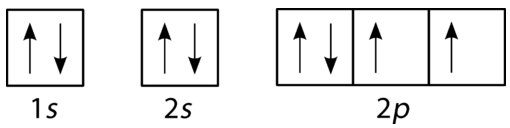
118.
This orbital diagram represents:  
a)
C
b)
B
c)
N
d)
O
119.
What is incorrect about this orbital diagram?
a)
Both arrows in the 2p box should be pointing up
b)
There is nothing incorrect with this diagram
c)
In the 2p box there should only be 1 electron in the first 2p box and one in the 2nd 2p box
d)
All the arrows should be pointing up.
120.
What is the Pauli Exclusion Principle?
a)
An atomic orbital can only hold a maximum of 2 electrons, each with opposite spins
b)
An atomic orbital can hold a minimum of 6 electrons, each with opposite spins
c)
An atomic orbital can hold a maximum of 6 electrons, each with the same spin
d)
An atomic orbital can hold a minimum of 2 electrons, each with opposite spins
121.
Which orbital shows a violation of the Pauli Exclusion Principle?
a)
A
b)
B
c)
C
d)
D