
 Worksheets
CH 4 Test
Total questions: 34
Worksheet time: 17mins
Name
Class
Date
1.
What is the smallest particle of an element?
a)
A) Molecule
b)
B) Atom
c)
C) Nucleus
d)
D) Compound
2.
Which subatomic particle is located in the nucleus and has a positive charge?
a)
A) Electron
b)
B) Proton
c)
C) Neutron
d)
D) Ion
3.
Which subatomic particle is neutral (has no charge)?
a)
A) Proton
b)
B) Electron
c)
C) Neutron
d)
D) Ion
4.
Electrons are found orbiting the nucleus in a cloud-like region. What is the charge of an electron?
a)
A) Positive
b)
B) Negative
c)
C) Neutral
d)
D) Variable
5.
The nucleus of an atom contains which two subatomic particles?
a)
A) Protons and Electrons
b)
B) Protons and Neutrons
c)
C) Neutrons and Electrons
d)
D) Ions and Isotopes
6.
The atomic number of an element is equal to the number of which particle?
a)
A) Neutrons
b)
B) Electrons
c)
C) Protons
d)
D) Subatomic Particles
7.
The mass number of an atom is the sum of which two particles?
a)
A) Protons and Electrons
b)
B) Electrons and Neutrons
c)
C) Protons and Neutrons
d)
D) Atomic Number and Electrons
8.
Which two particles contribute to the charge of an atom?
a)
A) Protons and Electrons
b)
B) Electrons and Neutrons
c)
C) Protons and Neutrons
d)
D) Atomic Number and Electrons
9.
If an atom of Lithium has an atomic number of 3 and a mass number of 7, how many neutrons does it have?
a)
A) 3
b)
B) 7
c)
C) 10
d)
D) 4
10.
What is the definition of an isotope?
a)
A) Atoms of the same element with different numbers of protons. / Átomos del mismo elemento con diferente número de protones.
b)
B) Atoms of the same element with different numbers of neutrons. / Átomos del mismo elemento con diferente número de neutrones.
c)
C) Atoms of different elements with the same mass number. / Átomos de diferentes elementos con el mismo número de masa.
d)
D) Atoms that have lost or gained electrons. / Átomos que han perdido o ganado electrones.
11.
Which statement is true about the structure of an atom?
a)
A) Most of the atom's mass is in the electrons. / La mayor parte de la masa del átomo está en los electrones.
b)
B) The nucleus is negatively charged. / El núcleo está cargado negativamente.
c)
C) Most of the atom is empty space. / La mayor parte del átomo es espacio vacío.
d)
D) The atom is a dense, solid sphere. / El átomo es una esfera densa y sólida.
12.
Which atomic model, proposed by J.J. Thomson, suggested that electrons were distributed throughout a sphere of positive charge
a)
A) Planetary Model
b)
B) Nuclear Model
c)
C) Plum Pudding Model
d)
D) Indivisible Sphere Model
13.
Ernest Rutherford's Gold Foil Experiment led to the discovery of what part of the atom?
a)
A) Electrons
b)
B) The Nucleus and Protons
c)
C) Neutrons
d)
D) Electron Cloud
14.
Niels Bohr's model is called the Planetary Model because he proposed that electrons:
a)
A) Are randomly distributed throughout the atom.
b)
B) Are concentrated in a cloud-like region.
c)
C) Orbit the nucleus in set paths that correspond to specific energy levels.
d)
D) Move in a perfect spiral towards the nucleus.
15.
How is the modern periodic table organized?
a)
A) By atomic mass.
b)
B) By date of discovery.
c)
C) By increasing atomic number.
d)
D) By reactivity.
16.
The vertical columns on the periodic table are called groups or families. What do elements in the same group have in common?
a)
A) The same number of occupied electron shells.
b)
B) The same atomic mass.
c)
C) The same number of valence electrons (and similar chemical properties).
d)
D) The same atomic number.
17.
Which type of element is generally a good conductor of heat and electricity, shiny (luster), and can be hammered into thin sheets (malleability)?
a)
A) Nonmetals
b)
B) Metalloids
c)
C) Metals
d)
D) Noble Gases
18.
Which property is a chemical property?
a)
A) Melting point
b)
B) Density
c)
C) Reactivity
d)
D) Luster
19.
Which elements are typically found on the far right side of the periodic table (excluding Group 18) and are described as dull and brittle?
a)
A) Nonmetals
b)
B) Transition Metals
c)
C) Alkali Metals
d)
D) Metalloids
20.
The term semiconductor describes a property of which group of elements, meaning they conduct electricity under some conditions but not others?
a)
A) Metals
b)
B) Nonmetals
c)
C) Metalloids
d)
D) Noble Gases
21.
Which family of nonmetals is the most reactive, including Fluorine (F) and Chlorine (Cl)?
a)
A) Group 2
b)
B) Period 2
c)
C) Group 17
d)
D) Period 17
22.
The Noble Gases (Group 18) are unreactive because:
a)
A) They are all liquids at room temperature.
b)
B) They are all extremely dense.
c)
C) They have a full valence shell.
d)
D) They are the lightest elements.
23.
Where are the Metalloids located on the periodic table?
a)
A) Far left side (Group 1).
b)
B) Bottom two rows.
c)
C) Along the border between the metals and nonmetals.
d)
D) In the center (Groups 3-12).
24.
Which element is the most unique, cannot be grouped into a family, and makes up more than 90% of the atoms in the universe?
a)
A) Helium (He)
b)
B) Oxygen (O)
c)
C) Carbon (C)
d)
D) Hydrogen (H)
25.
When an iron chain reacts with oxygen in the air to form rust, this is an example of a:
a)
A) Physical change
b)
B) Chemical change
c)
C) Phase change
d)
D) Nuclear change
26.
Most nonmetals are found in what state at room temperature?
a)
A) Solid
b)
B) Liquid
c)
C) Gas
d)
D) Plasma
27.
An atom of the element Chlorine (Cl) has 17 protons. One isotope of Chlorine has a mass number of 37. How many neutrons are in this specific isotope?
a)
A) 17
b)
B) 10
c)
C) 20
d)
D) 54
28.
You are given a sample of an element that is a silvery, shiny solid and conducts heat well. Where on the periodic table would you expect to find this element?
a)
A) In Group 18 (Noble Gases)
b)
B) On the far upper right side (Nonmetals)
c)
C) Along the zigzag line (Metalloids)
d)
D) On the left side and in the center (Metals)
29.
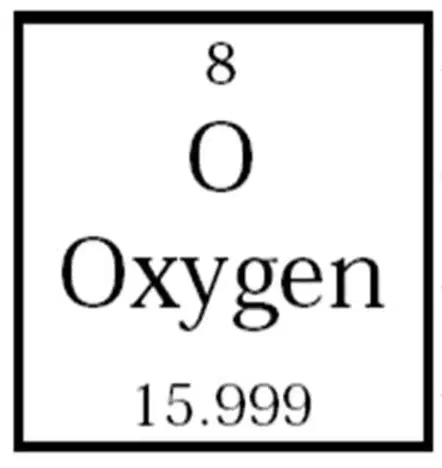
Using the photo below, identify the 'atomic number'.
a)
A) 8
b)
B) O
c)
C) Oxygen
d)
D) 15.999
30.
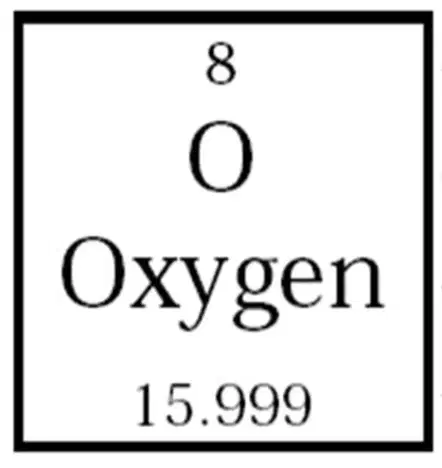
Using the photo below, identify the 'chemical symbol'.
a)
A) 8
b)
B) O
c)
C) Oxygen
d)
D) 15.999
31.
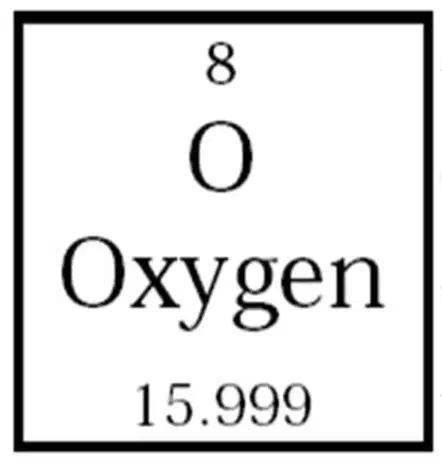
Using the photo below, identify the 'atomic mass'.
a)
A) 8
b)
B) O
c)
C) Oxygen
d)
D) 15.999
32.
A neutral atom of Sulfur has an atomic number of 16 and a mass number of 32. Use this information to determine the number of protons, electrons, and neutrons in this atom.
4 lines
33.
Describe the modern-day structure of an atom, including where to find the protons, neutrons, and electrons.
4 lines
34.
Describe the three main categories of elements on the periodic table (Metals, Nonmetals, and Metalloids). For each category, describe at least two of its typical physical properties and briefly explain its general location on the periodic table.
4 lines
100 %

