
 Worksheets
U.S. History A Final Exam
Total questions: 65
Worksheet time: 2hrs 54mins
Name
Class
Date
1.
Which of the following helped the industrial expansion of the United States?
a)
Land and natural resources
b)
monopolies
c)
Labor Unions
2.
How did business owners try to make more money?
a)
By getting rid of competition and making trusts
b)
increasing benefits for factory workers
c)
supporting the passage of strict antitrust laws (breaking up big companies)
3.
During the Gilded Age most poor, working-class Americans
a)
Usually remained poor
b)
Became middle class
c)
Moved to the country
4.
Which of the following was made illegal by the Sherman Antitrust Act?
a)
monopolies and trusts
b)
stock dividends
c)
anarchists (people who did not want a government)
5.
Which of the following pushed immigrants from their home countries?
a)
They were treated badly for their beliefs
b)
They wanted jobs in factories
c)
They needed food
6.
The Plessy v. Ferguson decision said...
a)
Segregation was okay if things were “separate but equal”
b)
Women could vote in state elections
c)
The Ku Klux Klan was right
7.
The late 1800s was called the…
a)
Gilded Age (looked fancy but had major problems)
b)
Golden Age
c)
New Age
8.
Political machines...
a)
Used their power to stay in control of cities and used immigrants
b)
Told immigrants not to vote
c)
ignored immigrant completely
9.
People from farm areas were attracted to cities because of
a)
A worker asking for rights
b)
A government worker running for office
c)
A woman asking for voting rights
10.
Because the government stayed out of business (laissez-faire)…
a)
Huge businesses controlled whole industries
b)
Low taxes helped foreign countries
c)
The government made prices cheaper
11.
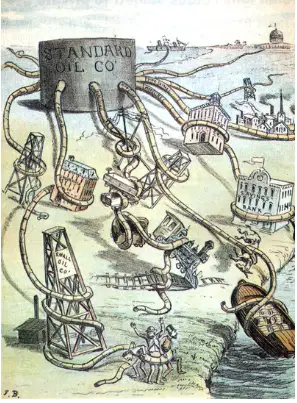
What is the main idea of this cartoon?
a)
The Standard Oil Company was a harmful monopoly
b)
Government rules were hurting Standard Oil
c)
Standard Oil was helping many other companies
12.
What did Progressives want?
a)
To make the government listen more to regular people and workers
b)
To remove all rules from businesses
c)
To make laws that forced businesses to compete more
13.
Industrial workers usually worked...
a)
For low pay and dangerous conditions
b)
Under perfect and safe conditions
c)
With safe machines and good equipment
14.
Why were writers called muckrakers?
a)
They pointed out unfair and unsafe conditions in cities and factories
b)
They fought against railroad companies
c)
They said schools were more important than anything
15.
Question: How did life change for women during the Progressive Era?
a)
More women worked and fought for better rights, including voting
b)
Women stopped getting jobs
c)
Women were told to leave cities and work on farms
16.
What caused American Imperialism?
a)
Nationalism, (Manifest Destiny), Economics, Religion, Social Darwinism
b)
Militaries, alliances, and nationalism
c)
The Spanish attacked Hawaii
17.
Why did the U.S. want overseas territories?
a)
To get natural resources and new places to sell products
b)
To make friends with European countries
c)
Because the U.S. didn’t have computers
18.
Social Darwinists believed that
a)
The strongest countries should win and control weaker ones
b)
Big empires help the economy
c)
Military power is the only thing that matters
19.
What happened after the Spanish–American War?
a)
Spain gave Puerto Rico and Guam to the U.S.
b)
The U.S. took over parts of Mexico
c)
The U.S. controlled Samoa
20.
Why did the U.S. support the Open Door Policy?
a)
To protect American trade in China
b)
To protect China’s government
c)
To protect missionaries only
21.
Pride and loyalty to your country is called…
a)
Alliances
b)
Militarism
c)
Nationalism
22.
Fighting over land was caused by an increase in…
a)
Alliances
b)
Militarism
c)
Imperialism
23.
The Allies (good guys) in WWI were
a)
Germany, Austria-Hungary, and Italy
b)
Russia, Germany, and Austria-Hungary
c)
Great Britain, France, Russia, and later the United States
24.
When WWI started, most Americans wanted…
a)
The U.S. to join the war right away
b)
The U.S. to stay out of the war
c)
The U.S. to help Russian soldiers
25.
Trench warfare consisted of
a)
airplanes dropping bombs.
b)
Using tanks in battles
c)
Having soldiers run through dangerous areas between trenches
26.
How did World War I change the lives of American women?
a)
Women got more jobs and chances to work
b)
Women got to vote later because of it
c)
Women had fewer chances to go to school
27.
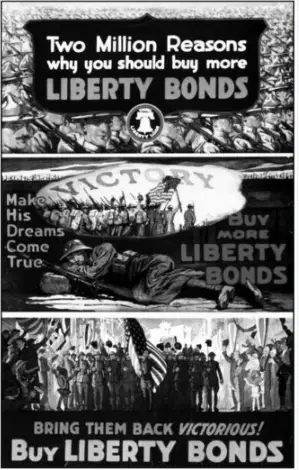
Question: What was this poster used for?
a)
emphasize the goals of the Fourteen Points
b)
Convince men to join the army
c)
help finance (pay for) the war effort
28.
How did WWI affect African Americans?
a)
The military ended segregation
b)
The South became richer
c)
Many African Americans moved North for jobs
29.
Germany surrendered in 1918 partly because…
a)
German soldiers had no supplies and stopped fighting
b)
Trench warfare didn’t work
c)
The blockade on France failed
30.
What happened because the Senate rejected the Treaty of Versailles?
a)
The League of Nations was never formed.
b)
The League of Nations was weak and couldn’t stop problems.
c)
Germany never had to pay for the war damages.
31.
Which country had the strongest economy after WWI?
a)
Great Britain
b)
Germany
c)
the United States
32.
Women’s efforts during WWI helped them gain…
a)
women's suffrage (the right to vote)
b)
Equal rights for races
c)
Freedom of religion
33.
During WWI, government power increased...
a)
True
b)
False
34.
African Americans in the 1920s faced discrimination especially in…
a)
the North, where they were not allowed to work.
b)
the South, where they were not allowed to work.
c)
the South, where the Jim Crow laws were in effect.
35.
How did Prohibition (banning alcohol) lead to more crime?
a)
Police were forced to arrest more people
b)
Bootleggers were able to sell many illegal things
c)
People respected the law more
36.
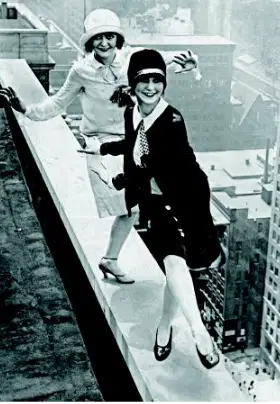
Use the image and your knowledge of social studies to answer the following questions.
Question: Who is in this photograph?
a)
women of the Victorian Age
b)
New Women known as flappers
c)
Superman's mother and best friend
37.
A big result of Ford’s factories was…
a)
Cars became more expensive
b)
Cars became cheaper
c)
Fewer Americans had jobs.
38.
The demand for cars in the 1920s…
a)
Helped other industries grow and helped the economy
b)
Caused a big recession
c)
Closed down the steel industry
39.
The 1920s showed that…
a)
America became more socialist
b)
Black and white people got along better
c)
Old and new American beliefs were fighting
40.
Farmers struggled because…
a)
Too much rain
b)
Less debt
c)
Lower crop prices
41.
What hid economic problems in the 1920s?
a)
Investors lost confidence.
b)
Farmers sold more crops.
c)
People bought too much on credit (borrowed money)
42.
Why did the stock market crash in 1929?
a)
The Federal Reserve printed too much money.
b)
Germany stopped paying war debts.
c)
Investors panicked and sold their stocks.
43.
Why did banks fail at the start of the Depression?
a)
Too many people tried to open bank accounts
b)
Too many people removed money from the bank at the same time
c)
Too much money existed
44.
People turned to radio and movies in the 1930s to
a)
escape their troubles.
b)
celebrate industrial workers.
c)
listen for ways to save money.
45.
What were the goals of the New Deal?
a)
create schools and protect farmers
b)
increase spending on defense and trade
c)
provide relief, recovery, and reform
46.
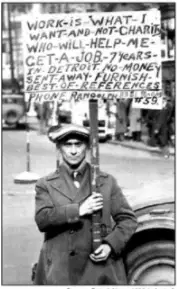
Question: Which program paid workers like the photo shows?
a)
Agricultural Adjustment Act (AAA)
b)
Works Progress Administration (WPA)
c)
Federal Deposit Insurance Corporation (FDIC)
47.
Which program gave young men jobs building parks, planting trees, and building camps?
a)
HOLC (Home Owners Loan Corporation)
b)
Federal Art Project
c)
CCC (Civilian Conservation Corps)
48.
Some people disliked the New Deal because…
a)
It only helped banks.
b)
It hurt people with houses.
c)
It gave the government too much power.
49.
A major result of the New Deal was…
a)
More government responsibility for helping citizens
b)
Moving people to farms
c)
Full employment permanently
50.
The policy the United States followed in the 1920s and 1930s was called
a)
isolationism (staying out of the world's problems)
b)
militarism
c)
protectionsim
51.
Which political party rose to power in Germany?
a)
The Nazi Party
b)
The Facist Party
c)
The Birthday Party
52.
As American forces approached Japan, Japanese forces
a)
fought to the end, preferring to kill themselves rather than surrender.
b)
won an important victory in the Philippines.
c)
surrendered quickly and joined the Allied forces.
53.
Why did Truman use the atomic bomb?
a)
save American lives.
b)
Make Japan a superpower.
c)
protect the lives of Japanese civilians.
54.
After WWII, the strongest nations were…
a)
the Soviet Union and the United States
b)
China and Japan
c)
Germany and Poland
55.
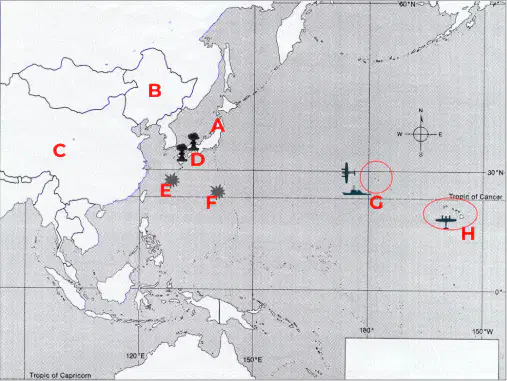
Which letter is Pearl Harbor?
a)
A
b)
C
c)
D
d)
H
56.
Which letter is China?
a)
A
b)
C
c)
D
d)
H
57.
Which letter is Japan?
a)
A
b)
C
c)
D
d)
H
58.
Which letter shows Hiroshima and Nagasaki?
a)
A
b)
C
c)
D
d)
H
59.
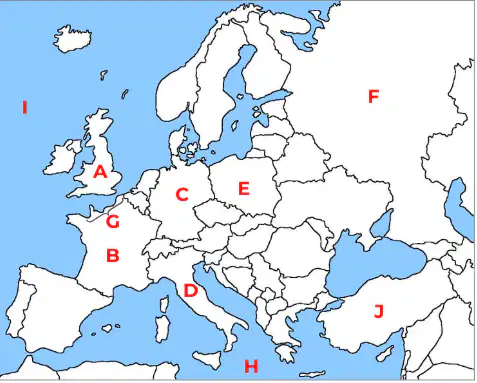
Where is Great Britain?
a)
A
b)
B
c)
C
d)
D
60.
Where is Italy?
a)
A
b)
B
c)
C
d)
D
61.
Where was the D-Day invasion?
a)
A
b)
B
c)
G
d)
D
62.
Which letter is the Soviet Union?
a)
A
b)
F
c)
G
d)
D
63.
Where is Germany?
a)
C
b)
F
c)
G
d)
D
64.
Where is France?
a)
B
b)
F
c)
G
d)
D
65.
Where is the Mediterranean Sea?
a)
B
b)
F
c)
H
d)
D
100 %

