
 Worksheets
AP CSP 300PT Quizizz 12-11
Total questions: 87
Worksheet time: 2hrs 31mins
What is data analysis?
Data analysis is the process of inspecting, cleaning, transforming, and modeling data in order to discover useful information, draw conclusions, and support decision-making.
Data analysis is the process of visualizing data using charts and graphs.
Data analysis is the process of organizing data in a database.
Data analysis is the process of collecting data from various sources.
Aria, Noah, and Priya are working on a computer science project. Why is their data analysis important?
Data analysis is not important in their computer science project
Data analysis is only important in other fields, not in their computer science project
Data analysis is only important for large companies, not for their small project
Data analysis is important in their computer science project because it helps in making informed decisions, identifying patterns and trends, detecting anomalies, improving performance, and optimizing processes.
What are the steps involved in data analysis?
Collect the data, Analyze the data, Draw conclusions, Communicate the results, Evaluate the results
Define the problem and objectives, Collect and prepare the data, Analyze the data, Present the data, Evaluate the data
Define the problem and objectives, Collect and prepare the data, Explore and analyze the data, Draw conclusions and make predictions, Communicate the results.
Define the problem and objectives, Analyze the data, Draw conclusions, Communicate the results, Evaluate the results
Arjun, Mia, and Daniel are working on a project. They have a lot of raw data and are unsure about how to present it. Arjun suggests they use data visualization. How would you describe data visualization to them?
The representation of data or information in a graphical or pictorial format.
The process of encrypting data
The analysis of data using statistical methods
The process of converting data into audio format
Abigail, Noah, and Benjamin are working on a project that involves a large amount of data. They are debating on the best way to present their findings. What are the benefits if they choose data visualization?
Data visualization is only useful for presenting data to a large audience
Data visualization is time-consuming and not worth the effort
Data visualization helps in understanding complex data, identifying patterns and trends, making data-driven decisions, and communicating information effectively.
Data visualization is only applicable to certain industries
Liam, Priya, and Henry are working on a project for their data science class. They have collected a lot of data and are now considering different ways to visualize it. What are the different types of data visualization techniques they could use?
bar graphs, line plots, scatter diagrams, pie diagrams, heat charts, bubble charts
bar charts, histograms, scatter plots, cross tab
bar graphs, line plots, scatter diagrams, pie diagrams, heat charts, network diagrams
bar graphs, line plots, scatter diagrams, pie diagrams, heat charts, tree diagrams
What are the best practices for creating effective data visualizations?
Identify the purpose, choose appropriate type, simplify design, use clear labels, ensure accessibility
Use small font sizes and unclear labels to save space
Use as many colors as possible, even if they don't relate to the data
Make the design as complex as possible to impress viewers
How can data visualization help in decision-making?
Data visualization helps in decision-making by presenting complex data in a visual format that is easy to understand and interpret.
Data visualization has no impact on decision-making.
Data visualization only works for small datasets.
Data visualization makes decision-making more complicated.
Abigail and Daniel are working on a project where they need to explore two columns of data at the same time. Oliver suggests a few visualization techniques. Which of these techniques would be most suitable for Abigail and Daniel's needs?
Bar charts and Histograms
Bar charts
Histograms
Scatter plots and Cross tab
Aiden, Rohan, and Priya are working on a school project. They have collected data and are deciding how to represent it. When should they use bar graphs and histograms?
When their data is not uniform
When they have collected a large amount of data
When they are analyzing data from one column only
When they need to analyze multiple values
Ethan, Rohan, and Aria are working on a project where they have a large dataset. They are particularly interested in exploring the relationship between two columns in the dataset. What would be the best visualization technique for them to use?
scatter plot
histogram
bar chart
cross tab
What is the role of data cleaning in data analysis?
Data cleaning is not necessary in data analysis.
Data cleaning is the process of collecting data for visualization.
Data cleaning is the process of identifying and correcting errors in the data, which is crucial for ensuring the accuracy of the analysis.
Data cleaning is the process of collecting data from various sources.
Maya, Anika, and Elijah are working on a data analysis project for their statistics class. Why is it important for them to choose the right visualization technique?
The choice of visualization technique has no impact on their project.
Choosing the right visualization technique can help them in effectively communicating the results of their project to the class.
Choosing the right visualization technique can make their project look more appealing.
Choosing the right visualization technique can help them in understanding their data better, identifying patterns and trends, and making informed decisions about their project.
What is data cleaning?
Data cleaning is the process of encrypting data for security purposes
Data cleaning is the process of deleting all data to start fresh
Data cleaning is the process of identifying and correcting errors or inconsistencies in data to improve its quality.
Data cleaning is the process of creating new data from scratch
Why is data cleaning important in AP CSP?
Data cleaning is important in AP CSP to ensure accurate, complete, and reliable data for analysis.
Data cleaning only applies to certain types of data in AP CSP
Data cleaning can be done after analysis in AP CSP
Data cleaning is unnecessary in AP CSP
What are some common techniques used in data cleaning?
Ignoring missing values completely
Adding more noise to the data
Mixing up data formats further
Removing duplicates, handling missing values, correcting inconsistent data formats, standardizing data values, detecting outliers
Explain the concept of missing data in data cleaning.
Missing data in data cleaning refers to the presence of values in a dataset
Missing data in data cleaning refers to the absence of values in a dataset, which can occur due to various reasons such as human error, equipment malfunction, or data corruption.
Missing data in data cleaning is always due to software bugs
Missing data in data cleaning is intentional and does not affect the analysis
How can outliers be handled during data cleaning?
Remove outliers if they are due to errors or extreme values, or transform them using techniques like winsorization or log transformation.
Create a separate dataset for outliers
Replace outliers with the mean of the dataset
Ignore outliers completely and proceed with analysis
What is the role of data validation in the data cleaning process?
Data validation is not necessary in data cleaning
Data validation is only useful for data analysis, not cleaning
Data validation only adds complexity to the process
Data validation plays a crucial role in ensuring the accuracy and quality of the data being cleaned.
Discuss the significance of data normalization in data cleaning.
Data normalization is not necessary for data cleaning
Data normalization can introduce errors in the data
Data normalization slows down the data cleaning process
Data normalization is crucial in data cleaning as it reduces redundancy, improves data consistency, and facilitates data analysis.
What are some tools or software used for data cleaning in AP CSP?
Microsoft Word
Excel, Google Sheets, OpenRefine, Python libraries like Pandas
Tableau
Photoshop
Explain the difference between data cleaning and data preprocessing.
Data cleaning involves adding noise to the dataset, while data preprocessing involves removing noise.
Data cleaning is done before data preprocessing in the data analysis pipeline.
Data cleaning focuses on transforming the data for analysis, while data preprocessing focuses on handling errors in the dataset.
Data cleaning focuses on handling errors in the dataset, while data preprocessing focuses on transforming the data for analysis.
How does data cleaning contribute to the overall data analysis process in AP CSP?
Data cleaning ensures data is encrypted before analysis.
Data cleaning ensures accurate, complete, and formatted data for reliable analysis.
Data cleaning involves creating duplicate data for analysis.
Data cleaning focuses on removing outliers from the dataset.
Convert 48 to a binary number
110000
110001
110111
111111
What is the value in binary of 11001 + 2?
111111
11101
11100
11011
What is the smallest number of bits needed to store the decimal number 7?
1
2
3
4
Which math calculation could result in a roundoff error?
2/9
2*6
6-2
3+5
Many older computers were designed to handle only 8-bit systems, meaning that all numbers that the computers used could not exceed 8 bits in length. Which of the following numbers would NOT be viable in an 8-bit system?
14
34
255
256
What signal can be represented using a digital signal without losing any data?
The human voice in air
The varying temperature during the day
Volume due to a train honking its horn
The varying grades of a student during the school year
Which of the following is a trade-off inherent in lossy compression of an image?
Smaller file size (bytes)
Speed of transmitting file
Image quality
Image size (number of pixels)
An Alaskan biologist is tracking a pod (group) of whales using tracking collars. For the whales, the following geolocation data are collected at frequent intervals:
* Time
*Date
*Geographical location of the sea mammals
Which of the following questions about a whale could NOT be answered using only the data collected from the tracking collars?
About how many miles did the animal travel in one week?
Does the animal travel in groups with other tracked animals?
Do the movement patterns of the animal vary according to the weather?
In what geographic location does the animal typically travel?
Why is it usually easier to read code written in a high-level language than code written in a low-level language?
High-level languages tend to be written by smarter people
High-level languages tend to be closer to basic computer code, which makes them easier to translate.
High-level languages tend to be written for more experienced programmers to use, which implicitly makes them easier to read.
High-level languages tend to be closer to natural language by utilizing simplified abstractions with descriptive names.

What binary number represents the letter J?
77
74
73
70
What is the purpose of using conditionals in programming?
To make decisions based on certain conditions
To repeat a block of code multiple times
To store and organize data
To perform mathematical calculations
Which statement is used to execute a block of code only if a condition is true?
if statement
for statement
while statement
switch statement
What is the syntax for an if statement in most programming languages?
if (condition) { code }
if (code) { condition }
condition { if (code) }
code { if (condition) }
When using an if-else statement, what happens if the condition is false?
The code inside the else block is executed
The code inside the if block is executed
The code inside both the if and else blocks is executed
The code inside neither the if nor else block is executed
What does a nested conditional refer to?
A conditional statement that is inside a loop
A conditional statement that is inside another conditional statement
A conditional statement that is inside a function
A conditional statement that is inside a class
What is the purpose of using Boolean variables in programming?
To store text data
To store numeric data
To store true or false values
To store complex data structures
In a Boolean expression, what value is returned when both conditions are true?
true
false
null
undefined
What is the output of the following code snippet?
var x = 5; var y = 10;
if (x > y) {
{ console.log("x is greater than y"); }
else { console.log("x is less than or equal to y"); }
x is greater than y
x is less than y
x is equal to y
x is less than or equal to y
What is the output of the following code snippet?
var age = 18;
if (age >= 18) {
console.log("You are eligible to vote");
}
else {
System.out.println("You are not eligible to vote");
}
You are eligible to vote
You are not eligible to vote
The code does not compile
The code produces an error
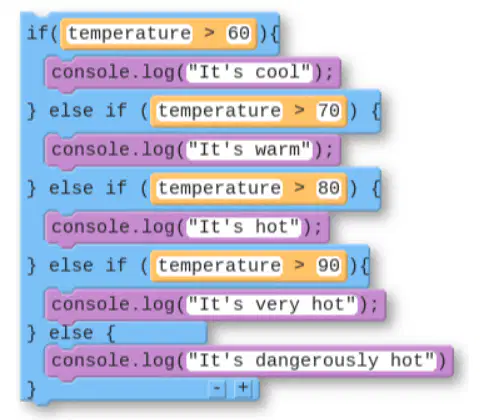
What will the output be when temperature = 85?
It's cool.
It's warm.
It's hot.
It's very hot.
A program is:
a series of steps to complete a task that a computer can understand.
Python, JavaScript, Java, PHP, and Ruby
the action we want the program to take.
a condition that is false.
Coding is:
Python, JavaScript, Java, PHP, and Ruby
the action of writing instructions for a computer in a language that it can understand.
a language that is more precise than English but less precise than a coding language.
a specific action to be taken if the condition is false.
What is syntax?
a catch-all for every other situation besides true.
pieces of code that direct the program to run in different ways depending on what else is happening.
a set of rules for how a language is written.
English, Chinese, or Spanish.
Control flow statements:
pieces of code that direct the program to run in different ways depending on what else is happening.
determine which code is being carried out at a given time.
give the program the flexibility to go down more than one path.
all of these.
Pieces of code that only run "under certain conditions":
conditional statements
control flow statments
syntax
variables
What is a condition?
JavaScript
Something that has to be true in order for an action to be carried out.
syntax
pseudocode
This is a catch-all for every other situation besides the one where the condition is true.
then
do
else
if
What is/are true about pseudocode?
somewhere between English and a coding language.
more precise than English but less precise than a coding language.
used by programmers to figure out the logic and flow of their programs without having to worry about syntax.
all of these
A variable is...
is a placeholder for a piece of information that can change.
is like a bucket for holding information.
can be written as letters or with longer words.
all of these
Which symbol means "not equal to"?
==
<=
>=
!=
Which of the following is a test statement?
color = sprite.ask("What's your favorite color?")
sprite.say("So your favorite color is " + color.")
if color == "red":
color = "red"
Which of the following best describes what a test statement is?
This part is the code that runs in a conditional if the condition is true
This is the part of the code that checks whether a condition is true or false
This is a code that shows how many times a loop should run
This is a code that saves multiple pieces of information in one place
Which of the following best describes what the nested code part of a conditional is?
This part is the code that runs in a conditional if the condition is true
This is the part of the code that checks whether a condition is true or false
This is a code that shows how many times a loop should run
This is a code that saves multiple pieces of information in one place

How many test statements does this program have?
1
2
3
4
What happens if the user inputs "winter" into the first question in this program?
The background changes to a winter background
The user is asked another question
The sprites says "Sad..."
The sprite says "Me too!"
Which of the following best describes what a flowchart is?
A diagram that shows each step of a process or algorithm
Conventions for making code easier for people to read
The line of code in a conditional that checks if something is true or false.
The line of code in a conditional that's indented over
Which of the following symbols compares two values to see if they are the same?
=
[ ]
==
""

According to the following flow chart, what will happen right after the user chooses "red"?
The sprite will ask "Would you like to choose the red door, or the blue door?"
The sprite will say "You win a car!"
The sprite will say "You win a house!"
The sprite will say "Thanks for playing!"
According to the following flow chart, in what situation will the sprite say "Thanks for playing!"?
If the user chooses "red"
If the user chooses "blue"
All of the above
None of the above

Which of the following programs follows the flowchart here?


In this program, there are several variables and If and statements. Check ALL of the lines that will be said by the program after the code is run.
"Cool!"
"Mindblowing!"
"Sweet!"
"Far out!"
Which of these best describes when you want to use a conditional?
When you want to repeat some code
When you want to save a value
When you want the program to do different things depending on user input
When you want to add a certain amount to your variable
Which of these is NOT a conditional?
If-else
If-And
If statement
For Counter

Which line of code here has an error?
1
3
5
6
To check if two values are the same, you need the (a) sign.
I have a program that has two variables, day and month. day tells you which # day it is, while month tells you which #r month it is. (Ex, for May 20 the month would be 5 and the day would be 20) Which kind of conditional would I need to check if today is Christmas?
If else
If
If And
For Counter
I want to write a program that if the day is a friday, the program says "TGIF!" and if it isn't, it says "Hang in there!" What kind of conditional do I need?
If else
If
If And
For Counter
I want to write a program so that if the user gets to 100 points, the program says "Congrats!" Which conditional should use?
If else
If
If And
For Counter
Which of the following variable declarations are right?
var 10 =10;
var num = 10;
var name = "Bob";
var number 10 = 10;

What is the value of x here?
(a)

What is the value of z?
(a)

Is this statement true or false? ( write true or false)
(a)

Is this statement true or false? (write true or false)
(a)

Is this statement true or false? (Write true or false)
(a)

Which statement will be printed to the console?
I am 5
I am not 5
I'm not sure
Nothing will be printed

Which of these statements will be printed?
I am less than or equal to 10
I am none of the options
I am 5

What will be printed to the console?
You are in elementary school
You are in high school
You are in some other school

What will be printed to the console?
You passed
You failed
None of the options

What will be printed to the console log?
You got the average
You failed
Congrats you get ice cream!
!
Not
||
or
&&
and
Logical Operator
A symbol or word used to connect two or more expressions
An expression that produces a true or false when evaluated
Boolean Expression
Any expression that can be evaluated for true or false is known as a ________ __________.
(a)

3 < 8 evaluates to? (a)
Evaluate the expression for a Boolean Value

