wayground logo

Free Printable Worksheets

Font size

S
M
L
XL
Worksheets

PBS 2.1.3 Routine Testing

Total questions: 17

Worksheet time: 11mins

Name
Class
Date
1.
Describe what normal heart sounds sound like & what causes them?
4 lines
2.
Your patient has a cough, and when you listen to the lungs, you hear a crackling sound. Which is most likely the cause?
a)
pneumonia
b)
something caught in the throat
c)
asthma
d)
pleural separation
3.
You look over a patient's chart, and find that they are diagnosed with a heart murmur. What sound or change do you expect to hear when you listen to their heart?
a)
Whoosh
b)
Extra beat
c)
Very long beat
d)
Thudding or clicking sound
4.
What does ABCDE refer to?
a)
Helps you remember what to look for to detect skin cancer
b)
Additional Beat of Cardiac - Deoxygenated Extraction (how to determine oxygenation of blood during the second half of the heartbeat)
c)
The five regions of the body that are checked in a physical
d)
No mention of ABCDE in this lesson
5.
What is 20/20 vision?
a)
What the average person sees at 20 feet, is what you can see at 20 feet.
b)
Both eyes need a p20 lens prescription
c)
20/20 does not refer to vision
d)
Both eyes are farsighted by about 20 feet
6.

A patient presents with shortness of breath and wheezing. What is the most likely diagnosis?

a)

Heart murmur

b)

Lymphadenopathy

c)

Pneumonia

d)

Asthma

7.

Why are veins thinner than arteries?

a)

Less blood passes through them

b)

The pressure of the blood against the arteries is less

c)

The pressure of the blood against the arteries is greater.

8.

Match the following

a)

Opthalmoscope

1.

eyes

b)

Otoscope

2.

ears

c)

Sphygmomanometer

3.

blood pressure

9.

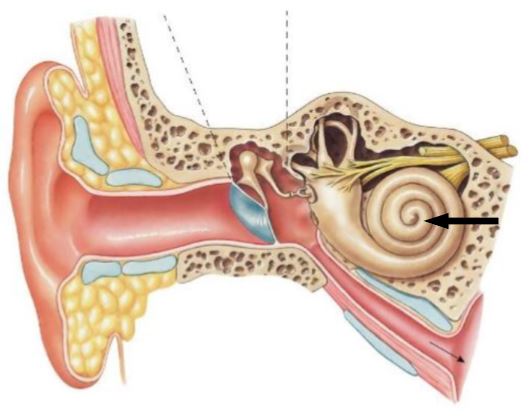
What is this?

a)

Pinna

b)

Hearing Nerve

c)

Cochlea

d)

Ear Drum

e)

Anvil

10.

What part is #2?

a)

Pinna

b)

Ear Canal

c)

Ear Drum

d)

Oval Window

11.
Which part of the eye opens in dark places and closes in bright places?  
a)
Cornea
b)
Retina
c)
Pupil
d)
Lens
12.
When inspecting spots on your skin, which method should you use
a)
The "F, G, H, I, J" method
b)
The "A, B, C, D, E" method
c)
The ignore it method
13.

A patient is breathing at a rate of 20 breaths every 15 seconds. What is their breathing rate?

a)

20 bpm

b)

15 bpm

c)

80 bpm

d)

35/60 bpm

14.

A patient comes to you with hypertension (high blood pressure).  Her pressure is 185/140. What is the systolic measurement?

a)

185

b)

140

c)

4.625

d)

45

15.

What does this measure?

a)

blood pressure

b)

temperature

c)

amount of oxygen in the blood

d)

all of these

16.

What is the healthy range for breaths per minute?

a)

12 to 20

b)

6 to 10

c)

10 to 35

d)

6 to 35

17.

The ​ (a)   in the cochlea transmit sound information via the ​ (b)   to the ​ (c)   lobe of the brain.

Choose from the below words
hair cells
cochlear nerve
temporal
Parietal
Optic Nerve
Cone Cells