
 Worksheets
Beckham's Science
Total questions: 7
Worksheet time: 5mins
Planets are formed from collisions of objects in the early solar system disk.
When those materials collide, they stick together.
What is this process called?
A. Differentiation
B. Mineralization
C. Nuclear Fusion
D. Accretion
E. Radioactive Decay
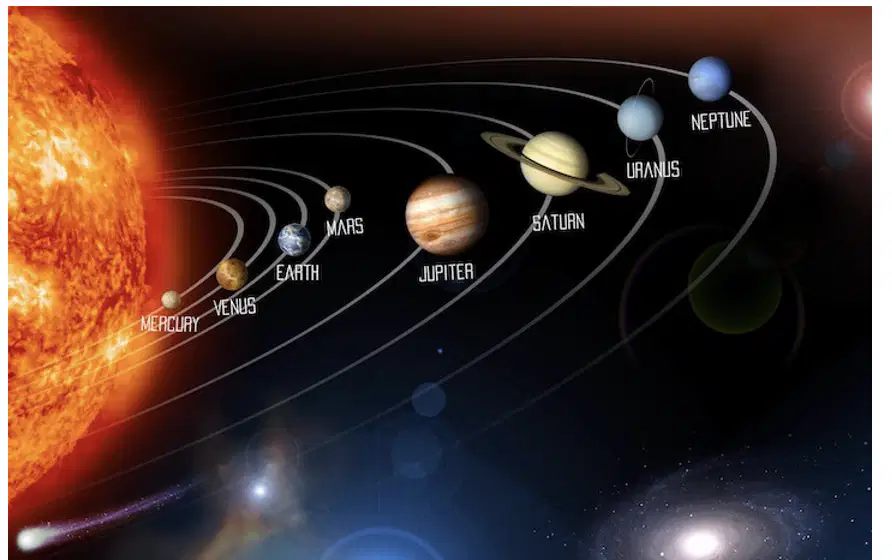
Select all that are TRUE about patterns we see in the solar system.
The planets get more icy the farther away from the sun they are.
The inner planets are rocky, while the outer planets are more gassy.
All the planets orbit in the same direction (the same direction the original nebula was spinning).
The planets orbit on the same basic plane.
The inner planets are gassy, while the outer planets are more rocky.
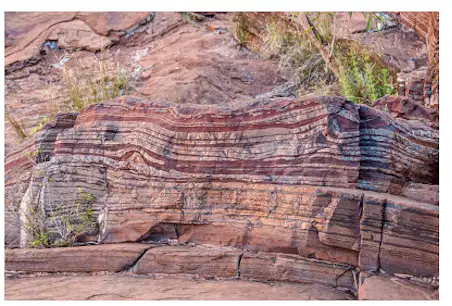
In the picture of a banded iron formation in Karijini National Park in Australia. Read through all of the following statements about banded iron formations and mark ALL answers that are CORRECT.
The formations formed before any type of life had evolved or was present on Earth.
The formations most likely formed at the bottom of an anoxic (without oxygen) freshwater swamp.
The formations required oxygen, so the environment in which they formed must have contained oxygen.
The formations probably formed in an ancient saltwater sea that contained single-celled life.
The formations must be at least 4 billion years old based on their layered structure.
Identify the statements below what correctly describe how Earth’s living system can impact Earth’s physical environment.
The microbe-filled fluff caused the scientist’s eye to swell shut.
Microbes were turning rock into soil more than one thousand feet underground.
Many caverns are formed by water eroding limestone.
Microbes released gas that turned into sulfuric acid, which ate away the limestone rock, making the process of cave formation much faster.
This cavern system is located in New Mexico.
Read through the following statements. All of the following statements are true but not all of them are good examples of the coevolution of living things and Earth’s physical environment. Please select ALL answers that are clear examples of the co-evolution of Earth and living things.
Microbes (such as bacteria and fungi) help to increase the nutrient levels in pure dirt (tiny rocks, tiny chunks of earth) to turn it into healthy soil; the soil then nourishes plant life as it is growing.
Rocks and dirt eroding from mountains because of the rain/water cycle; then the rocks settling at the river delta and eventually becoming new sedimentary rocks.
Rocks dissolving in the ocean to provide calcium for shelled creatures; the shells from those creatures are then incorporated into mountains made of limestone.
The oceans provide minerals to living things which then create more ocean floor by building coral reefs; the coral reefs then provide homes for other living things.
This meteorite brought with it nutrients that were beneficial for ancient life. When it landed, it created a tsunami, which spread these nutrients throughout the world, causing a rapid growth in life on Earth.
Knowing the half-life of isotopes can help you decide which elements to use to date a sample. Carbon-14 has a half-life of 5,730 years. Potassium-40 has a half-life of 2.35 billion years.
Select what is true.
Potassium-40 will decay slower than Carbon-14.
After 4.7 billion years, there will be no Potassium-40 left in your substance.
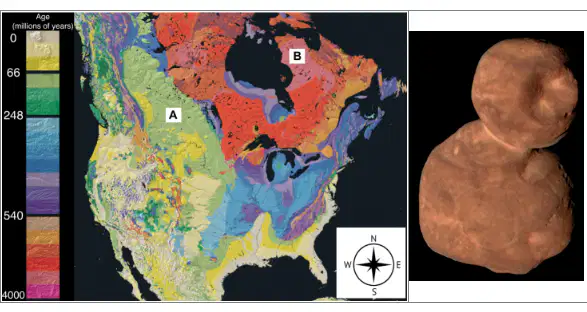
You can see the map of the different ages of the rocks of North America and a picture of Arrokoth. Remember, Arrokoth is an object from the outer solar system that formed at approximately the same time as the rest of the solar system. According to the map, which rocks would you expect would be closest in age to Arrokoth?
Tan (between 0 and 66 million years old)
Lime Green (about 250 million years old)
Purple (between 500 and 600 million years old)
Red/Pink/Fuscia (close to 4,000 million, or 4 billion, years old)

