
 Worksheets
Honors Chemistry - Fall Semester Test
Total questions: 102
Worksheet time: 51mins
Name
Class
Date
1.
1. An inference refers to _____
a)
A tentative scientific explanation that can be tested by further observation
b)
A correctly setup experiment that has only one variable
c)
A logical interpretation based on what the scientist already knows
d)
The act of knowing and describing an event or process
2.
2. A student measures out the lengths of rope to 2 meters, 1.4 meters, and 9 meters. What type of data does the student have?
a)
Qualitative
b)
Quality
c)
Quick
d)
Quantitative
3.
3. The function of the _____ is to reject or accept a given hypothesis based on the data obtained through the experiment or study.
a)
Conclusion
b)
Observation
c)
Hypothesis
d)
Problem
4.
4. A ____ refers to an anonymous, independent scientist that reviews the study or experiment before submission to science journals.
a)
Observation
b)
Peer-sharing
c)
Peer-analyzing
d)
Peer-reviewing
5.
5. An observation is ____
a)
A tentative scientific explanation that can be tested by further observations
b)
A correctly setup experiment that has only one variable
c)
A logical interpretation based on what the scientist already knows
d)
The act of knowing and describing an event or process
6.
6. Which of the following IS NOT a scientific theory?
a)
An old man looking at grass and says it will rain tomorrow
b)
Evolution
c)
Heliocentric (Sun in the middle of the solar system)
7.
7. When describing a person's bias, what is being described?
a)
A personal, rather than scientific, point of view
b)
A correctly setup experiment that has only one variable
c)
A logical interpretation based on what the scientist already knows
d)
The act of knowing and describing an event or process
8.
8. What is science?
a)
A personal, rather than scientific, point of view
b)
A correctly setup experiment that has only one variable
c)
A logical interpretation based on what the scientist already knows
d)
A use of evidence to construct a testable explanation and prediction of natural phenomena
9.
9. In correctly organized experiments and studies, the scientist is only concerned with ____ variables.
a)
One
b)
Two
c)
Three
d)
Four
10.
10. Which of the following correctly determines the difference between a control group and an experimental group?
a)
The experimental group is not affected by the variable while the control is.
b)
The control group is testing two different variables while the experimental is testing one
c)
The control group is not affected by the variable while the experimental groups are testing the one variable
d)
The experimental group is the only group allowed to be tested. Control groups are not tested.
11.
11. Which type of science would not be able to run experiments but need field observations instead?
a)
Chemistry
b)
Physics
c)
Animal Anatomy
d)
Animal Behavior
12.
12. The following equation is used to show the accuracy of a measurement. ( |Estimated Value - Actual Value| / Actual Value ) x 100
a)
Percent Yield
b)
Percent Error
c)
Percent Change
d)
Percentages
13.
13. The following equation is used to determine substances produced in a experiment vs. the calculated theoretical yield. = (Actual Yield/Theoretical Yield) x 100
a)
Percent Yield
b)
Percent Error
c)
Percent Change
d)
Percentages
14.
14. Which of the following does not concern itself with chemistry?
a)
Composition of Matter
b)
Living or Non-living Properties
c)
Structure of Substances
d)
Physical and Chemical Properties
15.
15. When understanding science, all must be applied EXCEPT
a)
Science dealing with the natural world
b)
Collecting data in orderly ways
c)
Replicating experimentation by peers
d)
Using only supernatural phenomena
16.
16. Jerry sees a dog chasing a cat outside. He concludes the dog must be hungry. What has Jerry made?
a)
Scientific Theory
b)
Hypothesis
c)
Inference
d)
Observation
17.
17. What is the variable the scientist changes in an experiment and is the focal point of all data collected?
a)
Dependent Variable
b)
Independent Variable
c)
Controls
d)
Constants
18.
18. Open-ended survey responses, animal behavior studies using field notes, and interview questions are all examples of possible _________ data.
a)
Quantitative
b)
Qualitative
c)
Quality
d)
Quirky
19.
19. _______ is used to describe how close a measurement is to the theoretical value calculated.
a)
Accuracy
b)
Precision
c)
Qualitative
d)
Quantitative
20.
20. If the scientist was to describe how closely multiple measurements agree with one another, then we would call this _________.
a)
Accuracy
b)
Precision
c)
Targetted
d)
Perfect
21.
21. Which part of John Dalton's atomic theory was MOST correct?
a)
All atoms are the same.
b)
Atoms of different elements have the same properties
c)
All elements contain atoms
d)
Nature is made of four distinct elements
22.
22. Matter is ____
a)
Anything that has velocity and takes up mass
b)
Anything that has acceleration and takes up area
c)
Anything that has mass and takes up space
d)
Anything that has matter and takes up volume
23.
23. Dry ice has the ability to go through sublimation. What is the physical change?
a)
Dry ice is moving from a liquid to a solid
b)
Dry ice is moving from a liquid to a gas
c)
Dry ice is moving from a solid to a gas
d)
Dry ice is moving from a gas to a solid
24.
24. Which statement best describes Dmitri Mendeleev’s approach in developing his periodic table?
a)
He arranged elements by increasing atomic number and ignored chemical properties.
b)
He classified elements solely by their states of matter at room temperature.
c)
He grouped elements by atomic mass and noticed families with similar reactions with oxygen and hydrogen
d)
He placed elements randomly and filled in blanks later with isotopes.
25.
25. How many elements are currently known?
a)
92
b)
24
c)
118
d)
116
26.
26. Which statement best explains the basis of the modern periodic table as established by Henry Moseley’s work in 1913?
a)
Elements are arranged by increasing atomic mass determined from chemical reactions
b)
Elements are arranged by decreasing atomic radius across a period
c)
Elements are arranged by increasing atomic number determined from X‑ray measurements of protons
d)
Elements are arranged by similar colors and physical appearances
27.
27. According to the data on element abundance, which element is most abundant in Earth’s crust and which is most abundant in the atmosphere?
a)
Oxygen in the crust; nitrogen in the atmosphere
b)
Silicon in the crust; oxygen in the atmosphere
c)
Oxygen in both the crust and the atmosphere
d)
Nitrogen in the crust; oxygen in the atmosphere
28.
28. Which statement best describes how an element’s position on the periodic table is used by chemists?
a)
It helps predict the element’s physical and chemical properties and how it bonds.
b)
It shows how many isotopes the element has.
c)
It indicates the element’s density at room temperature only.
d)
It reveals the age of the element.
29.
29. What does the atomic number of an element represent?
a)
The number of protons in an atom of that element
b)
The total number of neutrons and electrons
c)
The mass of the most common isotope
d)
The number of valence electrons
30.
30. Which piece of information is typically shown in an element’s periodic table square and identifies how many protons are in the atom?
a)
Atomic number
b)
State of matter at room temperature
c)
Element symbol
d)
Atomic mass
31.
31. On the periodic table on the wall in this chemistry room, how is the state of matter represented?
a)
By the atomic mass under the chemical symbol
b)
By the color of the symbol
c)
By the blue number in the top right corner of the individual squares
d)
By the period it is in
32.
32. Two different periodic table designs are compared. One includes the number of valence electrons in each square, while the other does not. Based on the typical contents summarized for a square, which conclusion is most accurate?
a)
Both are acceptable because periodic table squares can include various bits of information, but commonly list items like valence electrons.
b)
Only the table that lists the element’s discovery date is acceptable.
c)
The table without valence electrons is incorrect because all squares must include this.
d)
Including the element’s full electron configuration is required in every square.
33.
33. Which statement best describes the charge and location of electrons in an atom?
a)
Negatively charged particles orbiting the nucleus
b)
Positively charged particles located in the nucleus
c)
Negatively charged particles fixed inside the nucleus
d)
Neutral particles located in the nucleus
34.
34. As energy level increases from period 1 to period 4, what happens to the electrons’ average distance and energy?
a)
Distance decreases and energy decreases
b)
Distance increases and energy decreases
c)
Distance increases and energy increases
d)
Distance decreases and energy increases
35.
35. An element has 14 electrons. Using the stated shell limits and octet rule guidance, what is the most stable distribution of its electrons among the first three energy levels?
a)
2 in first, 6 in second, 6 in third
b)
2 in first, 8 in second, 4 in third
c)
2 in first, 10 in second, 0 in third
d)
2 in first, 8 in second, 2 in third
36.
36. Which statement best defines valence electrons?
a)
Electrons located in the outer energy level of an atom
b)
Neutrons with neutral charge
c)
Electrons found only in the nucleus
d)
Protons that have gained energy
37.
37. Which particles are included when calculating an atom’s atomic mass?
a)
Protons and electrons
b)
Protons and neutrons
c)
Electrons only
d)
Neutrons and electrons
38.
38. A neutral atom of carbon has an atomic mass of 14. If carbon has 6 protons, how many neutrons does it have? Use Atomic Mass = Protons + Neutrons.
a)
12
b)
4
c)
6
d)
8
39.
39. Which statement best defines isotopes?
a)
Atoms that have no neutrons
b)
Atoms with the same mass number but different elements
c)
Atoms of the same element with different numbers of neutrons
d)
Atoms with different numbers of protons
40.
40. A sample of an element shows several isotopes. Which option correctly explains why the element’s atomic mass on the periodic table often has a decimal?
a)
It counts only the number of protons.
b)
It is the number of protons plus the average number of neutrons across all isotopes.
c)
It is the total number of protons and neutrons in the most common atom.
d)
It equals the number of neutrons only.
41.
41. Who proposed the idea that light (photons) can be emitted as an electron moves from one energy level to a lower energy level in an atom?
a)
Albert Einstein
b)
Niels Bohr
c)
Wolfgang Pauli
d)
Werner Heisenberg
42.
42. Across a single period on the periodic table, how do properties generally change and what are the typical characteristics of the first and last elements in that period?
a)
Properties stay the same; both first and last are noble gases
b)
Properties change greatly; first is an extremely reactive element, last is an inactive noble gas
c)
Properties change slightly; first is a halogen, last is an alkali metal
d)
Properties are random; first and last have identical valence electrons
43.
43. Calcium - 40 and Calcium - 42 are common isotopes. What do these isotopes have in common?
a)
neutrons & mass number
b)
atomic number and neutrons
c)
atomic number and electrons
d)
protons, atomic number, and mass number
44.
44. What element is found in period 5 group 11?
a)
Astatine
b)
Argon
c)
Silicon
d)
Silver
45.
45. How many valence electrons are in the Boron family?
a)
3
b)
13
c)
4
d)
14
46.
46. What is the threshold frequency as it relates to the photoelectric effect?
a)
The amount of wavelength a photon must carry to cause an electron to be removed
b)
The amount of amplitude a photon must carry to cause an electron to be removed
c)
The amount of frequency a photon must carry to cause an electron to be removed
d)
The amount of wave height a photon must carry to cause an electron to be removed
47.
47. In 1905, Albert Einstein proposed the photoelectric effect. What does the photoelectric effect mean?
a)
The release of protons from the surface of a metal when in contact with light
b)
The emission of electrons from a surface like a metal when bombarded with electromagnetic radiation like light.
c)
The release of neutrons from the surface of a gas when in contact with radio waves
d)
The release of quantized units when a threshold frequency is not achieved.
48.
48. How many electron shells would Francium have in a Bohr model?
a)
3
b)
5
c)
7
d)
6
49.
49. This family is categorized as either having a full valence shell or eight valence electrons and an inert gas.
a)
Alkali Metals
b)
Alkaline Earth Metals
c)
Noble Gases
d)
Halogens
50.
50. Which of the following is not a property of metals?
a)
All are malleable
b)
All are ductile
c)
All are shiny
d)
All are brittle
51.
51. What atom matches this electron configuration?
1s ² 2s ² 2p ⁶ 3s ² 3p ⁶ 4s ² 3d ⁴
a)
Titanium
b)
Molybdenum
c)
Chromium
d)
Vanadium
52.
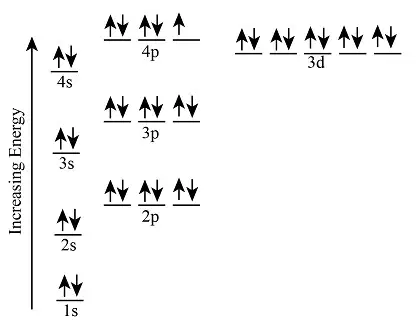
52.
a)
Arsenic
b)
Chlorine
c)
Krypton
d)
Bromine
53.
53. How many orbitals are in the d-block?
a)
2
b)
5
c)
10
d)
14
54.
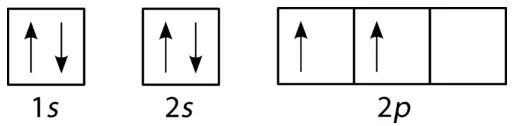
54. Which element is represented by the electron diagram?
a)
Nitrogen
b)
Helium
c)
Oxygen
d)
Carbon
55.
55. What 3-Dimensional shape would the p-orbitals occupy?
a)
Spherical
b)
Dumbbell
c)
Oblong
d)
Clover
56.
56. What is the purpose of Avogadro's number? (6.022 x 10²³)
a)
A conversion factor between the number of atoms in a mole
b)
A conversion factor between grams to moles
c)
A conversion factor between moles to mL
d)
A conversion factor between grams to atoms per centimeters cubed
57.
57. The distance between identical points on successive waves is called ______.
a)
Crest
b)
Wavelength
c)
Amplitude
d)
Wave Height
58.
58. ________ of a wave is the number of waves that pass through a particular point in 1 second. Also measured in Hertz (Hz).
a)
Frequency
b)
Wavelength
c)
Wave Height
d)
Amplitude
59.
59. Which type of wave has the shortest wavelength and the highest frequency?
a)
Radio Waves
b)
Infrared
c)
Ultra Violet
d)
Gamma Rays
60.
60. Max Planck described light (photons) being emitted in discrete units. What is the name of the smallest possible units for something like matter and energy?
a)
Work Function
b)
Total Energy
c)
Mass
d)
Quantum
61.
61. In Erwin Schrodinger's equation what does the wavefunction explain?
a)
The spin of an electron
b)
The potential energy of an electron
c)
The momentum of an electron
d)
The shape of the orbital
62.
62. What does a node represent for an s, d, p, and f orbital?
a)
The location of finding an up "spin" and down "spin" of an electron
b)
The magnetic moment of an electron
c)
The charge of a proton
d)
The location where there is zero possibility of finding an electron
63.
63. For the quantum numbers of electrons, what does "l" (lowercase L) represent?
a)
The spin of the electron
b)
The shape of the orbital
c)
The magnetic 3D orientation
d)
The period number
64.
64. An old car is left outside for 12 years. The paint begins to peel and rust starts to form on the frame. What is happening to the frame?
a)
A physical property
b)
A physical change
c)
A chemical property
d)
A chemical change
65.
65. Grandma wants to make some tea. She turns on the stove for 19 minutes and notices the water beginning to boil. What is happening?
a)
Physical Property
b)
Physical Change
c)
Chemical Property
d)
Chemical Change
66.
66. A student picks up an iron crowbar. She tells another student this bar is rather heavy. The density of the crowbar is a _______.
a)
Physical Property
b)
Physical Change
c)
Chemical Property
d)
Chemical Change
67.
67. When describing matter, the word "composition" means _______.
a)
What a substance weighs
b)
What a substance does in a reaction
c)
What a substance does when burned
d)
What a substance is made of
68.
68. A man working in a mine hits a rock with a hammer. The rock shatters into many pieces and is said to be _______.
a)
Malleable
b)
Brittle
c)
Crystalline
d)
Flammable
69.
69. A fluid described as having a high viscosity would be moving ________.
a)
Slowly
b)
Quickly
c)
Not at all
d)
Stationary
70.
70. A blacksmith hammers an ingot of iron into a thin workable sheet. What physical property is being applied?
a)
Density
b)
Viscosity
c)
Malleability
d)
Flammability
71.
71. Which of the following is NOT a chemical property?
a)
Reactivity
b)
Flammability
c)
Reactions
d)
Viscosity
72.
72. Oil and water form distinctly different layers when put in a glass together. What type of mixture is being described?
a)
Solution
b)
Suspension
c)
Colloid
d)
Homogeneous
73.
73. A student boils water and adds in 10g of salt and stirs until the salt seemingly disappears. What type of mixture is the student observing?
a)
Solution
b)
Suspension
c)
Colloid
d)
Heterogeneous
74.
74. Which of the following is NOT a pure substance?
a)
Water
b)
Lithium
c)
Elements
d)
Sugar Water
75.
75. A ________ solid has its particles arranged in a distinct geometric pattern throughout.
a)
Amorphous
b)
Flammable
c)
Crystalline
d)
Reactive
76.
76. Which two types of matter have the ability to flow?
a)
Gases and Solids
b)
Gases and Liquids
c)
Liquids and Solids
d)
Solids and Plasma
77.
77. When a liquid is described as having a low viscosity, how is able to move?
a)
Slowly
b)
Quickly
c)
Not at all
d)
Stationary
78.
78. Which of the following is an example of an amorphous solid?
a)
Salt
b)
Diamonds
c)
Sugar
d)
Coal
79.
79. What state of matter is fixed for shape and fixed for volume?
a)
Solid
b)
Liquid
c)
Gas
d)
Plasma
80.
80. An object ignites when near an open flame. The flammability of the substance in the object describes its _______.
a)
Physical Property
b)
Physical Change
c)
Chemical Property
d)
Chemical Change
81.
81. Deposition of molecules is the ability to physically change from a _________ to a __________
a)
Gas to a Liquid
b)
Liquid to a Solid
c)
Liquid to a Liquid
d)
Gas to a Solid
82.
82. Which of the following is NOT a type of mixture?
a)
Suspension
b)
Solution
c)
Compound
d)
Colloid
83.
83. Milk and fog are considered to be a _________ type of mixture because they have different intermediate sized particles.
a)
Solutions
b)
Colloids
c)
Homogenous
d)
Suspension
84.
84. Density is a measure of the ratio of __________ per unit ________.
a)
Volume per unit Area
b)
Mass per unit Matter
c)
Mass per unit Volume
d)
Volume per unit Mass
85.
85. A person lights a candle. The wax shifts from a solid into a liquid. That specific temperature is describing the wax's __________.
a)
Boiling Point
b)
Melting Point
c)
Sublimation Point
d)
Deposition Point
86.
86. High level conductors allow _________ and ______ to pass through all particles well. High level conductors include gold, silver, and copper.
a)
Heat and Electricity
b)
Heat and Ice
c)
Frost and Metal
d)
Malleability and Density
87.
87. Which of the following was NOT one of the four elements Aristotle used to describe nature
a)
Fire
b)
Air
c)
Earth
d)
Wind
88.
88. Which person was the first to describe atoms as having motion?
a)
Democritus
b)
J.J. Thomson
c)
John Dalton
d)
Aristotle
89.
89. In atoms, the proton has a _______ charge.
a)
Negative
b)
Postulate
c)
Positive
d)
Neutral
90.
90. _____ described atoms as a type of "plum pudding" that was made of positively charged areas with small negatively charged electrons scattered throughout.
a)
J.J. Thomson
b)
Niels Bohr
c)
John Dalton
d)
Ernest Rutherford
91.
91. What is the biggest problem with Bohr's 2-D model of the atom?
a)
It shows the nucleus of the atom where protons are found.
b)
It does not show where electrons are exactly found and only shows their level.
c)
It shows the electrons pairing
d)
It uses symbols to display the nucleus of the atom
92.
92. The current wave mechanics model does not show the exact location of electrons, but instead the ______ location of an electron based on how much energy it has.
a)
Exact
b)
Sketch
c)
Probable
d)
Invisible
93.
93. Electrons with the highest energy are found on the _____ energy level.
a)
Lowest
b)
Middle
c)
Empty
d)
Highest
94.
94. The _____ is found in the nucleus and has no charge.
a)
Proton
b)
Electron
c)
Neutron
d)
Photon
95.
95. What two particles are found in the nucleus?
a)
Protons and Neutrons
b)
Protons and Electrons
c)
Neutrons and Electrons
d)
Electrons and Photons
96.
96. Electrons with the lowest energy level are found on the _____ energy level.
a)
First
b)
Second
c)
Third
d)
Fourth
97.
97. _____ was the first person to discover atoms were divisible into smaller parts.
a)
John Dalton
b)
J.J. Thomson
c)
James Chadwick
d)
Niels Bohr
98.
98. _____ described his indivisible portions of matter as "atomos" which literally meant "not to be cut."
a)
Aristotle
b)
Democritus
c)
Niels Bohr
d)
John Dalton
99.
99. _____ is a particle of an atom that has a negative charge.
a)
Proton
b)
Electron
c)
Neutron
d)
Photon
100.
100. In most science textbooks, whose 2-D model is used to describe items?
a)
John Dalton
b)
Ernest Rutherford
c)
James Chadwick
d)
Niels Bohr
101.
101. ____ discovered the nucleus of the atom by using alpha particles fired at a gold sheet. The alpha particles were noted as reflecting, redirecting or passing completely through.
a)
Ernest Rutherford
b)
Niels Bohr
c)
James Chadwick
d)
Democritus
102.
102. ____ is credited with discovering the neutron and was a student of Ernest Rutherford. His experiment used a bombardment of particles onto beryllium and then sent through a magnetic field.
a)
Niels Bohr
b)
Edwin Shrodinger
c)
James Chadwick
d)
John Dalton
100 %

