
 Worksheets
Introduction to Newton's Second Law
Total questions: 28
Worksheet time: 14mins
Which statement best describes Newton's Second Law for motion?
Net force always equals zero in motion
Net force causes mass to accelerate
Acceleration creates mass from net force
Mass causes force to increase always
A constant net force acts on a cart. What happens to the cart's acceleration direction?
It matches the net force direction
It opposes the net force direction
It stays random regardless of force
It becomes zero regardless of mass
Select all quantities in the formula F = ma.
Acceleration measured in meters per second squared
Force measured in newtons
Mass measured in kilograms
Velocity measured in meters per second
If the net force on an object doubles while mass stays the same, what happens to acceleration?
It becomes negative automatically
It remains unchanged always
It halves with the same direction
It doubles with the same direction
Match each term to its correct unit.
Force
newton (N)
Mass
kilogram (kg)
Acceleration
meter per second squared (m/s^2)

A truck initially moving at 10 m/s begins braking with a net force opposite its motion. What describes the acceleration?
In the opposite direction to motion
In the same direction as motion
Perpendicular to truck motion
Zero regardless of braking force
Which equation correctly represents the relationship among net force, mass, and acceleration?
F = a/m
F = m/a
F = ma
F = m + a
Two objects experience the same net force. Object A has twice the mass of Object B. How do their accelerations compare?
A’s acceleration is zero while B’s is not
A has double the acceleration of B
A has half the acceleration of B
Both have equal acceleration always
Two carts are pushed with the same constant force. Cart A has 2 kg mass, Cart B has 4 kg mass. Which cart has the greater acceleration?
Neither will accelerate
Both accelerate equally
Cart B accelerates more
Cart A accelerates more
A constant force is applied to an object and its mass is doubled. What happens to its acceleration?
Acceleration becomes half
Acceleration becomes double
Acceleration stays constant
Acceleration becomes zero
Which statement best describes inertia for everyday pushing and pulling tasks?
Inertia disappears when force is applied
Inertia depends only on speed, not mass
Smaller mass resists changes in motion more
Greater mass resists changes in motion more
Select ALL scenarios that would increase acceleration of a heavy crate on a smooth floor.
Keep the same force but wait longer
Reduce the mass on the crate
Add more mass to the crate
Push with a larger force
Push with the same force at an angle
Match each situation to the expected acceleration when the same force is used.
Bicycle with rider
Largest acceleration
Empty shopping cart
Large but smaller than bicycle
Loaded pickup truck
Smallest acceleration
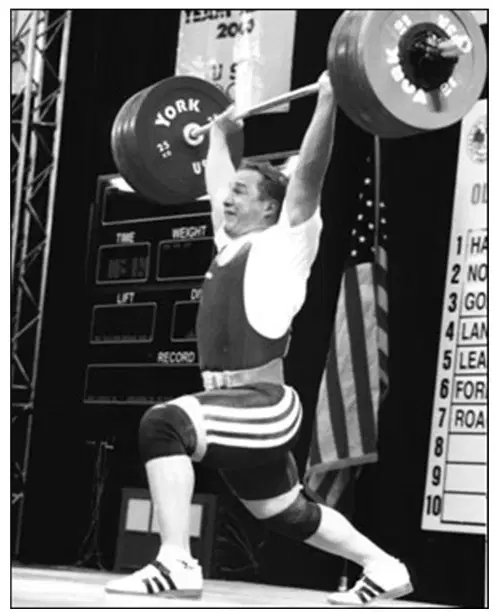
A sprinter and a loaded bus experience the same forward force for one second. Who speeds up more in that second, and why?
The sprinter, because smaller mass allows more acceleration
The bus, because larger mass creates more acceleration
Both, because acceleration depends only on force
Neither, because inertia prevents acceleration
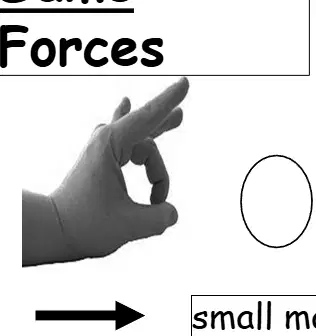
In the top diagram, the same push is applied to two objects of different mass. Which statement best explains the observed accelerations?
Acceleration is independent of mass for same force
Smaller mass shows larger acceleration with same force
Smaller mass shows smaller acceleration with same force
Larger mass shows larger acceleration with same force

Using F = ma, which pair matches the situation where both objects have the same acceleration?
Small mass with small force
a = F/m equal to target a
Large mass with large force
a = F/m equal to target a
Small mass with large force
a = F/m greater than target a

Two identical pushes act on a small cart and a heavy cart. What happens to their accelerations?
Small cart accelerates more than heavy cart
Both accelerate equally under same push
Neither cart accelerates under a push
Heavy cart accelerates more than small cart
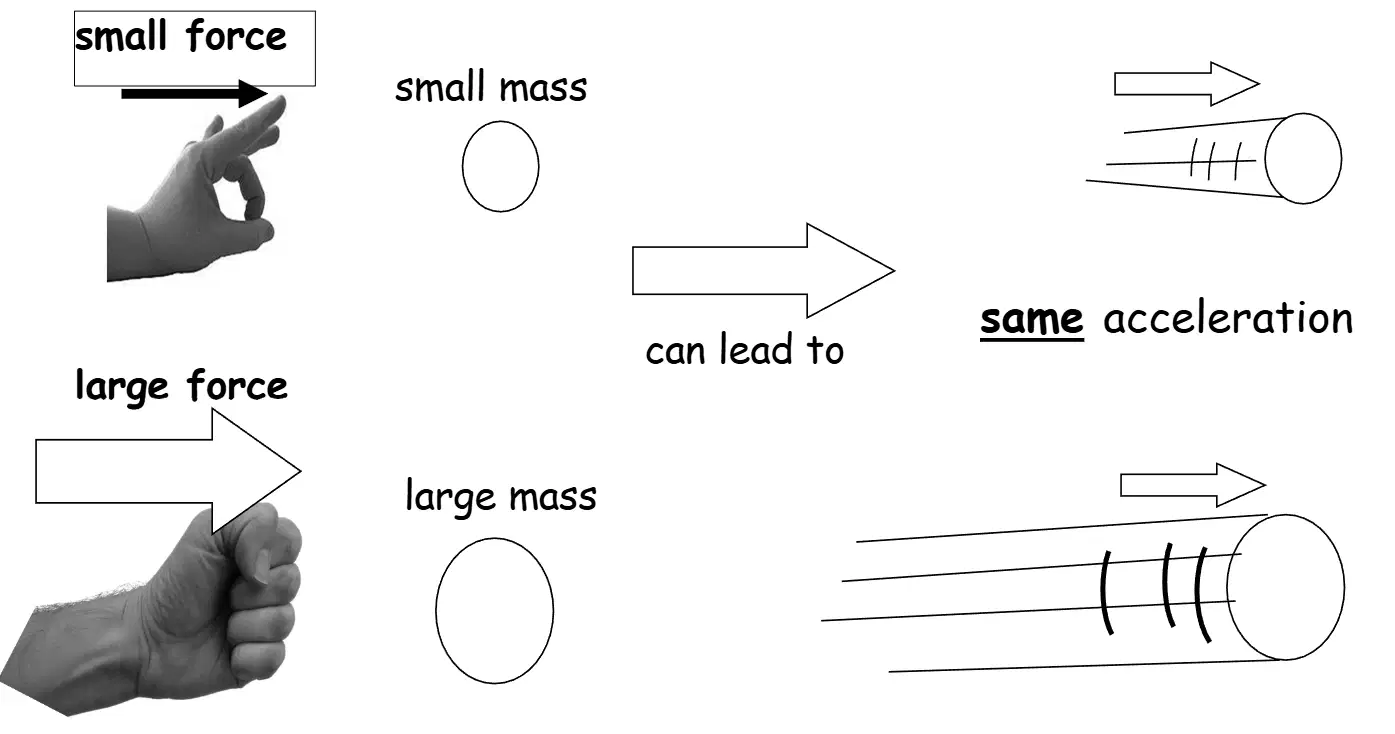
Which statements are true about acceleration in the second diagram? Select all that apply.
Same acceleration requires same force for any mass
Large mass needs larger force for same acceleration
Acceleration increases as applied force increases
Small mass needs smaller force for same acceleration
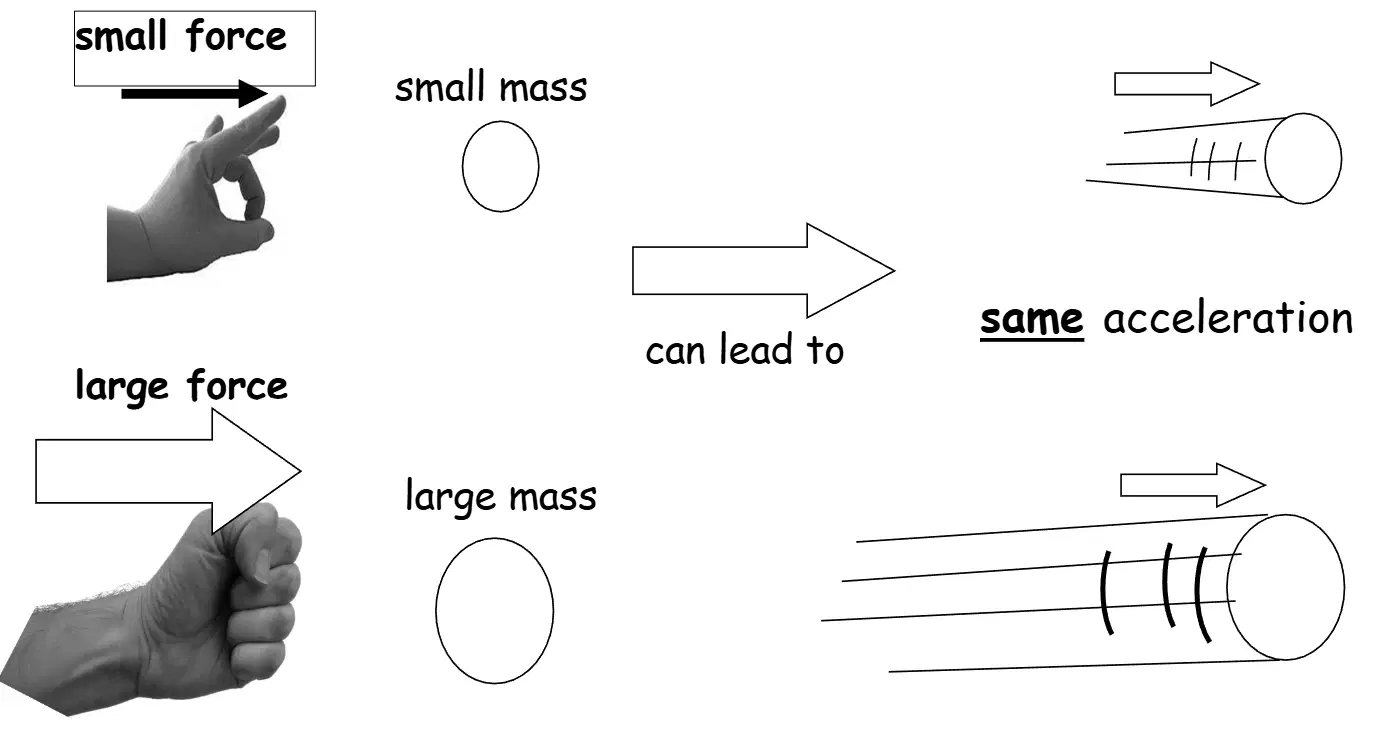
An engineer wants two objects to have equal acceleration. One object is twice the mass of the other. Which choice correctly describes the required forces?
Forces do not affect acceleration
Heavier object must get double the force
Heavier object must get half the force
Both objects must get equal force
A rock and a book are dropped from the same height in a vacuum. According to Newton’s Second Law, which statement best explains their motion?
The lighter rock accelerates faster due to smaller inertia
The heavier book accelerates faster due to greater weight
Both accelerate equally because net force scales with mass
Both fall at constant speed because forces are balanced
Both accelerate equally because gravity is absent in vacuum
Which idea best summarizes Galileo's finding about falling objects near Earth when air resistance is negligible?
Only objects with equal size reach the ground together
Lighter objects fall slower due to smaller gravity
Objects of different masses fall at the same rate
Heavier objects fall faster than lighter ones always
Match each term with its correct description.
Galileo Galilei
Italian physicist and astronomer
Free fall
Motion under gravity alone
Mass independence
Same acceleration regardless of mass
Two metal spheres, one 1 kg and one 5 kg, are dropped from the same height in a vacuum. What happens?
Both spheres fall with different constant accelerations
The 1 kg sphere accelerates more slowly overall
Both spheres hit the ground at the same time
The 5 kg sphere reaches the ground noticeably earlier
Which statements are consistent with Galileo’s study of falling objects? Select all that apply.
Mass does not change free-fall acceleration near Earth
Air resistance can cause objects to land at different times
Heavier objects naturally fall faster because they have more force
Gravity gives all objects the same acceleration in free fall

A 2 kg rock is dropped near Earth's surface. Using Newton's Second Law, what is the approximate net force during free fall (ignore air resistance)?
About 9.8 newtons downward
About 19.6 newtons downward
About 2.0 newtons downward
About 4.9 newtons downward
Which statement best connects Galileo's observations of free fall with Newton's Second Law?
Objects fall faster due to increasing mass
Uniform acceleration explains constant speed
Constant gravitational acceleration with F=ma
Velocity equals weight times gravity

Match each quantity to its correct relationship in free fall (ignore air resistance).
Weight (W)
mg
Net force on the object
Equal to weight downward
Acceleration of the object
Approximately 9.8 m/s^2 downward
Mass (m)
Resists acceleration; not a force

Which statements are true for an object in free fall near Earth (ignore air resistance)?
Mass determines the value of g
Net force equals the object's weight
Acceleration magnitude is about 9.8 m/s^2
Weight is the force due to gravity

