
 Worksheets
Advanced Characterization of Materials Quiz
Total questions: 100
Worksheet time: 50mins
Who is the instructor for the course "Advanced Characterization of Materials"?
Wen-Hui Cheng
Ming-Hui Chen
Li-Hua Wang
Chia-Yu Lin
Which department offers the course "Advanced Characterization of Materials"?
Department of Materials Science and Engineering
Department of Chemical Engineering
Department of Physics
Department of Mechanical Engineering
At which university is the course "Advanced Characterization of Materials" taught?
National Cheng Kung University
National Taiwan University
National Tsing Hua University
National Chiao Tung University

What is the academic year and semester mentioned for the course?
Academic Year 114 Semester 1
Academic Year 113 Semester 2
Academic Year 115 Semester 1
Academic Year 112 Semester 2
Which spectroscopy technique is covered in week 3 of the agenda?
Nuclear Magnetic Resonance Spectroscopy (NMR)
Infrared Spectrometry
Mass Spectrometry (MS)
Rutherford Backscattering Spectrometry (RBS)
On which date is the exam scheduled according to the agenda?
1/5
12/1
12/22
12/29
Which two spectrometry techniques are discussed in week 2?
Infrared Spectrometry and Raman Spectrometry
Mass Spectrometry and SIMS
X-ray Absorption Spectroscopy and Overview of Spectroscopy
Photoemission Spectroscopy and Review
What is the main topic for week 1 in the agenda?
Overview of Spectroscopy / X-ray Absorption Spectroscopy (XAS)
Exam
Mass Spectrometry (MS) / Secondary Ion Mass Spectrometry (SIMS)
Rutherford Backscattering Spectrometry (RBS) / Photoemission Spectroscopy (PES) / Review
Where can students find the lecture notes for this course?
Moodle
Google Classroom
Blackboard
Who is the instructor for the "Overview of Spectroscopy" course?
Wen-Hui Cheng
John Smith
Emily Wang
David Lee
Which department offers the "Overview of Spectroscopy" course at National Cheng Kung University?
Department of Materials Science and Engineering
Department of Chemistry
Department of Physics
Department of Electrical Engineering
What is the academic year and semester mentioned in the document?
Academic Year 114 Semester 1
Academic Year 113 Semester 2
Academic Year 115 Semester 1
Academic Year 112 Semester 2
What is the email address provided for contacting the instructor?
wcheng@gs.ncku.edu.tw
info@ncku.edu.tw
chengwenhui@ncku.edu.tw
contact@materials.ncku.edu.tw
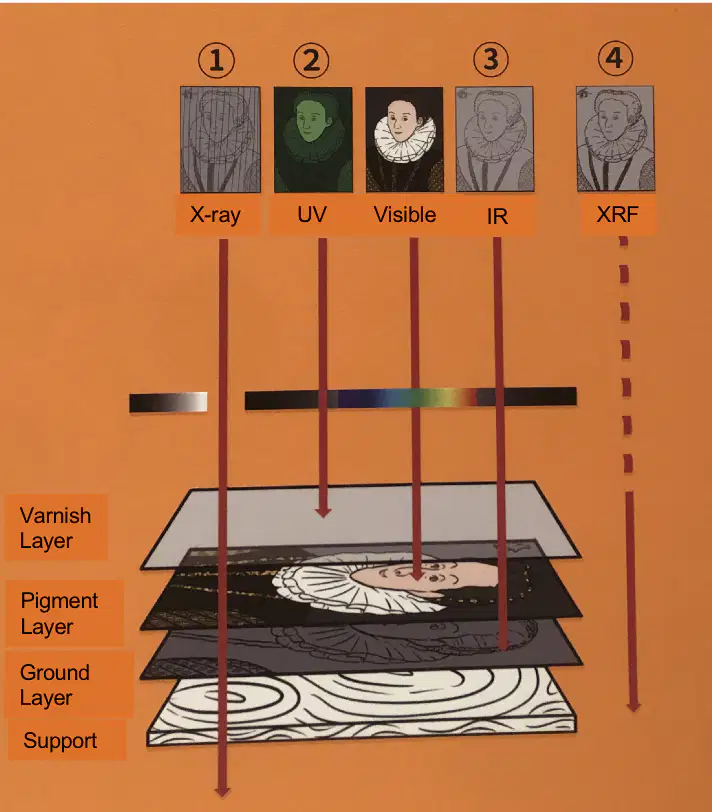
What does X-ray Transmission Imaging reveal in a painting?
The inner layers and composition of the base materials
Only the surface colors
The artist's signature
The age of the painting
What can X-ray Transmission Imaging detect in a painting?
Damages or restorations made before painting
The type of canvas used
The price of the painting
The location where the painting was made
What is identified by X-rays in the context of painting analysis?
The artist’s coloring techniques
The artist’s biography
The painting’s frame material
The exhibition history
What is the purpose of Ultraviolet Fluorescence Examination in art analysis?
To identify pigments and later retouching
To measure the painting’s dimensions
To determine the painting’s value
To clean the painting
How do modern restorations generally appear under UV light?
Darker
Brighter
Transparent
Unchanged
What causes different materials to emit different fluorescence responses during Ultraviolet Fluorescence Examination?
Ultraviolet illumination
Infrared radiation
Visible light
X-ray exposure
What is the main purpose of Infrared Reflectography in the analysis of artworks?
To measure the thickness of varnish layers
To reveal earlier sketches and brushwork beneath the surface design
To identify the artist of the painting
To clean the surface of the artwork
What does Macro X-ray Fluorescence (XRF) Spectroscopy help determine in pigments?
The age of the painting
The pigment types and detection of modifications or overpainting
The texture of the canvas
The color intensity of the artwork
Which type of rays are used in Infrared Reflectography?
Ultraviolet rays
X-rays
Infrared rays
Gamma rays
What causes elements in the pigment to emit characteristic fluorescence in XRF Spectroscopy?
Infrared radiation
X-ray excitation
Visible light exposure
Heat application
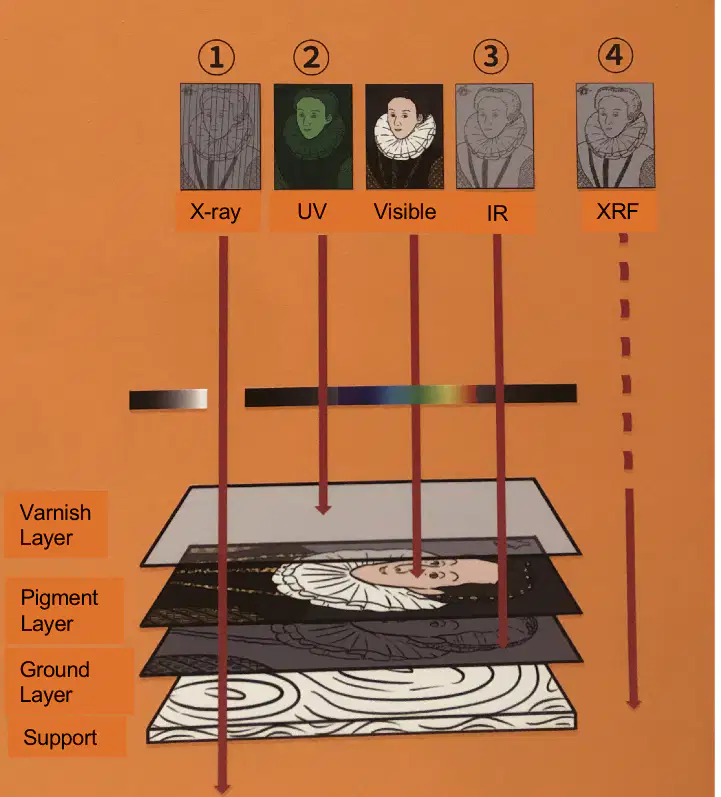
Diagram showing the use of X-ray, UV, Visible, IR, and XRF techniques to analyze different layers (varnish, pigment, ground, support) in an artwork.
Which scientific techniques are commonly used to analyze the different layers (varnish, pigment, ground, support) in an artwork?
Which of the following techniques is NOT used to analyze artwork layers: X-ray, UV, Visible, IR, or XRF?
Which layer in an artwork is typically analyzed using XRF technique?
Which combination of techniques is used to study the varnish, pigment, ground, and support layers in art conservation?
What is the title shown at the top of the page?
Example
Painting
Materials
Characterization
Which course is this slide from?
Advanced Characterization of Materials
Introduction to Chemistry
Modern Art History
Physics of Materials
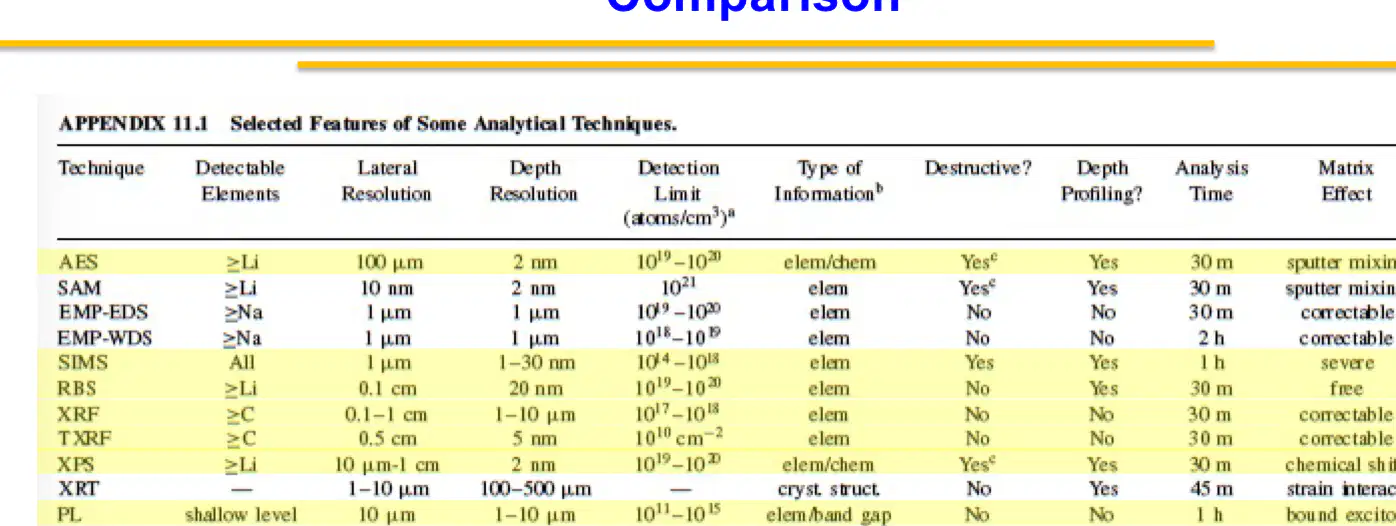
Which analytical technique is abbreviated as AES?
Auger electron spectroscopy
Atomic force microscopy
Energy dispersive spectrometer
Raman microprobe
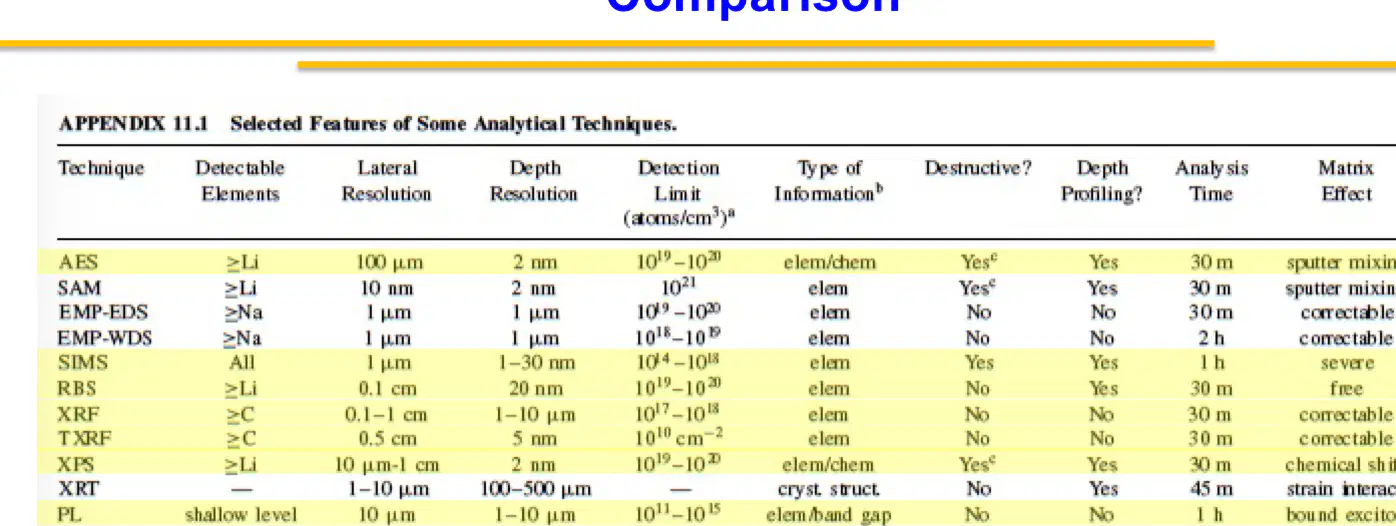
What is the lateral resolution of EMP-EDS?
1 μm
100 μm
0.1–1 cm
10 μm–1 cm
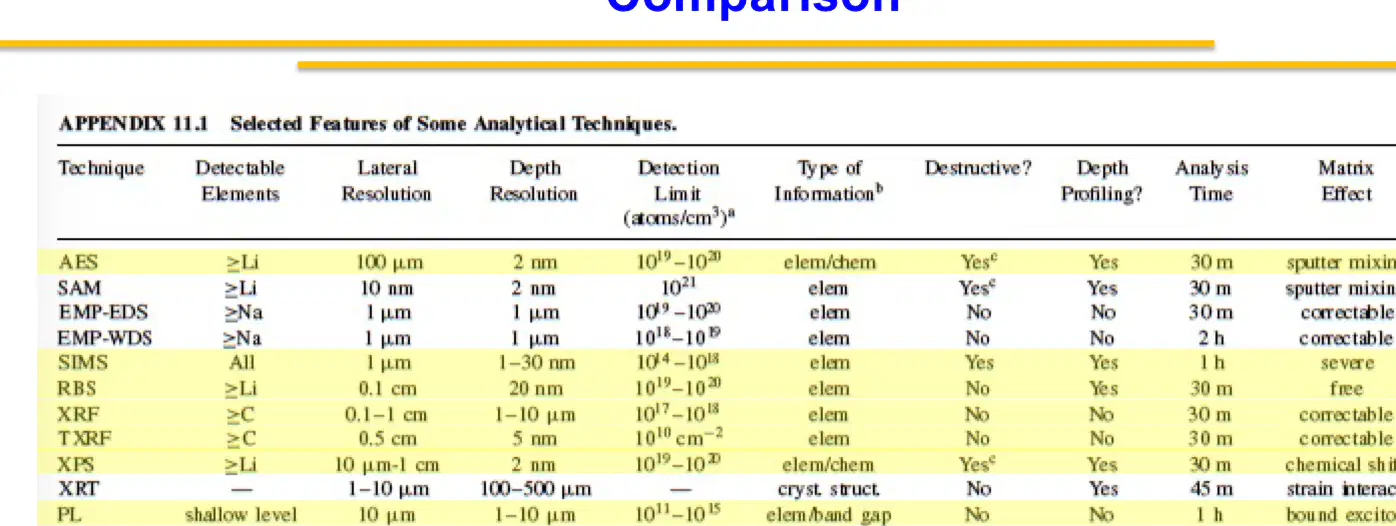
Which technique provides information about crystal structure and has a lateral resolution of 0.1–100 μm?
LEED
PL
SIMS
AFM
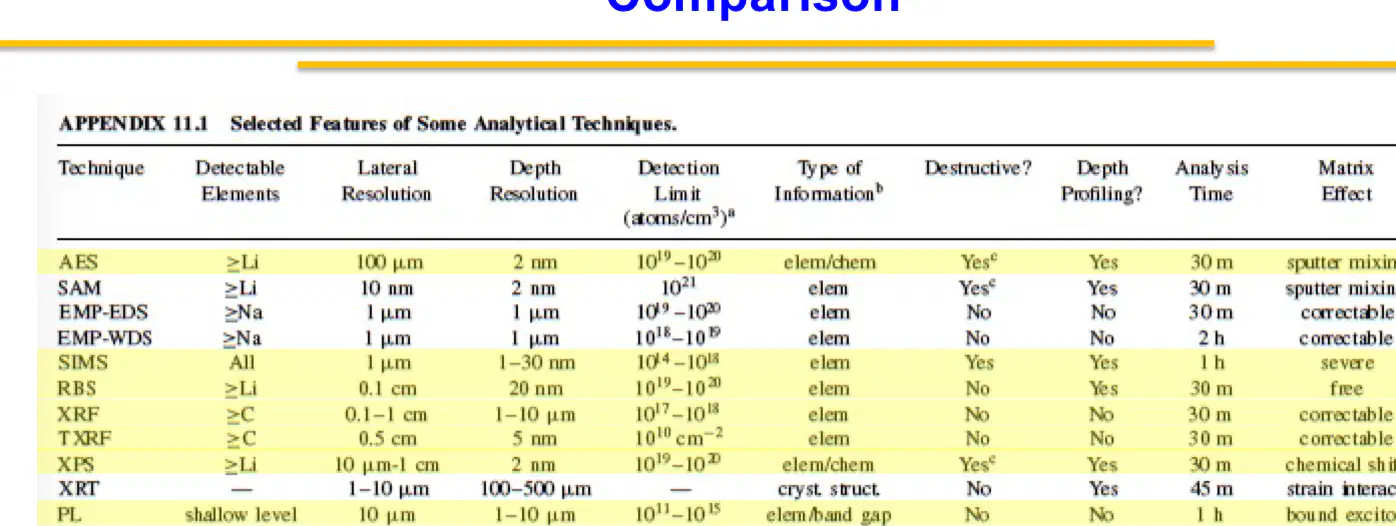
What is the detection limit (atoms/cm³) for SIMS?
10⁴–10¹⁸
10¹⁹–10²⁰
10¹¹–10¹⁵
10⁹–10²⁰
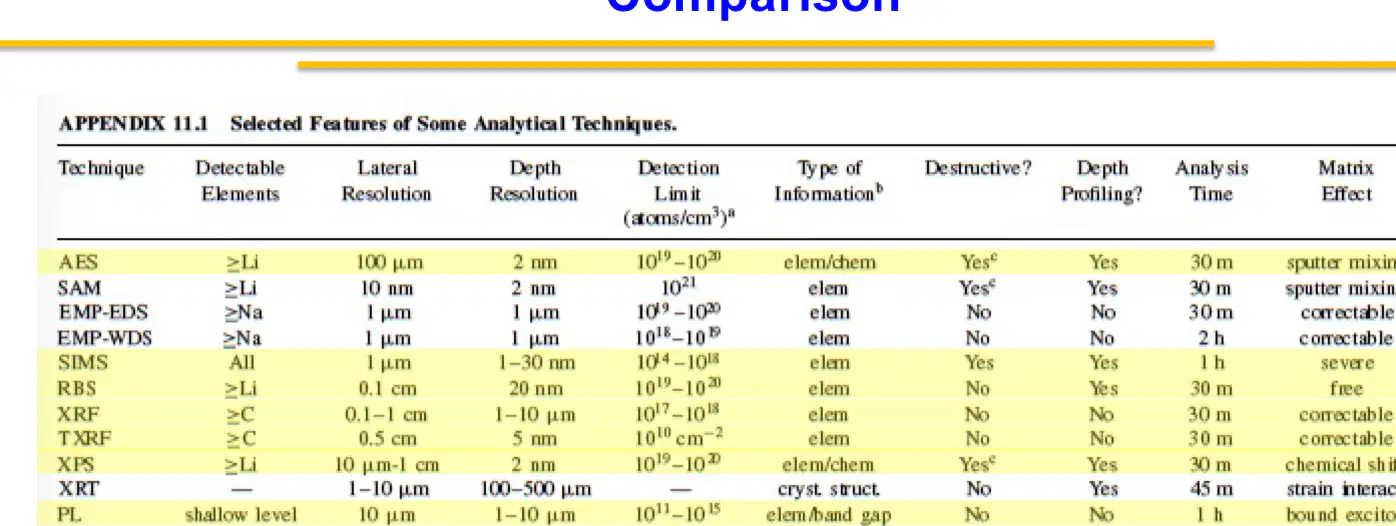
Which analytical technique is destructive and provides elemental/chemical information?
AES
XRF
AFM
NAA
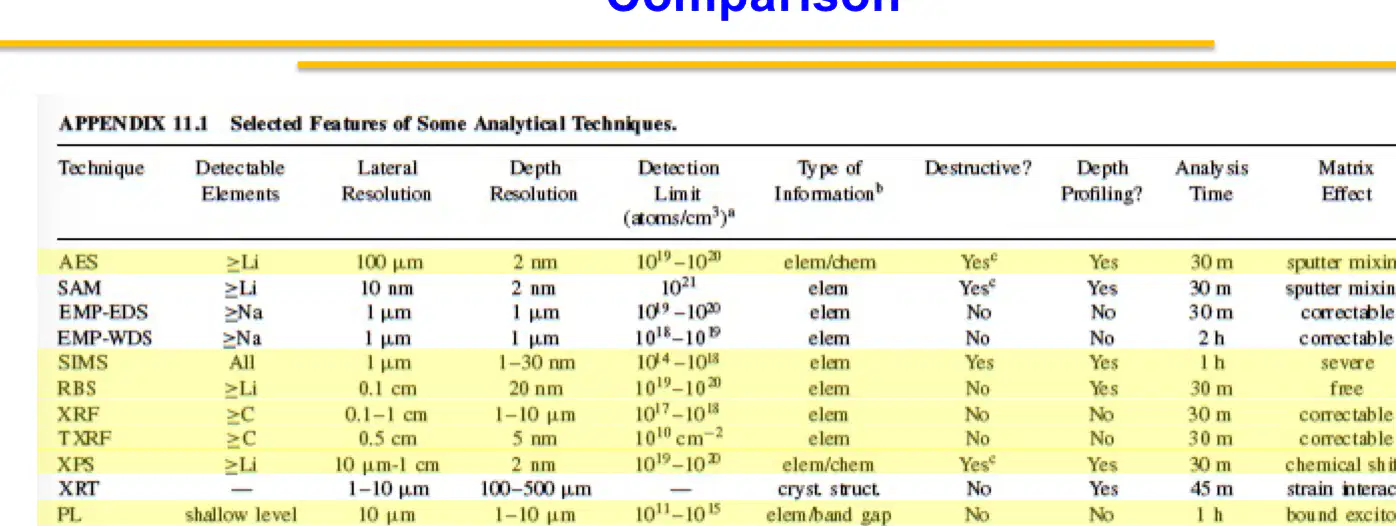
What type of information does FTIR provide?
Functional groups
Crystal structure
Elemental composition
Surface flatness
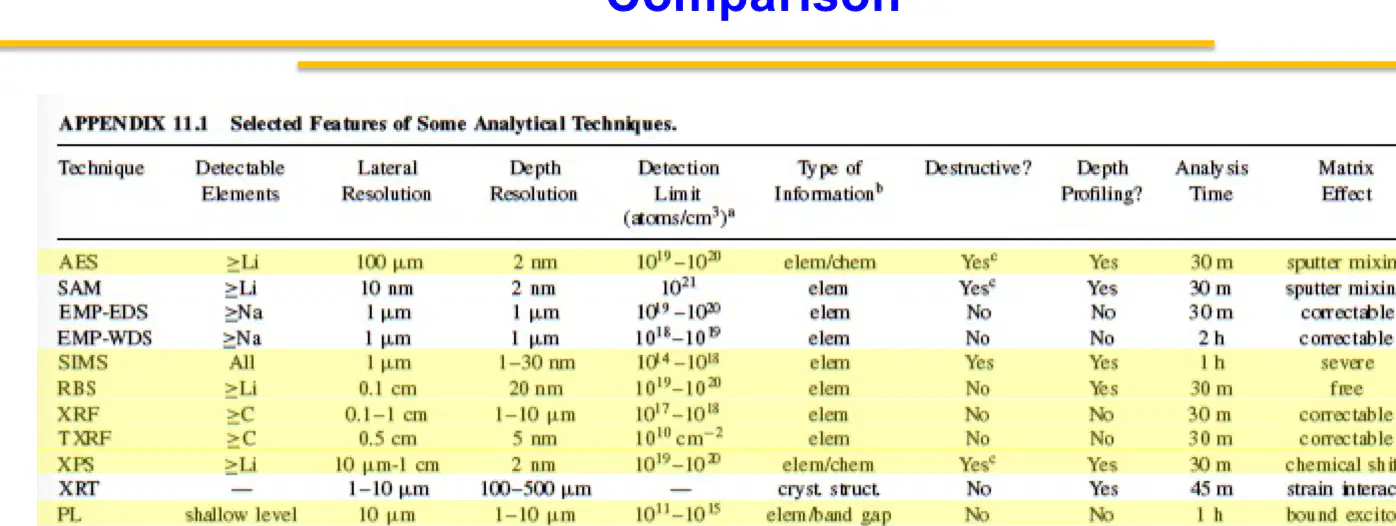
Which technique is used for surface flatness analysis?
AFM
SIMS
XPS
RBS

What is the analysis time for NAA?
2 days
30 minutes
1 hour
45 minutes
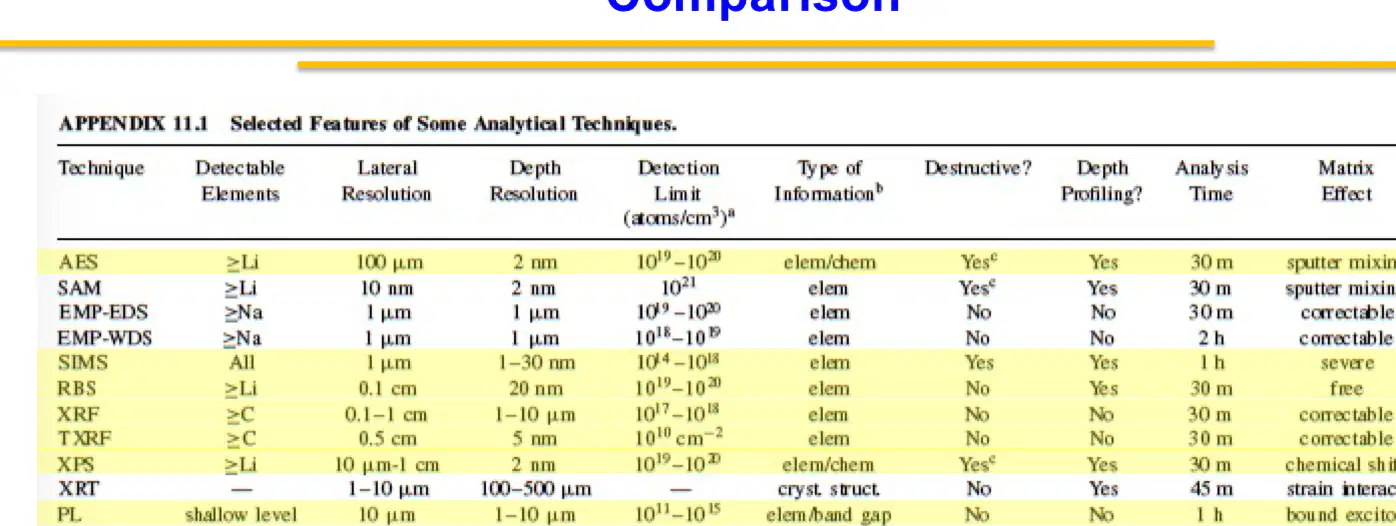
Which technique has a matrix effect described as 'severe'?
SIMS
XRF
PL
AFM
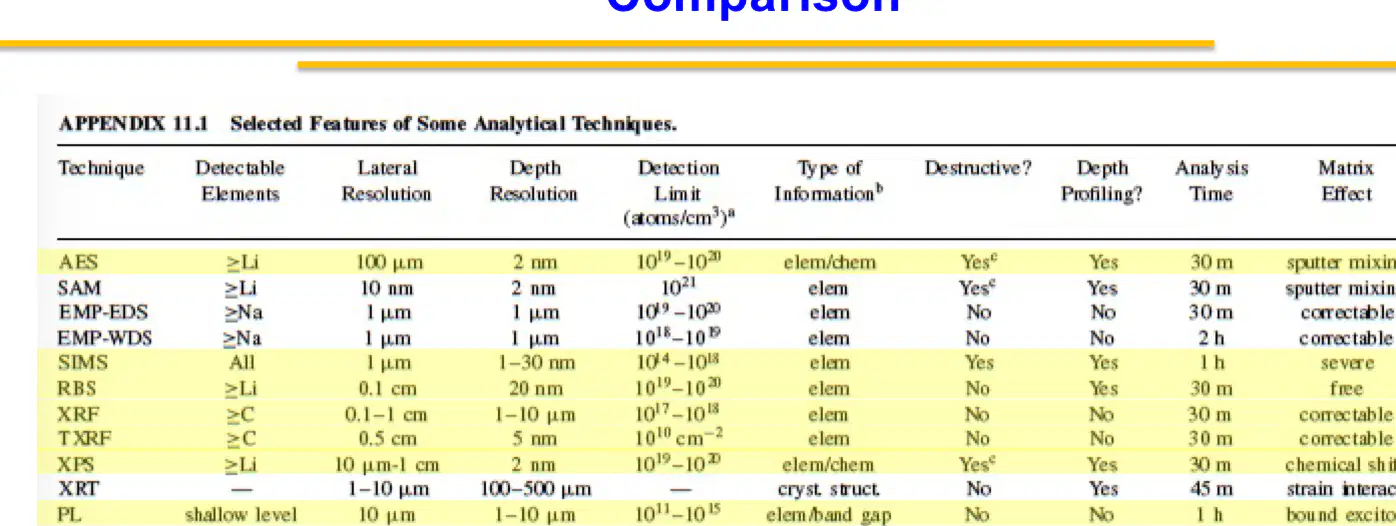
What does the abbreviation RBS stand for?
Rutherford backscattering spectrometry
Raman microprobe
Reflection high energy electron diffraction
Raman band spectroscopy
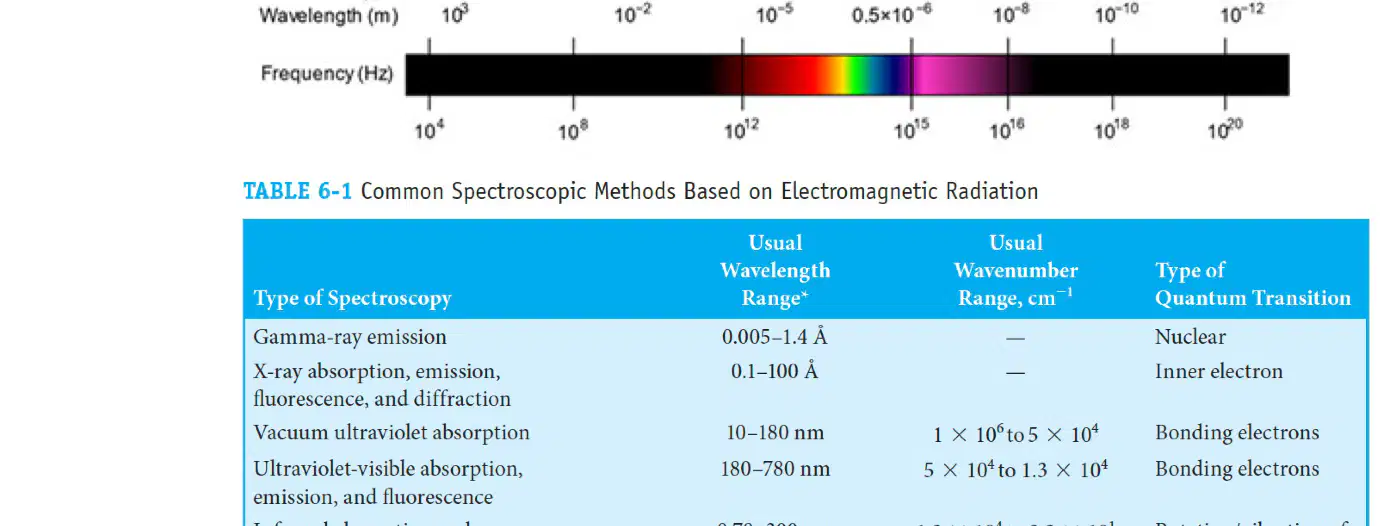
Which type of quantum transition is associated with gamma-ray emission in spectroscopy?
Nuclear
Bonding electrons
Rotation of molecules
Spin of nuclei in a magnetic field
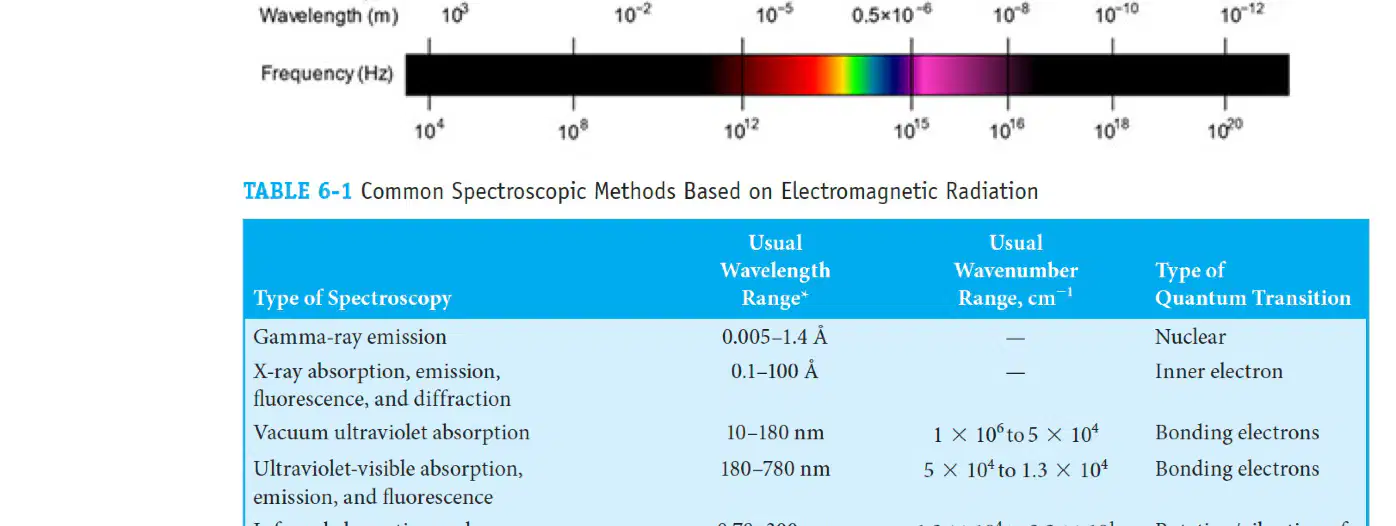
What is the usual wavelength range for X-ray absorption, emission, fluorescence, and diffraction?
0.1–100 Å
10–180 nm
0.005–1.4 Å
0.6–10 m
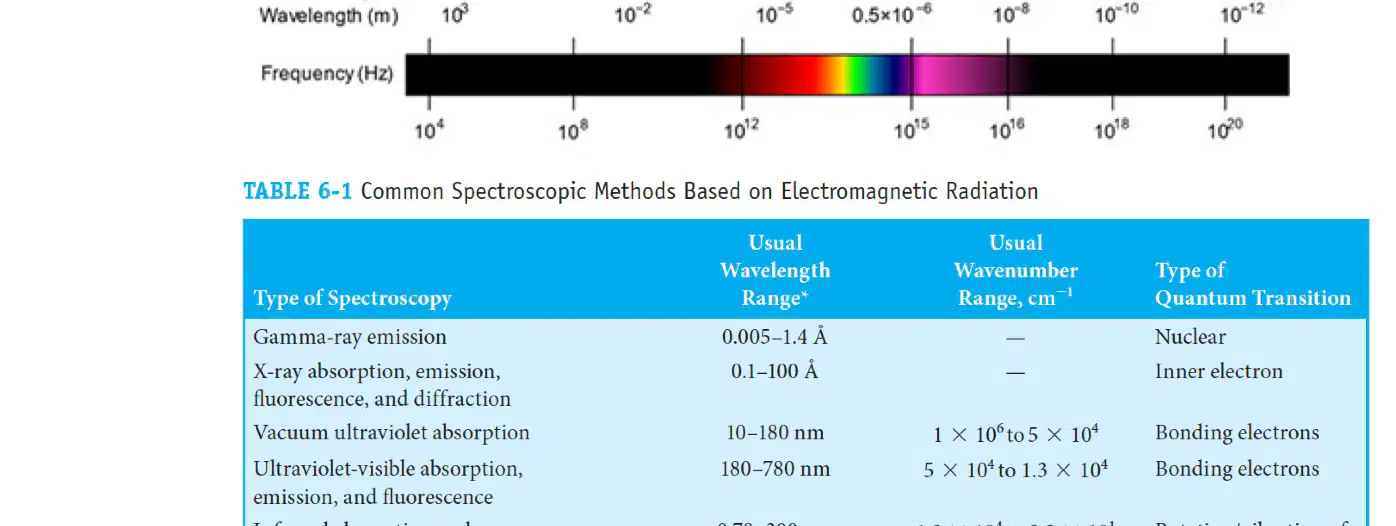
Which type of spectroscopy involves the rotation/vibration of molecules as the quantum transition?
Infrared absorption and Raman scattering
Microwave absorption
Electron spin resonance
Ultraviolet-visible absorption
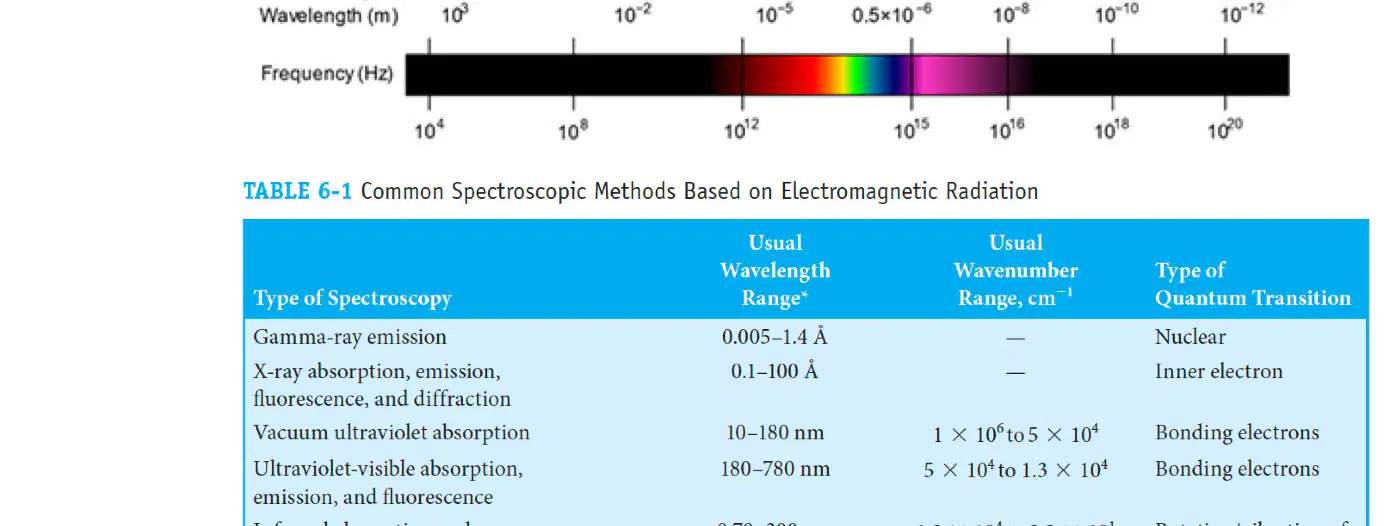
What is the usual wavenumber range for vacuum ultraviolet absorption?
1 × 10⁶ to 5 × 10⁴ cm⁻¹
13–0.03 cm⁻¹
0.33 cm⁻¹
1.7 × 10⁻² to 1 × 10³ cm⁻¹
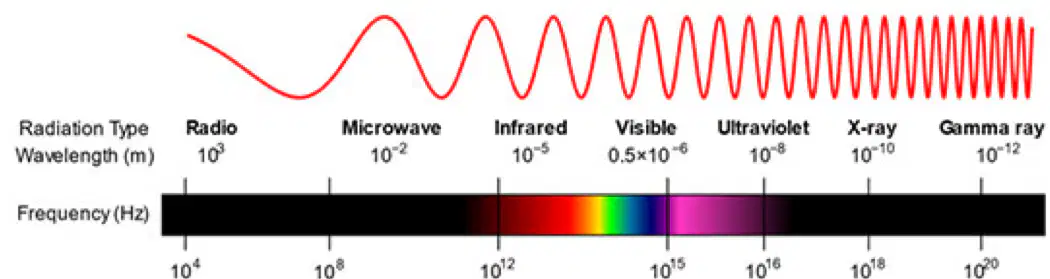
Which type of spectroscopy uses a wavelength of 3 cm and involves the spin of electrons in a magnetic field?
Electron spin resonance
Nuclear magnetic resonance
Microwave absorption
Infrared absorption
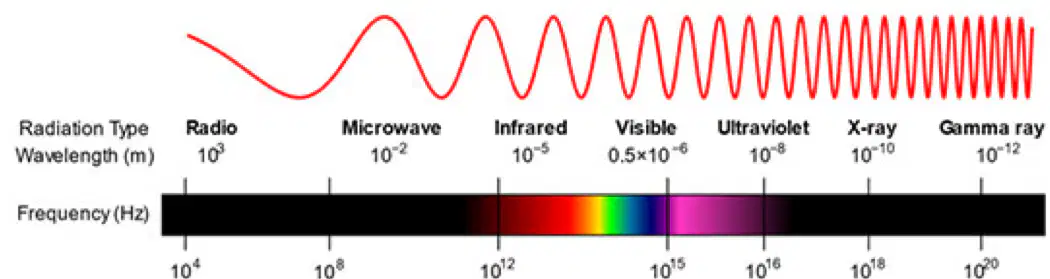
What is the usual wavelength range for nuclear magnetic resonance spectroscopy?
0.6–10 m
0.75–375 mm
0.005–1.4 Å
180–780 nm
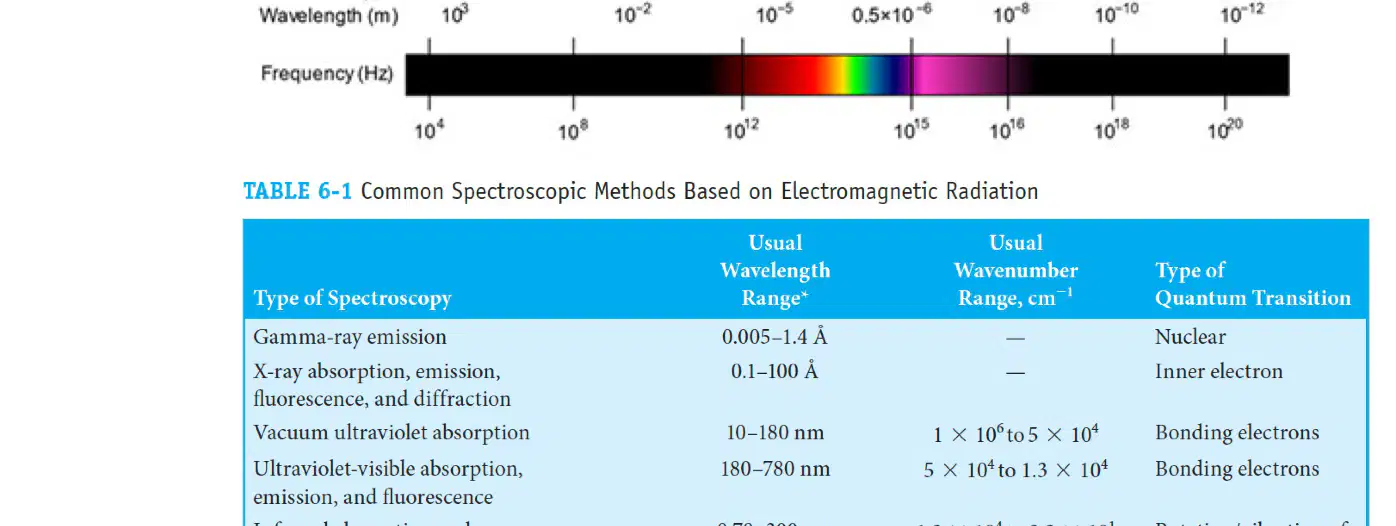
Which type of quantum transition is observed in ultraviolet-visible absorption, emission, and fluorescence spectroscopy?
Bonding electrons
Nuclear
Spin of nuclei in a magnetic field
Rotation of molecules
What is absorption spectroscopy?
The absorption of electromagnetic radiation as a function of the frequency of radiation due to its interaction with matter.
The emission of electromagnetic radiation from a sample.
The reflection of light from a surface.
The scattering of particles by a material.
Which type of electromagnetic radiation is associated with core electron transitions in absorption spectroscopy?
X-rays
UV-visible
Infrared
Microwave
What does IR (infrared) radiation primarily interact with in a sample during absorption spectroscopy?
Molecular vibrations
Core electrons
Electron and nuclear spins
Valence electrons
Which region of the electromagnetic spectrum is used to study molecular rotations in absorption spectroscopy?
Microwave
X-rays
UV-visible
RF (radio frequency)

What is the main variable measured in absorption spectroscopy?
Absorption as a function of frequency of radiation
Emission as a function of temperature
Reflection as a function of angle
Scattering as a function of wavelength
What does HOMO stand for in molecular orbital theory?
Highest Occupied Molecular Orbital
Highest Open Molecular Orbital
Lowest Unoccupied Molecular Orbital
Highest Unoccupied Molecular Orbital
What does LUMO stand for in molecular orbital theory?
Lowest Unoccupied Molecular Orbital
Lowest Occupied Molecular Orbital
Highest Unoccupied Molecular Orbital
Lowest Unoccupied Magnetic Orbital
In the context of band theory, to what is the HOMO analogous?
Valence band
Conduction band
Fermi level
Band gap
In the context of band theory, to what is the LUMO analogous?
Conduction band
Valence band
Fermi level
Band gap
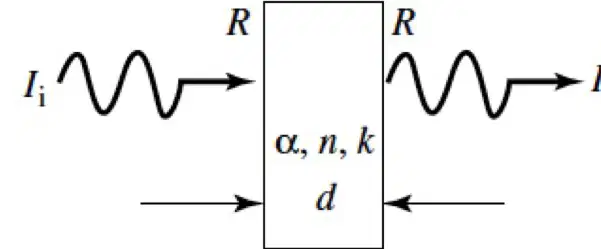
What is the absorption coefficient (α) formula as given in the material?
α = 4πk/λ
α = 2πn/λ
α = k/4πλ
α = 4πn/λ
What is the purpose of measuring the absorption coefficient as a function of photon energy in semiconductors?
To determine the semiconductor band gap
To measure the thickness of the material
To calculate the refractive index
To find the reflection coefficient
For indirect band-gap semiconductors, what is plotted against hν to determine the band gap?
α1/2
α2
n2
k2
For direct band-gap semiconductors like GaAs, what is plotted against hν to determine the band gap?
α2
α1/2
n2
k2
What is the name of the plot used to determine the semiconductor band gap from absorption data?
Tauc plot
Arrhenius plot
Nyquist plot
Bode plot
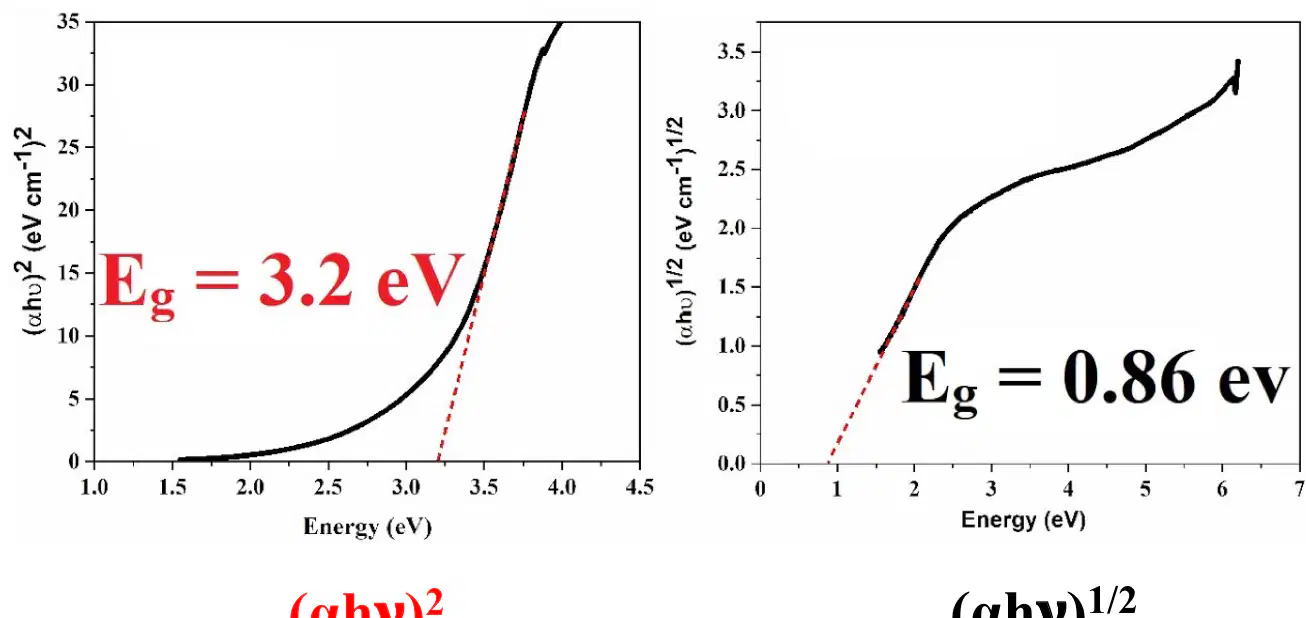
What is the bandgap energy (Eg) for a direct bandgap material as shown in the example?
3.2 eV
0.86 eV
2.5 eV
1.0 eV
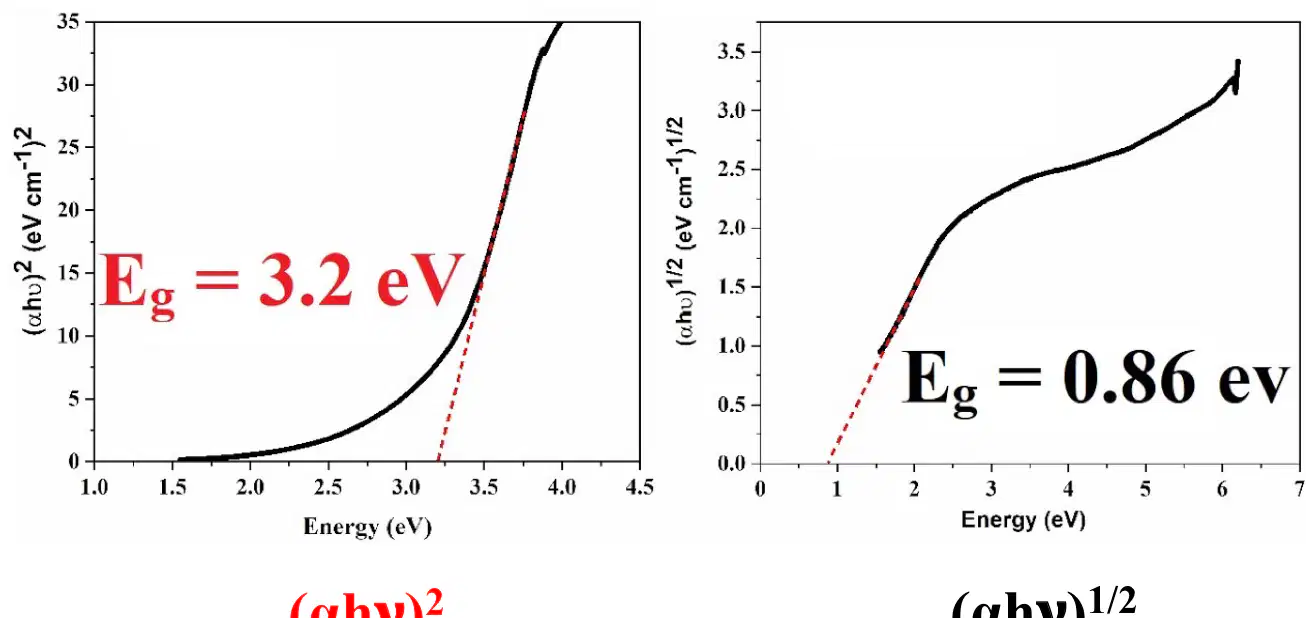
What is the bandgap energy (Eg) for an indirect bandgap material as shown in the example?
0.86 eV
3.2 eV
2.0 eV
1.5 eV
Which mathematical expression is used for direct bandgap materials in the given example?
(αhv)2
(αhv)(1/2)
(αhv)3
(αhv)4
Which mathematical expression is used for indirect bandgap materials in the given example?
(αhv)(1/2)
(αhv)2
(αhv)3
(αhv)4
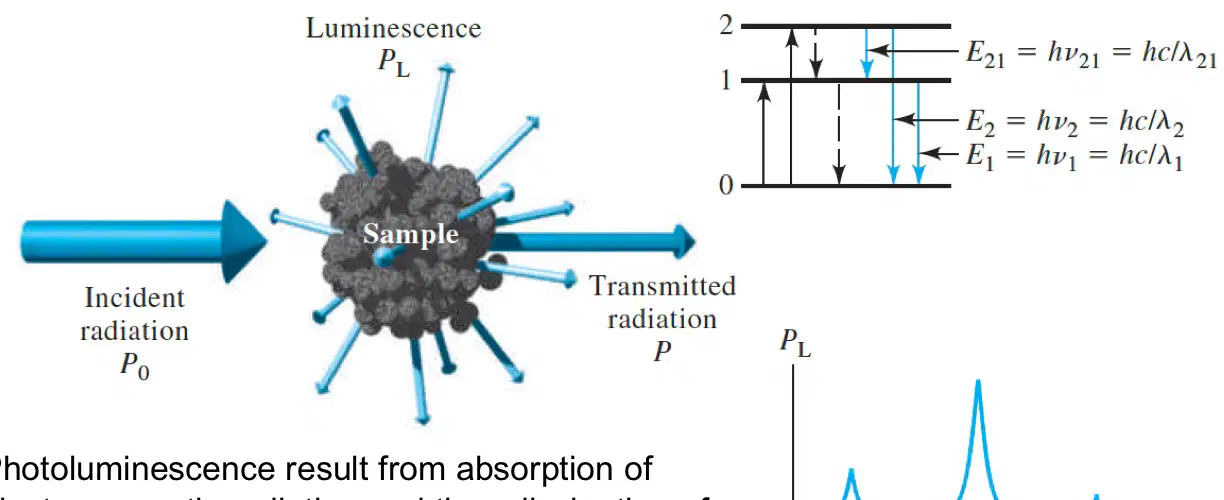
What is the primary cause of photoluminescence in a material?
Absorption of electromagnetic radiation followed by emission of energy
Reflection of visible light from the surface
Absorption of sound waves
Emission of heat due to friction
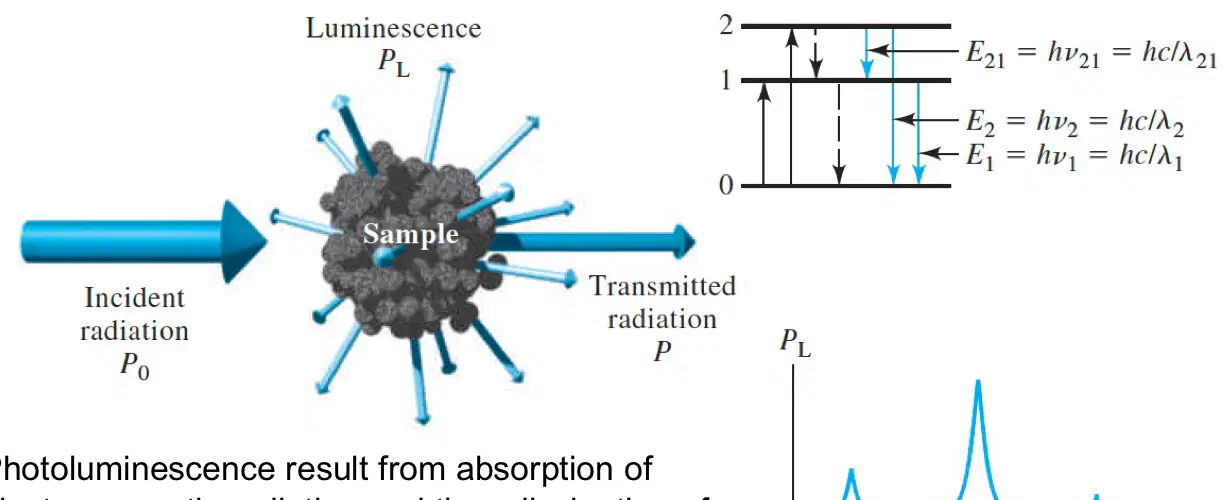
What happens to the excess energy when an analyte is excited to a higher state in photoluminescence?
It can be lost by emission of a photon or by nonradiative processes
It is always stored in the material
It is converted into mechanical energy
It is used to increase the mass of the analyte
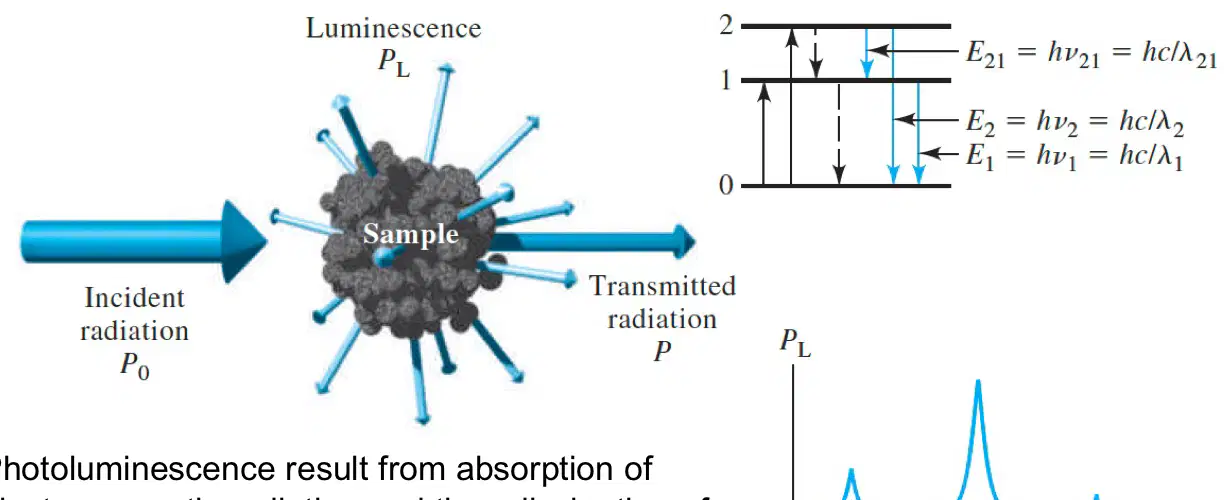
In photoluminescence, what do the wavelengths emitted correspond to?
Energy differences between levels
The temperature of the sample
The pressure applied to the sample
The color of the incident light

From which electronic state do absorption transitions occur in a Jablonski diagram?
Ground singlet electronic state (S₀)
Triplet excited state (T₁)
Singlet excited state (S₁)
Vibrational relaxation state
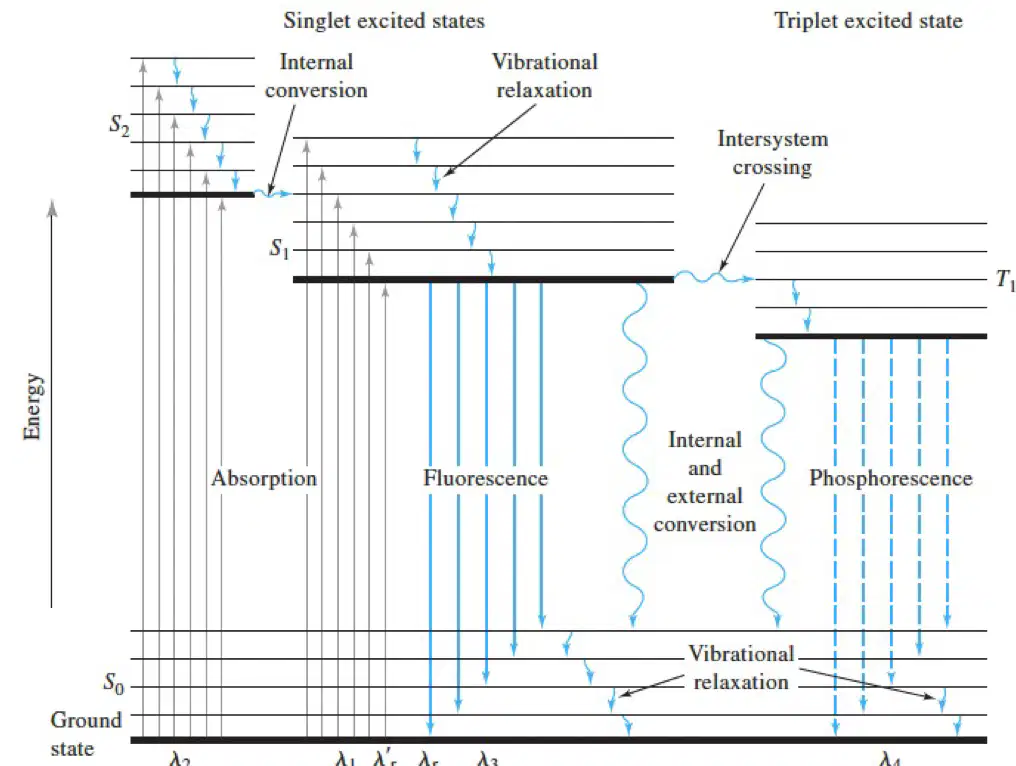
Which of the following statements about fluorescence and phosphorescence is correct?
Fluorescence is relatively intense and fast, while phosphorescence is weaker and slower.
Fluorescence is weaker and slower than phosphorescence.
Both fluorescence and phosphorescence are blue-shifted compared to the excitation wavelength.
Phosphorescence is more intense and faster than fluorescence.
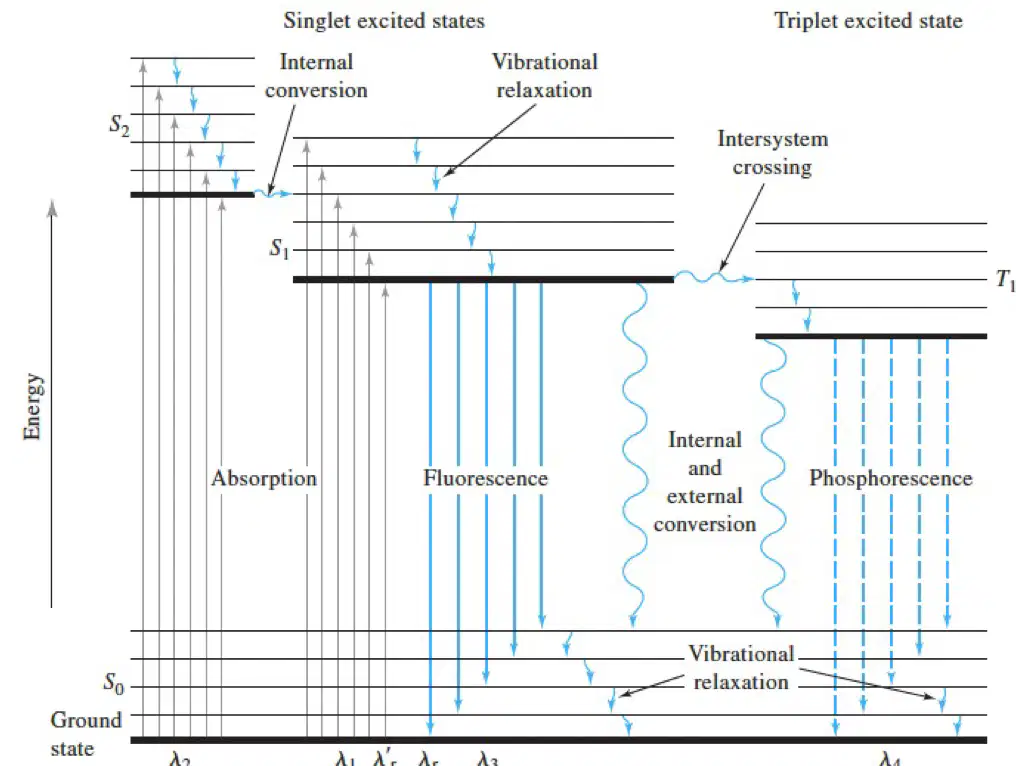
To which electronic states do absorption transitions occur from the ground singlet state (S₀)?
Excited singlet electronic states (S₁ and S₂)
Triplet excited state (T₁)
Ground vibrational state
Internal conversion state

How are fluorescence and phosphorescence wavelengths compared to the excitation wavelength?
Both are redshifted compared to the excitation wavelength.
Both are blueshifted compared to the excitation wavelength.
Fluorescence is redshifted, phosphorescence is blueshifted.
Both have the same wavelength as the excitation.
What is the term for the non-radiational process in which molecules excited to electronic states S₁ and S₂ rapidly lose excess vibrational energy and relax to the ground vibrational level?
Vibrational relaxation
Radiative emission
Photoionization
Phosphorescence
What is the typical average lifetime of a vibrationally excited molecule due to vibrational relaxation?
10⁻¹² seconds or less
1 second
10 seconds
10⁻⁶ seconds
What does the internal conversion process describe?
Intermolecular processes that leave the molecule in a lower-energy electronic state without emission of radiation
The emission of light from an excited molecule
The absorption of energy by a molecule
The transfer of energy to another molecule
What is the process called when deactivation of an excited electronic state involves energy transfer between the excited molecule and the solvent or other solutes?
External conversion
Internal conversion
Vibrational relaxation
Fluorescence
Excitation by the band of radiation labeled λ₂ usually produces a fluorescence band centered at which wavelength?
λ₃
λ₁
λ₄
λ₀
What is intersystem crossing?
A process in which there is a crossover between electronic states of different multiplicity.
A process in which electrons are excited to higher energy levels without changing multiplicity.
A process in which molecules emit light as they return to the ground state.
A process in which only singlet states are involved.
In which type of molecules is intersystem crossing most common?
Molecules that contain heavy atoms such as iodine or bromine.
Molecules that contain only light atoms such as hydrogen or helium.
Molecules that do not contain any atoms.
Molecules that are only in the gas phase.
Why does direct excitation to the triplet state have a very low probability of occurrence?
Because the transition involves a change in multiplicity.
Because the triplet state is always lower in energy.
Because the singlet state is unstable.
Because the molecule cannot absorb energy.
What is the typical range for the average lifetime of the excited triplet state with respect to emission?
From 10⁻⁴ to 10 seconds or more.
From 1 to 2 seconds.
From 10⁻⁸ to 10⁻⁶ seconds.
From 100 to 1000 seconds.
What effect do heavy atoms like iodine or bromine have on intersystem crossing?
They increase spin and orbital interactions, making a change in spin more favorable.
They decrease the probability of intersystem crossing.
They have no effect on intersystem crossing.
They prevent the formation of excited states.
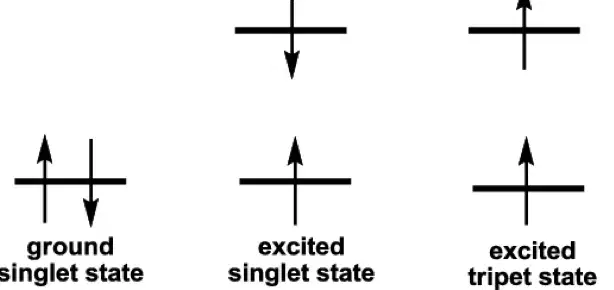
Which of the following diagrams best represents the ground singlet state, excited singlet state, and excited triplet state?
A diagram showing three sets of electron spin configurations: (1) ground singlet state with paired spins, (2) excited singlet state with one electron promoted but spins still paired, (3) excited triplet state with parallel spins.
A diagram showing only one electron in each state.
A diagram with all electrons paired in every state.
A diagram with no electrons shown.

What is the main function of a Fluorescence/Phosphorescence Spectrometer?
To measure the emission of photons from a sample after excitation
To measure the mass of a sample
To determine the electrical conductivity of a material
To analyze the chemical composition using X-rays
Which component in the spectrometer setup is responsible for providing the initial light source?
Xenon Lamp
Emission Monochromator
Sample Compartment
Lens
What does the quantum yield (Φ) represent in fluorescence/phosphorescence spectroscopy?
The ratio of photons emitted to photons absorbed
The ratio of electrons to protons
The ratio of mass to volume
The ratio of wavelength to frequency
What is the range of values for quantum yield (Φ) as shown in the image?
0 < Φ < 1
1 < Φ < 10
Φ = 0
Φ > 1
What is required to perform time-resolved fluorescence measurements?
A pulsed laser and a time-resolved detection scheme
A continuous light source and a static detector
A monochromator and a photodiode
A heating element and a thermometer
Which equation describes the time-dependent fluorescence intensity?
I(t)=I0e−(t/τ)
I(t) = I₀ + t/τ
I(t)=τeI0t
I(t) = I₀t/τ
In the equation I(t) = I0e−(t/τ) , what does I0 represent?
The initial intensity of the fluorescence
The fluorescence lifetime
The time after excitation
The emission wavelength
What is the fluorescence lifetime (τ)?
The time it takes for I(t) to reach 1/e of the initial value (I₀)
The time it takes for I(t) to double
The time it takes for I₀ to reach maximum intensity
The time it takes for the laser to pulse
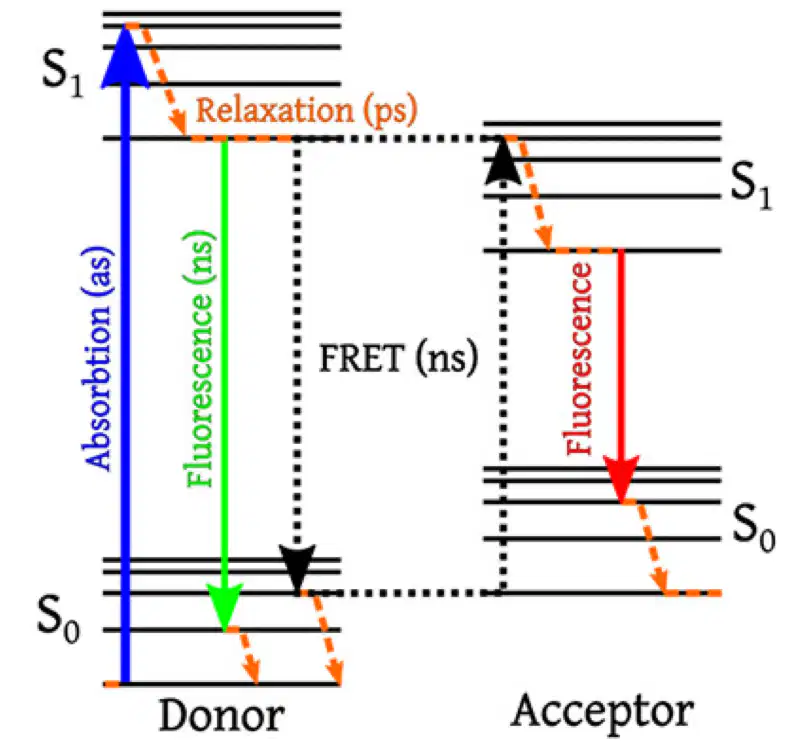
What does FRET stand for in the context of fluorescence?
Förster Resonance Energy Transfer
Fluorescence Resonance Electron Transfer
Fast Radiative Energy Transmission
Frequency Resonance Emission Transfer
In FRET, what must overlap for energy transfer to occur between two fluorophores?
The emission spectrum of the donor and the absorption spectrum of the acceptor
The absorption spectrum of the donor and the emission spectrum of the acceptor
The ground state energies of both fluorophores
The fluorescence lifetimes of both fluorophores
What happens when the donor molecule in a FRET pair is excited?
It can transfer energy non-radiatively to the acceptor, which then fluoresces
It emits light directly without energy transfer
It loses energy through heat only
It undergoes chemical decomposition
The efficiency of FRET is proportional to which mathematical relationship?
1/r⁶
r⁶
1/r²
r²

What does the partial energy level diagram shown in the image represent?
Common transitions producing X-rays
The structure of a crystal lattice
The emission spectrum of visible light
The absorption of ultraviolet radiation
How are the most intense lines indicated in the partial energy level diagram for X-rays?
By the wider arrows
By the color red
By dashed lines
By shaded regions

What is the primary process that occurs during X-ray fluorescence (XRF)?
Primary X-rays are absorbed by ejecting electrons from the atomic K-shell.
Primary X-rays are reflected off the sample surface.
Primary X-rays are converted into visible light.
Primary X-rays are absorbed by the atomic nucleus.
What type of analysis does X-ray fluorescence (XRF) allow?
Non-destructive elemental analysis of solids and liquids
Destructive chemical analysis of gases only
Only qualitative analysis of organic compounds
Only destructive analysis of metals
Why is XRF not considered a high-resolution method?
X-rays are difficult to focus
X-rays are too expensive to generate
X-rays are always absorbed by air
X-rays cannot penetrate solids
What is a typical analysis area for XRF?
1 cm²
100 cm²
0.01 cm²
10 m²
Why is XRF suitable for both conductors and insulators?
X-rays are uncharged
X-rays are magnetic
X-rays are always absorbed by conductors
X-rays only interact with metals
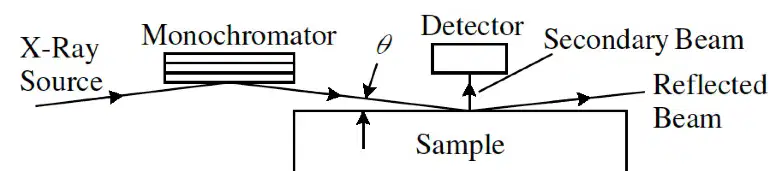
What is the main difference between conventional XRF and Total Reflection XRF (TXRF) in terms of surface sensitivity?
Conventional XRF is surface sensitive, while TXRF is not.
Both conventional XRF and TXRF are not surface sensitive.
TXRF is a surface sensitive technique, while conventional XRF is not.
Both techniques are equally surface sensitive.
What is the typical grazing incidence angle used in TXRF?
Around 45°
Less than 0.1°
90°
10°

