
Font size
 Worksheets
Homework #38: Moles / Stoichiometry Exam Basic Skills Review
Total questions: 20
Worksheet time: 15mins
What do you do first to find ppm from grams?
Multiply grams by 22.4
Convert grams to moles
Divide grams of solute by grams of solution
Multiply grams by (6.02×10^23)
Add the two masses
Which fraction is set up correctly for ppm?
grams solution ÷ grams solute
grams solute ÷ liters solution
grams solute ÷ grams solution
moles solute ÷ grams solution
liters solution ÷ grams solute
After you do solute ÷ solution, what do you do next?
Multiply by 100
Multiply by 1000
Divide by 1000
Multiply by 1,000,000
Multiply by 22.4
If you are given moles and need ppm, what do you do first?
Divide moles by grams solution
Convert moles to grams (use molar mass)
Multiply moles by 22.4
Multiply moles by (10^6)
Convert grams to liters
Which setup matches ppm after you have grams of solute?
(grams solution ÷ grams solute) × (10^6)
(grams solute ÷ grams solution) × (10^3)
(grams solute ÷ grams solution) × (10^6)
(grams solute ÷ liters solution) × (10^6)
(moles solute ÷ grams solution) × (10^6)
What do you do first if you are given grams and asked for molarity?
Divide grams by liters
Multiply grams by (10^6)
Convert grams to moles (use molar mass)
Multiply grams by 22.4
Convert liters to grams
Which unit matches molarity?
m
n
M
g
L
Which conversion factor would you multiply by to go from moles → liters (STP)?
(1 mol/22.4 L)
(6.02×10^23/1 mol)
(1 L/1000 mL)
(22.4 L/1 mol)
(MM/1 mol)
What do you do first to go from moles → particles?
Multiply by 22.4
Multiply by molar mass
Divide by (10^6)
Multiply by (6.02×10^23)
Divide by liters
Which setup is correct to find the particles in 2.8 moles of HCl?
(2.8 ÷ 6.02×10^23)
(2.8 × 22.4)
(2.8 × 6.02×10^23)
(2.8 ÷ 22.4)
(2.8 × 10^6)

In a stoichiometry problem with a balanced equation, if you are given grams of a substance, what is the first step?
Use the coefficients right away
Convert grams to moles (use molar mass)
Convert to liters
Multiply by (10^6)
Divide by 22.4
After you have moles of the given, what is the next step for a stoichometry problem with a balanced equation??
Convert to particles
Convert to liters
Use the mole ratio from the balanced equation
Multiply by (10^6)
Divide by molar mass again

In the image, what two “big steps” are you doing?
grams → liters → particles
grams → particles → moles
grams → moles → mole ratio (to moles CuO)
liters → moles → ppm
moles → grams → ppm

A “three-fraction” stoichiometry problem that begins with grams and ends with grams means:
grams → liters → ppm
liters → moles → particles
grams → moles → mole ratio → grams
moles → liters → grams
grams → ppm → moles
What does it mean to be “balanced”?
Same number of molecules on each side
Same coefficients on each side
Same number of each type of atom on each side
Same number of compounds on each side
Same total charge on each side
“Smallest whole-number coefficients” means:
Use decimals if needed
Make coefficients add to the same total
Use whole numbers and reduce if they share a common factor
Make oxygen equal first only
Use 1s everywhere
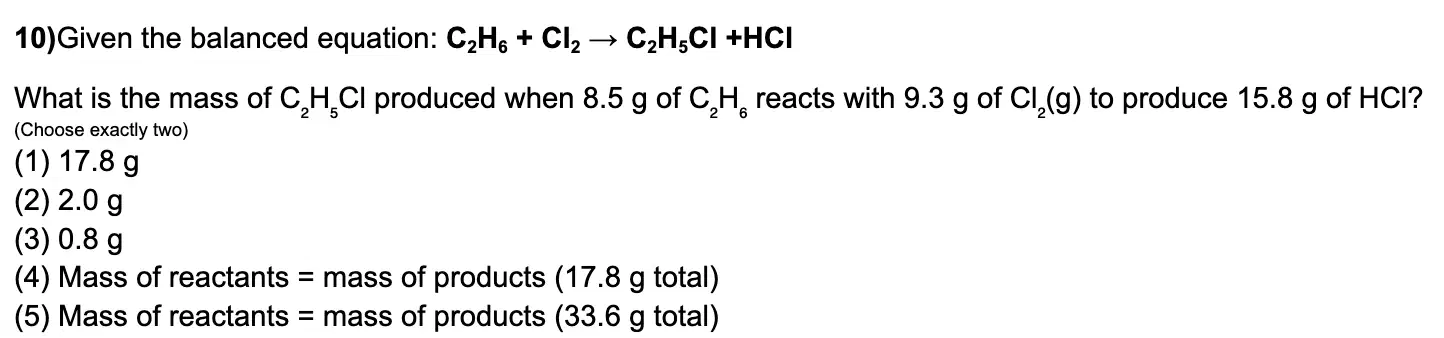
In Q10, what rule are you using?
STP rule
Avogadro’s rule
ppm rule
molarity rule
Mass of reactants = mass of products
Why is the mass of the reactants 17.8g?
Mass of C2H6
8.5g
Mass of Cl2
9.3g
Mass of Cl2 and C2H6
(reactants)
17.8g
Mass of HCl (product)
15.8g
Mass of missing product
2.0g

Match each equation to the correct number of atoms or description
C₂H₄ + 2O₂ → 2CO₂ + 2H₂O
2 C = 2 C
4H = 4 H
4 O ≠ 6O
C₃H₆ + 4O₂ → 3CO₂ + 3H₂O
3 C = 3 C
6 H = 6 H
8O ≠ 9 O
2C₂H₄ + 6O₂ → 4CO₂ + 4H₂O
Does not use smallest whole number
C₂H₄ + 3O₂ → 2CO₂ + 2H₂O
2 C = 2 C
4H = 4 H
6 O = 6O
2C₃H₆ + 9O₂ → 6CO₂ + 6H₂O
6 C = 6 C
12H = 12 H
18 O = 18O

Select five true and five false statements
Note that Mr. Rana and Mr. Higgins do not decide the dates of the midterm.
We received and discussed the testing calendar on the 2nd day of school.
Test dates are random
We will drop your lowest grade except for the midterm
The midterm grade can be dropped
The midterm is 1/9
We still have not received the midterm date
The midterm is on a Friday
The midterm is on a Saturday
We do not decide the date of your midterm
Mr. Higgins and Mr. Rana decided to give a midterm on 1/9 (this is false)

