
 Worksheets
Quarter Two Review
Total questions: 15
Worksheet time: 8mins
The following are newspaper headings from the 1920s: “PUBLIC IGNORES PROHIBITION RESTRICTIONS”, “EVOLUTION AND CREATION DEBATED IN SCOPES TRIAL”, “WOMEN BRING CHANGE TO THE INDUSTRIAL WORKFORCE”
Which of the following answers BEST fits what the newspaper headings of the 1920s described? (2 points)
There was a change in societal values. This change led to conflict between those that held on to traditional values versus those that were becoming more modern and liberal.
More immigrants were coming in to the country bringing dangerous new ideas with them.
America was becoming more modern and this contributed to changes in society.
There were new legislations being proposed and many challenged the old ways of doing things.
“Our success educationally, industrially and politically is based upon the protection of a nation founded by ourselves. And the nation can be nowhere else but in Africa” -Marcus Garvey
Intellectual Marcus Garvey was a well known Harlem Renaissance figure who preached the “back to Africa” movement through a message of black nationalism. His contributions (2 points)
left behind a powerful legacy of newly awakened black pride, economic independence, and reverence for Africa.
destroyed the legacy of Washington and DuBois and bolstered the reverence for Asia.
created a legacy of American pride and reconciliation.
left behind a powerful legacy of sorrow, economic dependence, and reverence for Europe.
he shift in United States foreign policy towards an imperialistic one led to the acquisition of overseas possessions in the late 1800s and early 1900s.
Which of the following statements supports this shift towards Imperialism? (2 points)
The United States realized the competition among nations for resources and markets was growing and the U.S. could not be left behind.
The United States wanted to become the main world power in order to conquer and colonize foreign nations on every continent.
The United States began to understand the need to strengthen its relationship with Spain and share overseas markets and territories.
The United States realized the Doctrine of Manifest Destiny was no longer valid and must be replaced by the Platt Amendment.
In the 1920’s, the automobile became the backbone of the American economy and dramatically altered American society.
Mass production of automobiles led to (2 points)
decreasing the cost of producing a vehicle leading to lower prices for the average American.
people not being able to afford cars and losing their sense of independence.
increasing the cost of producing a vehicle leading to higher prices for the average American.
workers living closer to their place of employment since less cars were on the road.
After WWI, the United States foreign policy positions shifted between isolationist and internationalist/engagement. This means U.S. foreign policy (2 points)
involved working with other countries to influence world affairs AND engaging "lone wolf" countries to end isolation.
shifted from negotiating with partners AND intervening in other nations' affairs in order to conquer and take possession of the lands.
promoted actions to support stronger nations to dominate weaker nations AND not support countries that were trying to stay independent and isolated from the great powers.
shifted between a strict non-involvement in the affairs of other nations AND intervention in other nations' affairs to promote national security.

Analyze the political cartoon titled "Big Stick" in the Caribbean Sea.
Which of the following best fits as a subject for this political cartoon? (2 points)
The Roosevelt Corollary as symbolized by the Big Stick extended the Monroe Doctrine to include a policy of protecting and taking action when necessary in the Caribbean Islands.
The Big Stick Diplomacy was also called Dollar Diplomacy which refused to recognize Caribbean governments that were not democratic.
The Missionary Diplomacy policy as symbolized by the Big Stick encouraged American business investment to help the Caribbean economy.
Big Stick Diplomacy promoted the Chinese Open Door Policy of trade relations within the Caribbean for Cubans.
Cultural movements during the 1920s impacted many groups in American society. The emancipated or free woman of the time (or flapper) resulted from many causes including (2 points)
the Great Migration and opportunities for women in cities.
the repeal of Prohibition which led to new openings in bars and breweries.
WWI, the suffrage movement, and greater opportunities for personal freedom.
the Harlem Renaissance and the passage of the Equal Rights Amendment which resulted in new rights for women.
“The voice of President Coolidge, addressing Congress tomorrow, will be carried over a greater portion of the United States and will be heard by more people than the voice of any man in history.” December 5, 1923 New York Times
How did the use of radio impact communication in American society? (2 points)
Editors learned how to hook readers by imitating the sensational stories in the tabloids.
Overtook the television as the main source for home entertainment.
Freed people in society for other community and leisure activities.
Shared national experience of hearing the news and important events as they happened.
“War is made or planned now by individual men, demagogues, and dictators who play on the patriotism of their people to mislead them into a belief in the great fallacy of war when all their vaunted reforms have failed to satisfy the people they misrule. And we in America should see that no man is ever given, no matter how gradually or how noble and excellent the man, the power to put this country into a war which is now being prepared and brought closer each day with all the premeditation of a long-planned murder.” Ernest Hemingway
Lost Generation writer Ernest Hemingway saw the most gruesome aspects of war and came to the conclusion that (2 points)
America had failed to provide support to the returning soldiers.
greed tended to make men lose hope and faith in modern society without love.
government leaders should show accountability for their decisions when it comes to war.
people in general are strong and able to overcome personal obstacles they have faced.
The 21st Amendment would repeal the 18th Amendment and put an end to Prohibition in 1933. A major contributor to the push for repeal was (2 points)
the strict enforcement of the federal government agencies.
Americans not wanting to drink alcohol legally again.
the failure of government to fund and enforce the laws, leading to problems like gang wars.
propaganda campaigns by liquor companies promoting the bad effects of alcohol.
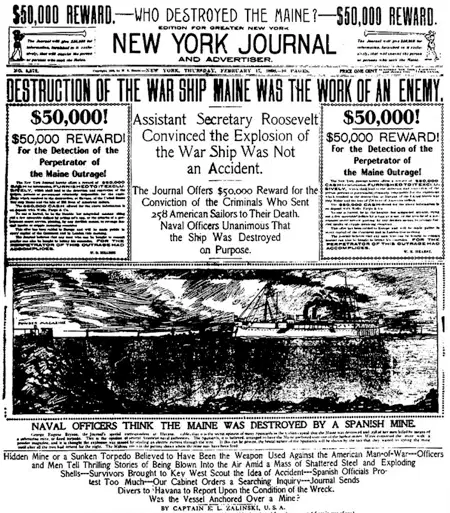
"Destruction of the War Ship Maine Was the Work of an Enemy"; "Assistant Secretary Roosevelt Convinced the Explosion of the War Ship Was Not an Accident"; "Who Destroyed the Maine?"; "Naval Officers Think the Maine Was Destroyed by a Spanish Mine."
These New York Journal headline quotes arguably present a sensationalized picture of events to its readers. Which of the following terms best describes this style of exaggerated writing by the newspaper. (2 points)
Investigative Reporting
Photographic Documentation
Political Cartoon
Yellow Journalism
The "Red Scare" in the United States began in 1919, after communist revolutionaries in Russia overthrew the czarist regime. During the "Palmer Raids," as the government focused on communists, Bolsheviks and "reds," Attorney General Palmer's men smashed union offices and the headquarters' of Communist and Socialist organizations and arrested citizens and foreigners who generally had fewer rights.
These raids were controversial because (2 points)
individual rights were denied; for example people were jailed without counsel and foreign-born radicals deported without trial.
the KKK was involved in helping to stamp out the communist scare.
they revealed evidence of the corruption in American government.
they showed how many radicals were living in America undermining its democratic ideals.

Analyze this political cartoon and identify the United States foreign policy and its purpose characterized in the drawing. (2 points)
The Platt Amendment; this amendment required the new Chinese constitution to include for the United States to control parts of China.
The Roosevelt Corollary; the purpose of this policy was to protect American business interests in China.
The Treaty of Paris; this treaty was created to help create spheres of influence in Europe for the sole purpose of trading.
The Open Door Policy; this policy aimed to help expand trade between the United States and China.
After the fighting ended in World War I, President Wilson advocated for Congress to ratify the Treaty of Versailles. The United States Congress voted against ratifying the treaty because Congress (2 points)
believed the Central Powers and especially Germany were not being punished enough.
wanted to commit to more troops and money for the re-building of Europe.
said the treaty and the League of Nations gave too much power to the United States.
argued signing the treaty would limit its power to make its own decisions under the Constitution.
"Whoever, when the United States is at war, shall wilfully make or convey false reports or false statements with intent to interfere with the operation or success of the military or naval forces of the United States or to promote the success of its enemies and whoever when the United States is at war, shall wilfully cause or attempt to cause insubordination, disloyalty, mutiny, refusal of duty, in the military or naval forces of the United States, or shall wilfully obstruct the recruiting or enlistment service of the United States, to the injury of the service or of the United States, shall be punished by a fine of not more than $10,000 or imprisonment for not more than twenty years, or both." -- Espionage Act of 1917
fear of German airstrikes on the U.S. mainland in the early part of WWI.
concerns over loyalty to the U.S. of immigrants or Americans of enemy ancestry.
fear of the lack of immigration hurting labor for war production and shipments to Europe.
concerns of multi-generational families losing faith in America and defecting to the German army.

