
NEW
Font size
 Worksheets
2025-2026 Semester 1 REVIEW- 8th Grade
Total questions: 20
Worksheet time: 3600secs
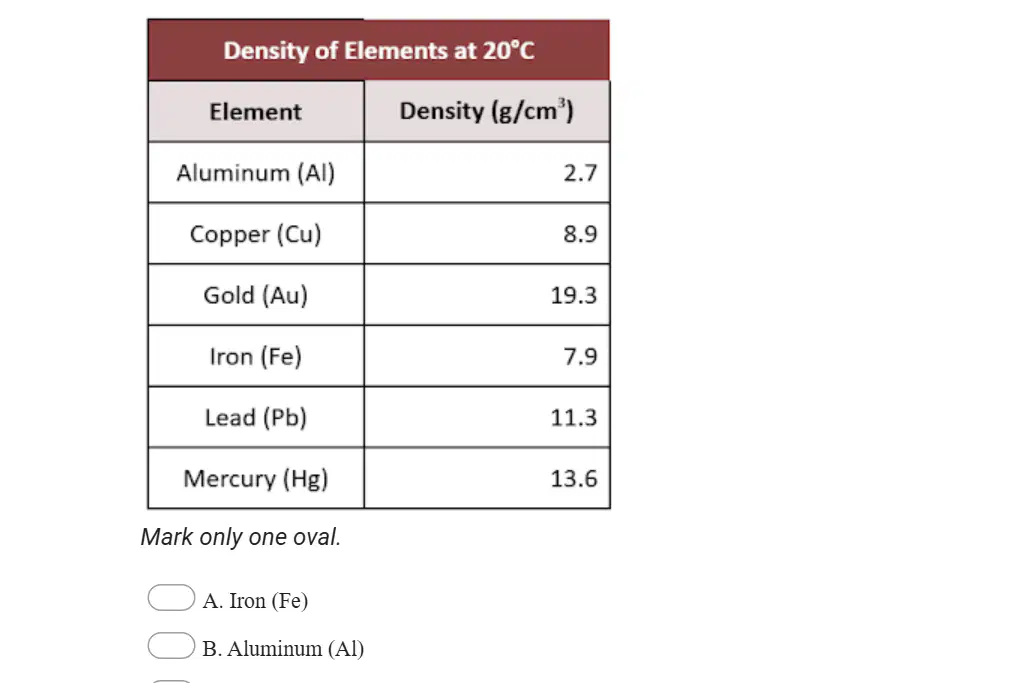
Based on the chart below, which element has particles that are farthest apart at this temperature?
Iron (Fe)
Aluminum (Al)
Gold (Au)
Lead (Pb)
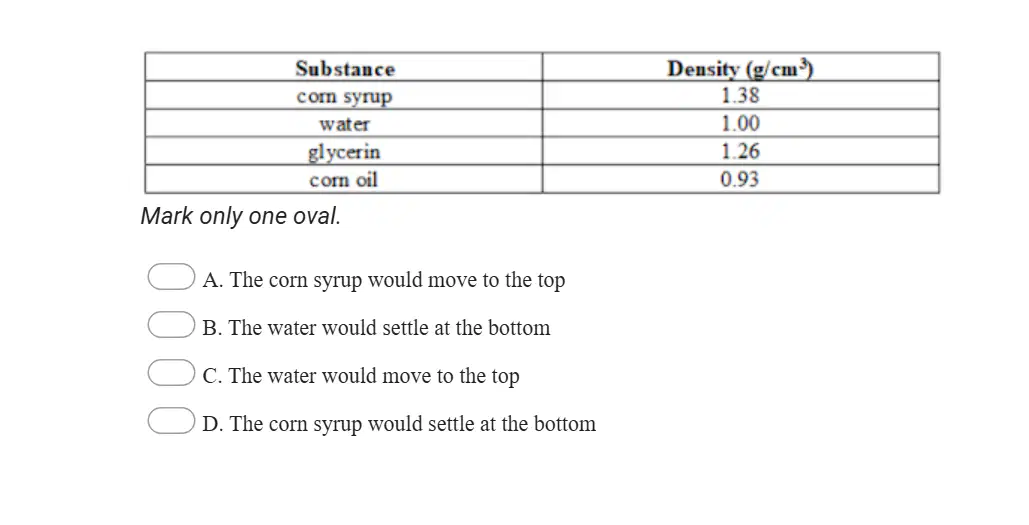
Use the table below to predict what would happen if corn syrup, water, and corn oil were combined in a beaker.
The corn syrup would move to the top
The water would settle at the bottom
The water would move to the top
The corn syrup would settle at the bottom
The density of corn syrup is 1.33 g/mL and the density of vegetable oil is 0.91 g/mL. Which liquid(s) will float on water?
both corn syrup and vegetable oil
corn syrup but not vegetable oil
vegetable oil but not corn syrup
neither vegetable oil nor corn syrup
How are repeated trials different from replication?
Repeated trials must be organized in one data chart. Replication may use several data Charts.
Repeated trials are based on observations. Replication is based on evidence.
The same scientists can do repeated trials. Replication occurs when another scientist repeats the experiment.
Repeated trials require the use of a calculator. Replication requires the use of a computer.
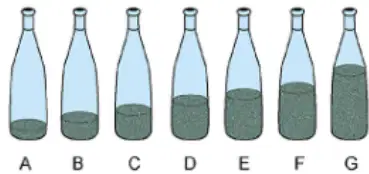
Benny fills seven bottles with different amounts of water (H2O), as shown below. When he taps on the bottles with a spoon, each produces a different pitch. Bottle A, which holds the least amount of water, produces the lowest pitch. Bottle B has a slightly higher pitch, and bottle C has an even higher pitch. The pitch continues to get higher, all the way through bottle G, which holds the most water. Study the picture of the bottles and the description of the experiment above. Which of the following statements about the pitch made by these bottles when tapped with a spoon is TRUE?
A. As the amount of water in the bottle increases, a softer sound is produced.
B. As the amount of water in the bottle increases, a louder sound is produced.
C. As the amount of water in the bottle increases, the pitch lower.
D. As the amount of water in the bottle increases, the pitch higher.
An explanation of the things you observe based on logical reasoning and prior knowledge is called a(n):
prediction.
classification.
observation.
inference.
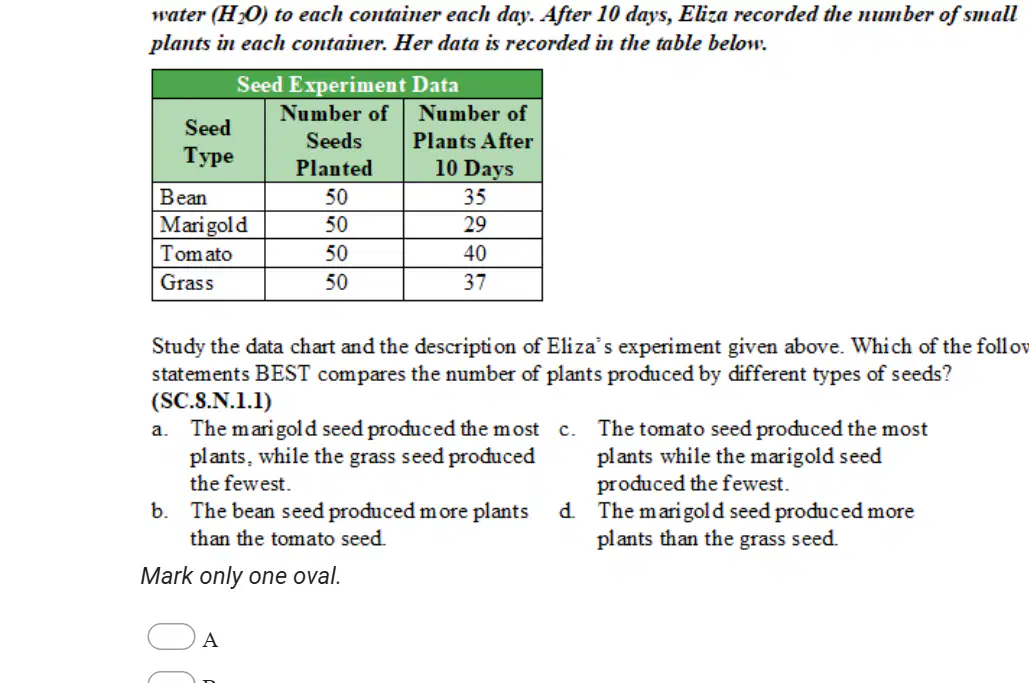
Eliza planted 50 bean seeds, 50 marigold seeds, 50 tomato seeds, and 50 grass seeds in four different containers. She left each container in a warm, sunny spot. She added 100 milliliters of water (H2O) to each container each day. After 10 days, Eliza recorded the number of small plants in each container. Her data is recorded in the table below. Seed Experiment Data Seed Type | Number of Seeds Planted | Number of Plants After 10 Days Bean | 50 | 35 Marigold | 50 | 29 Tomato | 50 | 40 Grass | 50 | 37 Study the data chart and the description of Eliza’s experiment given above. Which of the following statements BEST compares the number of plants produced by different types of seeds?
A. The marigold seed produced the most plants, while the grass seed produced the fewest.
B. The bean seed produced more plants than the tomato seed.
C. The tomato seed produced the most plants while the marigold seed produced the fewest.
D. The marigold seed produced more plants than the grass seed.
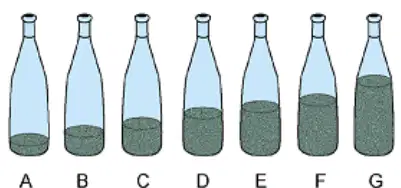
Benny fills seven bottles with different amounts of water (H2O), as shown below. When he taps on the bottles with a spoon, each produces a different pitch. Bottle A, which holds the least amount of water, produces the lowest pitch. Bottle B has a slightly higher pitch, and bottle C has an even higher pitch. The pitch continues to get higher, all the way through bottle G, which holds the most water. Study the picture and the description of the experiment above. Which of the following statements BEST describes Benny’s observations?
The more air inside the bottle, the higher the pitch of sound produced.
The more air inside the bottle, the lower the pitch of sound produced.
Tapping the bottles with a spoon produced sounds of the same pitch in each bottle.
The amount of air and water in the bottle did not affect the pitch of sound produced.
Chris has designed a mini hot air balloon. In order for his hot air balloon to work, he must use a candle to heat up the air trapped under the balloon. When molecules are heated they move faster, take up more space, and their volume increases. How does this enable the hot air balloon to rise?
The thermal energy is converted to kinetic energy which pushes the hot air balloon.
The air outside the balloon increases in density.
The heat pushes on the balloon, causing it to move.
The warm air becomes less dense than the air outside the balloon.
Your teacher gives you a table of substances and their physical properties. She gives you three unknown samples of substances. How could you determine what each substance is? (SC.S.P.8.4)
Burn the substances to see if they are flammable.
Perform experiments to test what each substance reacts with most violently.
Examine and record each substance's color, texture, boiling point, and density.
Leave the substances out on the counter overnight to see if they oxidize rust.
Cailynn wanted to know if adding fertilizer would create taller pepper plants that produced more peppers. She mixed up a solution of fertilizer and water using the amount recommended on the label. She planted the pepper plants in the same size pots with the same amount of potting soil. All of her pepper plants received the same amount of sunlight. The only difference between her two groups of pepper plants was that the one group had fertilizer in the water they were given. She measured the height of each plant every week for 3 months. She also counted the number of peppers each plant produced.
What is the test variable (independent variable) in Cailynn’s experiment? (SC.8.N.1.1)
The number of peppers produced.
The fertilizer.
The amount of sunlight.
The height of the plant.
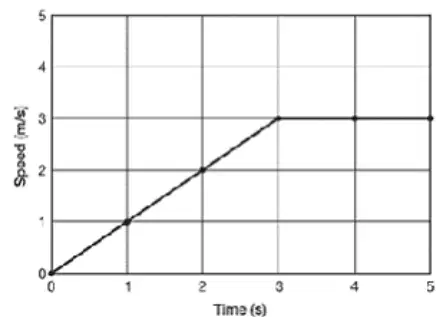
Ashley hypothesizes that the speed of a ball rolling downhill is greater on steep hills than on hills that are not as steep. How can Ashley BEST test her hypothesis?
Push the ball with varying force down inclines set at different angles, and measure the force with which the skateboard hits the wall
Push the ball with varying force down inclines set at different angles, and measure the distance traveled each time
Roll the ball down a single incline, and measure the force with which it hits the wall
Roll the ball down inclines set at different angles, and measure the time it takes to roll the same distance each time
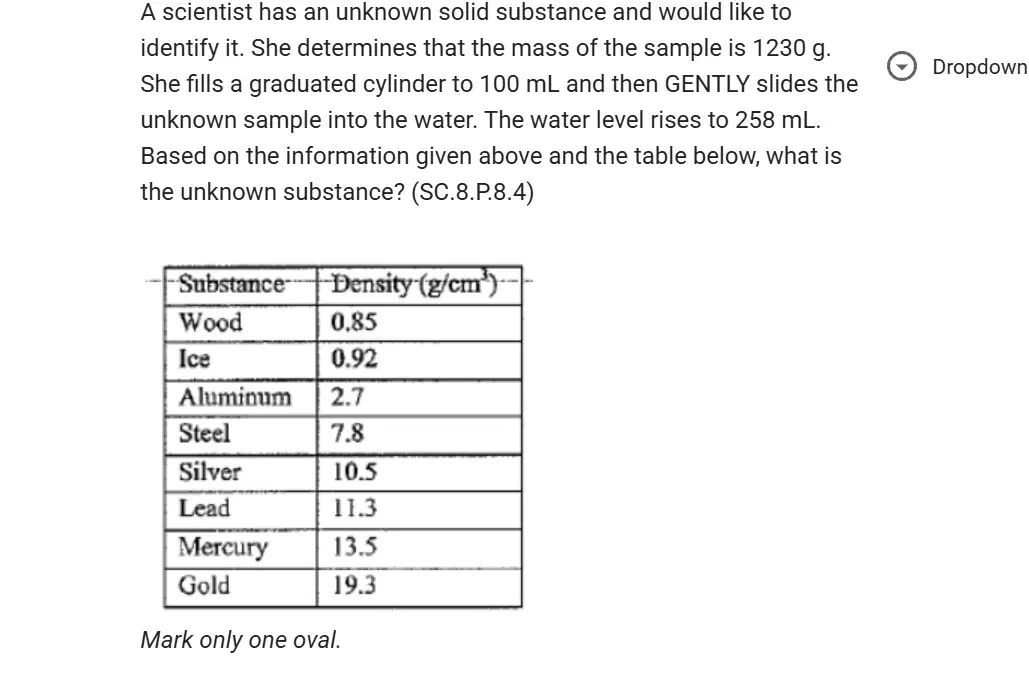
A scientist has an unknown solid substance and would like to identify it. She determines that the mass of the sample is 1230 g. She fills a graduated cylinder to 100 mL and then GENTLY slides the unknown sample into the water. The water level rises to 258 mL. Based on the information given above and the table below, what is the unknown substance?
gold
silver
lead
steel
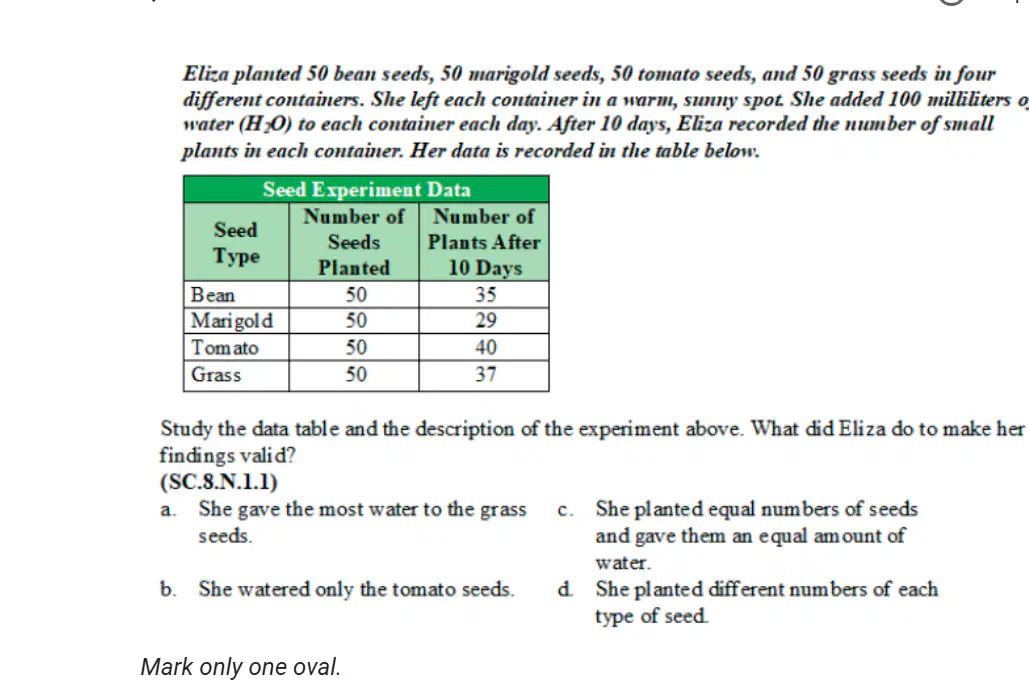
Eliza planted 50 bean seeds, 50 marigold seeds, 50 tomato seeds, and 50 grass seeds in four different containers. She left each container in a warm, sunny spot. She added 100 milliliters of water (H₂O) to each container each day. After 10 days, Eliza recorded the number of small plants in each container. Her data is recorded in the table below. Seed Experiment Data Seed Type | Number of Seeds Planted | Number of Plants After 10 Days Bean | 50 | 35 Marigold | 50 | 29 Tomato | 50 | 40 Grass | 50 | 37 Study the data table and the description of the experiment above. What did Eliza do to make her findings valid?
A. She gave the most water to the grass seeds.
B. She watered only the tomato seeds.
C. She planted equal numbers of seeds and gave them an equal amount of water.
D. She planted different numbers of each type of seed.
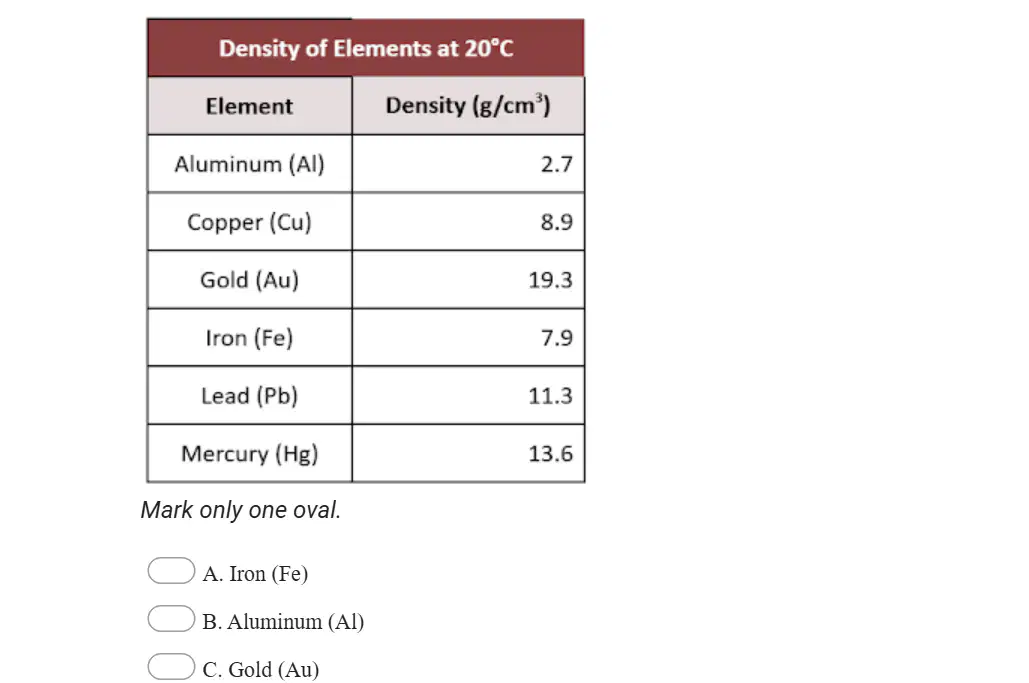
Based on the chart below, which element has particles that are packed most closely together at this temperature?
Iron (Fe)
Aluminum (Al)
Gold (Au)
Lead (Pb)
Why is it useful for scientists to develop models for the structure of atoms?
Atoms are too small to study directly.
Atoms move too quickly to see.
Looking at atoms directly can be harmful.
Atoms are too far away to study.
Chandra hypothesized that the blue winged butterfly likes dark, moist places over sunny, dry environments. She performs an experiment to test her hypothesis where she repeats the experiment three times. None of the results support her hypothesis. What should she do?
Repeat the experiment again
Revise her hypothesis and test the new hypothesis
Use someone else's hypothesis because it is supported by her data
Use another person's data because it fits her hypothesis
Cailynn wanted to know if adding fertilizer would create taller pepper plants that produced more peppers. She mixed up a solution of fertilizer and water using the amount recommended on the label. She planted the pepper plants in the same size pots with the same amount of potting soil. All of her pepper plants received the same amount of sunlight. The only difference between her two groups of pepper plants was that the one group had fertilizer in the water they were given. She measured the height of each plant every week for 3 months. She also counted the number of peppers each plant produced. Study the description of the experiment above. Which group of plants serves as Cailynn's control group?
The group of pepper plants with the fertilizer.
The group of pepper plants without fertilizer.
The amount of sunlight.
The height of the pepper plants.
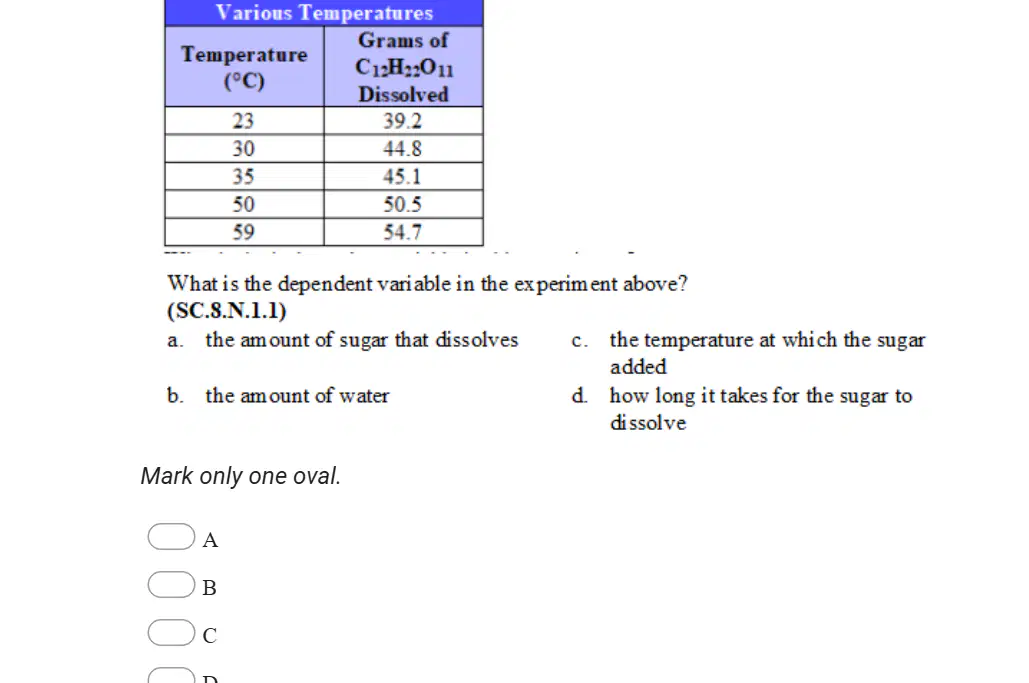
What is the dependent variable in this experiment?
the amount of sugar that dissolves
the amount of water
the temperature at which the sugar is added
how long it takes for the sugar to dissolve
Cailynn wanted to know if adding fertilizer would create taller pepper plants that produced more peppers. She mixed up a solution of fertilizer and water using the amount recommended on the label. She planted the pepper plants in the same size pots with the same amount of potting soil. All of her pepper plants received the same amount of sunlight. The only difference between her two groups of pepper plants was that the one group had fertilizer in the water they were given. She measured the height of each plant every week for 3 months. She also counted the number of peppers each plant produced. What is the outcome variable (dependent variable) in Cailynn’s experiment? (SC.8.N.1.1)
The fertilizer.
The height of the plant.
The amount of sunlight.
The amount of potting soil.

