
 Worksheets
Geometry – Mid-Year Assessment 2024-2025
Total questions: 64
Worksheet time: 35mins
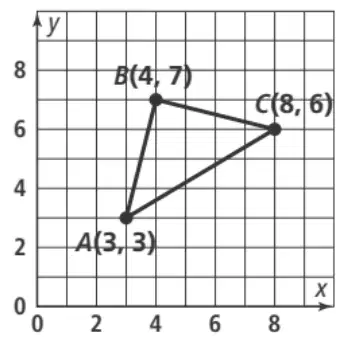
Select all the features of △ABC.
It is a right triangle.
It is isosceles.
It is equilateral.
It is scalene.
It is equiangular.
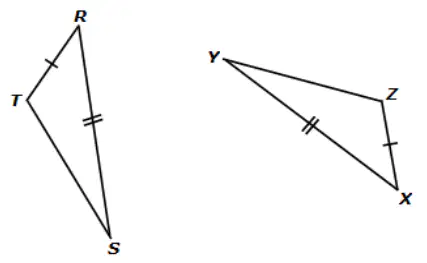
Triangles RST and XYZ are shown below. Emma knows that ∠R ≅ ∠X and ∠T ≅ ∠Z. She claims that triangles RST and XYZ are congruent. As part of her reasoning, which criterion could she use? Select all that apply.
Angle-Angle (AA)
Hypotenuse-Leg (HL)
Side-Angle-Side (SAS)
Angle-Side-Angle (ASA)
Side-Side-Side (SSS)
The vertices of ΔABC are A(7, 3), B(–8, 6), C(0, –5). If ΔABC is transformed following the rule (x, y) → (x – 9, y + 5), what are the coordinates of the vertices of ΔA′B′C′?
A. A′(–2, 8), B′(–17, 11), C′(–9, 0)
B. A′(8, –2), B′(11, –17), C′(0, –9)
C. A′(12, –6), B′(–3, –3), C′(5, –14)
D. A′(16, –2), B′(1, 1), C′(9, –10)
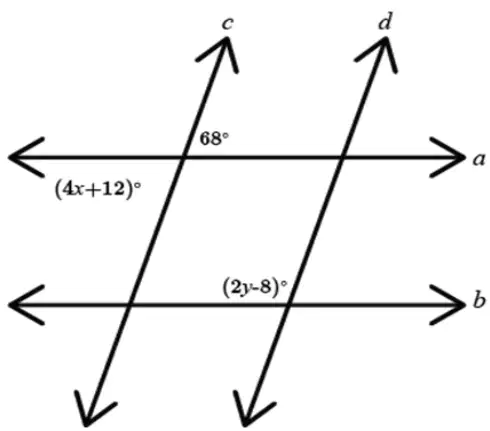
In the figure shown, a ∥ b and c ∥ d. Select the correct values of x and y.
x = 14 and y = 37
x = 14 and y = 60
x = 25 and y = 37
x = 25 and y = 60
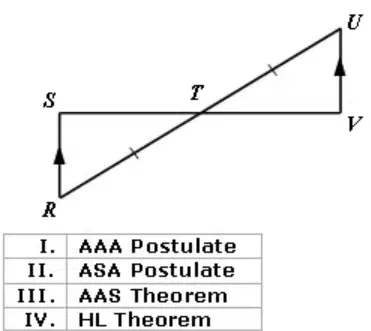
Which postulates or theorems can be used to prove ΔRST ≅ ΔUVT?
I. AAA Postulate
III. AAS Theorem
II. ASA Postulate
A. I and IV
IV. HL Theorem
Sarah is creating a triangular birthday card for her teacher. In order to glue lace around the outside of the card, Sarah needs to know the length of each side. She knows that two of the sides measure 4 inches and 9 inches. If the length of the third side is x inches, which inequality is true?
5 ≤ x ≤ 13
5 < x < 13
2.5 ≤ x < 36
2.5 < x < 36
Read the statement: “If two sides and the included angle of a triangle are congruent to two sides and the included angle of another triangle, then the two triangles are congruent.” Which sentence is the inverse of the statement shown?
If two triangles are congruent, then the two sides and the included angle of a triangle are congruent to two sides and the included angle of another triangle.
If two sides and the included angle of a triangle are congruent to two sides and the included angle of another triangle, then the two triangles are not congruent.
If two sides and the included angle of a triangle are not congruent to two sides and the included angle of another triangle, then the two triangles are not congruent.
If two triangles are not congruent, then the two sides and the included angle of a triangle are not congruent to two sides and the included angle of another triangle.

The points A, B, and C, shown on the number line, have weights 0.5, 0.3, and 0.2 respectively. Which statement is true about the weighted average, w, of the points A, B, and C?
w lies before A.
w lies beyond C.
w lies between A and B.
w lies between B and C.
Read the statement. "If all the angles in a triangle are 60°, then it is an equilateral triangle." Which option shows the correct Inverse, Converse, and Contrapositive of the given statement?
Inverse: If a triangle is not equilateral, then all the angles in the triangle are not 60°. Converse: If all the angles in a triangle are not 60°, then it is not an equilateral triangle. Contrapositive: If a triangle is equilateral, then all the angles in the triangle are 60°.
Inverse: If all the angles in a triangle are not 60°, then it is not an equilateral triangle. Converse: If a triangle is equilateral, then all the angles in the triangle are 60°. Contrapositive: If a triangle is equilateral, then all the angles in the triangle are 60°.
Inverse: If a triangle is not equilateral, then all the angles in the triangle are not 60°. Converse: If all the angles in a triangle are not 60°, then it is not an equilateral triangle. Contrapositive: If a triangle is not equilateral, then all the angles in the triangle are not 60°.
Inverse: If all the angles in a triangle are not 60°, then it is not an equilateral triangle. Converse: If a triangle is equilateral, then all the angles in the triangle are 60°. Contrapositive: If a triangle is not equilateral, then all the angles in the triangle are not 60°.
What is the location of the centroid?
(3, 6)
(4.5, 5.5)
(5, 6)
(5, 7)
If ΔABC, with coordinates A(2, –1), B(4, –1), C(2, –3), is reflected over the line y = x, what are the coordinates of ΔA′B′C′?
A. A′(2, 1), B′(4, 1), C′(2, 3)
B. A′(–1, 2), B′(–1, 4), C′(–3, 2)
C. A′(–2, 1), B′(–4, 1), C′(–2, 3)
D. A′(–2, –1), B′(–4, –1), C′(–2, –3)
A square is plotted on a coordinate plane. Henry claims that any transformation on the square will preserve the length of its sides. Which of the following transformations could be used to show that Henry's claim is incorrect? Select all that apply.
A. translation of 5 units to the right
B. horizontal stretch by a factor of 1/3
C. dilation by a factor of 2 through the origin
D. rotation of 45° clockwise about the square's center
E. a reflection over the x-axis
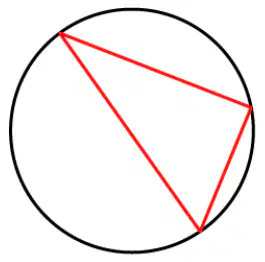
Examine the figure. Select all the statements that are required to construct a circumscribed circle of a triangle.
Construct the incenter.
Construct the circumcenter.
Construct a circle centered at the circumcenter that passes through one of the vertices.
Construct a line perpendicular to one side of the triangle that passes through the incenter.
Connect the incenter with the point of intersection of the triangle and the perpendicular line.
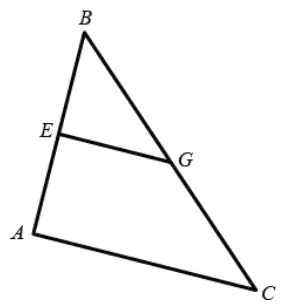
In triangle ABC, E is the midpoint of AB and G is the midpoint of BC. Which of the following are true?
A. AE = EB
B. EG || AC
C. AB ⟂ BC
D. AC = 2EG
E. AC = 1/2 EG
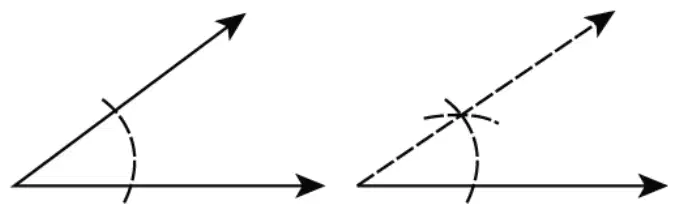
The diagram shows a student's steps in construction. What is the student trying to construct?
The bisector of a given angle
The bisector of a line segment
An angle congruent to a given angle
The perpendicular bisector of a line segment
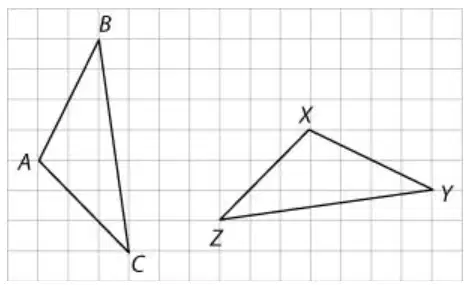
△ABC was transformed to create △XYZ, both shown below. Kelly thinks that the transformation was a rigid motion, but she is not certain. Knowing which of these would allow her to use the SAS congruency postulate to prove that a rigid motion occurred?
AB ≅ XY, BC ≅ YZ, ∠C ≅ ∠Z
∠A ≅ ∠X, ∠B ≅ ∠Y, ∠C ≅ ∠Z
AB ≅ XY, BC ≅ YZ, ∠A ≅ ∠X
AB ≅ XY, AC ≅ XZ, ∠A ≅ ∠X
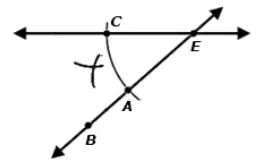
Hector is using a compass and straightedge to construct the bisector of angle CEB. Where did he position the fixed point of the compass when he created the two intersecting arcs on the interior of angle BEC?
Both arcs were drawn with the compass fixed on point E.
The compass was fixed on points A and B.
The compass was fixed on points A and C.
The compass was fixed on points C and E.
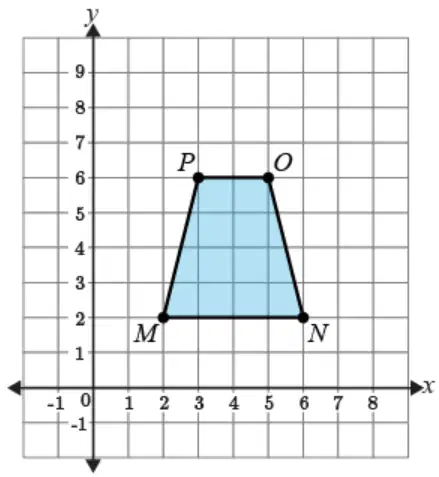
A child walks around a trapezoidal swimming pool as shown in the figure. What is the total distance covered by the child after walking one round around the pool?
A. 2(3 + √15) units
B. 2(6 + √15) units
C. 6 + √17 units
D. 6 + 2√17 units
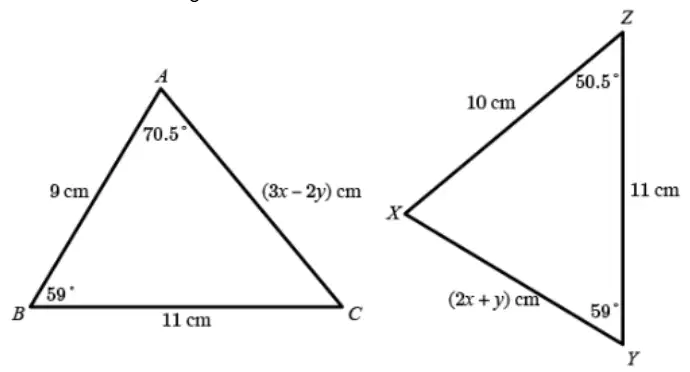
Look at the triangles ABC and XYZ as shown. What are the correct values x and y?
x = 1 and y = 4
x = 4 and y = 1
x = 29/7 and y = 41/9
x = 41/9 and y = 29/7
Which situation would provide a counterexample to the statement below? Alternate interior angles are never supplementary.
A line that is parallel to two parallel lines.
A transversal that forms 45° angle with two parallel lines.
A transversal that is perpendicular to two parallel lines.
A line that has a slope equal to the slopes of two parallel lines.
In an isosceles triangle ABC with AC ≅ AB, if m∠B = 50° then m∠C = 40°. Which statement is true?
The argument is valid because as a counterexample it can be said that the angles opposite to the congruent sides of an isosceles triangle are congruent.
The argument is valid because as a counterexample it can be said that the angles opposite to the congruent sides of an isosceles triangle are complementary.
The argument is invalid because as a counterexample it can be said that the angles opposite to the congruent sides of an isosceles triangle are congruent.
The argument is invalid because as a counterexample it can be said that the angles opposite to the congruent sides of an isosceles triangle are complementary.
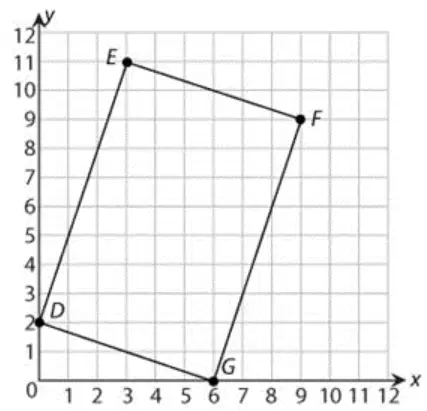
A farmer fences a rectangular field for rabbits as shown in the graph. Each unit of length on the graph represents 10 meters. The farmer wants to provide an area of 20 square meters for each rabbit. Which of these statements are true? Choose all that are correct.
The perimeter of the field is approximately 316 meters.
The area of the field is 5,400 square meters.
The area of the field is 6,000 square meters.
The field will hold a total of 270 rabbits.
The field will hold a total of 300 rabbits.
The description of a transformation on a coordinate plane is shown. A trapezoid is dilated by a scale factor of 1/3 with the origin as the center of dilation. Then, it is reflected across the x-axis. Which statement is true?
Transformation preserves only distance.
Transformation preserves only angle measure.
Transformation preserves neither distance nor angle measure.
Transformation preserves both distance and angle measure.
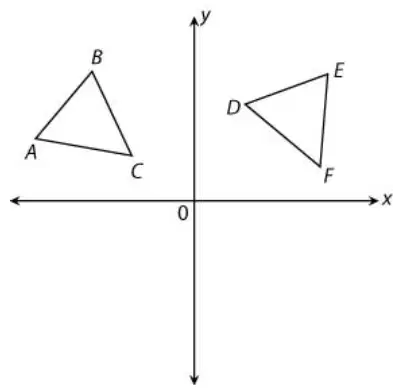
In the figure below, △DEF is the result of rotating △ABC and then reflecting it across the y-axis. If it is known that ∠B ≅ ∠E, what other pieces of information would be needed to show that △ABC ≅ △DEF?
AC ≅ FE and BC ≅ DF
AB ≅ DE and BC ≅ EF
AB ≅ DE and BC ≅ DF
∠B ≅ ∠D and ∠C ≅ ∠F
In which case does the transformation of △QRS result in an image △DEF where ∠LQ ≅ ∠LD, ∠LR ≅ ∠LE, ∠LS ≅ ∠LF, and DEQR=DFQS=EFRS=1 ?
a translation of 6 units to the left and 8.5 units up followed by a reflection over the line y = 2x
a reflection over the line y = -2x followed by a translation of 6.5 units to the right and 3.5 units down
a rotation of 45° clockwise about vertex A followed by a dilation by a scale factor of 0.95 about the origin
a dilation by a scale factor of 1 about the origin followed by a rotation of 45° clockwise about vertex A
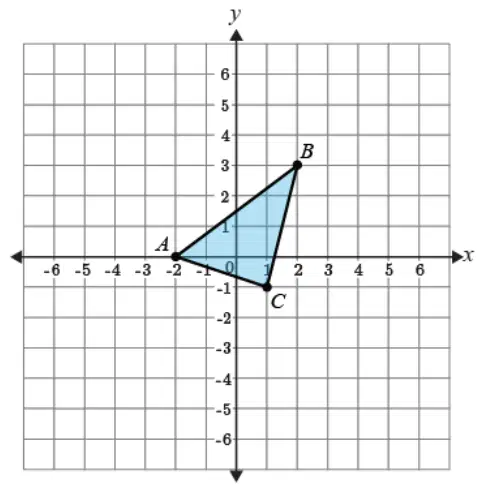
Look at the triangle ABC. If triangle ABC is rotated 90 degrees clockwise about the origin followed by dilation by a factor of 2 about the origin, what will be the resulting coordinates of the vertices of the transformed triangle A'B'C'?
A. A'(0, -4); B'(-6, 4); C'(2, 2)
B. A'(0, 2); B'(3, -2); C'(-1, -1)
C. A'(0, 4); B'(6, -4); C'(-2, -2)
D. A'(0, 4); B'(-4, 6); C'(-2, -2)

In the figure, lines PQ and RS intersect to form four angles. The table shows an incomplete proof that ∠1 ≅ ∠2. Complete the table by filling in the missing reasons for each statement: Statements: 1. m∠1 + m∠3 = 180° m∠2 + m∠3 = 180° 2. m∠1 + m∠3 = m∠2 + m∠3 3. m∠1 = m∠2 4. ∠1 ≅ ∠2 Reasons: 1. ________ 2. Substitution property 3. ________ 4. ________
1. Linear Pair Postulate 3. Subtraction Property 4. Definition of Congruence
1. Vertical Angles Theorem 3. Addition Property 4. Reflexive Property
1. Corresponding Angles Postulate 3. Division Property 4. Symmetric Property
1. Alternate Interior Angles Theorem 3. Multiplication Property 4. Transitive Property
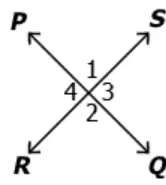
In the figure, lines PQ and RS intersect to form four angles. Which of the following correctly completes the proof that ∠1 ≅ ∠2?
A. Reason 1: Angle Addition Postulate Statement 2: m∠1 + m∠2 = m∠3 + m∠2 Reason 3: Definition of Vertical Angles Reason 4: Definition of Congruence
B. Reason 1: Angle Addition Postulate Statement 2: m∠1 + m∠3 = m∠2 + m∠3 Reason 3: Subtraction Property Reason 4: Definition of Congruence
C. Reason 1: Linear Pair Postulate Statement 2: m∠1 + m∠2 = m∠3 + m∠2 Reason 3: Definition of Vertical Angles Reason 4: Definition of Congruence
D. Reason 1: Linear Pair Postulate Statement 2: m∠1 + m∠3 = m∠2 + m∠3 Reason 3: Subtraction Property Reason 4: Definition of Congruence
A triangle PQR has vertices P(−1, 3), Q(9, −1) and R(−3, −2). Identify the type of triangle and select the correct statement.
△PQR is an equilateral triangle.
△PQR is an isosceles triangle.
△PQR is a right triangle.
△PQR is a right isosceles triangle.
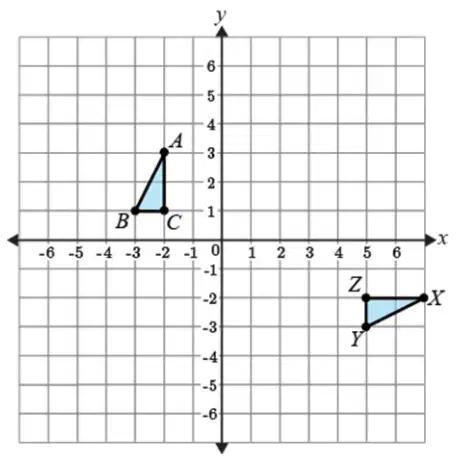
Look at the two triangles, ABC and XYZ. If triangles ABC and XYZ are congruent, which sequence of transformations maps the triangle ABC onto triangle XYZ?
Clockwise rotation of 180° about the origin and then the translation of 3 units to the right.
Counterclockwise rotation of 180° about the origin and then the translation of 6 units to the right.
Clockwise rotation of 90° about the origin and then reflection across the x-axis followed by the translation of 4 units to the right.
Counterclockwise rotation of 90° about the origin and then reflection across the y-axis followed by the translation of 5 units to the right.
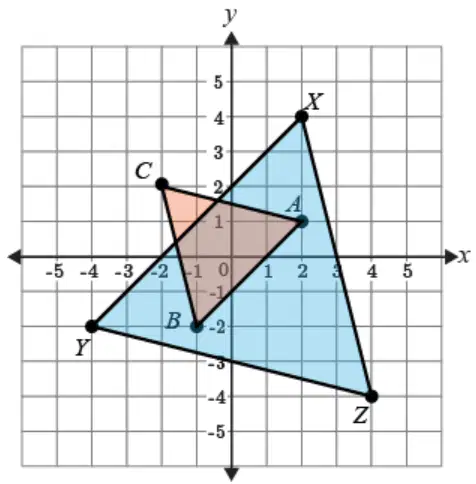
Look at the two triangles, ABC and XYZ. If triangles ABC and XYZ are similar, select two sequences of transformations that map the triangle ABC onto triangle XYZ.
Rotation of 90° clockwise about the origin, followed by reflection across the x-axis, and then dilation by a scale factor of 2 with origin as the center of dilation
Rotation of 90° counterclockwise about the origin, followed by reflection across the y-axis, and then dilation by a scale factor of 1/2 with origin as the center of dilation
Reflection in the line y = -x, followed by dilation by a scale factor of 2 with origin as the center of dilation
Reflection in the line y = x, followed by dilation by a scale factor of 2 with origin as the center of dilation
Reflection in the line y = x, followed by dilation by a scale factor of 1/2 with origin as the center of dilation
ΔQRS and ΔXYZ are two right triangles. The hypotenuse of each triangle is 10 cm long; m∠R = 55° and m∠Y = 35°. Which of the following best describes the two triangles?
They are similar and congruent.
They are similar but not congruent.
They are congruent but not similar.
They are neither similar nor congruent.
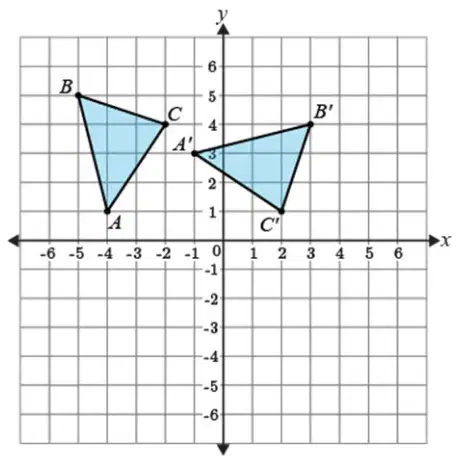
Look at the two triangles, ABC and A'B'C'. If triangles ABC and A'B'C' are congruent, which sequence of transformations maps the triangle A'B'C' onto triangle ABC?
Reflection across the y-axis followed by the translation of 3 units to the right and 1 unit downwards.
Clockwise rotation of 90° about the origin and then the translation of 2 units to the right and 1 unit downwards.
Counterclockwise rotation of 270° about the origin and then the translation of 2 units to the left and 1 unit downwards.
Rotation of 180° in either direction about the origin followed by the reflection across the x-axis and then the translation of 3 units to the left.
Point B is located on line segment AC. Point A is located at (−3, 6) and point B is located at (n, q) and point C is located at (−3, −4). The ratio of AB : AC is 2/5. What are the values of n and q?
n = −3 and q = 0
n = 0 and q = −3
n = −3 and q = 2
n = 2 and q = −3
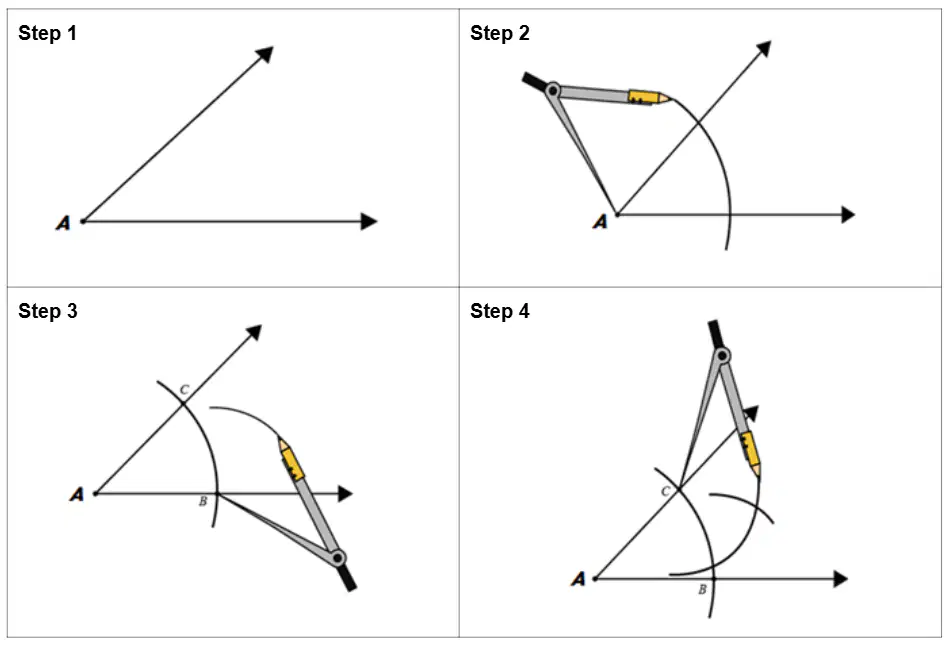
What is being constructed here?
Right triangle
Copy of a line segment
The angle bisector of an angle
The perpendicular bisector of a line segment
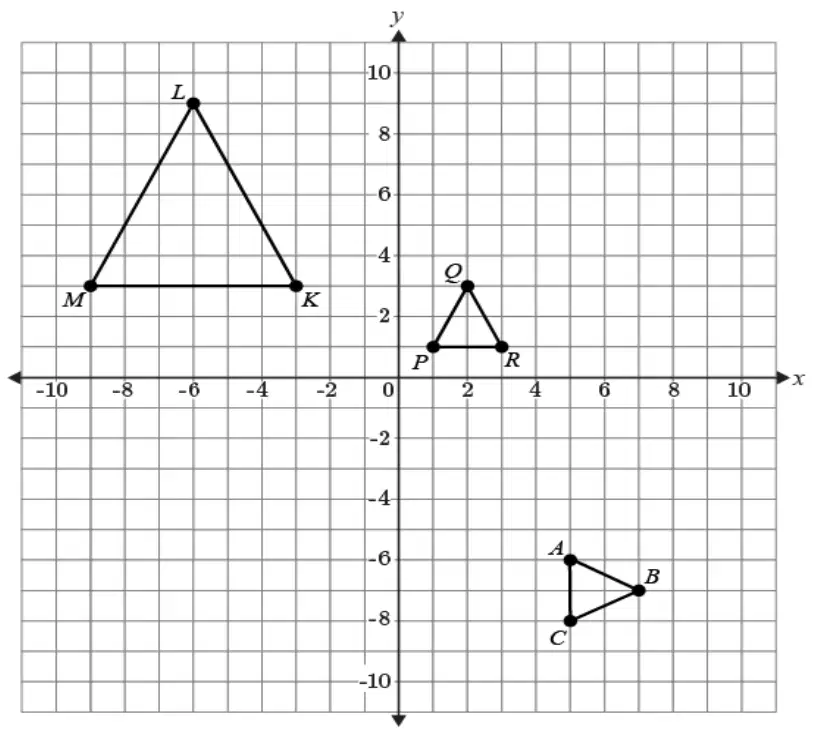
The graph shows the triangles, ABC, PQR, and KLM. Select all statements that explain why triangle PQR is similar to the other triangle.
Triangle PQR can be mapped onto triangle KLM on dilation by a scale factor of 3 centered at (0, 0) followed by a reflection over the y-axis.
Triangle PQR can be mapped onto triangle KLM on dilation by a scale factor of 3 centered at (0, 0) followed by 90° clockwise rotation about (0, 0).
Triangle PQR can be mapped onto triangle ABC by 90° clockwise rotation about (0, 0) followed by translation 4 units to the right and 5 units down.
Triangle PQR can be mapped onto triangle KLM on dilation by a scale factor of 3 centered at (0, 0) followed by 90° counterclockwise rotation about (0, 0).
Triangle PQR can be mapped onto triangle ABC by 90° counterclockwise rotation about (0, 0) followed by translation 4 units to the right and 5 units down.
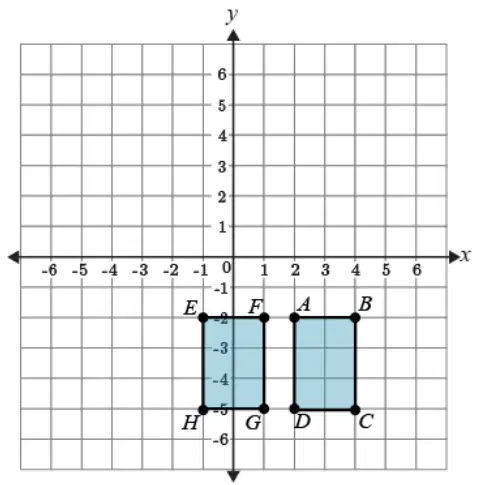
Look at the rectangles, ABCD and EFGH. Which sequence of transformations can prove that the rectangles are congruent?
Reflect across y = -x, translate 3 units downward, rotate by 180° about the origin, reflect across y = x
Reflect across y = x, translate 3 units downward, rotate by 180° about the origin, reflect across y = -x
Reflect across y = -x, translate 3 units upward, rotate by 180° about the origin, reflect across y = x
Reflect across y = x, translate 3 units upward, rotate by 180° about the origin, reflect across y = -x
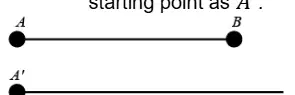
A student is constructing a copy of a line segment. Their incomplete work is shown. Step 1: A line segment AB is given. Step 2: Use a straight edge to draw a reference line that is longer than the line segment AB. Name the starting point as A'. Which is the next step?
Use a straight edge to connect point A to point A' by drawing a line.
Use a straight edge to connect point B to point B' by drawing a line.
Use a compass to draw a curve from point A' on the reference line passing through point B.
Use a compass to measure the length of line segment AB by extending it and putting its two ends at points A and B.
Which situation would provide a counterexample to the statement below? You can connect any three points to form a triangle.
Three coplanar points.
Three collinear points.
Two points on AB and one point not on AB.
Two points not on AB and one point on AB.
Read the statement. "If three sides of one triangle are congruent to three sides of another triangle, then the two triangles are congruent." Which statement is the contrapositive of the statement shown?
If two triangles are congruent, then three sides of one triangle are congruent to the three sides of another triangle.
If two triangles are not congruent, then the three sides of one triangle are not congruent to the three sides of another triangle.
If three sides of one triangle are congruent to the three sides of another triangle, then the two triangles are not congruent.
If three sides of one triangle are not congruent to the three sides of another triangle, then the two triangles are not congruent.
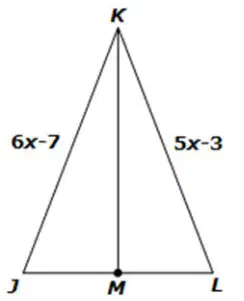
Examine the following figure. If JL = 16, KM = 4x - 1, and KM is the perpendicular bisector of JL, determine which of the following values are correct. Select all that apply.
A. x = 3
E. KM = 15
C. JM = 8
B. x = 4
F. KL = 17

The points A, B, and C are shown on a number line. Their weights are 0.2, 0.3, and 0.5 respectively. What is the weighted average of points A, B, and C?
1.7
5.5
5.7
6.4
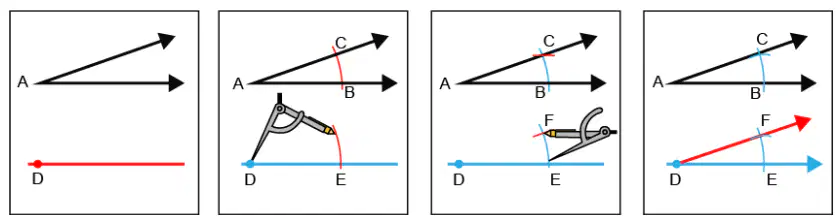
The image shows the construction of an angle congruent to a given angle. A student writes down the steps of the construction as shown. Which step written by the student is incorrect?
Step 1
Step 2
Step 3
Step 4
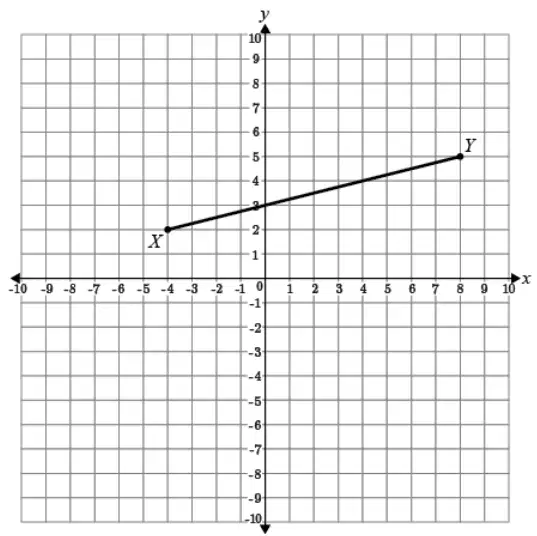
Point M divides the line segment XY such that XM/MY = 2/3. What is the location of point M?
(4/5, 16/5)
(16/5, 19/5)
(−4/5, 16/5)
(−16/5, 19/5)
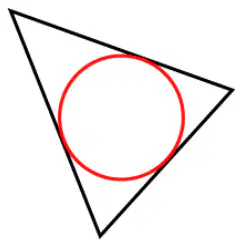
Examine the figure. Select all the statements that are required to construct an inscribed circle of a triangle.
Construct the incenter.
Construct the circumcenter.
Construct a circle centered at the circumcenter that passes through one of the vertices.
Construct a line perpendicular to one side of the triangle that passes through the incenter.
Identify the point of intersection of the side and the perpendicular that passes through the incenter.
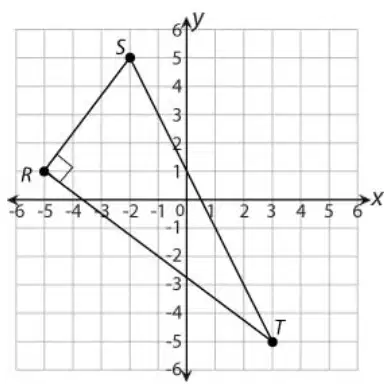
Look at the right triangle below. What is its area?
25 square units
26 square units
40 square units
50 square units
Given points D, E, and F on a number line with weights 0.4, 0.4, and 0.2 respectively, which statement is true about the weighted average, w, of the points D, E, and F?
w lies beyond F.
w lies before D.
w lies between E and F.
w lies between D and E.
Look at the triangle below. If its base is 8 units and its height is 7 units, what is its area?
35 square units
28 square units
56 square units
15 square units
Which situation would provide a counterexample to the statement below? All right triangles are isosceles.
A triangle with three different side lengths and no right angle.
A triangle with all sides equal.
A triangle with angles 90°, 60°, and 30°.
A triangle with two equal sides and a right angle.
The vertices of ΔDEF are D(5, –2), E(–3, 4), F(1, 0). If ΔDEF is translated by the rule (x, y) → (x + 2, y – 3), what are the coordinates of the vertices of ΔD′E′F′?
D′(3, 1), E′(–5, 7), F′(–1, 3)
D′(7, 1), E′(–1, 7), F′(3, 3)
D′(7, –5), E′(–1, 1), F′(3, –3)
D′(3, –5), E′(–5, 1), F′(–1, –3)
A rectangle is dilated by a scale factor of 2 with the origin as the center of dilation, then reflected across the y-axis. Which property is preserved by this sequence of transformations?
Neither distance nor angle measure is preserved.
Only angle measure is preserved.
Only distance is preserved.
Both distance and angle measure are preserved.


Which of the following statements is the contrapositive of: "If two triangles have two sides and the included angle congruent, then the triangles are congruent"?
If two triangles are congruent, then two sides and the included angle are congruent.
If two sides and the included angle are not congruent, then the triangles are not congruent.
If two triangles are not congruent, then two sides and the included angle are not congruent.
If two sides and the included angle are congruent, then the triangles are not congruent.
A triangle is reflected across the y-axis and then dilated by a scale factor of 2 with the origin as the center of dilation. Which property is preserved under these transformations?
Neither distance nor angle measure is preserved.
Both distance and angle measure are preserved.
Only distance is preserved.
Only angle measure is preserved.
Given the vertices of a triangle at (2, 4), (6, 2), and (4, 8), what are the coordinates of the centroid?
(4, 6)
(5, 5)
(4, 4.67)
(3, 7)
Triangle DEF has vertices at D(1, 2), E(5, 2), and F(1, -2). If triangle DEF is reflected over the y-axis, what are the coordinates of D′, E′, and F′?
A. D′(−1, 2), E′(−5, 2), F′(−1, −2)
D. D′(1, −2), E′(5, −2), F′(1, 2)
B. D′(2, 1), E′(2, 5), F′(−2, 1)
C. D′(−2, 1), E′(−2, 5), F′(−2, −1)
Which sequence of transformations will map triangle PQR onto triangle P′Q′R′ if both are congruent and PQR is first rotated 180° about the origin and then translated 4 units up?
Reflect across the y-axis, then translate 4 units down.
Rotate 180° about the origin, then translate 4 units up.
Reflect across the x-axis, then translate 4 units right.
Rotate 90° clockwise about the origin, then translate 4 units left.
Given triangle GHI with vertices G(0, 0), H(6, 0), and I(0, 8), what is the type of triangle GHI and which statement is correct?
△GHI is an equilateral triangle.
△GHI is an isosceles triangle.
△GHI is a right triangle.
△GHI is a scalene triangle.


What additional information do you need to prove ΔADE≅ΔCBE by ASA?
AE≅EC
∠A≅∠C
∠B≅∠D
AD≅BC

Which transformation would result in triangle MNO being similar but not congruent to triangle PQR, where ∠M ≅ ∠P, ∠N ≅ ∠Q, ∠O ≅ ∠R, and the side lengths of △PQR are twice those of △MNO?
A translation followed by a reflection over the y-axis
A rotation of 90° about the origin followed by a dilation with scale factor 2
A dilation with scale factor 1 followed by a rotation of 180°
A reflection over the x-axis followed by a translation of 5 units up
Which of the following is the contrapositive of the statement: “If two triangles have two sides and the included angle congruent, then the triangles are congruent”?
If two triangles do not have two sides and the included angle congruent, then they are not congruent.
If two triangles are congruent, then they have two sides and the included angle congruent.
If two triangles are not congruent, then they do not have two sides and the included angle congruent.
If two triangles are not congruent, then they have two sides and the included angle congruent.

