wayground logo

Free Printable Worksheets

Font size

S
M
L
XL
Worksheets

Semester 1 Exam PRACTICE TEST

Total questions: 103

Worksheet time: 5hrs 15mins
Name
Class
Date
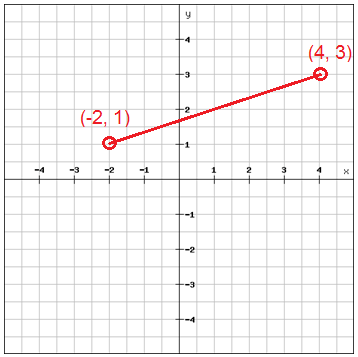
1.
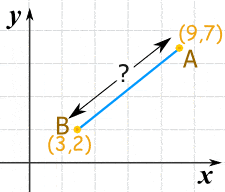
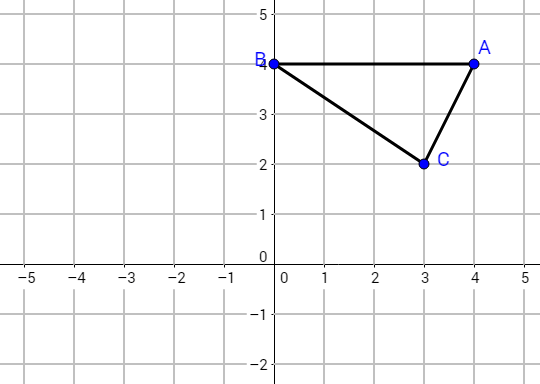
What is the distance between the two points?
a)
6.3
b)
6.5
c)
6.7
d)
16
2.
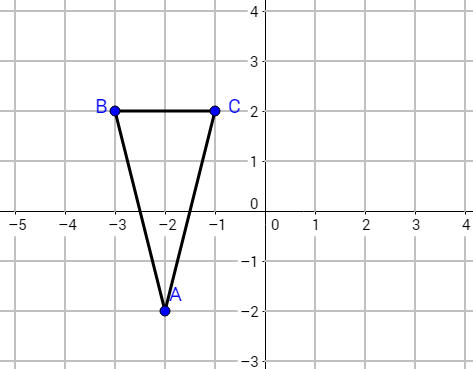
Find the distance.
a)
7.1
b)
7.8
c)
8.7
d)
8.9
3.

Find the midpoint of the line segment with the given endpoints.

(0, 2), (-2, -8)

a)

(1, 5)

b)

(-4, -18)

c)

(-1, -3)

d)

(1, -5)

4.

Find the midpoint of the line segment with the given endpoints.

(0, -3), (-2, -4)

a)

(-1.5, -3)

b)

(1, 0.5)

c)

(-1, -3.5)

d)

(-4, -5)

5.
a)

acute

b)

obtuse

c)

right

6.
a)

acute

b)

obtuse

c)

right

7.
a)

acute

b)

obtuse

c)

right

8.
a)

equilateral

b)

isosceles

c)

scalene

9.
a)

equilateral

b)

isosceles

c)

scalene

10.
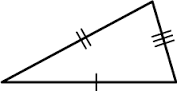
Name this triangle
a)
Acute, Scalene
b)
Obtuse, Scalene
c)
Right, Isosceles
d)
Acute, Equilateral
11.
What is an "Acute" Angle?
a)
Angle that measures 180
b)
An Angle that measures 90
c)
An angle that measures more than 90
d)
An angle that measures less than 90
12.
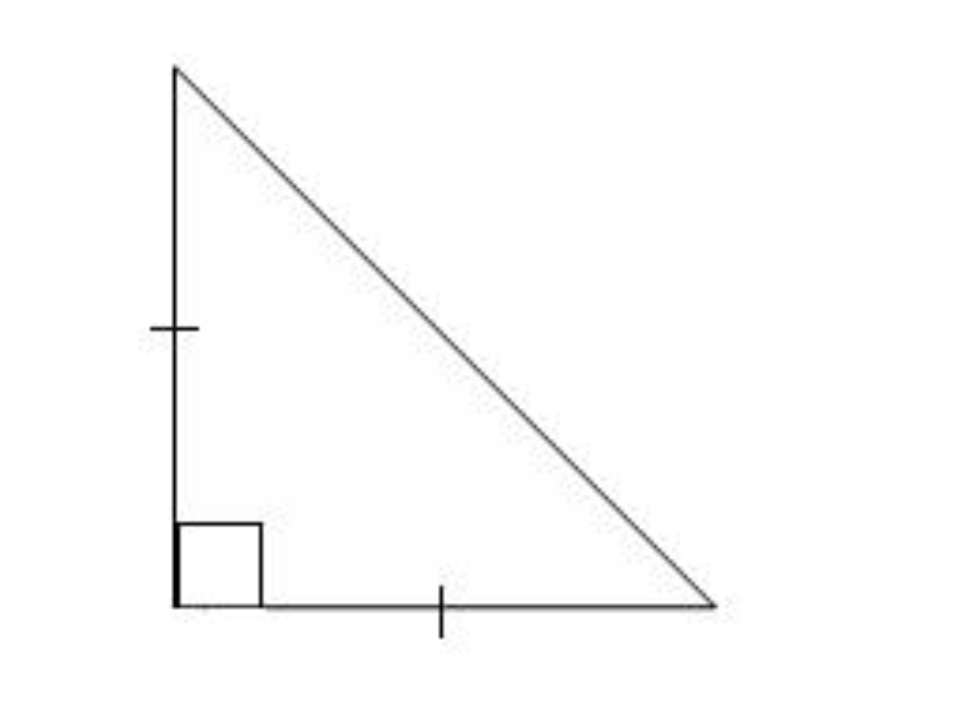
Which type of triangle is pictured?
a)
Equilateral Triangle
b)
Right Isosceles Triangle
c)
Obtuse Scalene Triangle
d)
Obtuse Equilateral Triangle
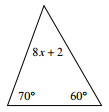
13.
What is the value of x?
a)
15
b)
16
c)
18
d)
19
14.
What is the value of x?
a)
9
b)
5
c)
13
d)
12
15.
What equation would you use to find the value of x?
a)
2x-6=7x+4
b)
2x-6+7x+4=90
c)
2x-6+7x+4=180
d)
2x-6+7x+4=360
16.
Find what the value of x.
a)
118
b)
108
c)
28
d)
58
17.
Tell whether the angles are complementary or supplementary. Then find the value of x.
a)
Complementary; x=25
b)
Complementary; x=5
c)
Supplementary; x=25
d)
Supplementary; x=5
18.
Solve for x
a)
6
b)
140
c)
20
d)
90
19.
What is the value of "a"?
a)
75°
b)
65°
c)
55°
d)
85°
20.
What is the measure of ∠ABC?
a)
25°
b)
75°
c)
108°
d)
150°
21.

Identify the relationship:

a)

vertical

b)

supplementary

22.
Find x if the angles are complementary.
a)
15
b)
75
c)
25
d)
90
23.

What is the value of "a"?

a)

82

b)

62

c)

72

d)

92

24.

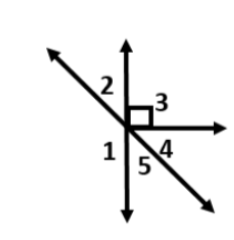
What angle is vertical to angle 2?

a)

∠4

b)

∠1

c)

∠2

d)

∠5

25.
Identify the property of equality.
If 9=x, then x=9
a)
Reflexive
b)
Symmetric
c)
Transitive
d)
Substitution
26.
What is Addition property of equality
a)
a.   If a=b, then a+c=b+c
b)
b.  If a=b, then a-c=b-c
c)
c.  If a=b, then ac=bc
d)
d.  If a=b, then a/c=b/c
27.
Identify the property used here:
39=39
a)
Reflexive
b)
Symmetric
c)
Transitive
d)
Substitution
28.
Simplify the expression with the distributive property
6(x + 3)
a)
6x + 3
b)
6x + 18
c)
x + 3
d)
9x
29.
What is always the 1st statement in reason column of a proof?
a)
Prove
b)
Given
c)
Reason
d)
Statement
30.
Step 2 is what
a)
Substitution property (simplify)
b)
Multiplication property of equality
c)
Division property of equality
d)
Distributive Property
31.
What is step 4
a)
Substitution property (simplify)
b)
Addition property of equality
c)
Subtraction property of equality
32.
What is step 6
a)
Subtraction property of equality
b)
Addition property of equality
c)
Division property of equality
33.
Step 1 is what
a)
addition property of equality
b)
given
c)
subtraction property of equality
d)
prove
34.
What is the Transitive property?
a)
If a=b, then  a can be substituted for b in any equation or expression
b)
a(b+c)=ab+ac
c)
If a=b, and b=c, then a=c
d)
 If a=b, then b=a
35.

Which of the following is true about the conditional statement below?

If a man is 7 feet tall, then he plays basketball.

a)

Hypothesis: a man is 7 feet tall

Conclusion: he plays basketball

b)

Hypothesis: IF a man is 7 feet tall

Conclusion: THEN he plays basketball

c)

Hypothesis: THEN he plays basketball

Conclusion: IF a man is 7 feet tall

d)

Hypothesis: he plays basketball

Conclusion: a man is 7 feet tall

36.

Which of the following is true about the conditional statement below?

If you are in Alaska, then you are

cold.

a)

Hypothesis: you are in Alaska

Conclusion: you are

cold

b)

Hypothesis: IF you are in Alaska

Conclusion: THEN you are

cold

c)

Hypothesis: THEN you are

cold

Conclusion: IF you are in Alaska

d)

Hypothesis: you are

cold

Conclusion: you are in Alaska

37.

Which of the following is the CONVERSE of the statement below?

If an object is a ring, then it is

made of gold.

a)

If an object is made of gold, then it is a ring.

b)

If an object is not a ring, then it is not made of god.

c)

If an object is not made of gold, then it is not a ring.

d)

There is no converse of the statement.

38.

What types of angles are ∠1 and ∠4?

a)

Alternate Interior Angles

b)

Alternate Exterior Angles

c)

Corresponding Angles

d)

Vertical angles

39.

What types of angles are ∠1 and ∠3?

a)

Alternate Interior Angles

b)

Corresponding Angles

c)

Linear Pair

d)

Vertical angles

40.

What types of angles are ∠1 and ∠5?

a)

Alternate Interior Angles

b)

Corresponding Angles

c)

Linear Pair

d)

Vertical angles

41.

What types of angles are ∠1 and ∠8?

a)

Alternate Interior Angles

b)

Alternate Exterior Angles

c)

Corresponding Angles

d)

Vertical angles

42.

What types of angles are ∠4 and ∠5?

a)

Alternate Interior Angles

b)

Alternate Exterior Angles

c)

Corresponding Angles

d)

Vertical angles

43.

What types of angles are ∠3 and ∠5?

a)

Alternate Interior Angles

b)

Same-Side Interior Angles

c)

Corresponding Angles

d)

Vertical angles

44.

What types of angles are ∠2 and ∠8?

a)

Same-Side Exterior Angles

b)

Same-Side Interior Angles

c)

Alternate Exterior Angles

d)

Vertical angles

45.

Which of the following types of angles are congruent? (Select ALL the answers that apply.)

a)

Corresponding Angles

b)

Alternate Exterior Angles

c)

Linear Pair

d)

Vertical Angles

46.

Are the slopes below parallel, perpendicular, or intersecting?
 Line A: 4Line\ A:\ 4  

 Line B: 4Line\ B:\ 4  

a)

Parallel

b)

Perpendicular

c)

Intersecting

47.

Are the slopes below parallel, perpendicular, or intersecting?
 Line A: 211Line\ A:\ \frac{2}{11}  

 Line B: 112Line\ B:\ -\frac{11}{2}  

a)

Parallel

b)

Perpendicular

c)

Intersecting

48.

Are the slopes below parallel, perpendicular, or intersecting?
 Line A: 2Line\ A:\ -2  

 Line B: 12Line\ B:\ \frac{1}{2}  

a)

Parallel

b)

Perpendicular

c)

Intersecting

49.

Are the slopes below parallel, perpendicular, or intersecting?
 Line A: 85Line\ A:\ -\frac{8}{5}  

 Line B: 85Line\ B:\ -\frac{8}{5}  

a)

Parallel

b)

Perpendicular

c)

Intersecting

50.
Parallel lines have __________ slopes
a)
Equal
b)
Opposite
c)
Reciprocal 
d)
Total
51.

What does the "m" represent in y=mx+by=mx+b  

a)

y-intercept

b)

measurement

c)

slope

d)

nothing

52.

What does the "b" represent in y=mx+by=mx+b  

a)

y-intercept

b)

nothing

c)

slope

d)

base

53.
Slopes of perpendicular lines are...
a)
opposite reciprocals.
b)
opposites.
c)
identical.
d)
always 7.
54.
y = 5/7x +2
y = 5/7x - 30
These lines are...
a)
Parallel
b)
Perpendicular
c)
Neither
55.
y = 6x + 2
y = -6x + 2
These lines are...
a)
Parallel
b)
Perpendicular
c)
Neither
56.
y = -2/3x + 2
y = 3/2x + 9
These lines are...
a)
Parallel
b)
Perpendicular
c)
Neither
57.

Which of the following lines is PARALLEL to the graph of y = -6x + 3 and goes through the point (-1,4)?

a)

y=1/6x +25/6

b)

y = 1/6x + 4

c)

y = -6x - 2

d)

y = -6x + 4

58.

Which of the following represents the equation of the line passing through (-4, 5) PERPENDICULAR to the line y = -1/2x + 5/2?

a)

y = 2x + 13

b)

y = 2x + 5

c)

y = -1/2x + 3

d)

y = -1/4x + 11/2

59.

Name the transformation.

a)

Translation

b)

Reflection

c)

Rotation

60.

Name the transformation.

a)

Translation

b)

Reflection

c)

Rotation

61.

Name the transformation.

a)

Translation

b)

Reflection

c)

Rotation

62.
Reflect Point C over the y-axis:
a)
(-3, 2)
b)
(3,2)
c)
(-2,3)
d)
(3,0)
63.
Reflect over x-axis. Which point would be at (3, -6)
a)
A
b)
B
c)
C
d)
H
64.
State the line of reflection.
a)
Reflection across y-axis
b)
Reflection across x-axis
c)
Reflection across x = 1
d)
Reflection across y = 1
65.
Determine where X' would be if you translated X 3 units to the left and 9 units down.
a)
(-4, 4)
b)
(-10, 2)
c)
(-4, -5)
d)
(-1, 5)
66.
What is the angle of rotation for this counterclockwise rotation about the origin?
a)
90°
b)
180°
c)
270°
d)
360°
67.
If you were to rotate ABCD 180°  about the origin, what would the coordinate of A' be?
a)
(-5, 5)
b)
(-3, -5)
c)
(-5, 3)
d)
(-3, 3)
68.
If you were to rotate ABCD 90° counterclockwise about the origin, what would the coordinate of A' be?
a)
(-5, 5)
b)
(-3, 5)
c)
(-5, 3)
d)
(-3, 3)
69.
If you were to rotate ABCD 180° about the origin, what would the coordinates of B' be?
a)
(0, 0)
b)
(-6, -5)
c)
(-1, 3)
d)
(-6, 2)
70.
Rotate the point (-3,-4) around the origin 180 degrees. State the image of the point.
a)
(-4,-3)
b)
(-4,3)
c)
(4,-3)
d)
(3,4)
71.

When you rotate 180 degrees the ( x , y ) becomes ?

a)

( y , x )

b)

( -y , x )

c)

( -x , y )

d)

( -x , -y )

72.
Reflecting over the y-axis changes the ____-_____________. 
a)
x-axis
b)
x-coordinate
c)
y-coordinate
d)
none of the above
73.

When you rotate 90 degrees the ( x , y ) becomes ?

a)

( y , x )

b)

( -y , x )

c)

( -x , y )

d)

( -x , -y )

74.

Write the rule for this translation:

Slide 5 up and 7 right

a)

(x, y)---->(x + 5, y + 7)

b)

(x, y)-----> (x + 7, y + 5)

c)

(x, y)----> (x - 7, y - 5)

d)

(x, y)----> (7x, 5y)

75.

Which rule describes rotating 180° clockwise?

a)

( x, y ) → ( y, -x )

b)

( x, y ) → ( -x, -y )

c)

( x, y) → ( -y, -x )

d)

( x, y ) → ( -y, x )

76.

Point W(3, -4) is rotated 90°90\degree  clockwise. Where is W'?

a)

(-4, -3)

b)

(4, 3)

c)

(-3, -4)

d)

(-4, 3)

77.
Dilate Point B by a scale factor of 3:
a)
(12,0)
b)
(12,12)
c)
(4,3)
d)
(0,12)
78.
Dilate Point B by a scale factor of 1/2
a)
(1.5,-4)
b)
(-1.5,1)
c)
(-1,-1.5)
d)
(-2,-2)
79.
Identify the smallest angle of rotation that maps the image to itself.
a)
180°
b)
360°
c)
90°
d)
No rotational symmetry
80.

Determine if the figure has line, point, and/or rotational symmetry. Check all that apply.

a)

Line

b)

Point

c)

Rotational

d)

None

81.

Determine if the figure has line, point, and/or rotational symmetry. Check all that apply.

a)

Line

b)

Point

c)

Rotational

d)

None

82.

Determine if the figure has line, point, and/or rotational symmetry. Check all that apply.

a)

Line

b)

Point

c)

Rotational

d)

None

83.

The Triangle Sum Theorem states that the sum of all angles in a triangle is (a)  

84.

Find the measure of the indicated angle.

(a)  

85.

Find the value of k.

(a)  

86.

Solve for x.

(a)  

87.
Which of the following terms best describes Angle d?
a)
Remote interior angle
b)
Corresponding angle
c)
Exterior angle
d)
Interior angle
88.

Which equation would solve for x?

a)

x + 51 + 47 = 180

b)

x = 51 - 47

c)

x = 51 + 47

d)

x + 57 + 47 = 18

89.

Solve for x.

(a)  

90.
Solve for x.
a)
16
b)
11
c)
50
d)
6
91.
Solve for x.
a)
6
b)
-10
c)
7
d)
-9
92.
Solve for x.
a)
6
b)
5
c)
-11
d)
4
93.

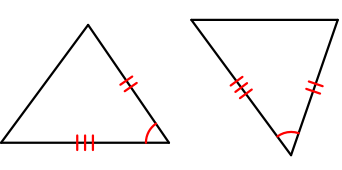
Can the triangles be proven congruent and if so by what postulate?

a)

SSS

b)

AAS

c)

ASA

d)

HL

e)

Can't be proven congruent

94.

Which triangle congruence postulate is illustrated?

a)

SSS

b)

SAS

c)

ASA

d)

AAS

e)

Not a postulate

95.

Which triangle congruence postulate is illustrated?

a)

SSS

b)

SAS

c)

ASA

d)

AAS

e)

Not a postulate

96.

Which triangle congruence postulate is illustrated?

a)

SSS

b)

SAS

c)

ASA

d)

AAS

e)

Not a postulate

97.

Can the triangles be proven congruent and if so by what postulate?

a)

SSS

b)

SAS

c)

ASA

d)

HL

e)

Can't be proven congruent

98.

Which triangle congruence postulate is illustrated?

a)

SSS

b)

SAS

c)

ASA

d)

AAS

e)

Not a postulate

99.

Which triangle congruence postulate is illustrated?

a)

SSS

b)

SAS

c)

ASA

d)

AAS

e)

Not a postulate

100.

Which triangle congruence postulate is illustrated?

a)

SSS

b)

SAS

c)

ASA

d)

AAS

e)

Not a postulate

101.

Which triangle congruence postulate is illustrated?

a)

SSS

b)

SAS

c)

ASA

d)

AAS

e)

Not a postulate

102.

Which triangle congruence postulate is illustrated?

a)

SSS

b)

SAS

c)

ASA

d)

AAS

e)

Not a postulate

103.
Which triangle congruence theorem can be used to prove the triangles are congruent?
a)
HL
b)
SSA
c)
SAS
d)
AAS