
 Worksheets
Aerobic Adaptations and Interval Training Quiz
Total questions: 77
Worksheet time: 39mins
Which of the following is NOT a direct aerobic adaptation resulting from interval training?
Increase in VO₂max
Decrease in mitochondrial density
Reduction in arterial-venous O₂ difference
Decrease in intramuscular glycogen stores
After aerobic training, muscle cells show a 50-100% increase in mitochondrial density and protein. Which of the following is NOT indicated by this adaptation?
They have reduced ability to store fat.
They have improved capacity for aerobic metabolism.
They have decreased resistance to fatigue.
They have increased fiber size.
During exercise, aerobic adaptations lead to which change in substrate use?
Increase in carbohydrate use and decrease in fat oxidation
Decrease in carbohydrate use and increase in fat oxidation
No change in substrate use
Decrease in both carbohydrate and fat oxidation
Which of the following is typically NOT altered by aerobic adaptations from interval training?
Neural recruitment patterns
Acid-base balance
Fiber size
Intramuscular glycogen stores
Interval training can lead to which of the following changes in muscle fibers?
Decrease in area of type 1 fibers CSA by 50%
Potential increase in area of type 1 fibers CSA by as much as 20%
No change in type 1 fibers CSA
Increase in area of type 2 fibers CSA by 20%
Which of the following best explains how aerobic adaptations improve fatigue resistance in muscles, based on physiological changes?
By decreasing fiber size and reducing fat oxidation, muscles tire more quickly.
By increasing VO₂max, Qmax, arterial-venous O₂ difference, mitochondrial density, and intramuscular glycogen and fat stores, muscles can produce more energy aerobically and delay fatigue.
By reducing acid-base balance and lowering mitochondrial protein, muscles become less efficient.
By increasing carbohydrate use and decreasing neural recruitment, muscles lose endurance.
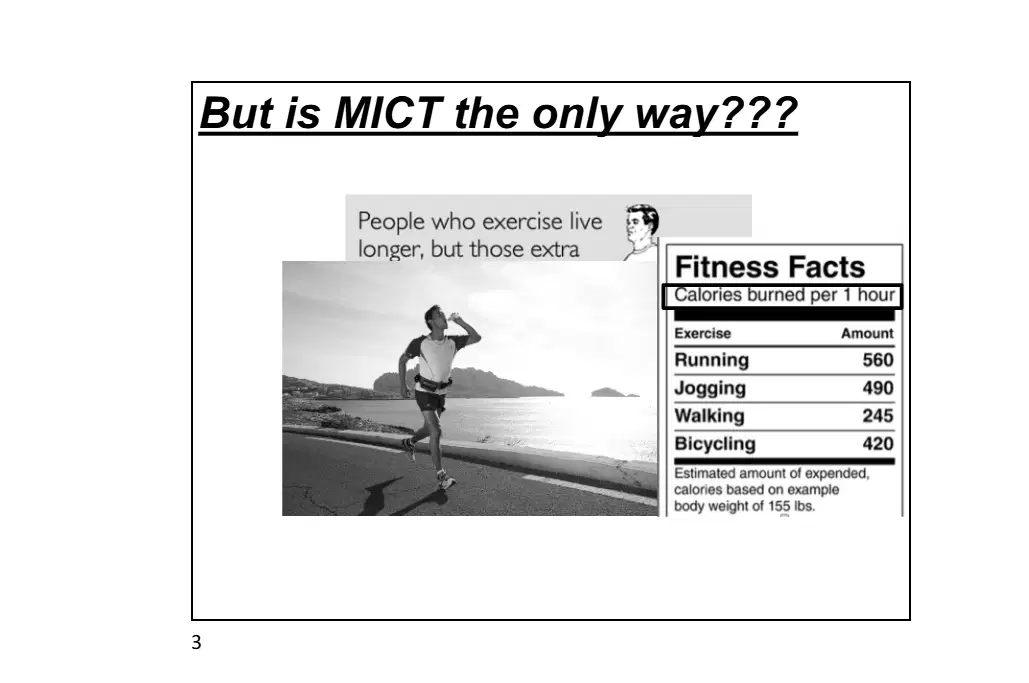
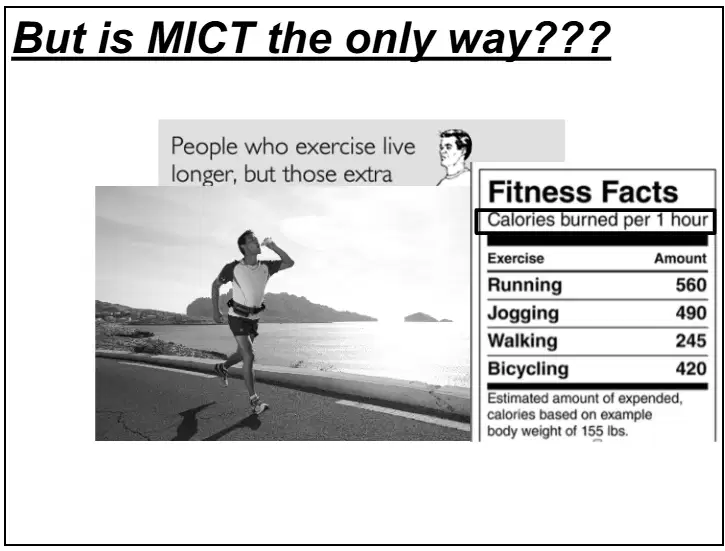
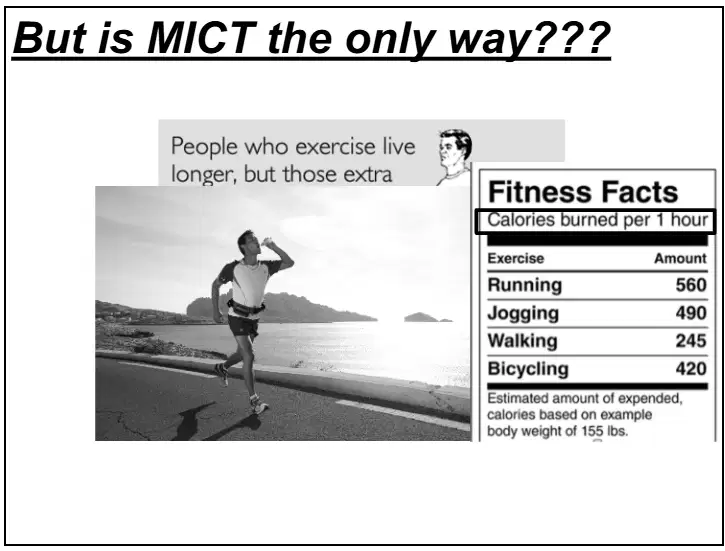
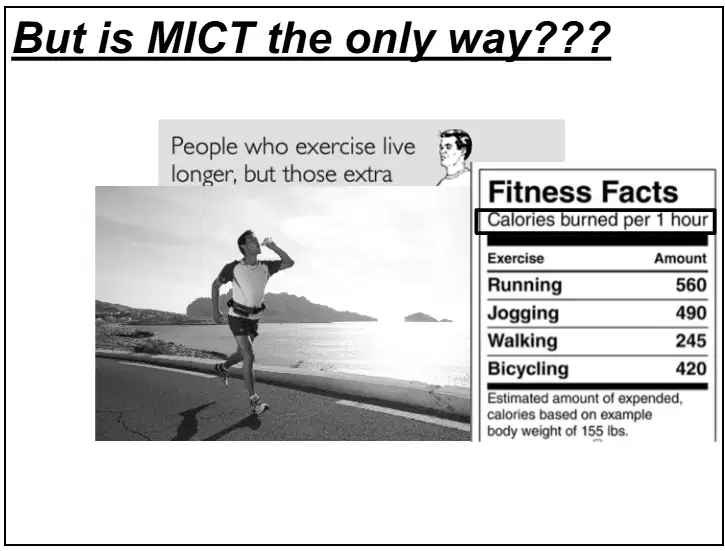
According to the provided Fitness Facts, which of the following exercises burns the most calories per hour?
Jogging
Walking
Bicycling
Running
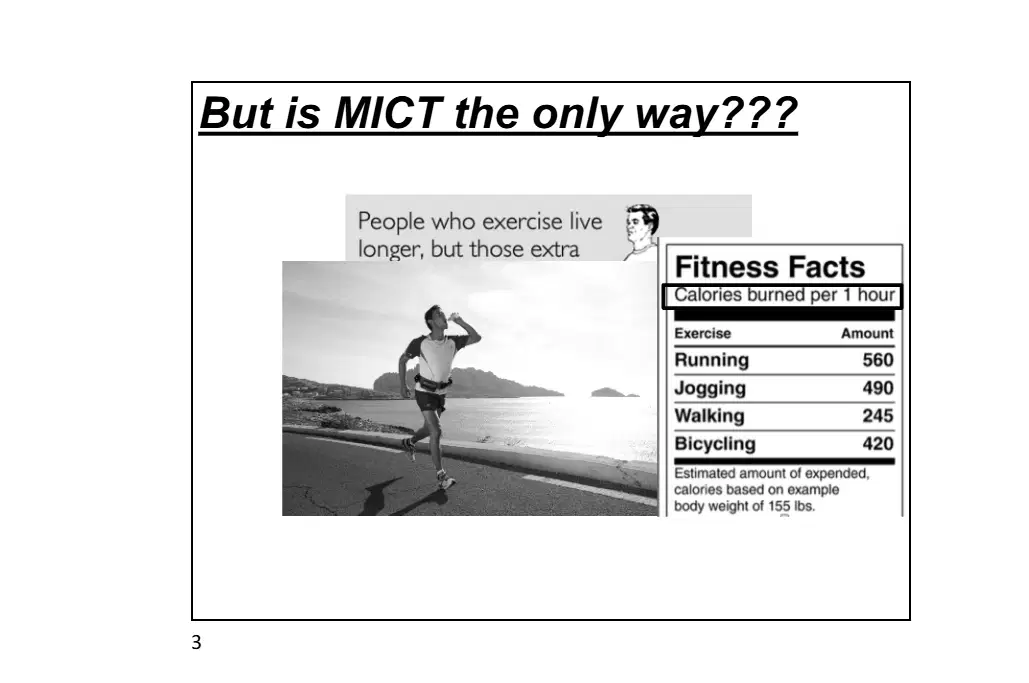
For a person weighing 155 lbs, which activity burns approximately 245 calories per hour?
Running
Jogging
Walking
Bicycling
Which aerobic enzyme shows the greatest increase in activity in aerobically trained individuals compared to untrained individuals?
MDH
SDH
CPT
PFK
Which of the following enzymes shows a significantly higher activity in anaerobically trained individuals compared to untrained individuals, based on the data?
Myokinase
GP
LDH
Creatine Kinase
Explain how aerobic and anaerobic training affect enzyme activities differently, using the data provided in the table.
Both aerobic and anaerobic training decrease all enzyme activities.
Aerobic training increases aerobic enzyme activities more than anaerobic training, while anaerobic training increases certain anaerobic enzyme activities.
Anaerobic training only affects aerobic enzymes.
Aerobic training has no effect on enzyme activities.
Which of the following best describes the basic concept of interval training?
Exercising at a constant moderate pace for a long duration
Alternating periods of relatively intense exercise with periods of lower-intensity effort or complete recovery
Only performing high-intensity exercise without rest
Exercising without any structured plan or intervals
What does HIIT stand for in the context of fitness training?
High-Intensity Internal Therapy
Heavy Interval Intensity Training
High-Intensity Interval Training
High-Impact Interval Training
Which of the following is an example of a HIIT protocol mentioned in the material?
Running at a steady pace for 30 minutes
Tabata (20 sec on, 10 sec off, ~8 repeats)
Yoga for 60 minutes
Walking for 10 minutes without stopping
According to the material, what is a key feature of High-intensity Interval Training (HIIT)?
Long periods of continuous exercise without rest
Brief bouts of exercise separated with short recovery periods
Only low-intensity exercise with long recovery periods
Exercise performed only once a week
Based on the information provided, why might HIIT be considered beneficial compared to longer, moderate exercise sessions?
It eliminates the need for any warm-up
It can be as beneficial as longer sessions in less time
It requires no recovery periods
It is only suitable for professional athletes
Which of the following is NOT a characteristic of interval training as described in the material?
Continuous, unbroken exercise at one intensity
Alternating intense and less intense periods
Complete recovery between intervals
Variation in protocols
Which organization published the Top 10 Fitness Trends for 2018 and 2019 as shown in the material?
WHO (World Health Organization)
CDC (Centers for Disease Control and Prevention)
ACSM (American College of Sports Medicine)
FDA (Food and Drug Administration)
What does SIT stand for in the context of exercise training?
Strength Intensive Training
Sprint Interval Training
Speed Improvement Technique
Standard Interval Training
Which of the following best describes the effort level required in Sprint Interval Training (SIT)?
Moderate continuous efforts
All-out or supramaximal efforts
Low-intensity steady-state efforts
Submaximal aerobic efforts
According to the material, how long is each effort in a typical SIT session?
2 minutes
10 seconds
1 minute
30 seconds
Which of the following is not a recommended rest period between efforts in a SIT session?
4 minutes
1 minute
30 seconds
10 minutes
Which activities are commonly used in Sprint Interval Training (SIT)?
Swimming or Rowing
Cycling (Wingate) or Running (sprints)
Yoga or Pilates
Weightlifting or Gymnastics
Based on the classification provided, SIT falls under which type of interval?
Submaximal interval
Low-intensity interval
Near-maximal to maximal interval
Continuous interval
Why might Sprint Interval Training (SIT) be considered different from other interval training methods? Use evidence from the material to support your answer.
Because it uses only low-intensity exercise
Because it involves all-out or supramaximal efforts and short bursts with long rest periods
Because it focuses on flexibility and balance
Because it is performed only in water
Which of the following training methods is abbreviated as SIT?
Strength Interval Training
Sprint Interval Training
Speed Intensity Training
Steady-state Interval Training
In exercise physiology, which of the following is defined as VO2max?
Maximum heart rate
Maximum oxygen uptake
Maximum power output
Maximum speed
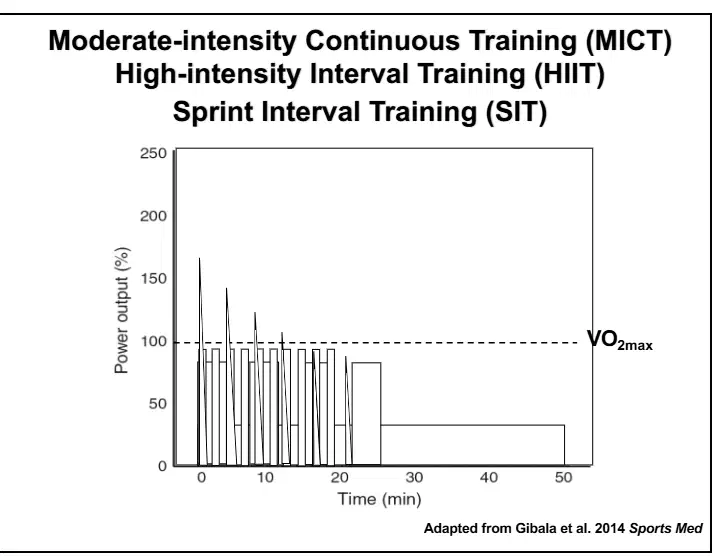
Which training method, according to the graph, involves higher power output intervals: Sprint Interval Training (SIT) or Moderate-intensity Continuous Training (MICT)?
MICT involves higher power output intervals than SIT
SIT involves higher power output intervals than MICT
Both SIT and MICT have the same power output
SIT involves lower power output intervals than MICT
According to MacDougall et al. 1998, which of the following is NOT the approximate percentage increase in VO2max after SIT?
15-20%
5-10%
20-25%
1-2%
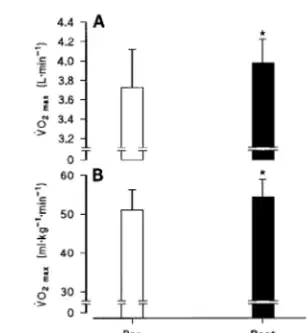
Using the data from MacDougall et al. 1998, how would you respond to a student who claims that Sprint Interval Training (SIT) does not lead to aerobic adaptations?
SIT only increases muscle size, not VO2max
SIT increases VO2max, indicating aerobic adaptations
SIT decreases VO2max, showing it is not aerobic
SIT has no effect on aerobic capacity
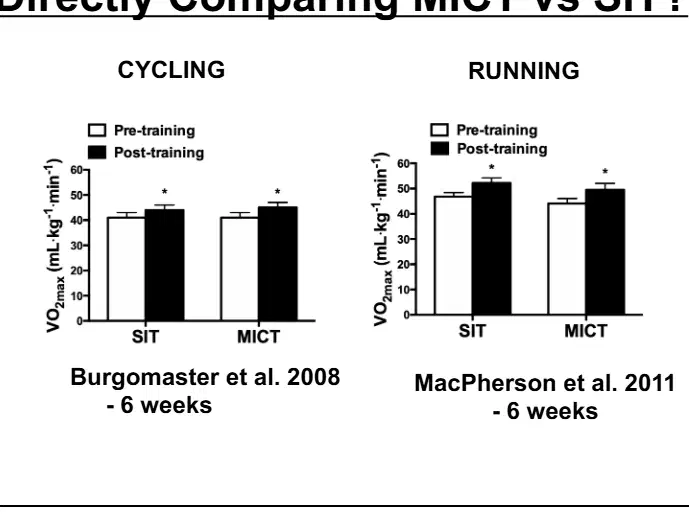
Which of the following best describes the main difference between SIT and MICT as shown in the studies by Burgomaster et al. (2008) and MacPherson et al. (2011)?
SIT involves longer duration and lower intensity compared to MICT.
MICT and SIT have the same duration and intensity.
SIT is performed at a lower intensity than MICT.
MICT involves longer duration and lower intensity compared to SIT.
According to the summary table, which group has an approximate weekly training time of ~1 hour?
SIT
Group B
Group C
Group D
Which protocol is used by the SIT group in the comparison table?
40-60 min cycling, 5 times per week
30 seconds x 4-6 repeats, 4.5 min rest, 3 times per week
20 min running, 2 times per week
10 min walking, 7 times per week
Based on the data, which statement best describes the training time required per week for MICT compared to HIIT (SIT)?
MICT requires significantly more training time per week than HIIT.
MICT requires the same training time as HIIT.
MICT requires less training time than HIIT.
MICT is less effective due to more training time.
If a student wants to maximize VO2max improvements but has limited time, which training protocol would be least suitable based on the information provided?
SIT (Sprint Interval Training)
MICT (Moderate-Intensity Continuous Training)
No training at all
Only low-intensity walking
Compare the weekly energy expenditure between the SIT and ET groups based on their training volumes. Which statement is most accurate?
SIT group expends more energy weekly than ET group.
Both groups expend the same amount of energy weekly.
SIT group does not expend any energy.
ET group expends much more energy weekly than SIT group.
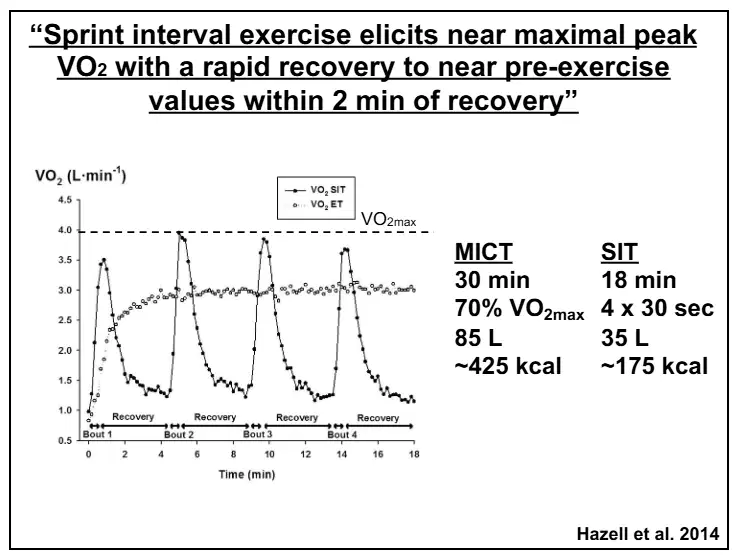
Near maximal peak VO₂ with a rapid recovery to near pre-exercise values within 2 minutes of recovery is most commonly observed after which type of exercise?
Moderate intensity continuous training
Sprint interval exercise
Resistance training
Flexibility training
Which of the following best describes the duration and intensity of MICT (Moderate Intensity Continuous Training) as per the material?
18 min, 90% VO₂max
30 min, 70% VO₂max
45 min, 60% VO₂max
20 min, 80% VO₂max
Which of the following is NOT the amount of oxygen consumed during SIT (Sprint Interval Training) according to the material?
85 L
35 L
50 L
100 L
According to Hazell et al. 2014, which of the following is NOT the approximate caloric expenditure for SIT?
~425 kcal
~175 kcal
~300 kcal
~600 kcal
How much total exercise time is required for SIT compared to MICT, based on the studies cited?
SIT: 13.5 h, MICT: < 1 h
SIT: 6 h, MICT: 3 h
SIT: 10 h, MICT: 5 h
SIT: 20 h, MICT: 2 h
According to MacPherson et al. 2011 and Hazell et al. 2014, which of the following is not a training method shown to improve aerobic performance in women without maximal cardiac output?
Resistance training
Sprint interval training
Flexibility training
Balance training
Which exercise protocol, according to the information given, leads to a higher overall oxygen consumption?
SIT
Both are equal
MICT
Neither
Which protocol should a student avoid if they want to achieve similar aerobic improvements with less total exercise time?
SIT
MICT
Resistance training
Flexibility training
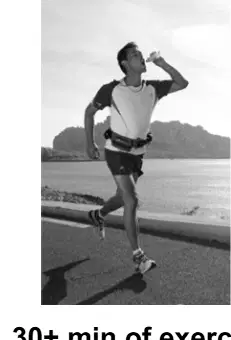
According to the material, which of the following is described as a session that lasts for 30 or more minutes?
Continuous endurance exercise (MICT)
Sprint-interval training (SIT)
Yoga session
Weightlifting session
According to Hazell et al. 2012, which of the following represents the difference in oxygen consumption (VO₂) over 24 hours between MICT and SIT?
5 L
50 L
40 L
25 L
According to the material, what does SIT increase?
Post-exercise metabolism
Pre-exercise metabolism
Resting heart rate
Muscle mass
Which exercise type does not result in a greater difference in energy expenditure (EE kcal) over 24 hours compared to the other?
SIT
MICT
Both are equal
Neither
If a student wants to achieve similar 24-hour oxygen consumption with less exercise time, which method should they consider?
18 minutes of sprint-interval training (SIT)
30 minutes of continuous endurance exercise (MICT)
60 minutes of yoga
45 minutes of weightlifting
Using the evidence provided, explain why SIT might be considered efficient for increasing post-exercise metabolism compared to MICT.
SIT burns more calories during exercise than MICT.
SIT is less intense than MICT.
SIT requires less time and increases post-exercise metabolism, leading to similar 24-hour oxygen consumption as MICT.
SIT does not affect metabolism.
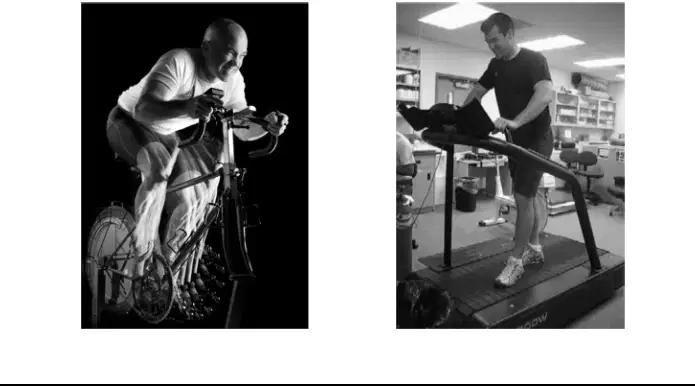
Which two exercise modes are depicted as examples of SIT (Sprint Interval Training) in the provided images?
Cycling and running
Swimming and rowing
Jumping and walking
Weightlifting and yoga
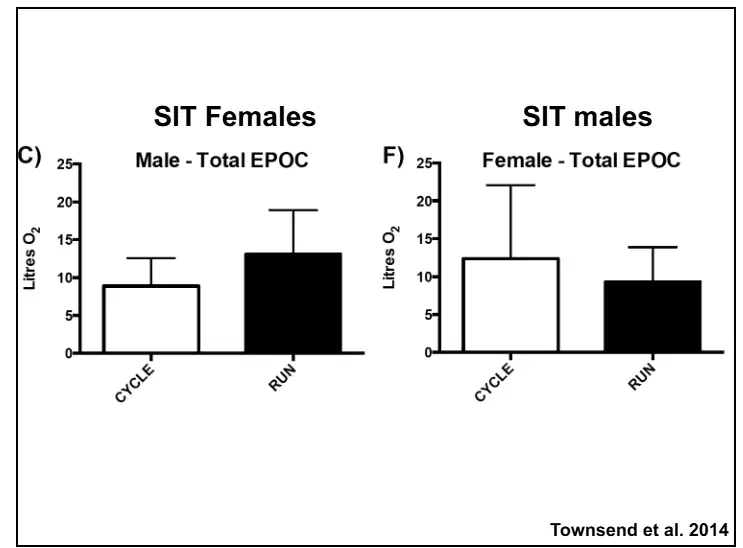
According to the graphs, which mode of SIT resulted in a higher total EPOC (Excess Post-exercise Oxygen Consumption) for females?
Cycling
Running
Both modes are equal
Neither mode
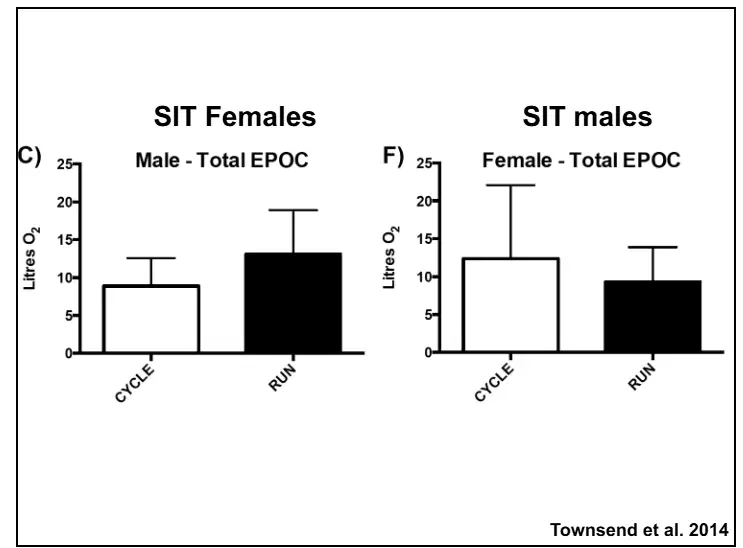
Based on the data presented, which mode of SIT resulted in a higher total EPOC for males?
Cycling
Running
Both modes are equal
Neither mode
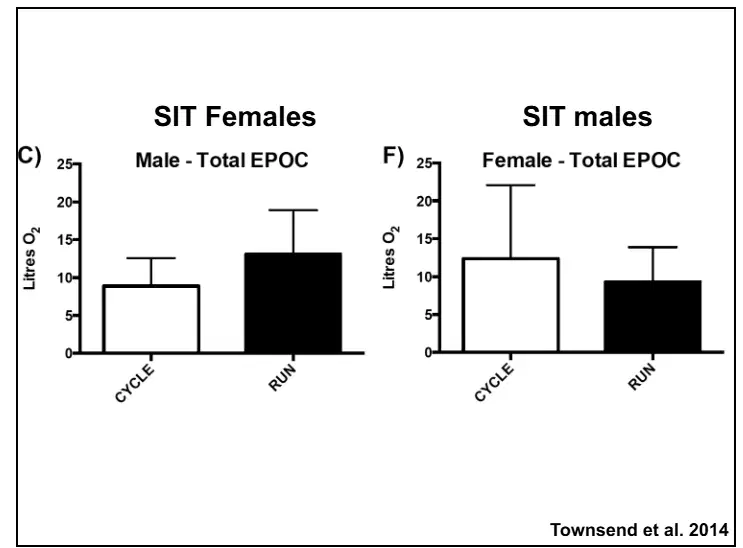
Using the evidence from Townsend et al. 2014, how does the effect of SIT mode on total EPOC differ between males and females?
Females have higher EPOC with running, males with cycling
Both males and females have higher EPOC with running
Both males and females have higher EPOC with cycling
Males and females have equal EPOC in both modes
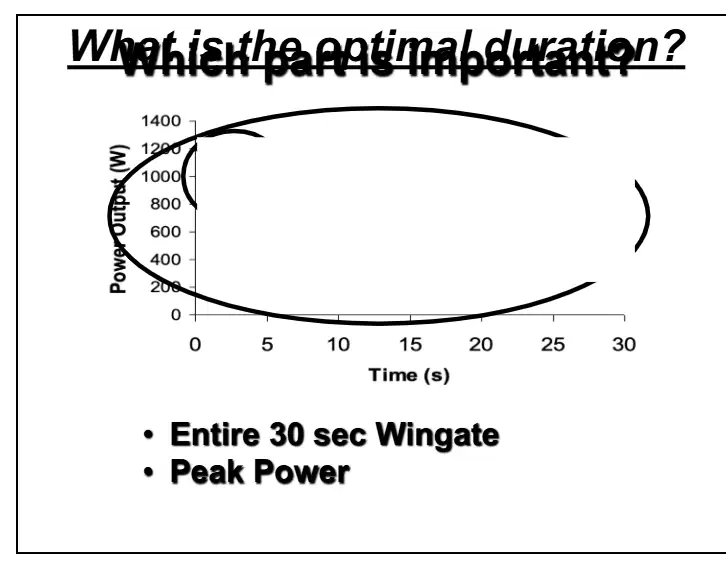
Which two aspects are highlighted as important in the context of the Wingate test?
Entire 30 sec Wingate and Peak Power
Initial 5 sec and Average Power
Final 10 sec and Minimum Power
Recovery Time and Total Distance
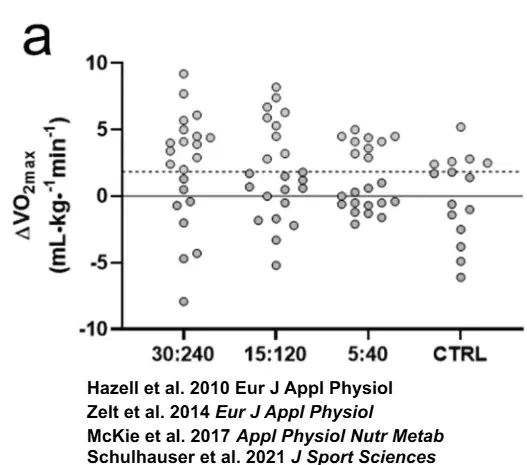
Which of the following studies is NOT listed as a reference for research on optimal duration in the provided material?
Hazell et al. 2010 Eur J Appl Physiol
Zelt et al. 2014 Eur J Appl Physiol
McKie et al. 2017 Appl Physiol Nutr Metab
Smith et al. 2015 J Appl Physiol
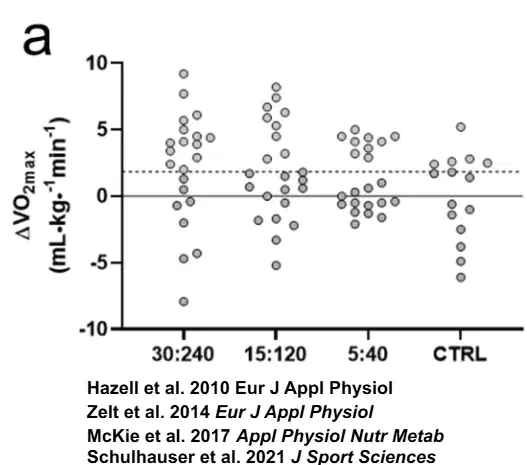
Based on the provided references, which variable is being measured to assess the optimal duration?
ΔVO2max (mL·kg⁻¹·min⁻¹)
Heart Rate (bpm)
Blood Lactate (mmol/L)
Muscle Strength (kg)
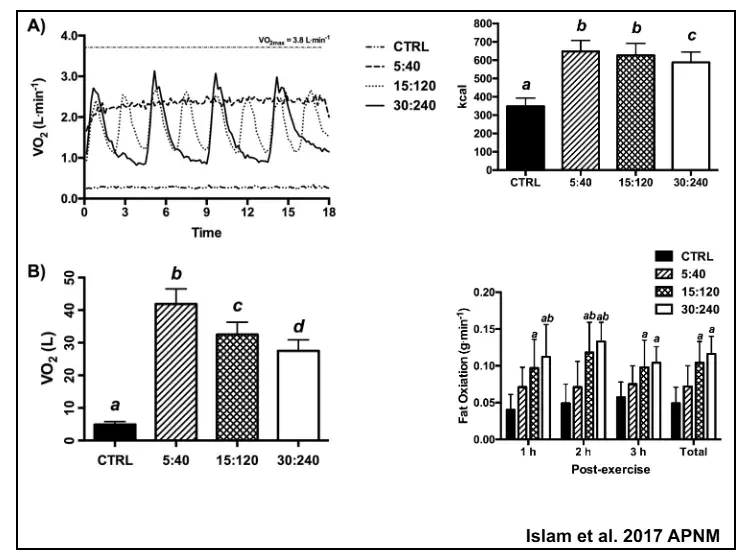
Which variable is measured on the y-axis in the top left graph labeled "A)" from Islam et al. 2017 APNM?
VO2 (L/min)
Heart Rate (bpm)
Lactate Concentration (mmol/L)
Blood Pressure (mmHg)
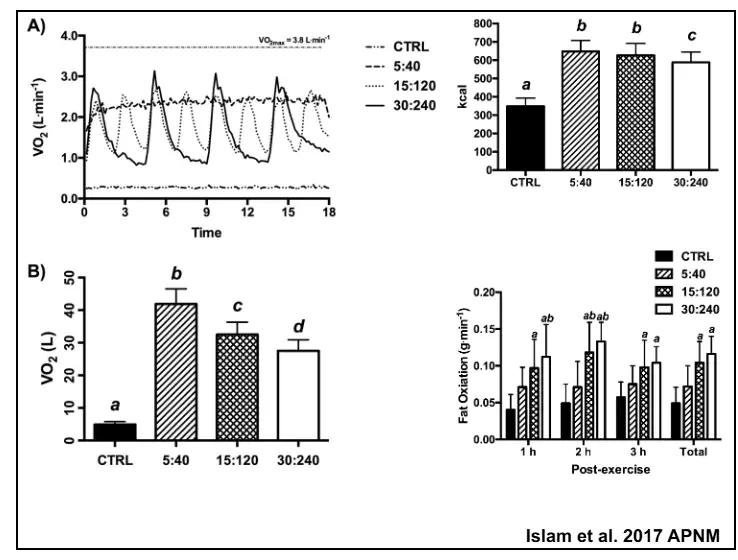
According to the bar graph labeled "B)" in the figure from Islam et al. 2017 APNM, which exercise protocol resulted in the highest total VO2 (L)?
5:40
CTRL
15:120
30:240
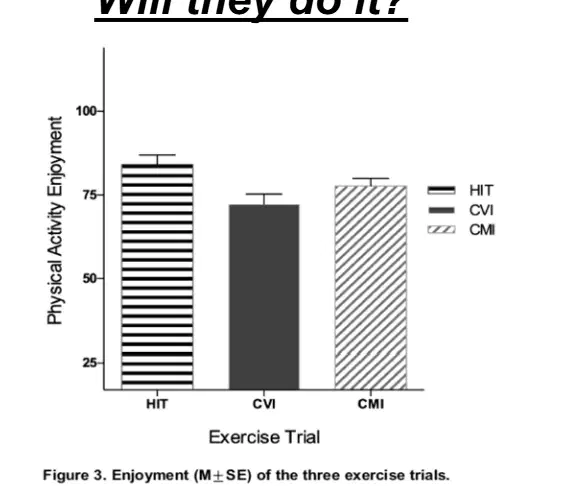
Based on Figure 3, which exercise trial had the highest mean physical activity enjoyment?
CVI
HIT
CMI
All were equal
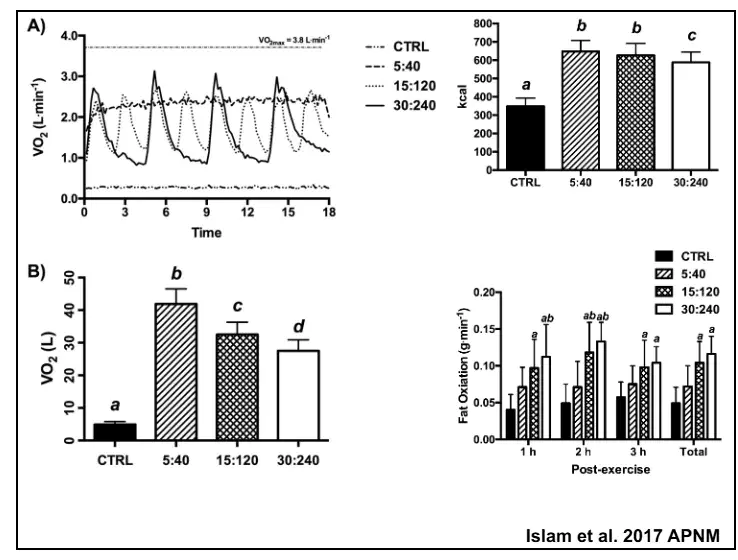
If a researcher wants to maximize post-exercise fat oxidation, which protocol should they consider based on the data from Islam et al. 2017 APNM?
5:40
CTRL
15:120
30:240
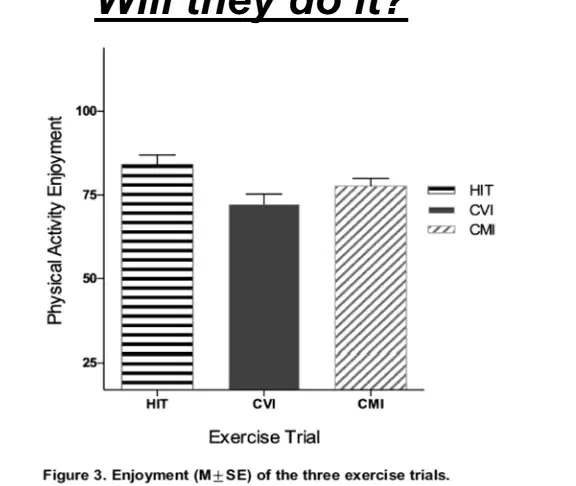
Analyze the enjoyment scores in Figure 3. What might be a potential implication for exercise adherence based on these results?
Higher enjoyment may lead to better adherence to the CVI protocol.
Lower enjoyment means people will avoid all exercise.
Enjoyment scores do not affect adherence.
HIT is always preferred regardless of enjoyment.
Which of the following is a health outcome that is similar between HIIT/SIT and continuous endurance training (ET)?
Cardiorespiratory fitness
Increased risk of injury
Decreased bone density
Reduced flexibility
What additional benefit is specifically improved with HIIT/SIT compared to continuous ET?
Insulin sensitivity/glucose handling
Decreased lung capacity
Reduced muscle mass
Lowered hydration levels
Which of the following is NOT listed as an outcome improved by HIIT/SIT?
Appetite
Cardiovascular system function
Insulin sensitivity
Bone fracture healing
Explain how HIIT/SIT can impact body composition and provide one additional health benefit not typically associated with continuous ET.
HIIT/SIT improves body composition and also enhances appetite regulation.
HIIT/SIT decreases bone density and increases dehydration.
HIIT/SIT reduces flexibility and increases risk of injury.
HIIT/SIT lowers immune function and increases fatigue.
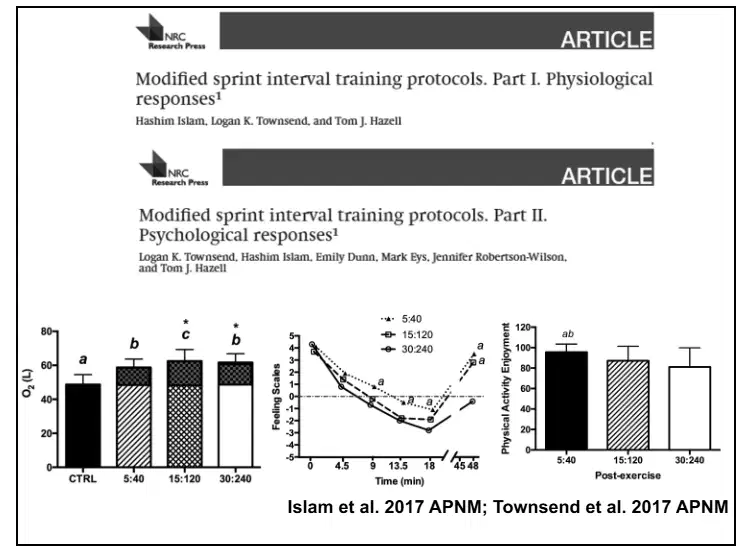
Which type of research is referenced in the provided diagram?
Modified sprint interval training protocols
Nutritional supplementation studies
Long-distance running case studies
Sleep deprivation experiments
Which of the following factors does interval training adaptation depend on?
Intensity of exercise and duration of exercise and rest periods
Type of shoes worn during exercise
Time of day the exercise is performed
Amount of water consumed before exercise
Interval training can result in similar adaptations to which type of training?
Endurance training (ET)
Flexibility training
Strength training only
Balance training
Which of the following is NOT an adaptation associated with improved anaerobic metabolism due to interval training?
Increased glycolytic enzymes (HK, PFK)
Increased muscle buffering capacity
Increased ionic regulation/acid-base balance
Decreased aerobic metabolism
Explain how interval training can improve both aerobic and anaerobic metabolism. Provide at least two physiological changes that occur as a result.
Interval training increases aerobic metabolism and improves anaerobic metabolism by increasing glycolytic enzymes and muscle buffering capacity.
Interval training only improves flexibility and balance.
Interval training decreases both aerobic and anaerobic metabolism.
Interval training only affects muscle size, not metabolism.
A coach wants to design an interval training program to maximize improvements in both aerobic and anaerobic metabolism for their athletes. What two key variables should the coach manipulate in the interval protocol, and why?
Intensity of exercise and duration of exercise/rest periods, because these determine the metabolic adaptations.
The color of the training clothes and the type of music played, because these affect motivation.
The number of athletes and the size of the training field, because these affect group dynamics.
The amount of water breaks and the type of snacks provided, because these affect energy levels.
What does HIIT stand for in the context of physical fitness?
High-Intensity Interval Training
Heavy Intensity Internal Training
High-Impact Interval Therapy
Healthy Individual Interval Training
Which of the following is NOT listed as a take home point from the material?
Dietary supplements
Benefits of HIIT
HIIT vs ET outcomes
Health outcomes
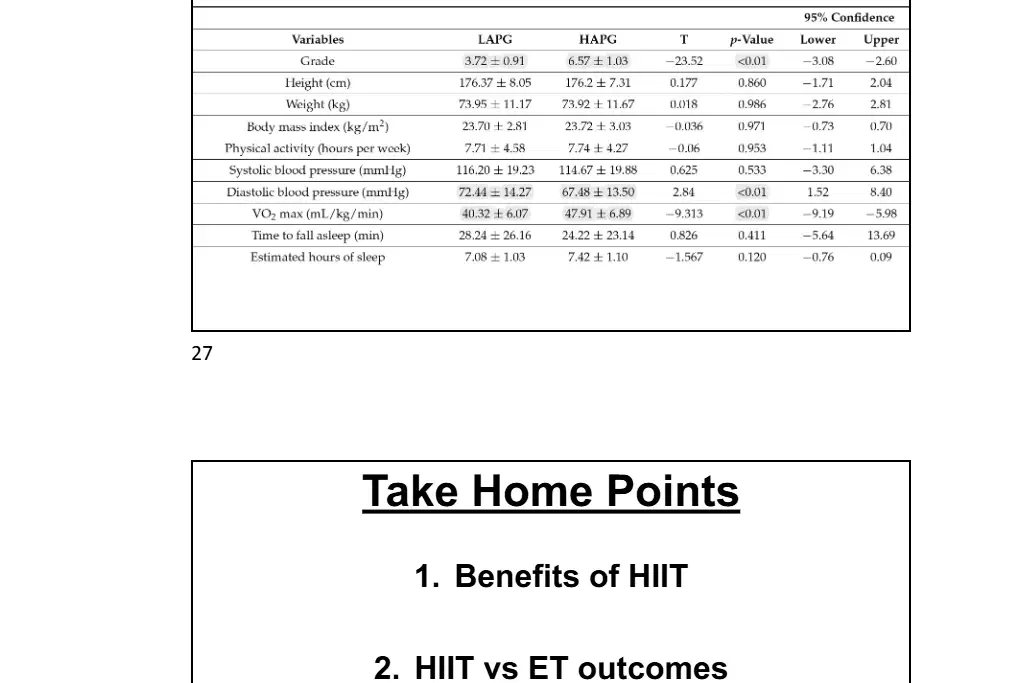
Based on the table, which variable showed a statistically significant difference (p < 0.05) between LAPG and HAPG groups?
Grade
Height
Body mass index
Time to fall asleep
If you were to design a study comparing HIIT and ET, which outcome would be most appropriate to measure based on the take home points?
Physical health outcomes
Favorite sports teams
Preferred workout music
Class attendance
Why might researchers compare HIIT and ET outcomes in university students?
To determine which exercise method leads to better health and academic outcomes
To find out which is more popular among students
To see which is easier to organize
To compare their costs

